
FREE FLIGHT INDOOR
Bud Tenny, Box 830545, Richardson TX 75083 rtenn@nstarnet
HANGAR NEWS
The previous column may have been pessimistic about the use of Hangar #1 at Tustin, but the latest word is that the expected lease deal for the hangar fell through. So for now, the guys are still flying there regularly.
Meanwhile, the hangar at Moffett Field, near San Francisco, is used for monthly sessions on the third Saturday each month. This hangar has problems, including a huge opening for truck access that has no door. The fliers are cautiously feeling out the hangar, learning when turbulence is less, etc.
INDOOR RC ELECTRIC DURATION
Bob Wilder has done it again! On February 19 Bob upped the ante with a time of 48:09 at the Cat I Bedford site. The airplane is his original design: 40-inch span, 250 sq. in. area, weighing 110 grams. He used a DC-5 West-Tek coreless motor, an 8:1 home-built gearbox, four 600 mAh cells, and a carbon-fiber 9 x 4.5 West-Tek prop.
Another Bob Wilder indoor RC electric endurance flight: 1:03:33. Date: February 24, 1998. Site: American Indoor Sports Facility, Carrollton, TX. Building is 210 feet long and 90 feet wide. Ceiling is 25 feet at the walls and 30 feet at the center. The airplane is the same as flown at the Bedford Boys Ranch, with some changes to motor, gearbox, and battery pack. Pilots were Bob Wilder and Ernie Harwood.
INDOOR GROUP
More than 140 members have registered with Bud Tenny by sending e-mail to rtenn@nstarnet to receive late-breaking news. All clubs holding indoor events can send announcements to Bud Tenny via e-mail or snail mail (Box 830545, Richardson TX 75083) for prompt posting to members of the Indoor Group and on Del Ogren's web page.
RUBBER MOTOR STORAGE
Several years ago there was a big flap over rapid deterioration of rubber motors between seasons or even between flying sessions. The problem was solved by changing the type of envelope used for storing motors. Tony Italiano reported:
There has been concern by rubber modelers, especially indoor ones, about rubber deteriorating when stored in plastic or paper envelopes. The Australians have found that the culprit is polyvinyl chloride (PVC), which outgasses vinyl chloride (VC) from the plastic bag. VC is bad for rubber (and is a suspected carcinogen). Some plastic bags are made from PVC and polyethylene; manufacturers may call their bags polyethylene, polythene, or polyester, but formulations vary widely.
Bags made from polyester are chemically inert and will not harm rubber. Polyester bags (often sold as "oven" bags) melt at approximately 280°C (536°F). It is advised that rubber be stored in polyester bags — but do not overwrap with a polythene or PVC-containing bag, because VC gas from such bags can penetrate and damage the stored rubber. A simple test: polyester smells like a burnt candle when ignited, whereas PVC has an acid smell when burnt.
An alternative is transparent paper envelopes called glassine (cassine), used by stamp collectors and available from stamp shops or the Postal Service.
INDOOR ETIQUETTE
- Open and close the door slowly as you enter or leave the site, and close it promptly to reduce drafts and shock waves.
- Move slowly about the site to reduce turbulence; bow waves from fast walking can knock down superlight models.
- Launch your model and then slowly clear the floor to reduce obstacles and floor turbulence.
- Do not touch someone else's model without permission; indoor models are fragile and prone to breakage. Let the owner retrieve a model that lands near you — move slowly and with care.
- Do not talk to fliers while they wind the motor, hook up, or launch a model.
- Retrieve your model cautiously; use a balloon or other help only with permission from the contest director (CD) and other fliers.
- Answer questions from non-fliers politely or refer them to another club member who is a flier. Keep children under control and eliminate horseplay. Clean up the area before leaving.
SHOP 101: CyA GLUE POT
(from the Boeing Hawks newsletter, edited by Gene Stubbs)
Cyanoacrylate (CyA) glue has added a new dimension of speed to classic construction techniques. While it has detractors (and can lead to stuck fingers), it is widely used — and its weight penalty can be severe if applied carelessly. Technique is everything: less is more.
Practical tip: take a small 1 x 1 x 1 cube of modeling clay and, with your fingertip, form a depression in the top. Line the depression with a square of waxed paper pressed smooth. This creates a non-spill receptacle for a CyA puddle.
For an applicator, snip off the head of a pin (or use 1/32" wire), bend a tiny loop in the end, stick the other end into a bamboo dowel or balsa stick, and paint it a bright color so you can find it easily on the workbench. Use Kleenex to wick away excess glue from joints.
LEAD WOOL?
Lead wool, found in plumbing sections of hardware stores, looks like steel wool and is used by plumbers to jam into cracks and joints. Modelers might find it useful when packing a lot of nose weight into a small or odd-shaped cavity; it packs more densely and conforms better than lead sheet or shot. It could also be used with epoxy as filler to make molded ballast forms such as spinners.
EVENT SURVEY
Jack Koehler, ramrod of the Topeka club (HAFFAS), reported on a survey by Roger Schroeder to indicate which events might be dropped from future contests. The numbers indicate how many fliers showed interest in each event.
AMA Competition Events
- Limited Pennyplane: 11
- Bostonian (7-gram): 9
- Easy B: 8
- F1L; EZB (1.2-gram): 7
- HLG: 6
- MiniStick: 6
- Manhattan: 5
- Pennyplane: 5
- Peanut Scale: 5
- Intermediate Stick: 4
- Std. Catapult Glider: 4
- Unlm. Cat. Glider: 4
- Kit/Plan Scale: 3
- ROG Stick: 3
- Flying Scale: 2
- HL Stick: 2
- F1D: 1
- Cabin: 1
- Helicopter: 1
- Ornithopter: 1
- Autogiro: 1
- Experimental Autogiro: 1
- Indoor Power Scale: 1
Club Events
- P-18: 1
- A-6: 9
- 14-gram Bostonian: 6
- USIC 3.1-gram ROG: 6
- Peck ROG: 5
Free Flight: Indoor
Checking Your Stopwatch
by Dan O'Grady
The modern digital electronic stopwatch is lightyears ahead of the mechanical analog ones we used not too many years ago. But like some digital wrist watches, there can occasionally be errors. Here's a simple way to check accuracy:
All television stations employ cesium- or rubidium-based oscillators for frequency control of their TV emissions. In most cable-served areas, one channel will carry local news or weather and display the time in hours, minutes, and seconds.
Get your stopwatch, a pencil, and paper. When the time displayed is a convenient number (for example, 6:37:00), start your stopwatch and write down the TV time. You can switch off the TV, change channels, or do other tasks for several hours. Return to that TV channel, wait until the time indicated is again a convenient number, stop your watch, and write down the TV time. Compare the accumulated time on your stopwatch to the time difference between the two TV readings. Knowing your stopwatch's accuracy is valuable should timing be questioned.
Supersensitive Scale?
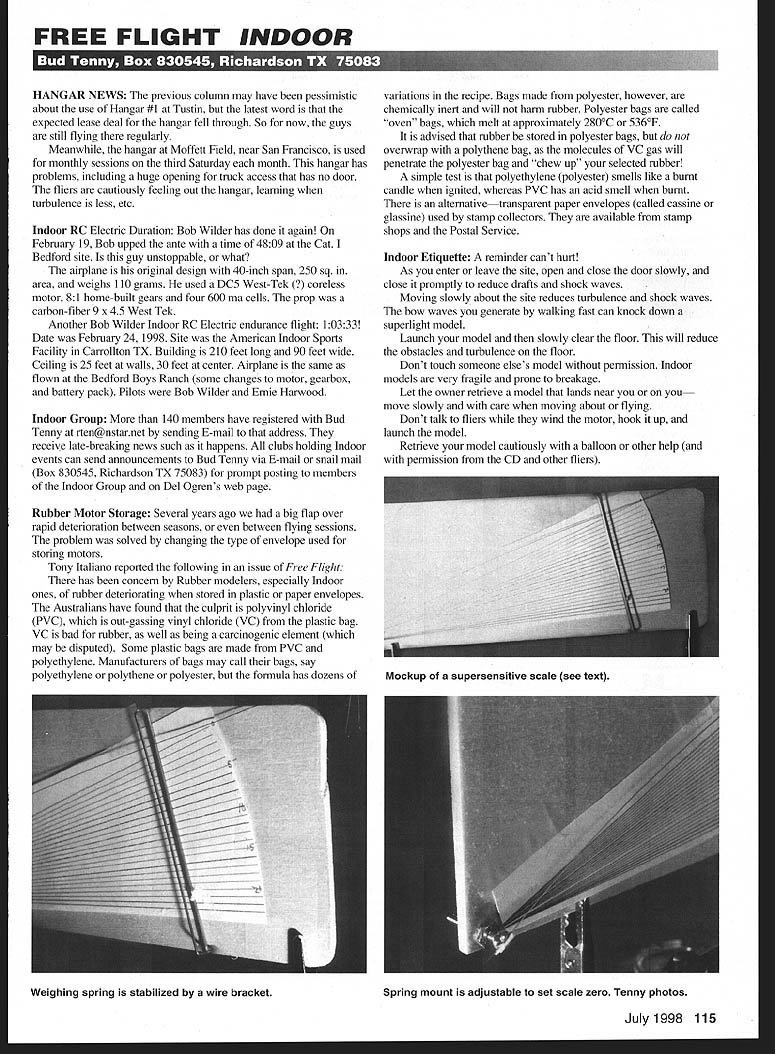
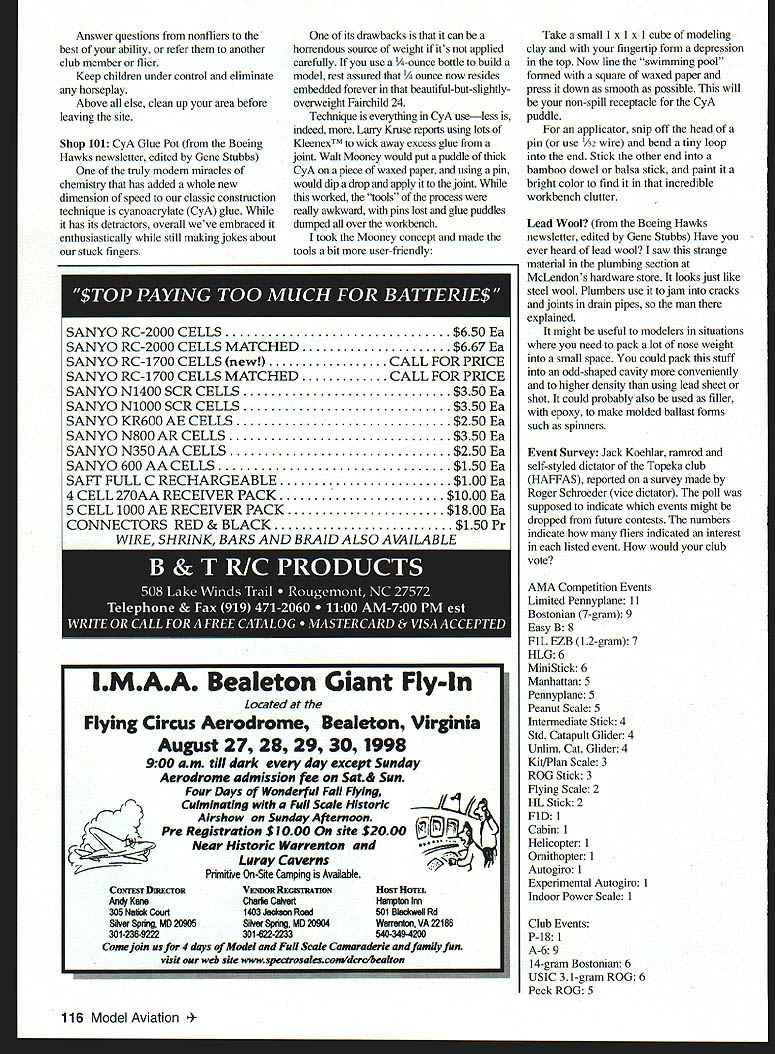
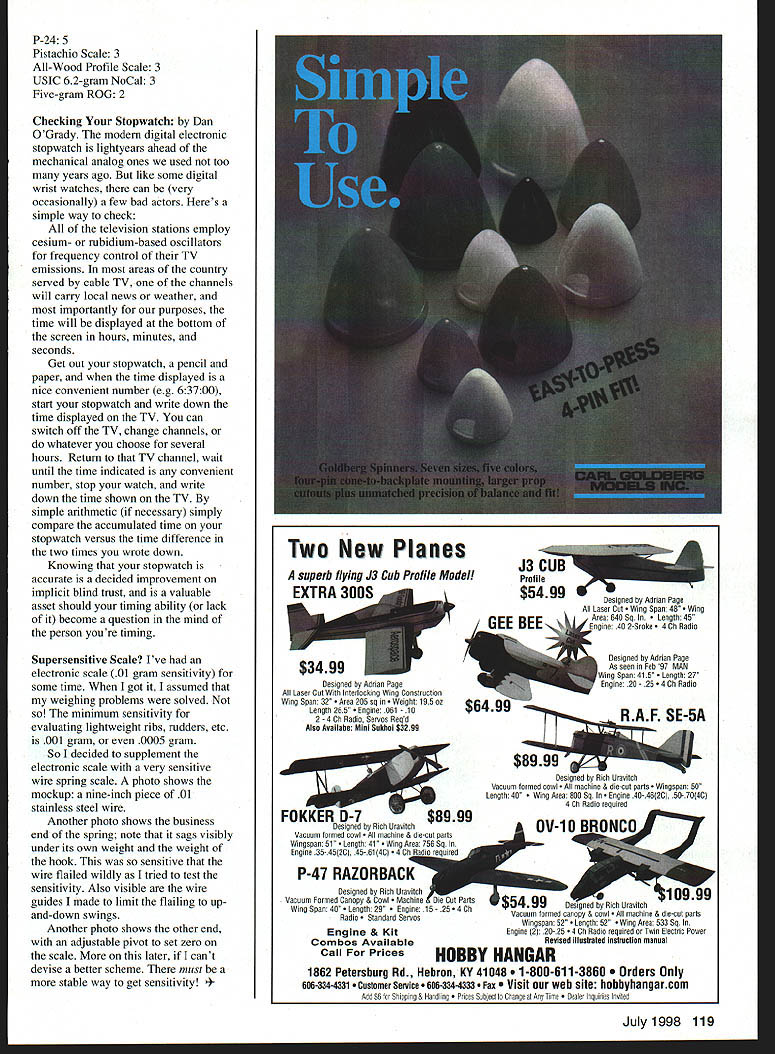
I have an electronic scale with 0.01 gram sensitivity, but for evaluating very lightweight ribs, rudders, etc., you often need 0.001 gram or better. I experimented with a very sensitive wire spring scale: a nine-inch length of 0.01" stainless steel wire. The wire sags visibly under its own weight and the weight of the gnatlike hook; it was so sensitive it flailed wildly during testing. I added wire guides to limit the motion to up-and-down swings and an adjustable pivot to set zero on the scale. This setup was promising but unstable — there must be a more stable way to get the sensitivity needed; more on this later.
INDOOR RC ELECTRIC DURATION
Bob Wilder has done it again. On February 19, Bob recorded a time of 48:09 at the Cat I Bedford site. The airplane is an original design: 40-inch span, 250 sq. in. area, 110 grams, using a DC-5 West-Tek coreless motor, an 8:1 home-built gearbox, four 600 mAh cells, and a carbon-fiber 9 x 4.5 West-Tek prop.
Another indoor RC electric endurance flight by Bob Wilder: 1:03:33 on February 24, 1998, at the American Indoor Sports Facility in Carrollton, TX (building 210' x 90', ceiling 25' at walls, 30' at center). The airplane was similar to the Bedford design with changes to motor, gearbox, and battery pack. Pilots: Bob Wilder and Ernie Harwood.
INDOOR GROUP
About 140 members have registered with Bud Tenny (rten@nstarnet) to receive late-breaking news. Clubs holding indoor events can send announcements to Bud Tenny via e-mail or snail mail (Box 830545, Richardson, TX 75083) for posting to members and on Del Ogren's web page.
RUBBER MOTOR STORAGE
See notes above on PVC outgassing and recommended use of polyester (oven) bags or glassine envelopes for storing rubber motors. Avoid storing rubber in PVC-containing bags or overwrapping polyester bags with polythene/PVC bags.
INDOOR ETIQUETTE
See the etiquette guidelines above: move slowly, minimize drafts and turbulence, respect others' models, avoid interrupting fliers during critical operations, and obtain permission before assisting with retrievals.
SHOP 101 — CyA GLUE POT
Cyanoacrylate glue is an invaluable tool but must be used sparingly. The clay-and-waxed-paper non-spill puddle and the pin-loop applicator mounted in a bamboo dowel make controlled, minimal applications easy and reduce waste and weight. Use Kleenex to wick excess glue away from joints.
Transcribed from original scans by AI. Minor OCR errors may remain.

