
Free Flight: Indoor
Bud Tenney
AN INCREDIBLE EXPERIENCE: Indoor HLG's need quiet air for maximum times, right? Picture a 28-ft. room about 8 feet larger each way than a basketball court, with six gaping air-conditioning ducts pointing down and dumping torrents of air into the room. Anywhere in the room, one feels buffeted by variable air currents. Is this any place to set a new HLG record?
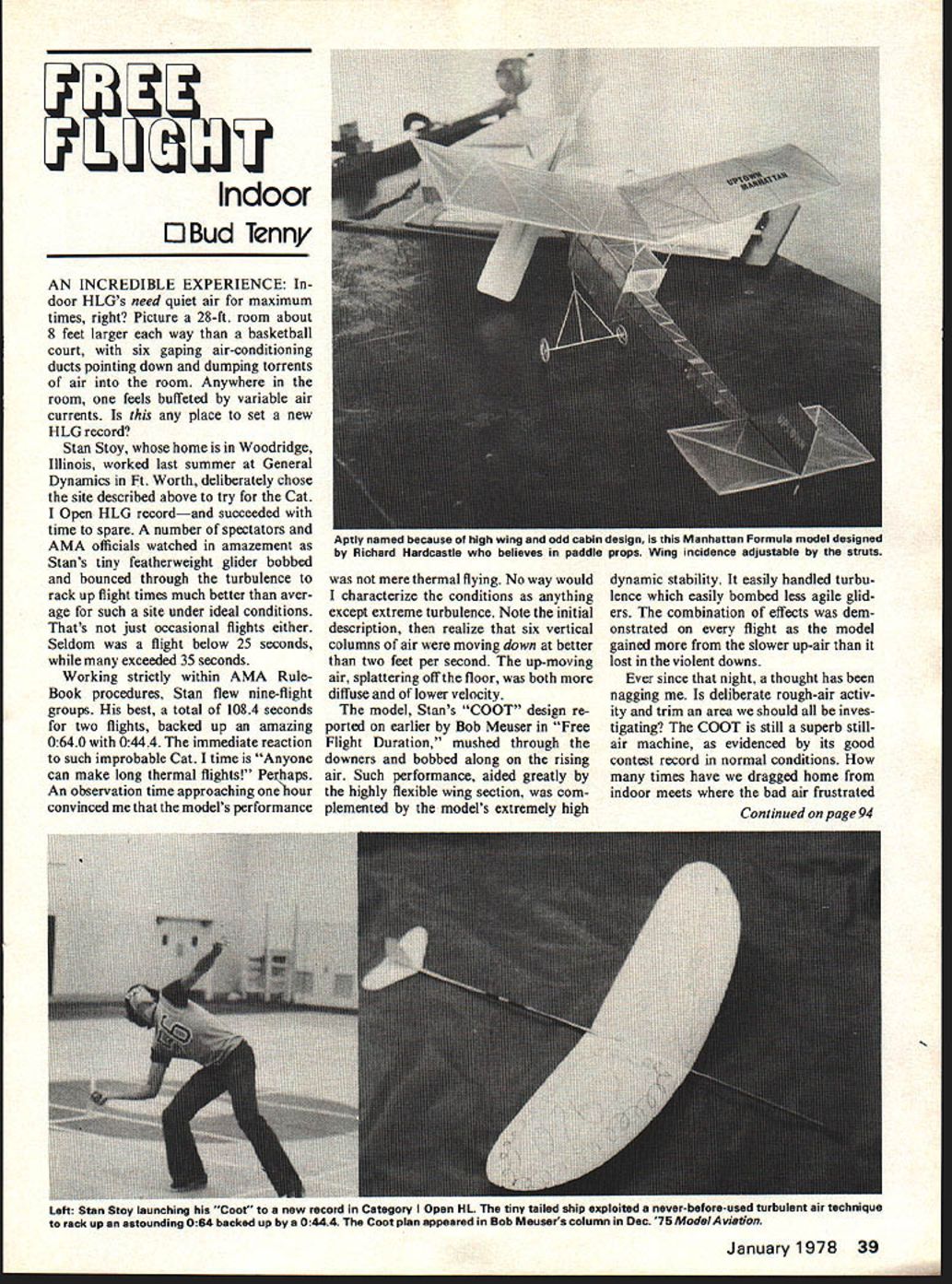
Stan Stoy, whose home is in Woodridge, Illinois, worked last summer at General Dynamics in Ft. Worth, deliberately chose the site described above to try for the Cat. I Open HLG record—and succeeded with time to spare. A number of spectators and AMA officials watched in amazement as Stan's tiny featherweight glider bobbed and bounced through the turbulence to rack up flight times much better than average for such a site under ideal conditions. That's not just occasional flights either. Seldom was a flight below 25 seconds, while many exceeded 35 seconds.
Working strictly within AMA Rule-Book procedures, Stan flew nine-flight groups. His best, a total of 108.4 seconds for two flights, backed up an amazing 0:64.0 with 0:44.4. The immediate reaction to such improbable Cat. I time is "Anyone can make long thermal flights!" Perhaps. An observation time approaching one hour convinced me that the model's performance was not mere thermal flying. No way would I characterize the conditions as anything except extreme turbulence. Note the initial description, then realize that six vertical columns of air were moving down at better than two feet per second. The up-moving air, splattering off the floor, was both more diffuse and of lower velocity.
The model, Stan's "COOT" design reported on earlier by Bob Meuser in "Free Flight Duration," mushed through the downers and bobbed along on the rising air. Such performance, aided greatly by the highly flexible wing section, was complemented by the model's extremely high dynamic stability. It easily handled turbulence which easily bombed less agile gliders. The combination of effects was demonstrated on every flight as the model gained more from the slower up-air than it lost in the violent downs.
Ever since that night, a thought has been nagging me. Is deliberate rough-air activity and trim an area we should all be investigating? The COOT is still a superb still-air machine, as evidenced by its good contest record in normal conditions. How many times have we dragged home from indoor meets where the bad air frustrated our attempts? Can microfilm models be "trained" to survive in poor air? If so, will that also help improve the good-air performance? Certainly, heavy drift and extreme conditions such as Stan sought out cannot be useful or even instructive for the "serious" indoor flier. However, it has been noted that certain kinds of model trim seem to enable models to drift less. High dynamic stability does minimize altitude loss in light turbulence. Starting from these two points, how much improvement can we make? One thing for sure, almost every Indoor World Championship in recent times has had its share of poor air. The team which has models with superior turbulent air performance ought to have an edge.
The Energy Crisis: Rubber model fliers who have exhausted their supplies of Pirelli are feeling the energy pinch. A number of other types of rubber thread have been tried, and no one has been very optimistic over the results. Various reports have indicated even greater variation between batches of each new type than had been the case with Pirelli. Now comes a report that Bill Hulbert, one member of the 1978 U.S. Indoor Team, won his team berth with a type of rubber other than Pirelli. This rubber apparently approaches Pirelli for energy content, but may require slightly different handling techniques. I'll try to get more data and report as soon as possible.
A number of years ago, some experiments with Pirelli indicated that rubber thread characteristics can be modified. Specifically, some batches that were too "soft" (very stretchy rubber that takes a lot of turns without delivering much torque) were heat-cycled under controlled conditions. The follow-up testing was not geared to measure absolute energy output, but proper heat treatment resulted in rubber which delivered higher torque for a given rubber size and number of turns.
The method is this. Wrap the rubber in aluminum foil to protect it from light and infrared radiation. Heat the rubber to about 140°F and hold the temperature for an hour. Allow to cool for several hours and repeat the operation a number of times. Arrange the rubber sample so that portions can be removed for test after each group of ten heat/cool cycles. If history repeats itself, the samples will show successively higher torque output compared to the uncooked rubber. Eventually, the process hardens the rubber enough so it will be unusable, but careful evaluation may help pinpoint a method of treating some kinds of rubber so it will be usable. If anyone tries this, please keep careful records and share the results.
Some Wakefield and Unlimited Rubber fliers store even well-used motors as carefully as new ones. In many cases, these motors contain nicked and worn strands with all the wear and tear on the edges of the strips. Since some types of rubber stripping operations (to cut indoor motors) waste the edge pieces anyway, maybe the fliers with stored, used motors can be persuaded to sell or trade some rubber. Anyway, it is worth a try!
Indoor Season Starting! By the time you read this, the indoor season will be getting started. Many areas have regular flying schedules during the winter and spring, and these sessions will be announced if sufficient advance notice is given. Sometimes business or pleasure travelers manage to visit sessions in another part of the country, renewing old friendships or making new ones. Some of the friendliest people now flying indoor models are the Miami (Fla.) Indoor Airplane Modelers Association under the strong and active guidance of Dr. John Martin. Their season has already begun, with additional sessions scheduled for Nov. 20 and Dec. 18, 1977, and Jan. 22, Feb. 19, Mar. 19, Apr. 16 and May 21, 1978. Visitors and regulars alike are cautioned to call 305-858-6363 a day or so before the meet to be sure schedule conflicts have not arisen.
Bud Tenny, Box 545, Richardson, TX 75080.
Transcribed from original scans by AI. Minor OCR errors may remain.

