
Free Flight: Indoor
Bud Tenny, Box 830545, Richardson TX 75083
Junior Programs
The following notice has circulated for some time on the Internet. The stated purpose has almost timed out, but there will be a continuing need for Junior Program sponsorship:
Thanks to efforts by Vern Hacker and Steve Kaluf, AMA has agreed to be the collection and distribution point for any funds sent to it for the purpose of sending a junior flier to the international contest for F1D models at Slănic, Romania, in October. Monies donated should be sent to Teresa McKee at AMA HQ and should be marked for this cause. AMA has indicated that any monies received will be tax-deductible. If stock is given, AMA's taxpayer ID is 52-07-99408.
I hope that we will generate considerable interest, since AMA is unable to support any junior program as part of its normal commitments.
Contest Incidents
During the Nats IHLG event, we noted that Jim Buxton was missing. We soon learned Jim had broken his neck the week before. The good news was that there was no spinal cord damage. After one month he was already through wearing a support collar and had returned to work. He is cleared for all normal activity except athletic events; it will be at least four months before he can work out again. Really good news!
On the third day of competition, Jim Grant fell and opened a split above his eye, requiring six stitches. By the next day his son John reported he was OK and was held over for more tests. Jim is OK and sounded like his usual cheerful self.
Dr. Colin Raymond-Jones, a Canadian contestant, was with Jim immediately after the fall; campus police were on the scene almost immediately, and an ambulance arrived within 10 minutes.
Indoor Group E-mail List
The list has passed 150 members. Register by sending e-mail to Bud Tenny at rten@nstarnet.net. You receive late-breaking news as it happens. Clubs holding indoor events can send announcements to Bud Tenny via e-mail or snail mail for prompt posting. Come join us!
- To register: send e-mail to rten@nstarnet.net
- To submit announcements: e-mail or snail mail to Bud Tenny
Two Hours Plus!
Bob Wilder's "serious" record attempt is history. After his one-hour, 19-minute flight, Bob completely reworked his model, changing to fully proportional control for rudder and throttle and using the latest lithium battery technology. The model was about 16 grams lighter.
At about 10:20 a.m. Bob launched his revamped model, and it landed two hours, 34 minutes, and 40 seconds later. It was hard to realize this momentous event because Bob made it look too easy!
He topped off his flight batteries while his transmitter batteries were charging, assembled the model, inserted the flight batteries, strapped on the wing, and went out to launch. His initial throttle setting was too high and had to be backed off.
The first 92 minutes of the flight were uneventful. Suddenly the air conditioner came on and the air got very turbulent. It was touch-and-go for about six minutes until the A/C shut down again. Earlier in the day the technician had been testing the system, and we had waited about half an hour to be sure he had finished.
As the flight progressed the model would begin to sink slightly until Bob advanced the speed setting another click. There was a minor cheer as the time clicked over to one hour and 20 minutes—the old record was history.
As the time passed two hours, the throttle detents were almost used up. One of the witnesses put up a pool on when the model would land. Finally, Bob had to change the circular flight pattern to a long oval—passing under the basketball goals on one end and approaching the other goal. The periods of straight flight and larger-diameter circles stretched the flight time by about three minutes.
It all looked very easy, but it really required more than four months of testing every component of the model, with the model representing the best-available product. By the time the record trials started, all that was left was to fly the model. Three weeks before, Bob had indicated that the new batteries should last more than two hours. His science is good!
Still Bud Tenny After Cancer?
At the Oklahoma City contest last spring I did a number of dumb things. The worst was making my fifth Novice Pennyplane flight on a P-24 motor, scoring a glorious 258! Well, anyone can make a mistake, right? Except that while winding for the last flight I checked turns vs. torque and wondered, "Why is the torque so low at 1,800 turns?"
I kept cranking until I had the torque I wanted, and hooked up. As I started to hook the motor to the prop, I wondered again, "Where is the rubber tubing that slides over the prop hook?"
Yes, anyone can make a mistake. The real problem was that I ignored two perfectly valid error flags and made the flight anyway. There was no time crunch—just unheeded carelessness. Was I out of practice, or completely out of it?
I wasn't much better at USIC. In P-24, with only half an hour to prepare for the one-shot atmosphere of a mass launch, I did have the foresight to pick a motor, using a partial-motor flight. After making the new motor, I spent so much time swapping lines (it was the first day!) that there wasn't time to make a test flight before the mass launch. That also meant the new motor hadn't been test-flown.
So I chickened out on pushing the motor, stopping at 6,800 turns instead of the 7,500 turns I now know the motor could handle. Fourth place, 50 seconds out of first.
Shipping damage included significant damage to my full Pennyplane and minor damage to the Limited Pennyplane. I fixed both, but only put a couple of flights on the full Penny. After all, as a monoplane with a fixed-geometry prop, it wasn't really competitive. The Limited Pennyplane looked OK, but I decided to turn that event into a real test of my flying strategy and ability.
I waited until 90 minutes before the end of the round to process the model. I made a short flight to change the trim, then laid out two new motors and a backup that I felt was too wide and short to hold enough turns, but it would get the model up on the one flight I was allowing myself.
The first motor broke right at the knot; the second motor was ready to hook up when I noted the knot was slipping. Three minutes left; dump the turns and wind the backup motor. Launched with 30 seconds to spare, the model did as well as it has ever done in that site.
So what's the verdict? Both new motors should have been prewound, but I had a backup that did work. The model trim held, even under high torque. Neither new motor was pushed to the limit, so the motors weren't properly tried. I guess I pass, since I did get a reasonable flight. The point of the whole exercise was to discover if the skills were rusty or gone away. There is a lot to relearn!
Rubber Test Update
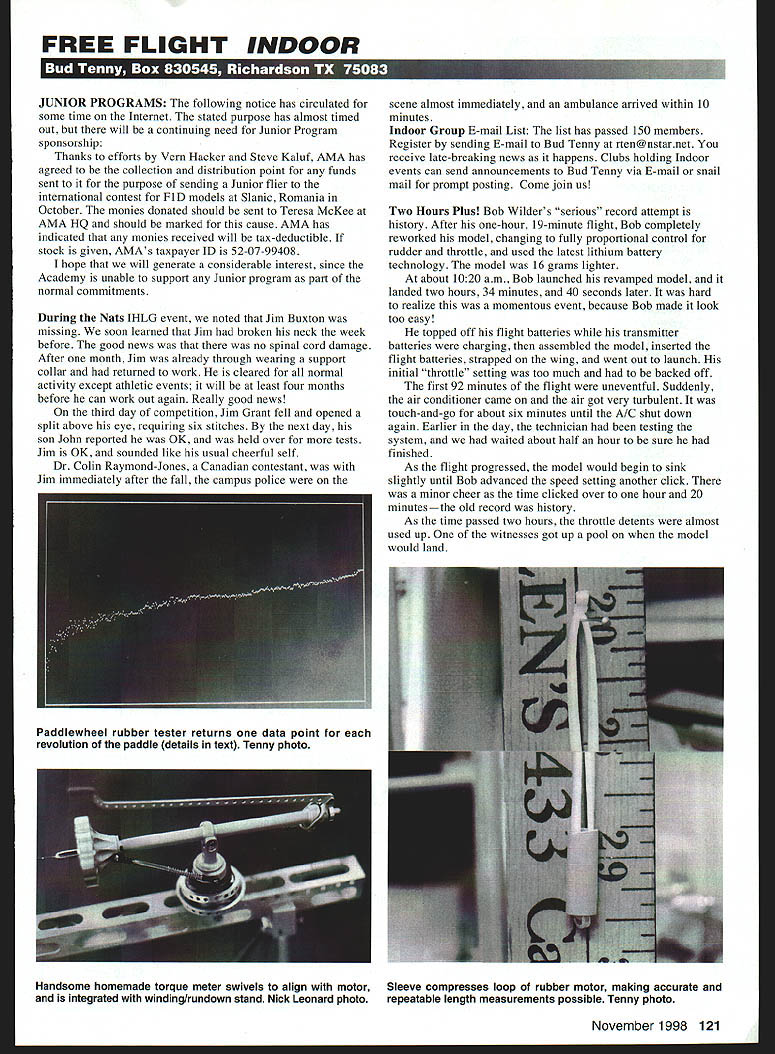
The paddlewheel tester is running and producing data—almost too much data. A CRT plot of the raw data shows so much information that it is hard to evaluate. There is a data point for each revolution of the rundown, and you can see each knot come out. As each knot pops out, there is a quick jump in energy that briefly speeds up the prop.
The mass of data from this test method is large enough to be difficult to work with and derive meaning from. The last pieces of the procedure are planned, except for plotting the data to a printer. Once plotting is possible, plots can be normalized and directly compared.
The final goal for this test rig is to create a pedigree for each motor. A motor will be made, then tested with hook spacing matching the model. Proper choice of paddlewheel area will set test runs in the same RPM range as expected on the model. Direct overlay of performance graphs should allow quicker motor choice.
Each motor is already performance-tested, so a ready supply of motors should make it easy to get flights in.
How Long Is That Motor?
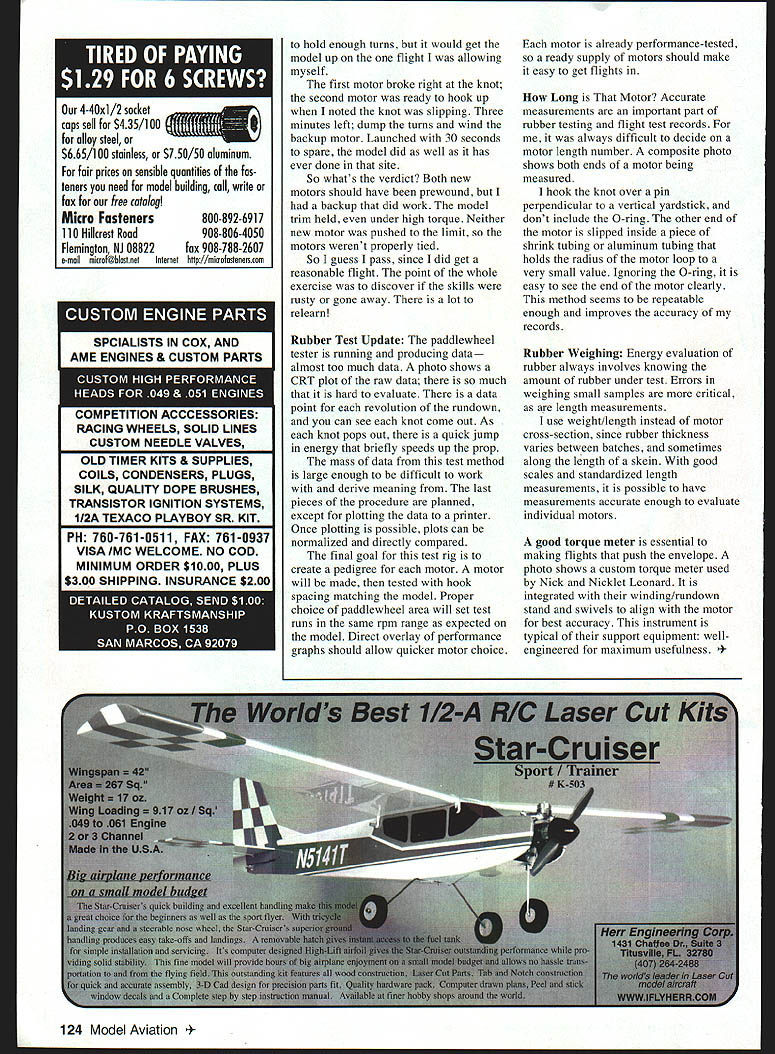
Accurate measurements are an important part of rubber testing and flight-test records. For me it was always difficult to decide on a motor-length number. A composite photo shows both ends of a motor being measured.
I hook the knot over a pin perpendicular to a vertical yardstick and don't include the O-ring. The other end of the motor is slipped inside a piece of shrink tubing or aluminum tubing that holds the radius of the motor loop to a very small value. Ignoring the O-ring, it is easy to see the end of the motor clearly. This method seems repeatable enough and improves the accuracy of my records.
Rubber Weighing
Energy evaluation of rubber always involves knowing the amount of rubber under test. Errors in weighing small samples are more critical, as are length measurements.
I use weight/length instead of motor cross-section, since rubber thickness varies between batches and sometimes along the length of a skein. With good scales and standardized length measurements, it is possible to have precision measurements accurate enough to evaluate individual motors.
Torque Meter
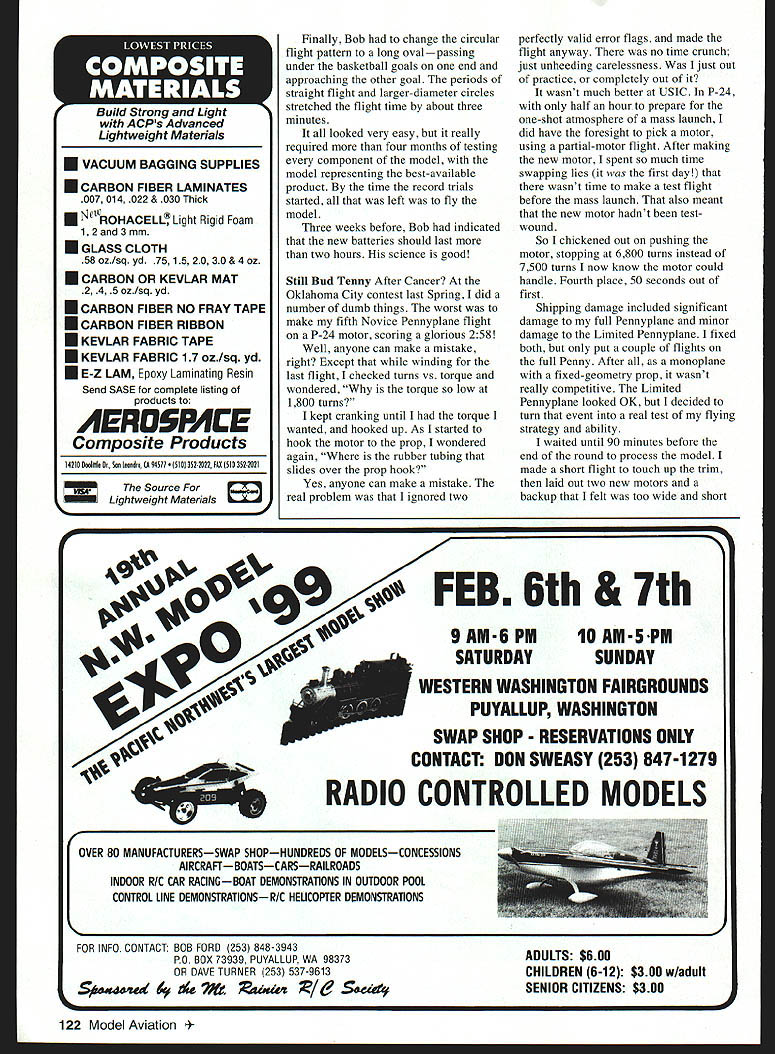
A good torque meter is essential to making flights that push the envelope. A custom torque meter used by Nick and Nicklet Leonard is integrated with their winding/rundown stand and swivels to align with the motor for best accuracy. This instrument is typical of their support equipment: well engineered for maximum usefulness.
Transcribed from original scans by AI. Minor OCR errors may remain.

