
FREE FLIGHT INDOOR
Bud Tenney, Box 830545, Richardson TX 75083
WELCOME MESSAGE!
As I was building this column, the following e-mail arrived:
"This is Jimmy Buxton trying to get a hold of you and let you know I am still all in one piece, and fully recovered from my little incident that kept me from getting to Johnson City this year.
"I wanted to let you know that I feel fine, and thank you along with the rest of the Indoor community for the card that was created, and the well wishes I received. It really was great to see the names that I associate with so many familiar faces all on a card wishing me a full and speedy recovery. I promise I will be at Johnson City next year to thank everyone that I can in person.
"I am also back at throwing gliders again, trying to get in shape to chase the elusive 80‑second barrier at the Mini‑Dome. I also really want to help Bernie [Boehm] in trying to prevent the United States Indoor HLG [Hand‑Launched Glider] title from making its way to Australia again! Thanks to you and all the Indoor Group."
Indoor Radio Control (RC) Fun‑Flying
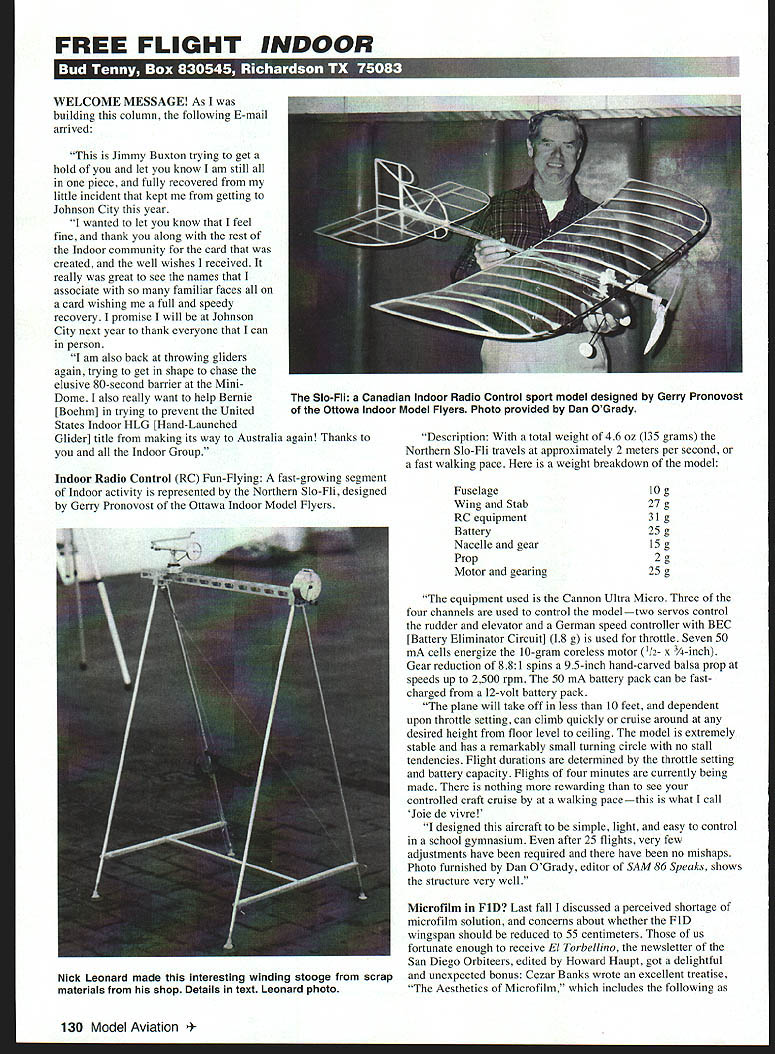
A fast‑growing segment of indoor activity is represented by the Northern Slo‑Fli, designed by Gerry Pronovost of the Ottawa Indoor Model Flyers.
Description: With a total weight of 4.6 oz (135 grams) the Northern Slo‑Fli travels at approximately 2 meters per second, or a fast walking pace. Here is a weight breakdown of the model:
- Fuselage: 10 g
- Wing and stab: 27 g
- RC equipment: 31 g
- Battery: 25 g
- Nacelle and gear: 15 g
- Prop: 2 g
- Motor and gearing: 25 g
The equipment used is the Cannon Ultra Micro. Three of the four channels are used to control the model—two servos control the rudder and elevator and a German speed controller with BEC (1.8 g) is used for throttle. Seven 50‑mAh cells energize the 10‑gram coreless motor (1/2 x 3/8‑inch). Gear reduction of 8.8:1 spins a 9.5‑inch hand‑carved balsa prop at speeds up to 2,500 rpm. The 50‑mAh battery pack can be fast‑charged from a 12‑volt source.
The plane will take off in less than 10 feet, and dependent upon throttle setting, can climb quickly or cruise around at any desired height from floor level to ceiling. The model is extremely stable, and has a remarkably small turning circle with no stall tendencies. Flight durations are determined by the throttle setting and battery capacity. Flights of four minutes are currently being made. There is nothing more rewarding than to see your controlled craft cruise by at a walking pace—this is what I call "Joie de vivre!"
"I designed this aircraft to be simple, light, and easy to control in a school gymnasium. Even after 25 flights, very few adjustments have been required and there have been no mishaps. Photo furnished by Dan O'Grady, editor of SAM 86 Speaks, shows the structure very well."
Microfilm in F1D?
Last fall I discussed a perceived shortage of microfilm solution, and concerns about whether the F1D wingspan should be reduced to 55 centimeters. Those of us fortunate enough to receive El Torbellino, the newsletter of the San Diego Orbiteers, edited by Howard Haupt, got a delightful and unexpected bonus: Cezar Banks wrote an excellent treatise, "The Aesthetics of Microfilm," which includes the following as background for his position (there's much more in the newsletter):
"I'm not in love with microfilm. But I am in awe. Many of us are. And not just modelers, either. Have you ever run across anyone from toddler to very senior citizen who, seeing a 'micro' ship fly for the very first time has not looked on in wonder? When it lands, very young kids want to get their hands on it. Others press in and have to be cautioned not to get too close. It's as though a magnetic pull is at work.
"Is something magical happening here? Are emotions being stirred? You bet, but why? Beats me. Wonder, like beauty, cannot be explained. In the 80s I gave five dinner talks around the country to local chapters of the AIAA (American Institute of Aeronautics and Astronautics), capping off with an F1D flight demo a few feet over their heads in the dining room. The audience was mostly engineers and a few spouses. Their individual reactions were always the same. The eyes got wider, and the jaw would drop, the mouth opened, the whole face lit up. They were kids again, if only for a moment. But for that moment they were mesmerized.
"Indeed, words like mesmerized, gossamer, ethereal, majestic, etc., have been used to describe the subjective qualities of microfilm models since they first appeared on the scene in the 1930s. In the 60‑odd years since, their mystique has endured if not grown.
"But if these objective qualities can't be explained, they can be compared. Imagine, in your mind's eye, a current 65 cm Microfilm model cruising alongside a proposed 55 cm plastic ship. And for the sake of argument let's say they are both mesmerizing, gossamer, ethereal, and majestic. But which is more so? A little? Or a lot? Just how big is the aesthetic margin between them? Which leads to: Do you think the rationale for the smaller model with plastic covering is compelling enough that we are willing to give up this aesthetic margin? I say no. How about you?"
Fudge Factors
"Years ago, Charlie Sotch suggested the concept of a 'fudge factor' that could be used to make allowances for ceiling height of different sites where postal contests were held. The basic formula, first used by members of NIMAS (National Indoor Model Airplane Society), worked pretty well as long as there wasn't a big difference in ceiling heights, and the MiniStick International Postal meets have used a formula that allows for a wide range of heights.
Then, Robert Leifeld posted this query for the Indoor Group:
'Hello. I am an (old) prof. who still does a bit of indoor flying. Your report in Model Aviation of a postal contest gives rise to this note. It has always bothered me that the fudge factor for ceiling height is factored into the scoring while there is no fudge factor for air density! The consequence of course is that those of us who don't live at or near sea level can't compete and don't enter. How about getting some or one of the "pros" in the indoor flying business to do a paper on the variation of flying times with air density? The effect is likely non‑linear.'
Numerous replies agreed with that posting. Then Hermann Andresen referred to a paper published in the NFFS (National Free Flight Society) Symposium and passed on this comment:
'It was correctly stated that the elevation correction is nonlinear, but for simplicity, a close approximation would be to consider the atmosphere as an ocean of air 30,000 ft. At sea level there is full pressure. At 6,000 ft, one is about 20% lower in density. In order for the plane to generate the same lift (equal to its weight), it will have to fly about 10% faster; for the same lift‑to‑drag angle, it would have 10% less performance. For indoor (and most outdoor) models flying in the laminar regime this translates into a 5% increase in skin friction and profile drag. Since there are other sources of drag, especially induced, the lift/drag ratio is two to three percent worse. In short, we lose about 2% in performance for each 1,000 feet elevation.
Similarly, we lose about 1% for each ten degrees (F) increase in temperature. For rubber‑powered models, this is totally overwhelmed by the rubber motor's increase in energy release with temperature. I don't have that information, but Fred Pearce and others have test data.
Yes, it would be fairer to correct indoor postal times for both elevation and temperature.'"
Winding Stooge
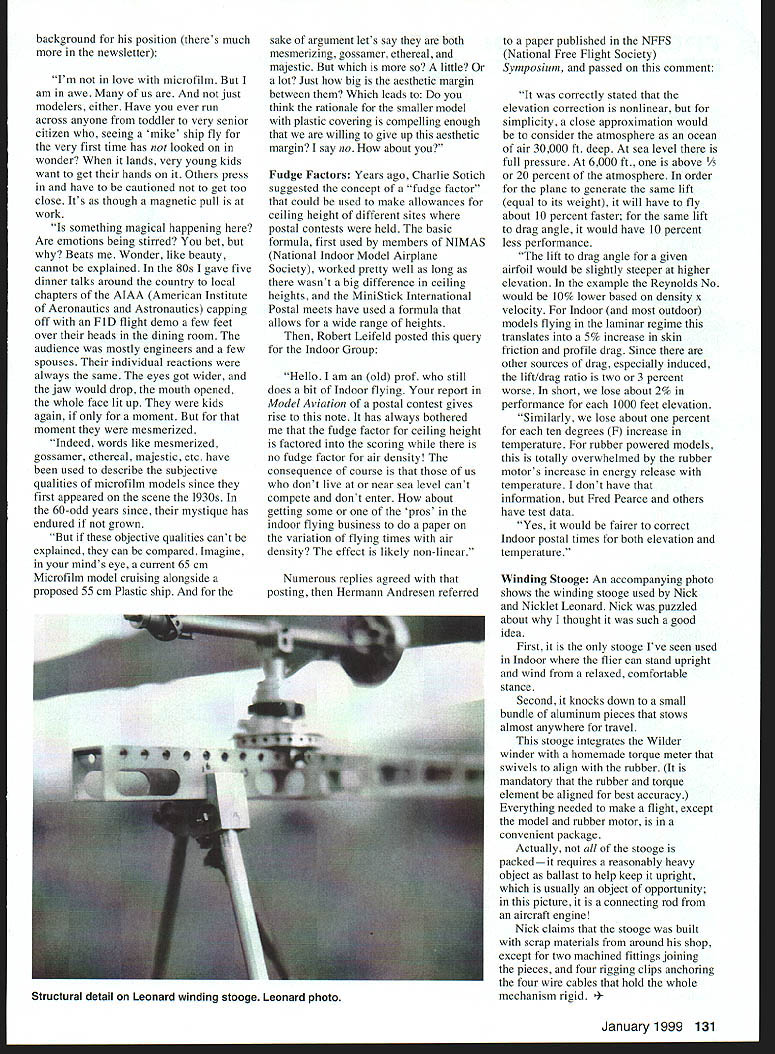
An accompanying photo shows the winding stooge used by Nick Leonard. Nick was puzzled about why I thought it was such a good idea.
First, it is the only stooge I've seen used in indoor where the flier can stand upright and wind from a relaxed, comfortable stance.
Second, it knocks down to a small bundle of aluminum pieces that stows almost anywhere for travel.
This stooge integrates the Wilder winder with a homemade torque meter that swivels to align with the rubber. (It is mandatory that the rubber and torque element be aligned for best accuracy.) Everything needed to make a flight, except the model and rubber motor, is in a convenient package.
Actually, not all of the stooge is packed — it requires a reasonably heavy object as ballast to help keep it upright, which is usually an object of opportunity; in this picture, it is a connecting rod from an aircraft engine!
Nick claims that the stooge was built with scrap materials from around his shop, except for two machined fittings joining the pieces, and four rigging clips anchoring the four wire cables that hold the whole mechanism rigid.
Transcribed from original scans by AI. Minor OCR errors may remain.

