

FREE FLIGHT INDOOR
Bud Tenny, Box 830545, Richardson, TX 75083
Year of the High Ceilings?
With continued good relations at Lakehurst, NJ, it can be assumed that 1999 will have a large number of Lakehurst dates. About the time you read this, another landmark site will be visited by indoor fliers: the 231-foot Tropicana Stadium in St. Petersburg, Florida, is the highest ceiling in the U.S. that has been available.
A Reprise
Excerpts of a message from Bob Clemens:
We have a firm date for the 1999 Empire State Indoor Championships at the Buffalo Bills fieldhouse near Orchard Park, NY. It's Saturday, May 22, 1999. This is one of the best indoor sites available: a 200- x 400-foot carpeted floor area with a 128-foot ceiling.
Contact: Bob Clemens; RClemens@compuserve.com; Tel. (716) 392-3346.
How long do you want to fly indoor?
Several individuals and organizations are devoting time and/or money to making excellent indoor sites available. If attendance isn't high enough to support the activity, it will vanish. Paul Harvey noted that a failure to vote or refusal to vote, for whatever reason, is actually a vote. I want to fly indoor as long as I can; help keep these sites available!
Finding Sites
Many clubs have earned the periodic use of sites by trading their services for them. The group organized by Tom Brennan of Marin County, California organized classes for students at a school in exchange for monthly use of the school's gymnasium. In addition, the group donates event entry fees to the school recreation fund.
In a previous column I reported a similar program at the Air Force Academy near Denver.
Do any other groups have similar programs? There is a possibility that these stories can be assembled as a document and made available with other materials on finding and securing sites. Let's make it happen!
Comments on A-6 rules
From Herman T. Adams, 34 Mount Alto Rd., Rome, GA 30615-4148:
I would rather see A-6 left as a tissue-covered class. Even with the cost of gampi (it doesn't take much to cover the A-6), I would rather see the class as tissue. As to minimum weight, perhaps there could be brackets, as in drag racing. An example: a flier wants to fly in the 3.0 to 3.5-gram class: weigh the model. If enough competitors have not entered, he can enter the next lighter class. Wood size and wire size rules are OK. I hope the class becomes popular enough to have lots of competitors.
From Don Carron (AMA 9825 CD):
I agree a minimum weight obviates other considerations. If A-6 is to lure beginners, the model's appearance is important. A beginner seeing a bunch of colorful tissue-covered models is encouraged. If he sees models covered with materials he considers outside his abilities or experience, he is intimidated. He probably would be more interested in No-Cal models, even though he'd be better off with an A-6.
I say "stay with tissue" for this event. Since gampi isn't an option for everyone, minimum weight is the answer. If all models weigh the same, gampi or other tissue can be used with no advantage. The last thing we want is for A-6 to "look like" a beginner's event that has been taken over by experts.
Bud Tenny comment: The only "beginner" event is one with separate events limited to beginners!
Postal Contest Canceled
Tom Vallee reported that it wasn't possible to arrange a Japan/U.S. postal contest for 1998. He concluded (excerpts):
I think the postal contests have been a real success. The Japanese fliers and their organizer, Shigeyoshi Nonaka, were ideal partners for the contest. I came to expect nothing but the highest standards of fair play and good sportsmanship from them. The contest did a lot to improve the art of low-ceiling indoor competition. In the last F1D postal contest, three fliers broke the Cat. I world record. You had to equal or beat the category world record to place in the contest! This is a pretty high level of competition.
Technical Stuff
(From the Boeing Hawks Newsletter, edited by Gene Stubbs.)
I take back all the mean things I said a while back about using rubber cement to attach indoor covering films. Andy Tagliafico and the other Oregon fliers highly recommend using very dilute rubber cement. They brush it onto the structure, where it dries instantly. Then they lay the structure on the covering film and activate the cement with a swipe of thinner.
When I first tried it I couldn't get the film to adhere at all. Now I believe my problem was with the thinner. At first I was using white gas to thin the cement, and it probably has oils in it that interfered with the cement. I bought a can of "official" rubber cement thinner (probably n-hexane) and have had no more adhesion problems. The main advantages in using rubber cement over shellac are that the thinner doesn't warp the structure and loosen the glue joints like alcohol does.
Hair Tape?
That's right. It's one of those mysterious materials that some women keep with their cosmetics. It comes on a (pink) plastic roll, as Scotch tape does, but it's made of a silkspan-like fabric with a milder adhesive.
This tape has proven useful for model building. It can be used the same way you might use masking tape, but with a couple of advantages: since it is a fabric, it's thinner and more pliable than masking tape. Also, the adhesive is much weaker, allowing it to come off easier and without damage to the surface.
I have used the tape to adhere plans to the building board, since it comes off without tearing the plan. It is also good for attaching thin balsa strips to the building board or to cardboard fixtures while assembling indoor models. With masking tape, you need to use "used" or old pieces so that the stickiness is reduced.
Ask for the tape at the cosmetics department of your local drugstore.
From the Archives of INAV (Indoor News and Views)
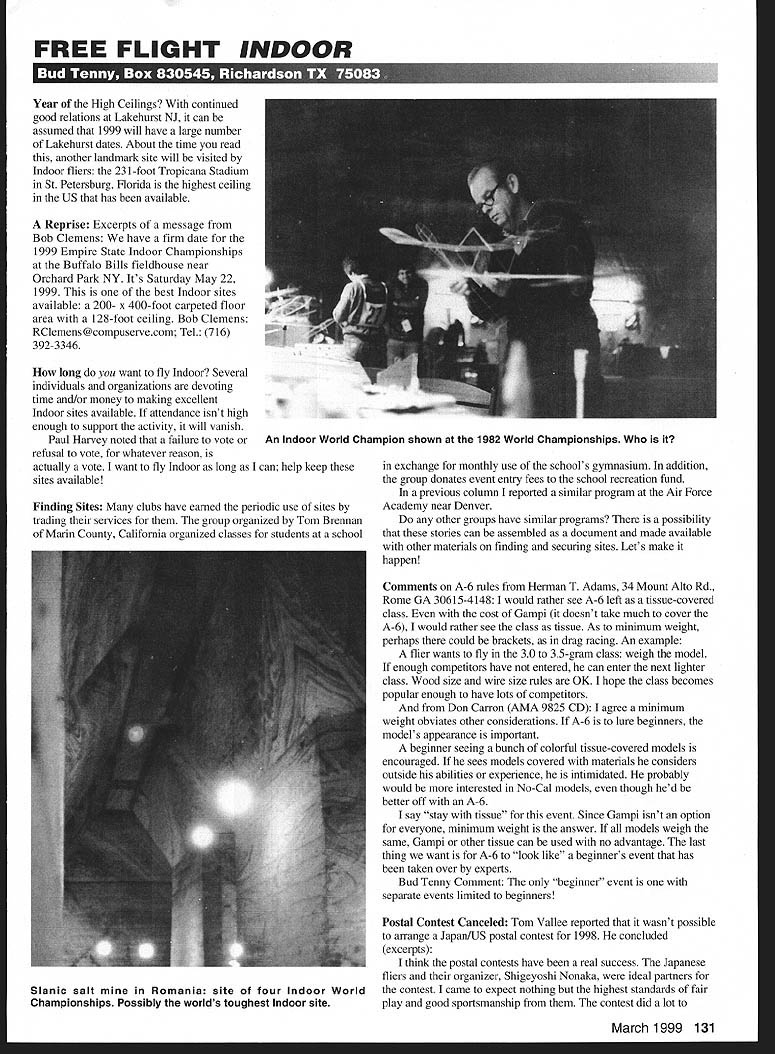
This is being written shortly after the 1998 Indoor World Championships in Slănic, the salt mine in Romania. This month's photos were taken at the 1982 World Championships in Slănic.
A quiz: Who is shown in Photo 1? Photo 2 is a view of the site, which unfortunately shows nothing to give a visual size reference of what may be the world's most difficult indoor site.
Another mystery: Who took these photos? I think I know, but haven't been able to confirm my guess.
Transcribed from original scans by AI. Minor OCR errors may remain.

