
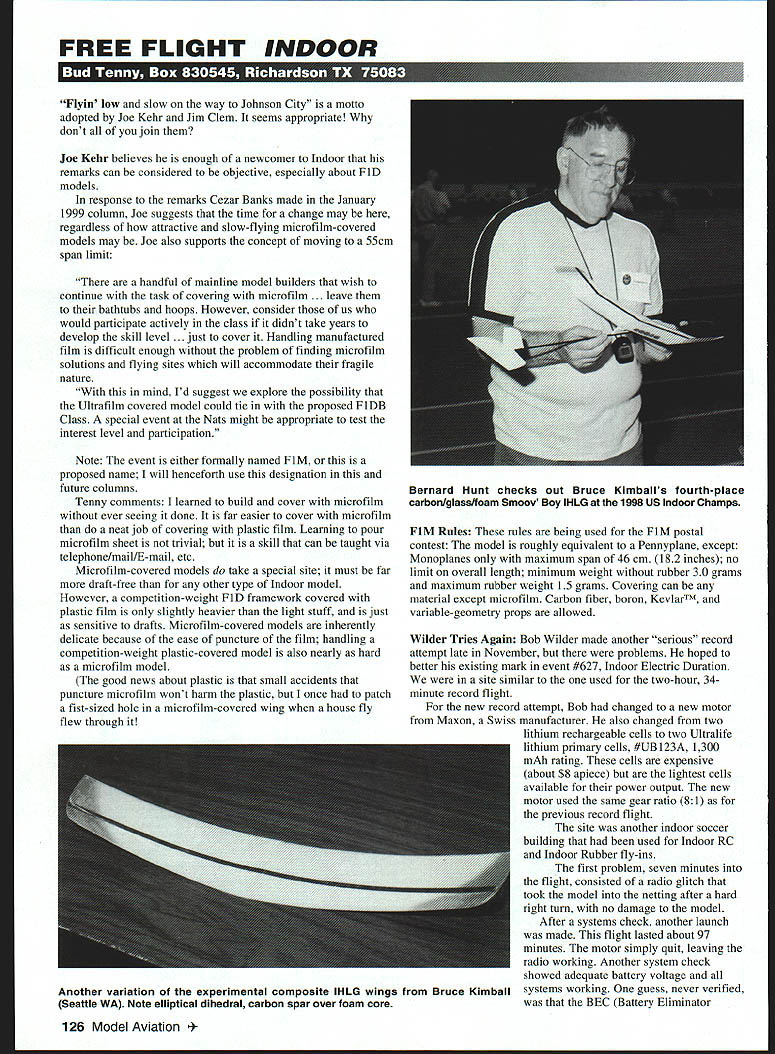
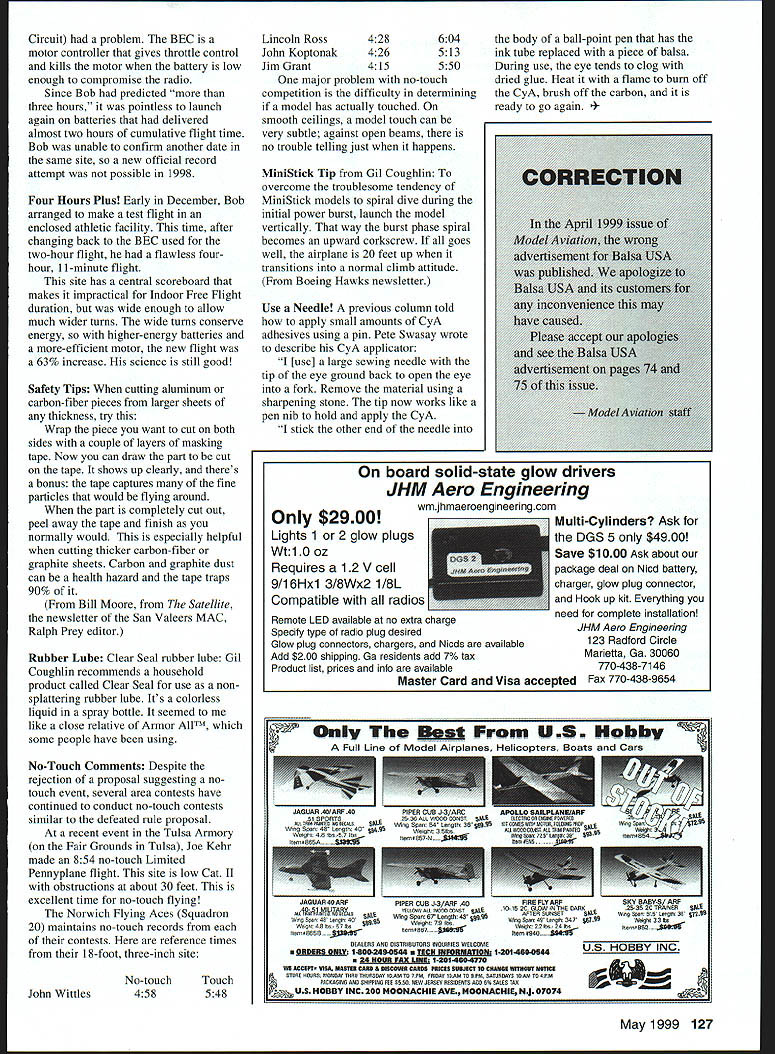
FREE FLIGHT INDOOR
Bud Tenny, Box 830545, Richardson TX 75083
"Flyin' low and slow on the way to Johnson City" is a motto adopted by Joe Kehr and Jim Clem. It seems appropriate — why don't all of you join them?
Joe Kehr believes he is enough of a newcomer to indoor flying that his remarks can be considered objective, especially about F1D models. In response to the remarks Cezar Banks made in the January 1999 column, Joe suggests that the time for a change may be here, regardless of how attractive and slow-flying microfilm-covered models may be. Joe also supports the concept of moving to a 55 cm span limit.
Joe Kehr's suggestion
"There are a handful of mainline model builders that wish to continue with the task of covering with microfilm — leave them to their bathtubs and hoops. However, consider those of us who would participate actively in the class if it didn't take years to develop the skill level just to cover it. Handling manufactured film is difficult enough without the problem of finding microfilm solutions and flying sites which will accommodate their fragile nature.
"With this in mind, I'd suggest we explore the possibility that the Ultrafilm-covered model could tie in with the proposed F1DB Class. A special event at the Nats might be appropriate to test the interest level and participation."
Note: The event is either formally named F1M, or this is a proposed name; I will henceforth use this designation in this and future columns.
Tenny comments
I learned to build and cover with microfilm without ever seeing it done. It is far easier to cover with microfilm than to do a neat job of covering with plastic film. Learning to pour a microfilm sheet is not trivial, but it is a skill that can be taught via telephone/mail/e-mail, etc.
Microfilm-covered models do require a special site; it must be far more draft-free than for any other type of indoor model. However, a competition-weight F1D framework covered with plastic film is only slightly heavier than the lightweight versions, and is just as sensitive to drafts. Microfilm-covered models are inherently delicate because the film punctures easily; handling a competition-weight plastic-covered model is also nearly as hard as handling a microfilm model.
The good news about plastic is that small accidents that puncture microfilm won't harm the plastic, but I once had to patch a fist-sized hole in a microfilm-covered wing when a house fly flew through it!
F1M Rules
These rules are being used for the F1M postal contest. The model is roughly equivalent to a Pennyplane, except:
- Monoplanes only with maximum span of 46 cm (18.2 inches).
- No limit on overall length.
- Minimum weight without rubber: 3.0 grams.
- Maximum rubber weight: 1.5 grams.
- Covering can be any material except microfilm.
- Carbon fiber, boron, Kevlar™, and variable-geometry props are allowed.
Wilder tries again
Bob Wilder made another "serious" record attempt late in November, but there were problems. He hoped to better his existing mark in event #627, Indoor Electric Duration. The site used was similar to the one for his previous two-hour, 34-minute record flight.
For the new attempt, Bob changed to a new motor from Maxon (Switzerland). He also switched from two lithium rechargeable cells to two Ultralife lithium primary cells, UB123A, rated 1,300 mAh. These cells are expensive (about $8 apiece) but are the lightest cells available for their power output. The new motor used the same gear ratio (8:1) as for the previous record flight.
The site was another indoor soccer building that had been used for indoor RC and indoor rubber fly-ins. Seven minutes into the first flight a radio glitch took the model into the netting after a hard right turn; there was no damage. After a systems check another launch was made. That flight lasted about 97 minutes before the motor quit while the radio continued to work.
A systems check showed adequate battery voltage and all systems working. One unverified guess was that the BEC (Battery Eliminator Controller) motor controller, which provides throttle control, shut down the motor when the battery was low enough to compromise the radio. Since Bob had predicted three hours, it was pointless to launch again; the batteries delivered almost two hours cumulative flight time. Bob was unable to confirm another date at the same site for a new official record attempt.
1998 — Four hours plus
Early in December Bob arranged a test flight at an enclosed athletic facility after changing back to the BEC used for the two-hour flight. The flight was flawless — four hours, 11 minutes. The site has a central scoreboard that makes it impractical for a record attempt, but the large space is wide enough to allow much wider turns. Wide turns conserve energy. With higher-energy batteries and a more-efficient motor, the new flight was a 63% increase over the previous record. Science still good.
Safety tips
When cutting aluminum or carbon-fiber pieces from larger sheets of any thickness, try this:
- Wrap the piece you want to cut on both sides with a couple of layers of masking tape.
- Draw the part to be cut on the tape — it shows up clearly.
- The tape captures many of the fine particles that would otherwise fly around.
- When the part is completely cut out, peel away the tape and finish as you normally would.
This is especially helpful when cutting thinner carbon-fiber or graphite sheets. Carbon and graphite dust can be a health hazard and the tape traps about 90% of it.
(From Bill Moore, The Satellite — newsletter of the San Valeers MAC, Ralph Prey, editor.)
Rubber lube
Clear Seal rubber lube: Gil Coughlin recommends a household product called Clear Seal for use as a non-splattering rubber lube. It's a colorless liquid in a spray bottle. It seems similar to Armor All™, which some people have been using.
No-touch comments
Despite the rejection of a proposal suggesting a no-touch event, several area contests have continued to conduct no-touch contests similar to the defeated rule proposal.
At a recent event in the Tulsa Armory (on the fairgrounds in Tulsa), Joe Kehr made an 8:54 no-touch Limited Pennyplane flight. This site is low Cat. II with obstructions at about 30 feet. This is excellent time for no-touch flying!
The Norwich Fly Zones (Squadron 20) maintain no-touch and touch records from each of their contests. Here are reference times from their 18-foot, three-inch site:
- Lincoln Ross — No-touch: 4:28, Touch: 6:04
- John Koptomak — No-touch: 4:26, Touch: 5:13
- Jim Grant — No-touch: 4:15, Touch: 5:50
John Wittles — No-touch: 4:58, Touch: 5:48
One major problem with no-touch competition is the difficulty in determining if a model has actually touched. On smooth ceilings a model touch can be very subtle; against open beams there is no trouble telling just when it happens.
MiniStick tip (from Gil Coughlin)
To overcome the troublesome tendency of MiniStick models to spiral-dive during the initial power burst, launch the model vertically. That way the burst-phase spiral becomes an upward corkscrew. If all goes well, the airplane is 20 feet up when it transitions into a normal climb attitude.
(From Boeing Hawks newsletter.)
Use a needle!
A previous column told how to apply small amounts of CyA adhesives using a pin. Pete Swasay wrote to describe his CyA applicator:
"I use a large sewing needle with the tip of the eye ground back to open the eye into a fork. Remove the material using a sharpening stone. The tip now works like a pen nib to hold and apply the CyA.
"I stick the other end of the needle into the body of a ballpoint pen that has the ink tube replaced with a piece of balsa. During use, the eye tends to clog with dried glue. Heat it with a flame to burn off the CyA, brush off the carbon, and it is ready to go again."
Transcribed from original scans by AI. Minor OCR errors may remain.

