
FREE FLIGHT INDOOR
Bud Tenny, Box 830545, Richardson TX 75083
Terry Jenkins of Ontario, Canada wrote to mildly chastise me for "promoting Radio Controlled Indoor Flying." His well-taken point is that RC interests may well overwhelm all available indoor sites, to the exclusion of "true" indoor flying. This is a troubling possibility, but my not reporting this activity surely would have little impact on the site problem.
There is no doubt that indoor RC of any ilk is not compatible with other indoor types. However, Indoor Electric, FF CO2, FF Scale, all other indoor scale models except perhaps Lo-Cal, and P-24 models are equally incompatible with what I call "true" indoor models.
As fliers of duration models covered with microfilm or plastic, Jim Clem and I pay our pro rata share of site rental and get, at most on average, 50 minutes of flying time in return for a 70+ mile round trip. My real love is F1D. In a good year, I pay to travel more than 1,000 miles in any direction to gain access to a site worthy of the class. I haven't built a new F1D in more years than I care to count. As Jim Clem says, "Sooner or later, the agony exceeds the ecstasy."
Jim lives about six blocks from the Plano (TX) YMCA, and flies there as part of his membership several times a month. Of course, this requires advance planning, since the air-conditioning is computer-controlled from someplace in Oklahoma.
I live even closer to the Richardson (TX) YMCA, but that building has a humidity problem that mandates constant operation of the air handlers. Fortunately, my membership is also good at the Plano YMCA, so I can fly with Jim as often as I make time to do so.
Jim and I can probably still get access to a local church gym at $50 a pop. It is half the length of a small gym, so realistically we take turns flying. I feel sure that the cost per minute of flight time is higher than at the Bedford or Euless (Ft. Worth suburbs) sites currently available twice a month.
The bottom line seems to be that indoor fliers can have as much exclusive site access as they can afford. Are there any more reasons for modeling to seek corporate sponsors? If my understanding is correct, that is the only type of access enjoyed by indoor fliers in Japan.
Ornithopters, Anyone?
The Ornithopter Society (formerly Ornithopters' Society), Box 376, Arkville NY 12406, is circulating a Membership Directory Survey. For more information or to complete the survey online, see www.catskill.net/evolution/flight.
Kudos to Nicklet!
Nick Leonard, our Junior Team member to the 1998 Indoor World Champs, did very well in competition at the Slanic site. While Nicklet strongly acknowledges the support of Nick Sr. and the help and advice of many leading adult fliers, I honor his dedication and willingness to tackle and master the skills to compete in F1D. I am proud to know him and look forward to watching him compete in the future.
Lakehurst Flying
With a total of 113 flying opportunities at Lakehurst Hangar #1, East Coast fliers have almost unlimited opportunity to fly indoor models of all types. The confirmed and sanctioned events include long weekends:
- Memorial Day weekend: May 29–31
- Independence Day weekend: July 2–5
- Labor Day weekend: Sept. 3–5
This is an excellent site, hosted by friendly and helpful folks. For those who haven't been there in a while, some after-dark lighting is available to help you clean up and pack your models when you underestimate how long you need to clear the site.
Specific Impulse
After hours of indoor catapult flying at the Lubbock Nats, I speculated about the specific impulse — the energy released by the catapult rubber. I haven't had much chance to practice since then, but I have a Cat I glider that flutters unless the energy release is slow. I get much better control with a longer piece of thin rubber.
Under high ceilings, the highest energy release may be more important than the precise shape of the curve, provided your glider can handle the rubber output. Recent club newsletters have had discussions about what rubber is best. One factor I haven't seen mentioned is the difference between indoor and outdoor catapults: each has a six-inch limit on the overall length of the handle. The outdoor hand-held catapult is limited to a nine-inch loop of 1/4-inch rubber; the indoor catapult can use any length or size of rubber.
My expectation is that most Cat I gliders will benefit from a long, thin loop (or single strand). I use .02 x .043 rubber. One conclusion about high-impulse launching gleaned from the newsletters is that the stretch limit of 9x–10x for Tan II makes it less suitable than rubber that has a lower stretch limit (unless, perhaps, your arms are four feet long!). In the Turbulator, Bob Klipp, who is 5'3", says he can only stretch rubber hooked to the glider about 48 inches.
Please don't let zany hot-dogging give the wrong impression — I've seen Bees performing foolish stunts and some think it's just hot-rodding. Most guys simply can't resist flying that way because the Bee lets them get away with things no other plane would survive. So please forgive those who fly a little too low or a little too close to the crowd; the small excitement that Bee flying brings out in the Walter Mitty pilot is hard to resist. Beginners, build with confidence.
Covering With the UHU Stick
(condensed from Wingovers and Wallbangers, the newsletter of the Norwich Flying Aces)
Have any of you tried the Tom Hallman UHU method? This covering method uses the UHU brand glue stick and rubbing alcohol.
- Coat the structure with the UHU stick and allow it to dry. It is dry when the color turns from purple to clear, but it may still be a bit tacky. This helps position the tissue; the tackiness holds it in place.
- Apply rubbing alcohol through the tissue. The alcohol softens the glue so you can work out wrinkles. Apply more alcohol as needed.
- Preshrink the tissue for light structures; otherwise, shrink the tissue after the UHU has cured.
This method allowed me to complete covering jobs in record time, with beautiful results. It also allowed me to uncover one half of a wing, repair it, and recover it quickly. It works great for round fuselages because smaller sections can be done quickly and the edges between pieces of tissue seem to disappear. Other advantages include no dope fumes and the ability to work almost anywhere.
Both ingredients are inexpensive; a glue stick should last for many models, and rubbing alcohol is very inexpensive. Cleanup is a breeze. UHU also works great for applying registration numbers and insignia: apply UHU to tissue, allow it to dry, cut the numbers from the tissue, place them, and apply rubbing alcohol. Don't worry if they look wrinkly at first; the alcohol will dry and shrink them nicely.
35 cm Records?
Some time back, Tony D'Alessandro asked what the current records were for 35 cm indoor Stick. Since that isn't an AMA class, and I hadn't heard any unofficial times for Cat IV, I suggested his 27:15 flight could be considered an unofficial record. That is a very good time for a 13.8-inch wingspan model!
Tony scaled Bob Randolph's F1D to 35 cm, except he did the wing bracing differently and used an overall length of 18.75 inches. Because of concern over buckling compression ribs, he eliminated the cabane by bracing leading edge and trailing edge directly from the respective posts. This may allow the wing twist with torque to increase; it works well on the model, which weighs .014 oz (0.3997 g) — lighter than a MiniStick is required to be!
Tony sent a photocopy of a photo of the model climbing out; the wing twist is clearly shown. If anyone wants more information, send a SASE and I'll copy his sketches and weight chart for you. Good job of building and flying!
Torque Meter Data
You really need a torque meter if you hope to get the most from your models — especially in low-ceiling sites. The data below was generated by Charlie Sotich. The length data shown is the length from the rear anchor point to the torque meter pointer. The torque value shown is the amount of torque required to twist the wire 360° (more twist might overstress the wire).
- Dia .004 — Length 1.88 — Torque .016
- Dia .005 — Length 2.36 — Torque .031
- Dia .006 — Length 2.83 — Torque .054
- Dia .007 — Length 3.30 — Torque .086
- Dia .008 — Length 3.77 — Torque .129
- Dia .009 — Length 4.24 — Torque .183
- Dia .010 — Length 4.71 — Torque .255
- Dia .011 — Length 5.18 — Torque .355
- Dia .012 — Length 5.65 — Torque .454
- Dia .013 — Length 6.13 — Torque .552
- Dia .014 — Length 6.60 — Torque .690
- Dia .015 — Length 7.07 — Torque .848
- Dia .016 — Length 7.54 — Torque 1.029
- Dia .017 — Length 8.01 — Torque 1.235
- Dia .018 — Length 8.48 — Torque 1.465
- Dia .019 — Length 8.95 — Torque 1.724
- Dia .020 — Length 9.42 — Torque 2.011
- Dia .021 — Length 9.90 — Torque 2.528
- Dia .022 — Length 10.70 — Torque 2.676
- Dia .023 — Length 10.84 — Torque 3.058
- Dia .024 — Length 11.31 — Torque 3.474
- Dia .025 — Length 11.78 — Torque 3.927
- Dia .026 — Length 12.25 — Torque 4.417
- Dia .027 — Length 12.72 — Torque 4.947
- Dia .028 — Length 13.19 — Torque 5.517
- Dia .029 — Length 13.67 — Torque 6.150
- Dia .030 — Length 14.14 — Torque 6.786
- Dia .031 — Length 14.61 — Torque 7.487
- Dia .032 — Length 15.08 — Torque 8.235
Wilder Science
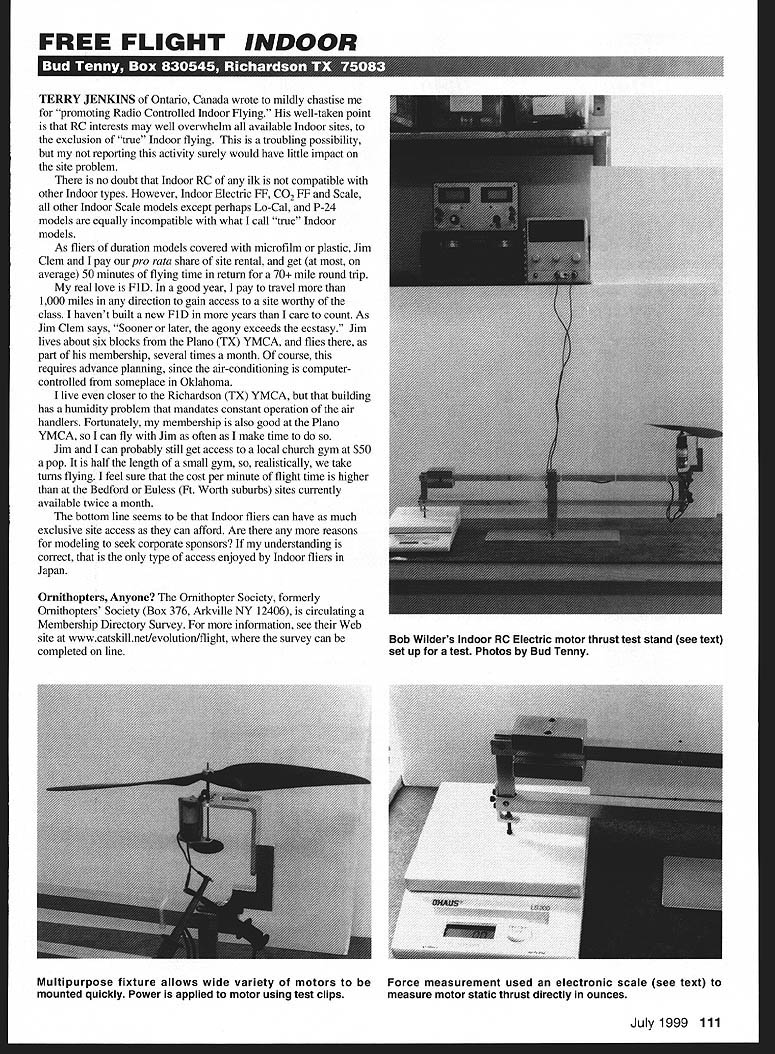
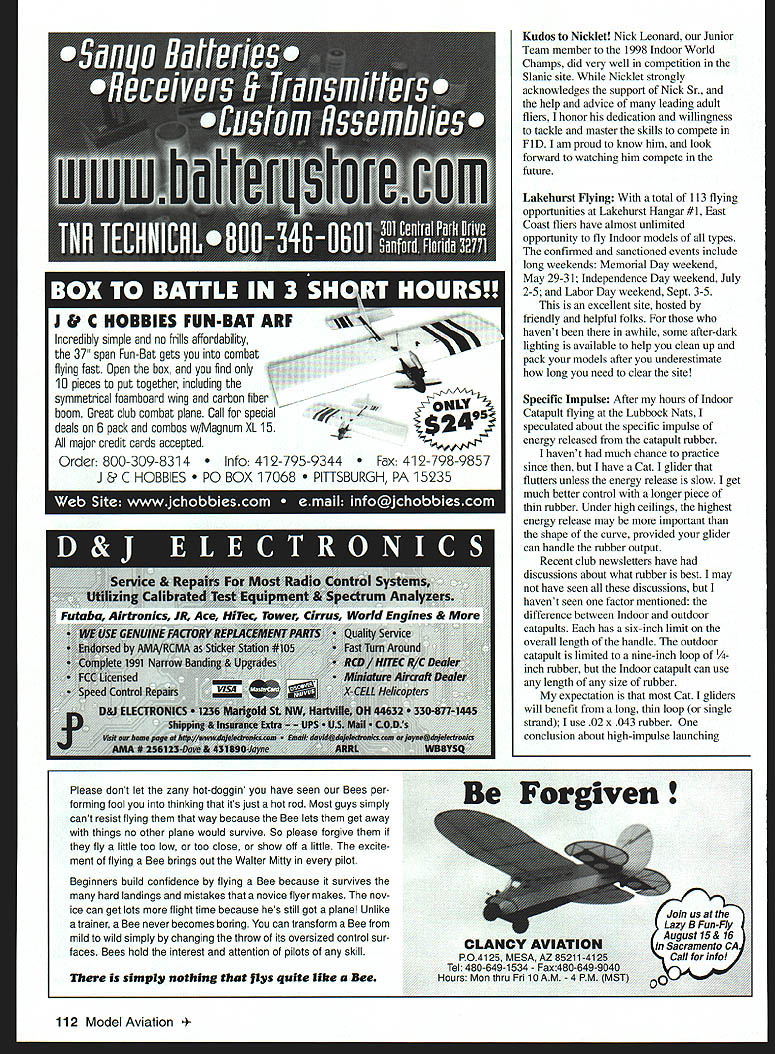
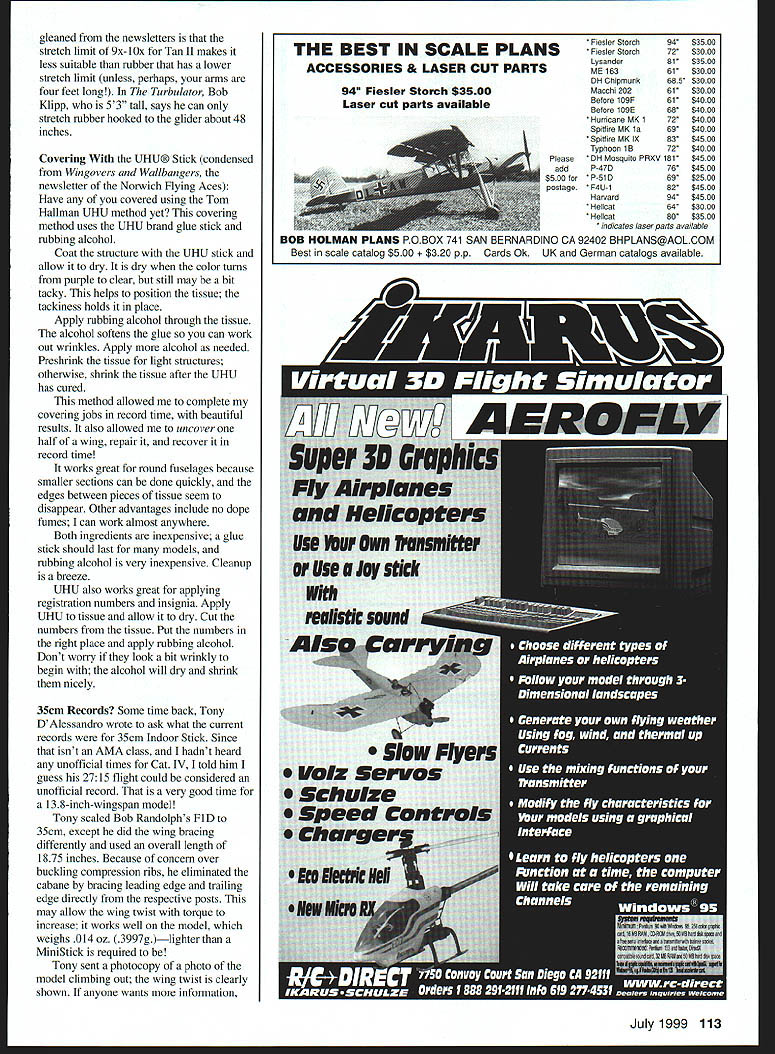
In previous columns I commented on Bob Wilder's test measurements that allowed him to select the most efficient combination of motor, prop, and batteries for his indoor RC duration model. One of the key elements is thrust measurement of various combinations.
Bob's test rig uses a precision parallelogram with precision bearings. With the motor running, the propeller pulls up on one end of the beam while the other end presses down on an electronic scale. Before applying power the beam is balanced using a sliding weight so that only a small force is exerted on the scale, which is then nulled to zero. With the motor running, the scale measures static thrust directly in ounces. Clever! A photo shows the rig, another shows the motor and prop used on the four-hour flight, and another shows the thrust sensor — an electronic scale.
Transcribed from original scans by AI. Minor OCR errors may remain.

