
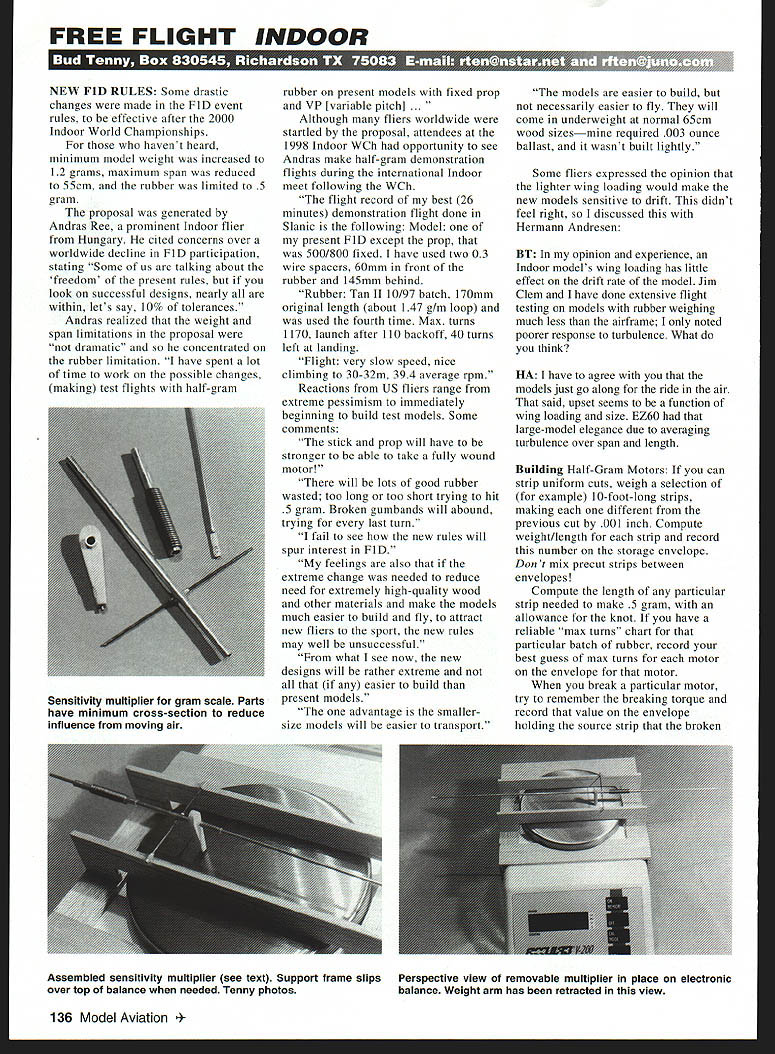
FREE FLIGHT INDOOR
Bud Tenny, Box 830545, Richardson TX 75083. E-mail: rten@nstar.net
NEW F1D RULES: Some drastic changes were made in the F1D event rules, to be effective after the 2000 Indoor World Championships.
For those who haven't heard, minimum model weight was increased to 1.2 grams, maximum span was reduced to 55 cm, and the rubber was limited to 0.5 gram.
The proposal was generated by Andras Reé, a prominent indoor flier from Hungary. He cited concerns over a worldwide decline in F1D participation, stating: "Some of us are talking about the 'freedom' of the present rules, but if you look on successful designs, nearly all are within, let's say, 10% of tolerances." Andras realized that the weight and span limitations in the proposal were "not dramatic" and so he concentrated on the rubber limitation. "I have spent a lot of time to work on the possible changes, (making) test flights with half-gram rubber on present models with fixed prop and VP [variable pitch] ..."
Although many fliers worldwide were startled by the proposal, attendees at the 1998 Indoor World Championships had an opportunity to see Andras make half-gram demonstration flights during the international indoor meet following the championships.
Andras reported a best demonstration flight of 26 minutes at Slănic. His flight record was as follows:
Model: one of my present F1D except the prop, that was 500/800 fixed. I have used two 0.3 wire spacers, 60 mm in front of the rubber and 145 mm behind.
Rubber: Tan II 10/97 batch, 170 mm original length (about 1.47 g/m loop) and was used the fourth time. Max turns 1170, launch after 110 backoff, 40 turns left at landing.
Flight: very slow speed, nice climbing to 30–32 m, 39.4 average rpm.
Reactions from US fliers range from extreme pessimism to immediately beginning to build test models. Some comments:
- "The stick and prop will have to be stronger to be able to take a fully wound motor!"
- "There will be lots of good rubber wasted; too long or too short trying to hit 0.5 gram. Broken gumbands will abound, trying for every last turn."
- "I fail to see how the new rules will spur interest in F1D."
- "My feelings are also that if the extreme change was needed to reduce need for extremely high-quality wood and other materials and make the models much easier to build and fly, to attract new fliers to the sport, the new rules may well be unsuccessful."
- "From what I see now, the new designs will be rather extreme and not all that (if any) easier to build than present models. The one advantage is the smaller-size models will be easier to transport."
- "The models are easier to build, but not necessarily easier to fly. They will come in underweight at normal 65 cm wood sizes—mine required .003 ounce ballast, and it wasn't built lightly."
Some fliers expressed the opinion that the lighter wing loading would make the new models sensitive to drift. This didn't feel right to me, so I discussed it with Hermann Andresen.
BT: In my opinion and experience, an indoor model's wing loading has little effect on the drift rate of the model. Jim Clem and I have done extensive flight testing on models with rubber weighing much less than the airframe; I only noted poorer response to turbulence. What do you think?
HA: I have to agree with you that the models just go along for the ride in the air. That said, upset seems to be a function of wing loading and size. EZ60 had that large-model elegance due to averaging turbulence over span and length.
Building Half-Gram Motors
If you can strip uniform cuts, weigh a selection of (for example) 10-foot-long strips, making each one different from the previous cut by 0.001 inch. Compute weight/length for each strip and record this number on the storage envelope. Don't mix precut strips between envelopes.
Compute the length of any particular strip needed to make 0.5 gram, with an allowance for the knot. If you have a reliable "max turns" chart for that particular batch of rubber, record your best guess of max turns for each motor on the envelope for that motor.
When you break a particular motor, try to remember the breaking torque and record that value on the envelope holding the source strip that the broken motor was made from.
Anyone experienced making partial-motor flight tests will quickly master building 0.499-gram motors. Selection of variable-cross-section motors finished will be slightly longer; the next motor of larger cross section will be easier to zero-correct. I suspect almost no rubber will actually be wasted using this method. Sooner or later you will find uses for motors made. A real clue: making and keeping detailed records of motor performance can quickly fine-tune power combos for a new meet model.
Via several messages I learned Bob Oppegård has resumed production of very fine rubber strippers.
Free Flight: Indoor
Hair Tape Reprise: Alan Welling (San Marco, TX) and Ken Carter (Speedway, IN) wrote to suggest that drafting tape can be used in place of hair tape; their wives are pleased!
Alan also noted that fine detail painting on scale models is easier using striping tape, sold by automotive supply stores. This tape is very thin (smaller ridges at the stripe line) and flexible. It is available in widths from 1/8 to 3/8 inch.
Finally! A great many columns ago I mentioned trying to build a more-sensitive scale than my 0.01 gram electronic balance. I now have the pieces built to multiply the sensitivity of that balance by at least 10:1—to 0.001 gram sensitivity.
A photo shows the active parts of the multiplier. All parts were built using minimum cross-section to reduce influence from moving air. The weight arm was built from 1/16 precision aluminum tubing. The pivot assemblies consist of 3/32 tubing and a 1/2 pivot wire. The pressure foot was built from 1/8 basswood, an insert of 1/8 tubing, and a stub of a straight pin that actually contacts the top pan of the electronic balance. The remaining piece, a piece of 1/8 tubing wrapped with small-diameter solder, is the counterweight.
The weight arm has a flat that will assist in attaching a weight pan. On the pivot assembly you can see a short piece of 1/16 tubing glued to the main arm. Similar pieces of 1/16 tubing support the pivot wire on the support frame. The pieces are assembled to the support frame, which slips over the top of the balance when needed.
Another photo puts the whole assembly into perspective: the weight arm has been retracted to balance the photo.
So does it work? A preliminary test indicated a practical limit in multiplication of perhaps 25:1. When I work out the calibration procedure, this will be reported in a future column.
Transcribed from original scans by AI. Minor OCR errors may remain.

