
FREE FLIGHT INDOOR
Bud Tenny, Box 830545, Richardson TX 75083
OLD BUSINESS
A previous column presented a "mystery" photo taken in Slanic. Only Robert Dunham of Tulsa, Oklahoma correctly identified Erv Rodemsky.
Health Watch at USIC
As expected, Jim Grant made it back, looking as well as he always has.
It was also good to see Jim Buxton flying HLG, almost as well as he had before his accident. Before the competition, Jim had expressed some doubt about how well he would do. He had been working out and had consulted a physical therapist about specific training. As it turned out, he very nearly won HLG—only a fraction of a second behind Bernie Boehm, his longtime mentor.
Although Bob Champine hasn't flown Indoor for several years, he returned this year. Bob is in a long recovery from a serious stroke, and was able to fly several events. Welcome back, Bob!
Dick Hardcastle learned early this year that he had melanoma on his back and cancer in one lung. In a dual operation, the melanoma was removed and exploratory surgery was done on the lung. Dick said the doctors cheered when the lung cancer wasn't melanoma—and then they removed the lung. Dick was upbeat at USIC, flying several events. He is getting stronger by the day, with a very good prognosis.
Throw Your Age?
Bernie Boehm has been an obstacle to those who want to win Indoor HLG at the Nats. This year, he said he needed to get at least 64 seconds to match his age. When he started throwing, he had some muscle pain but worked through it and got 65.3 on his fourth toss. By then his arm was back in top form and he went on to post top times of 71.1 and 67.7. This was enough to just beat Jim Buxton by 0.4 seconds for one more Nats win.
Site Records
There was some speculation that a 50-minute flight might be made at this year's Nats. It almost happened—twice:
- John Kagan: 48:48 in F1D
- Larry Coslick: 48:48 in Indoor Stick
- Steve Gardiner: won Limited Pennyplane with 16:34
Reprise — Specific Impulse
Previous columns have commented on the specific impulse of the rubber used for catapult gliders. (Specific impulse is the rate of energy release coupled with total energy release.) Some fliers have noted that Tan II may not be the best rubber to use, even if it is the highest-energy rubber available, because of its very high stretch ratio (up to 10:1). Who has arms that are long enough?
Has anyone conducted specific, instrumented tests of various rubber batches to measure specific impulse? What constitutes a good test of specific impulse for rubber?
HLG/Catapult Consistency
For several years I have analyzed the performance of HLG and Catapult fliers at the Indoor Nats, trying to better understand the dynamics of these events.
My analysis of each flier's performance consists of dropping the two lowest times and averaging the remaining scores. If a flier has posted fewer than five flights, the analysis gets pretty shaky, and I use the three best flights.
The concept is simple: a flier with a consistency score of 98 or higher is getting all the model can deliver. If these times don't win, a new glider is needed. This year, consistency was lower than in the most recent studies.
HLG:
- Bernie Boehm: 93.9
- Jim Buxton: 95.5
- Robert Romash: 95.9
Standard Catapult:
- Ralph Schlarb: 90.5
- Bill Schlarb: 97.7
- Robert Romash: 95.4
- John Marett: 89.8
- Tem Johnson: 95.1
Unlimited Catapult:
- Bernie Boehm: 98.8
- Ralph Schlarb: 97.3
- Bill Schlarb: 96.3
- John Marett: 88.4
- Tem Johnson: 90.0
MiniStick Postal Winner
Walt Collins won the 1999 MiniStick Postal event with flights of 8:01 and 8:29. He was good enough to share the details of his model and flight strategies to fit his eight-foot-ceiling site.
Walt's report details a methodical test-and-adjustment scheme that can be adapted to all indoor models:
"We flew in the large meeting room of the St. Joan of Arc Catholic Church in Yorktown, Virginia. The Brainbusters have used this site for several years to compete in the MiniStick Postal contest. The room is about 25 feet wide and 40 feet long, with a dropped-tile ceiling and flush lighting panels. Most of the time during the winter, the drift is from the northwest corner to the southeast corner (the southeast corner is exterior on both walls). We do not allow any steering in this site because of its relatively large length and width compared to the height.
"My approach was to try to keep the airplane on the ceiling as long as possible with a small circle, avoiding the walls as much as possible. The wing offset of 3/8 inch, combined with the seven-inch prop, usually caused a bounce off the wall back into the room rather than an immediate loss.
"I also set the wingtip height about 1/2 inch below the prop radius so the prop would not touch the airplane. The design was conventional: 49% stab/rudder projected area, twin rudders, CG about 75% of the flat center-section. The two most important factors were weight and wing attack angle. The airplane was built to a 43-gram minimum and performed well. Motor weight exceeded 39 grams including lube. Since attack angle is also critical, the wing was cemented in place and the tail boom tweaked to optimize flight at the low-torque end of the motor.
"Make the circle diameter a constant 10 feet. The small circle ensured that the plane would always approach a wall at a small angle so it could bounce off.
"The final settings here were about three degrees of left thrust and almost no washout. The nominal torque was primarily handled by the 3/8 inch of wing offset.
"After many hours of cutting and winding rubber, as well as flight testing, I was able to identify which rubber I had that gave the highest torque at the low end of the torque curve; this was 2/98 Tan II.
"The winning flight used a motor 10.5 inches long weighing 0.38 gram new. After a hard wind, the length was about 11 inches. This motor was wound to 2,400 turns with no backoff. The airplane went vertical immediately after launch and pirouetted against the ceiling. It would momentarily back off several times when the ceiling stopped the prop, but fell back only slightly.
"After 45 seconds, the airplane stopped rotating and started across the room with the left wingtip down. In about 10 feet, the airplane righted itself and began walking the ceiling in 10-foot-diameter circles, while drifting slightly toward the cold corner.
"Several lucky hits against the ceiling kept the airplane off the walls in the latter part of the flight. Prop stoppages on ceiling impact at the inboard side of the room caused the left wingtip to drop, resulting in increased clearance from the wall on the next pass.
"The last ceiling bump was at about seven minutes, and was very gentle. The trip to the floor from eight feet took another minute and a half. Only about 150 turns remained in the motor."
Follow-Up: F1D/SS
The new rules for F1D are being investigated by several fliers as of this date (7/5/99). Steve Brown is flying a 10-inch-chord model with a fixed 20-inch prop. Andres Hulas of Argentina reported being pleased with his first efforts but doesn't have a suitable test site. At USIC, Bernard Hunt was flying a six-inch-chord model of about 130 square inches. Richard Doig, using AutoCAD, took a two-inch-wide spanwise slice from his 65 cm model and scaled that to 55 cm—again, about 130 square inches.
A-6 Props
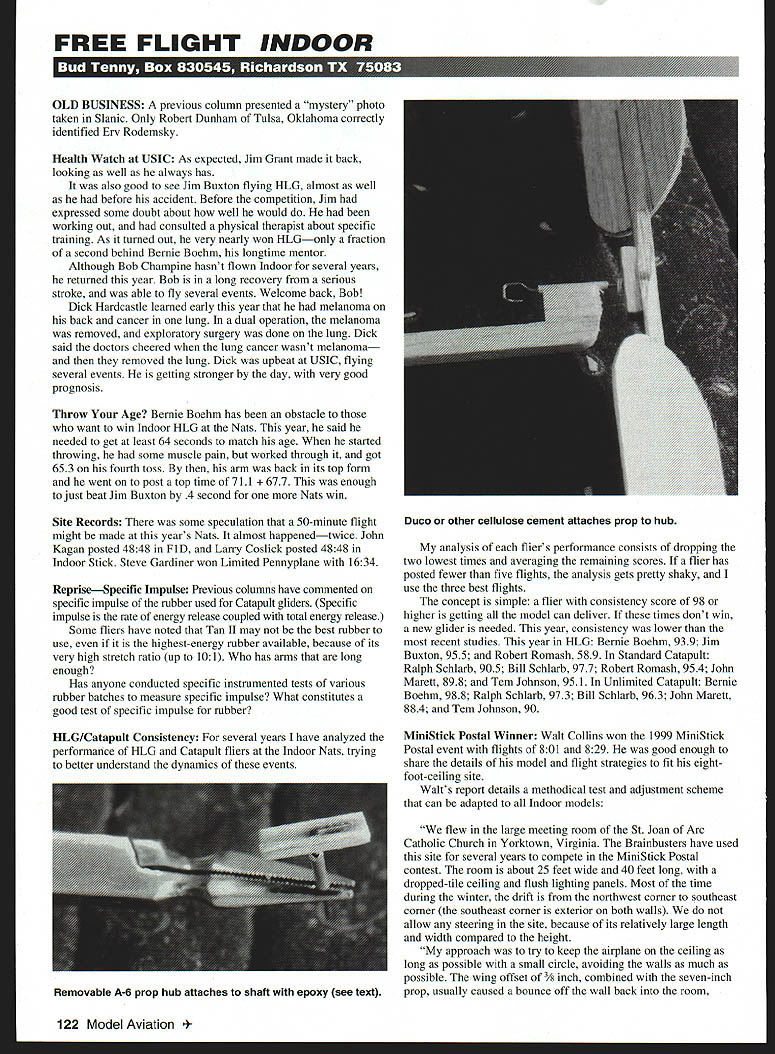
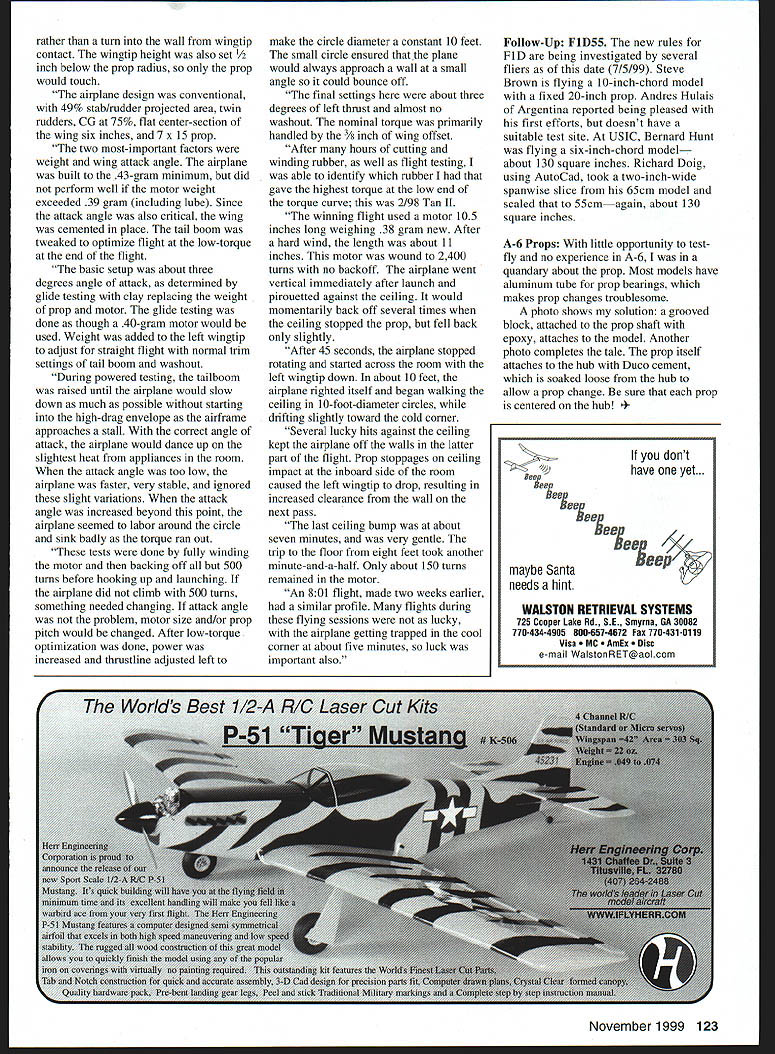
With little opportunity to test-fly and no experience in A-6, I was in a quandary about the prop. Most models have aluminum tube for prop bearings, which makes prop changes troublesome.
My solution: a grooved block, attached to the prop shaft with epoxy, attaches to the model. The prop itself attaches to the hub with Duco cement, which is soaked loose from the hub to allow a prop change. Be sure that each prop is centered on the hub!
Transcribed from original scans by AI. Minor OCR errors may remain.

