
Free Flight-- Indoor..
Bud Tenny
COME FLY YOUR MODELS! The Third NIMAS International Record Trials (THNIRT for short) is being tentatively planned for June 23-25, 1978. This highly enjoyable indoor contest is once again being set up for the almost unbelievable Atrium at Northwood Institute, West Baden, Indiana.
The contest format, which has been used before, is a mixture of record challenges and more standard indoor competition. In the record challenges, all entrants pit their models against the existing AMA record for the model class. The flier's score is the ratio of his recorded time to the record time, and the highest ratio wins. For example, if the record is 10 minutes and the flight time is 11 minutes, the score is 11/10 or 1.1. In practice, the score has been expressed in %, so this score would be 110%. This arrangement allows competition between many different model classes and age groups. Past winners have been really sharp Juniors and Seniors flying FAI and AMA Stick models, and Open fliers with less common craft, such as Cabin jobs and Ornithopter or Autogyro models.
The really hard part in preparing for such a meet is the choice of model. Does one try to excel in the conventional events against stiff competition, or try to advance the state of the art of a less popular event?
For more info: Since the next issue of this column will appear after THNIRT, those who wish information on the final arrangements will need to send a SASE to: Bud Tenny, Box 545, Richardson, TX 75080. Information on the final arrangements will be distributed as soon as it is available. Although attendance at the previous contests has been small, the competition has been high and the fun factor even higher. Come one, come all!
Energy Crisis Revisited: A previous column mentioned the lack of energy (suitable rubber) available for indoor flying. There is at least one source of rubber which is proving to be useable—even good—under many circumstances. Bill Hulbert won a berth on the U.S. Indoor Team while using FAI Contest Rubber. This rubber is produced in the U.S., and is available in sizes for indoor models from Micro-X, P.O. Box 1063, Lorain, OH 44055. Micro-X sells the rubber under the brand name Tri-X. It has a different torque curve than Pirelli, with slightly less energy storage. It has a flatter curve during the cruise portion of the flight, which would indicate greater suitability for low ceiling sites.
All rubber loses energy at lower temperatures, but Tri-X loses at a slightly higher rate than Pirelli. This low temperature characteristic seems to be the major drawback of Tri-X, since the energy storage at "normal" temperatures (summer flying at the Akron hangar) was sufficient for Bill to win a team slot. As mentioned before, the flatter torque curve may be especially advantageous for low ceiling flying, which is more common in the U.S. than high ceiling activity.
What Torque? It has been mentioned in previous columns that knowledge of the torque an indoor meter is wound to is important, particularly in lower ceiling sites which have a "dirty" ceiling. Consequently, most of the more serious indoor fliers wind their motors on a torque meter. This gives a very good idea of what torque the motor has while it is still hooked to the torquemeter, but what happens when the meter is hooked to the model? This problem arises because a few turns must be let out of the motor so it will unhook from the winder. As a result, the torque level is lower than before. The meter has to be un-
FF Indoor/Tenny
hooked twice—once from the winder so the rubber can be hooked to the prop shaft, and once more to unhook it from the torquemeter. It is easy enough to hook the meter to the prop and re-check the torque, but how much is lost while moving the motor from the torquemeter to the model's rear hook?
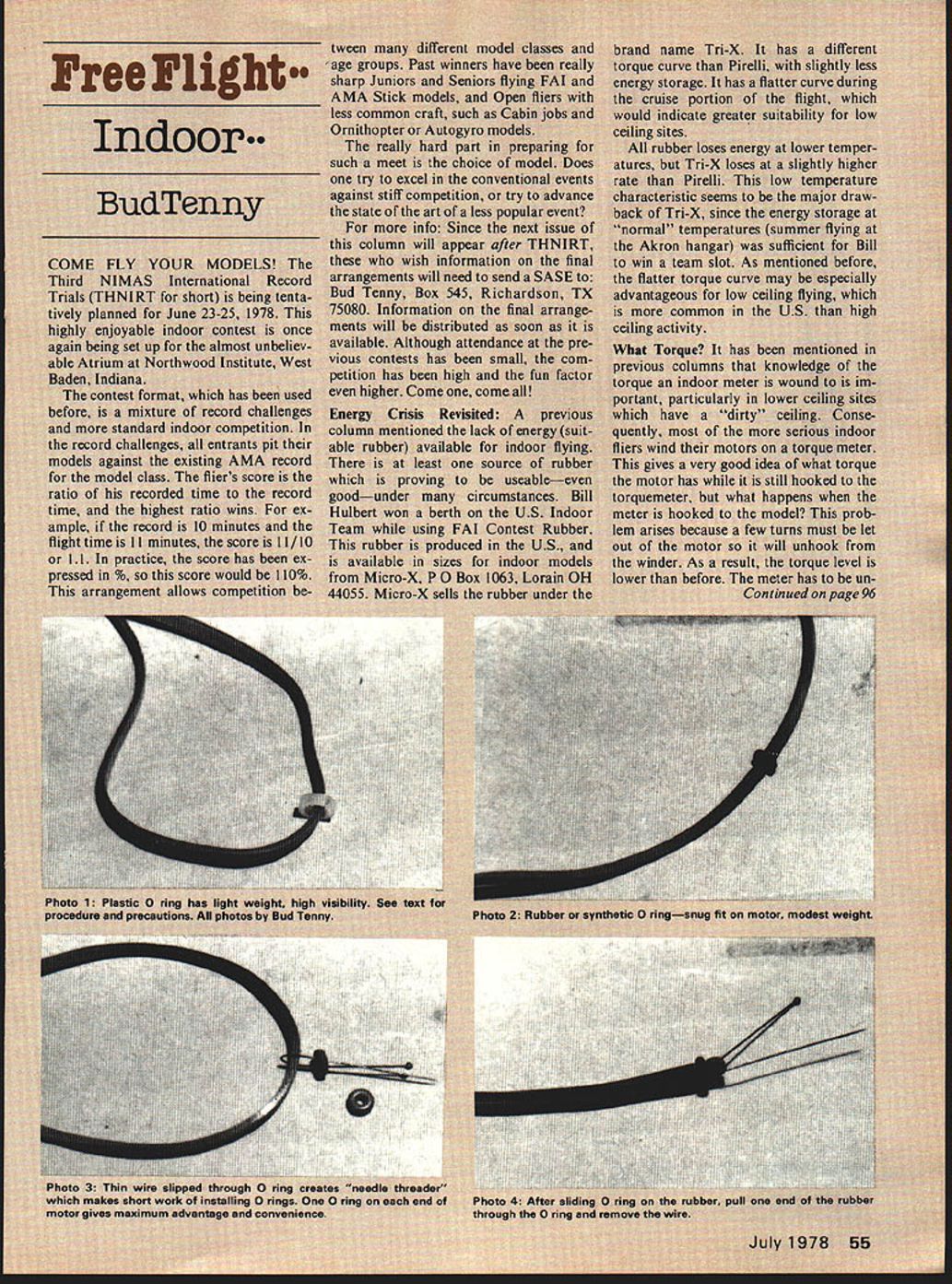
Use an "O" Ring! From a purist standpoint, an "O" ring is a rubber or synthetic circle of rubber—a doughnut shape—which is used as a gasket between metal fittings in pressure and vacuum systems. For indoor models, an O ring is something slipped on the meter which allows the motor to be unhooked without removing turns. In the past, O rings have been made from small diameter music wire bent into a circle and hooked to itself. More recently, either plastic rings or real O rings—very tiny ones—have been used. Photo 1 shows a plastic O ring on a motor, and Photo 2 shows a rubber O ring on the same size motor. Note that the rubber O ring fits very closely on the motor—which can be an advantage. Because the O ring fits snugly, it helps hold the motor on the rear hook if the motor unwinds completely.
The plastic O rings are made by slicing them off the end of a piece of Nyrod (a particular brand of pushrod for radio control models). After the rings are cut, the sharp edges are removed by boiling them in water. These O rings are very light, and each flier should experimentally test the strength of his O rings by winding motors to destruction of the model. The rubber O rings are available from Ron Plotzke (Aorolite), 36659 Ledgestone, Mt. Clemens, MI 48043; and from Ray Harlan, 15 Happy Hollow Rd., Wayland, MA 01778.
As mentioned before, the rubber O rings fit rather snugly on a rubber motor, enough so that it is difficult to get the O ring to slide on the rubber. The answer is shown in Photos 3 and 4. A small diameter wire (an insect mounting pin is shown) is bent double and pushed through the O ring. The O ring is then pushed over the rubber and one end of the rubber pulled through.
Whether to use the extra O ring is the question, since there is no doubt in my mind about using at least one! After the experience of using O rings, it is difficult to accept the inconvenience and uncertainty involved in not having at least one O ring. The factors weighing in the decision are: model size, ceiling height, and weight of the O ring. In some cases, factors like failing eyesight or poor lighting of the contest site enter into the picture. It is simply easier to see how to hook up the O ring, particularly the plastic ones. The weight of the O ring (typically less than .0005 oz.) is certainly a minor factor on a FAI Stick model which must weigh .0354 oz., especially since more precise control of the model's trajectory is possible. (With all other factors unchanged, the altitude a model attains is directly proportional to the launch torque.) Then, too, on a small model such as an A ROG, where the O ring is a higher proportion of the model's flying weight, the loss of a few turns in the tiny rubber has an almost negligible effect on the launch torque.
The heavier an indoor model is, the more power (proportionally) it needs for a given model size. This leads to problems of bunching rubber, and knots rubbing on the fuselage, usually with effects detrimental to long flights. Pennyplane models compound the problem by having high required weight and requiring very short fuselages. Although any rubber model only approaches its maximum duration if the rubber weight approaches 1/2 times the airplane weight, the short Pennyplane fuselages pose such rubber handling problems that few fliers manage to use more than 80% as much rubber weight as airplane weight. Thus, if rubber handling problems can be solved, the Pennyplane times are bound to go up. O rings tend to help prevent rubber bunching at the prep, but no one has reported an O ring really strong enough. With rubber weight already short, every improvement helps. And so should O rings on Pennyplane!
Bud Tenny, Box 545, Richardson, TX 75080.
Transcribed from original scans by AI. Minor OCR errors may remain.

