
Free Flight: Indoor
Bud Tenny
Indoor State of the Art — The Midwest
Thanks to the activity of several model clubs in the central U.S., indoor contest activity during last winter was plentiful. Even with the extra-cold winter that threatened to close some sites during the fuel shortage, St. Louis and Chicago area indoor fliers had four or five monthly meets and fun-fly sessions during the "indoor season."
Several clubs in the Great Lakes area sponsored indoor sessions and contests, including:
- Calumet Modelers
- Bong Eagles
- Illinois Model Aero Club
- Central Indiana Acromodelers
- Chicago Aeronuts
In the St. Louis area, the Thermaleers and the McDonnell-Douglas Free Flight Club accounted for the activity.
Although a few of the contests were special-purpose events—like the scale meet hosted by the Calumet Modelers and the Stock Delta Dart contest hosted in a high school gym by the Chicago Aeronuts—most were multi-event sessions. Typical events at these meets include:
- Indoor HLG (two age classes)
- Pennyplane and/or Easy B (often combined)
- Peanut or Sport Scale
Of the various scale events, Peanut Scale nearly always is held and attracts by far the most entrants. Contests that combined Pennyplane and Easy B showed that, on average, these models have similar performance potential and neither class has a clear advantage.
Know the Rules!
Two popular classes have been suffering from rules controversy. Peanut Scale fliers have been embroiled in rapid rule changes, trying to balance scale points and flying points. Scale purists push for greater emphasis on scale fidelity, detail, and workmanship, while proponents of flight scoring argue that Peanut Scale rules should emphasize flying ability of the model. Better-flying models are easier to trim and generally more fun to fly.
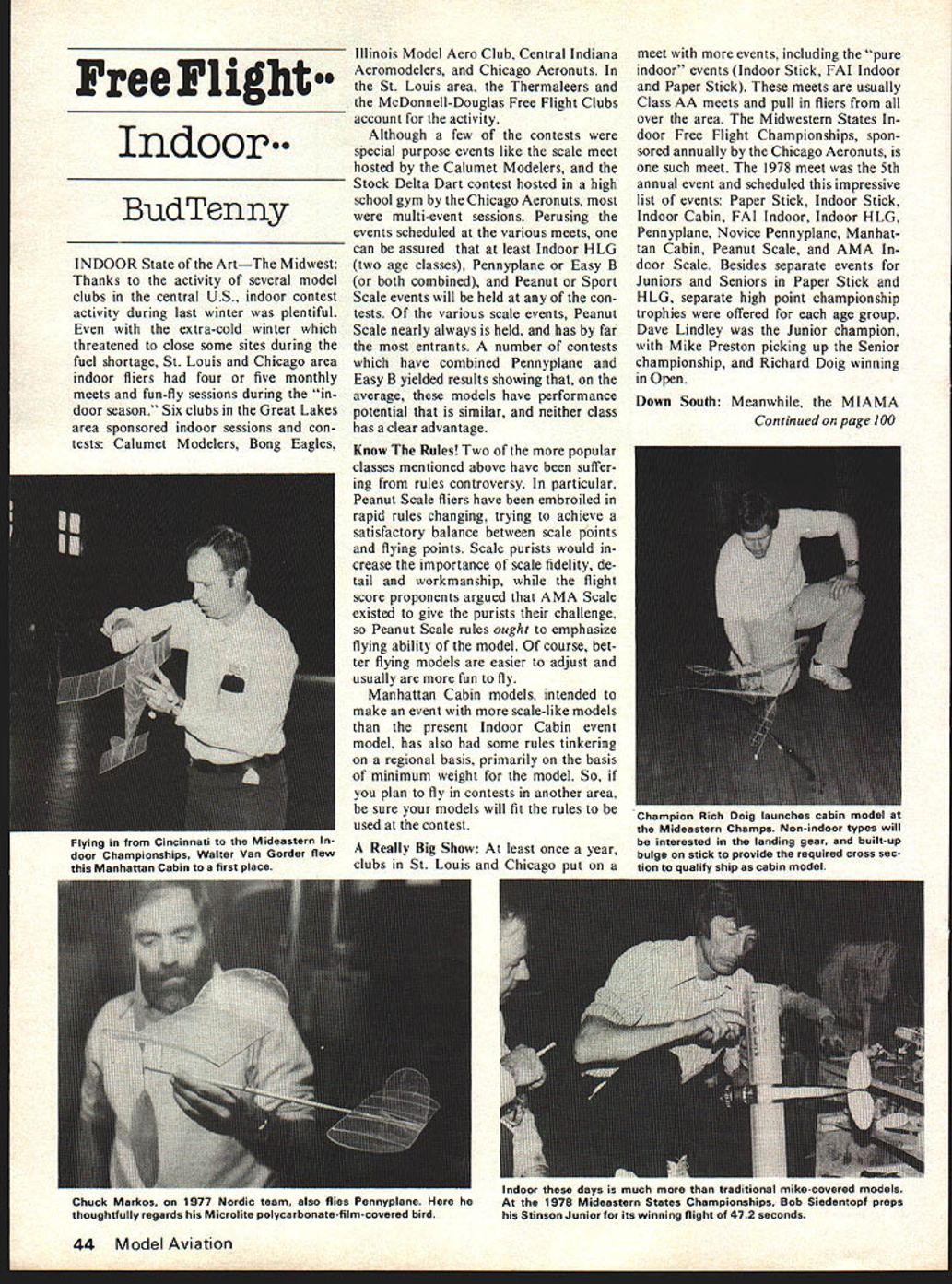
Manhattan Cabin models—intended to create an event with more scale-like models than the present Indoor Cabin event model—have also had regional rule tinkering, primarily concerning minimum weight. If you plan to fly in contests in another area, be sure your models conform to the rules that will be used at that contest.
A Really Big Show
At least once a year, clubs in St. Louis and Chicago put on larger meets that include the "pure indoor" events (Indoor Stick, FAI Indoor, and Paper Stick). These Class AA meets draw fliers from across the region.
The Midwestern States Indoor Free Flight Championships, sponsored annually by the Chicago Aeronuts, is one such meet. The 1978 meet (the 5th annual) scheduled the following events:
- Paper Stick
- Indoor Stick
- Indoor Cabin
- FAI Indoor
- Indoor HLG
- Pennyplane
- Novice Pennyplane
- Manhattan Cabin
- Peanut Scale
- AMA Indoor Scale
Separate Junior and Senior events were held for Paper Stick and HLG, and separate high-point championship trophies were offered for each age group. Dave Lindley was the Junior champion; Mike Preston won the Senior championship; Richard Doig won Open.
Down South
MIAMA (Miami Indoor Aircraft Modelers Association) continues to hold varied classes at monthly contests in the Goodyear Blimp Hangar at Opa-locka Airport in Miami, Florida. MIAMA is the only active all-indoor model club in the U.S., and their contest event schedules are typical of indoor clubs. One outstanding feature is the enthusiastic sponsorship by Dr. John Martin, which includes a monthly newsletter filled with cartoons and sketches. Each year the club holds an awards banquet to recognize its best fliers.
This year the real attraction was a proxy contest for Manhattan Cabin models. With nine entries, it was decided that all the models would be flown by the same modeler—FAI Indoor flier Roman Szymula—to keep the judging consistent. Out-of-state models finished 2nd (David Hagen, Oregon City, Oregon) and 4th (John O'Leary, Minneapolis, Minnesota). Dan Kilgore (Plantation, Florida) won 1st with 4:49.1, and John Martin (Coconut Grove, Florida) took 3rd.
Special Classes
One interesting event idea gleaned from club activity around the country is an indoor "scale" model of Old Timer gas models. These are approximately the size of Peanut Scale models and should perform well, even when replicating real airplanes with short nose-moment arms.
When this event was tried in Glastonbury, Connecticut, in 1977, it was won by a "Miss America" replica that competed against, among others, a Trenton Terror and a Miss Philly.
(And a reminder: model airplanes are real—special-purpose miniature aircraft—whether or not they are miniatures of man-carrying airplanes.)
Indoor Sites
A matter of overwhelming importance to indoor fliers is locating places to fly. The AMA Nats usually are held in sites not otherwise available to local fliers because rent is too steep for regular local activity. Local meets are often held in school gymnasiums. Only a few places can regularly plan on large, dependable sites:
- Chicago, with one or two massive armories
- New Jersey/New York, with hangars at Lakehurst Naval Air Station
- Miami, with the Goodyear hangar
Much of America's indoor flying therefore goes on in gymnasiums, small armories, and city recreation buildings. Exceptions include New York City, with the Low Library Rotunda at Columbia University (about 105' high with a very small floor area), and Cincinnati, Ohio, where fliers have occasionally used the 105' Cincinnati Union Terminal.
CD's — Now Hear This!
Some correspondents have requested that contest information be carried in this column. Note that this column is due about 50 days before the magazine reaches the reader. If you can plan that far ahead, I will be glad to carry contest information—especially series of contests or flying sessions stretching over months and big annual contests that are normally planned well in advance.
Local Publicity
Newspaper and TV coverage of local contests is often overlooked. In recent months, a number of clubs have obtained excellent coverage—ranging from half-page to full-page newspaper stories with good photos. TV coverage made at the NIMAS International Record Trials at West Baden, Indiana, in 1977 was well edited and shown on network shows in several cities.
How is this done? Bob Clemens of Rochester, New York, says, "There is no big secret to obtaining media publicity. Any club or group desiring coverage can talk to their local papers and TV stations and explain the models, flight performance, site location, dates, and so on. Better yet, have a spokesman stop by the paper/station and show the news director (TV) or city editor some of the models being flown. Indoor fliers have really missed the boat publicity-wise, and there is no good reason for it."
Bud Tenny P.O. Box 545 Richardson, TX 75080
Transcribed from original scans by AI. Minor OCR errors may remain.

