
Free Flight: Indoor
Bud Tenny
Two Really Good Performances
Both Jim Richmond, whose 84:42 total made him Indoor World Champion again, and Bud Romak (defending World Champion from the 1976 World Championship), who placed second with a total of 81:42, gave really good performances at the recently completed 1978 Indoor World Championships. This event was once again held in the Cardington hangars in Cardington, England. Although a more complete story appears elsewhere in this issue, we couldn't miss this opportunity to congratulate Jim and Bud on stellar performances!
Name a FF'er to the Hall of Fame!
The National Free Flight Society has instituted the Free Flight Hall of Fame to give due recognition to individuals who have contributed to the development and furtherance of free flight model airplane activities. Nominations are now in order and should be received by Jan. 31, 1979. Nominations must include a detailed narrative of the individual's accomplishments over the years. Consider the following:
- Scientific developments directly attributable to model airplane advancements.
- Designs that have formed a trend copied by many.
- Sportsmanship and rapport on the field.
- Individuals who have, through their efforts, coalesced concepts and designs and edited them down into written words understood by the average modeler.
- Nominees must be known to more than a handful of modelers.
Send nominations to: A. J. Italiano, 1655 Revere Dr., Brookfield, WI 53005.
What Makes Life Easier at the Contest?
Many fliers find that various gadgets and "third hand" type devices are greatly helpful at contests. Our models are often delicate or finicky during the process of preparing for launch, especially under contest pressure. Anything that helps us stay calm and careful at such times is valuable, perhaps indispensable, and can contribute greatly to winning.
A few of these devices have been highlighted in previous columns, and it is time for more fliers to share neat ideas. Remember that one picture is worth a thousand words — send clear black-and-white photos of your most helpful flight-line device. Each photo used is paid for ($5), and you get a chance to show your own inventiveness. Share!
FF Indoor (continued from page 50)
Plan Ahead!
Most experienced fliers are fairly adept at getting the initial aerodynamic setups on their models, but sometimes extra adjustments are needed at the last minute. Especially critical to top performance is the combination of wing placement (which is rather firmly fixed when the wing sockets are mounted on the motor stick), stabilizer incidence, and elevator setting. If you have to make changes just before flying, have a plan: know which adjustments you will try, make them in small steps, and recheck the glide after each change.
Most fliers move wing posts up or down in the sockets to set wing incidence, which works quite well. However, there are a few disadvantages to moving the wing posts, not the least being the quandary of where to set the posts for the first test flight. Many fliers have found their models have much more repeatable performance if the wing posts are cut to the proper length to "bottom out" in the bottom of the sockets.
How Do I Work That?
Note in Fig. 1 that the bottom of each socket has a plug of balsa glued firmly to the bottom of the motor stick. Actually, this plug is tapered so that it can extend out the bottom of the motor stick, where it is glued and then trimmed flush. It is very important that the bottom end of the socket be anchored so the motor stick's natural torsion resistance helps stabilize the wing's tendency to twist under flight loads.
If the post is not fully inserted in the socket, part of the available torsional leverage is not being used, and there is a possibility that the post can slip out of the socket under load. So, instead of making tiny marks on the posts during test flying (how do you remember which is the right mark?), cut off a tiny bit of the longer post (fingernail clippers are ideal) and fully insert the post again. After flight trim is finished, the wing posts will automatically set up an almost perfect flight adjustment at the next session.
What If I Need to Change?
There are at least two ways to change the incidence after cutting the posts to length. Minor trimming can be done at the next session. However, if too many changes are needed, the wing post's growth will appear to be stunted.
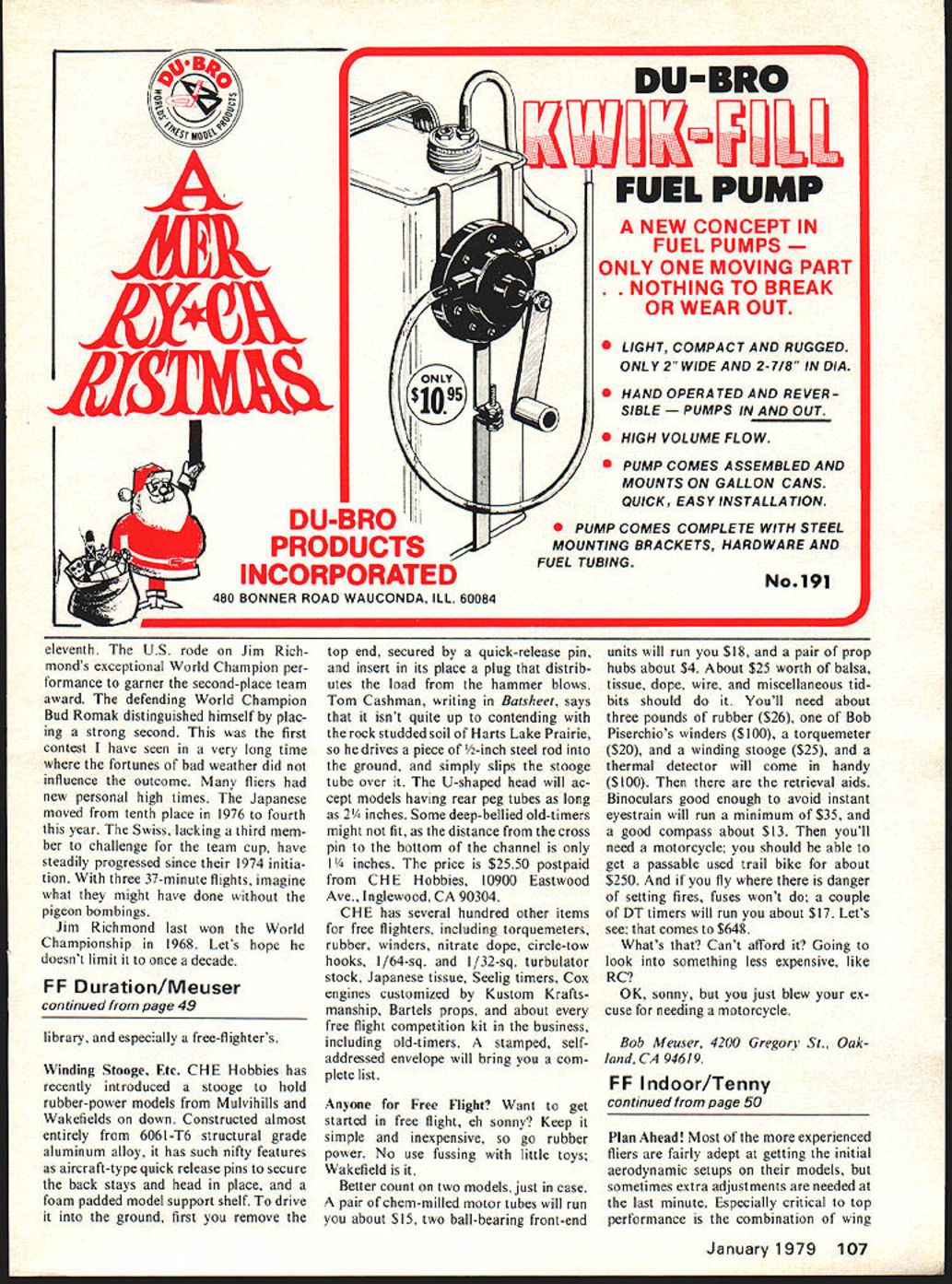
Stan Chilton uses variable incidence in the stabilizer of his models, allowing very fine tuning of flight trim. Stan's setup is doubly useful: the leading edge of his rudder extends through the stabilizer for about 1½ inches and serves as a bracing post as well. A close study shows a tiny paper socket at the end of the tail boom, with the post/leading edge going through the socket. Not only is the tail boom shorter (and therefore lighter), but the stabilizer incidence is easily adjustable.
Take a Close Look!
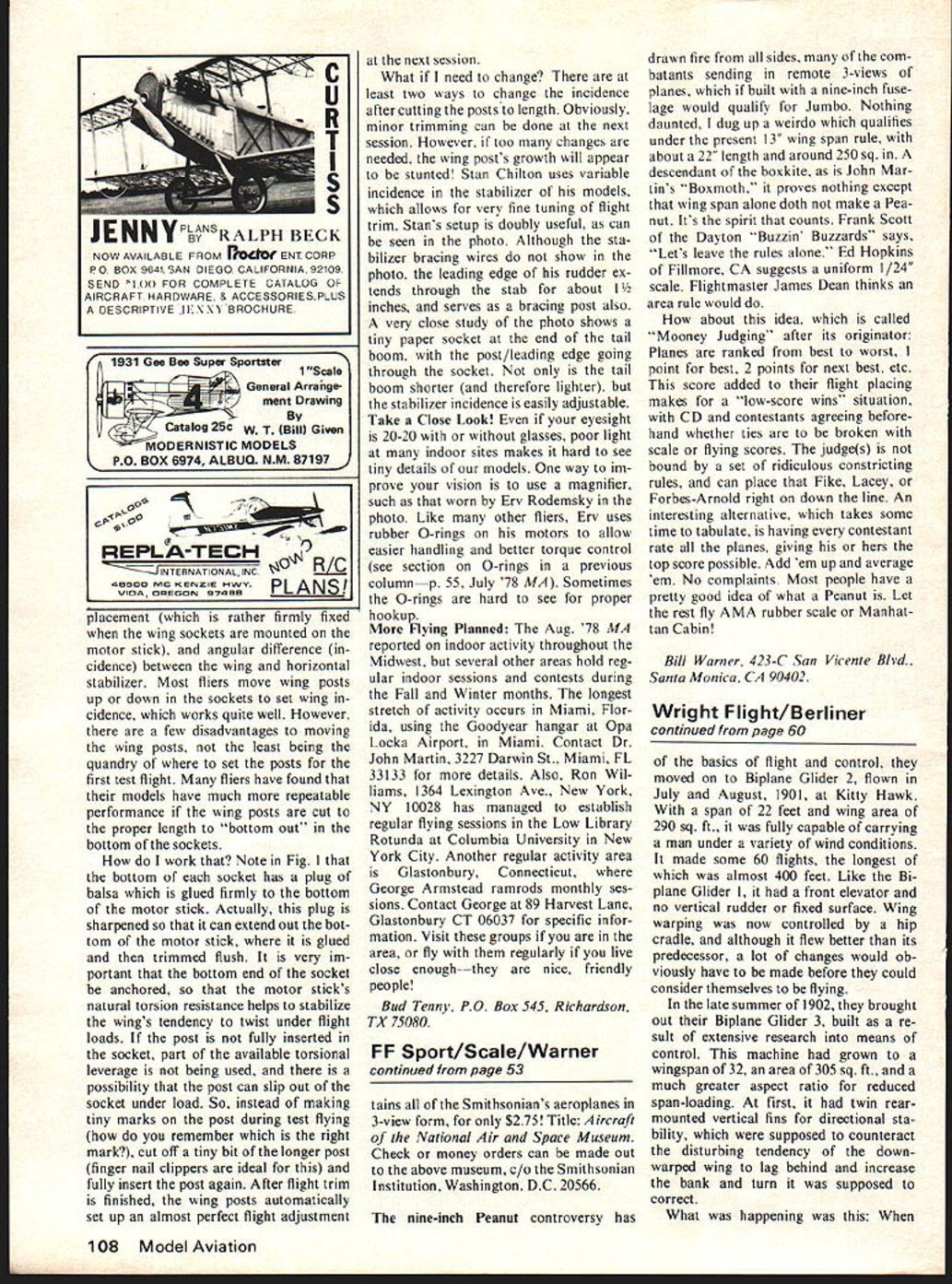
Even if your eyesight is 20/20 with or without glasses, poor light at many indoor sites makes it hard to see tiny details on models. Improve your vision with a magnifier, such as that worn by Erv Rodemsky in the photo. Like many other fliers, Erv uses rubber O-rings on his motors to allow easier handling and better torque control (see the section on O-rings in a previous column — p. 55, July '78 MA). Sometimes the O-rings are hard to see for proper hookup.
More Flying Planned
The Aug. '78 Model Aviation reported on indoor activity throughout the Midwest, but several other areas hold regular indoor sessions and contests during the fall and winter months:
- Miami, Florida — the longest stretch of activity uses the Goodyear hangar at Opa-Locka Airport. Contact Dr. John Martin, 3227 Darwin St., Miami, FL 33133.
- New York City — Ron Williams has established regular flying sessions in the Low Library Rotunda at Columbia University. Contact Ron Williams, 1364 Lexington Ave., New York, NY 10028.
- Glastonbury, Connecticut — George Armstead conducts monthly sessions. Contact George Armstead, 89 Harvest Lane, Glastonbury, CT 06037.
Visit these groups if you are in the area, or fly with them regularly if you live nearby — they are nice, friendly people!
Bud Tenny, P.O. Box 545, Richardson, TX 75080.
Transcribed from original scans by AI. Minor OCR errors may remain.

