
Free Flight: Indoor
Bud Tenny
Feedback is welcome! Jerry Bockius, of Colchester, CT, has gently chided me over a couple of items reported in a past issue about the contests held by George Armstead in Glastonbury, CT. To set the record straight: one of the special classes flown at the Glastonbury meets is Old Timer Gas Scale. Entries in this event are rubber-powered scale replicas of pioneering gas models, but Jerry's point is that the maximum span for the class is 24", not "Peanut Scale" size as reported. Jerry also furnished the winners' names for one recent contest: Bert Bailey's replica Miss America placed first and Royal Moore placed second with the model shown in the photo. No ID was available on the model, so perhaps someone else can identify it?
Jerry Bockius also requested clarification on changeover torque (discussed in the Feb. '77 column). So, let's try it this way:
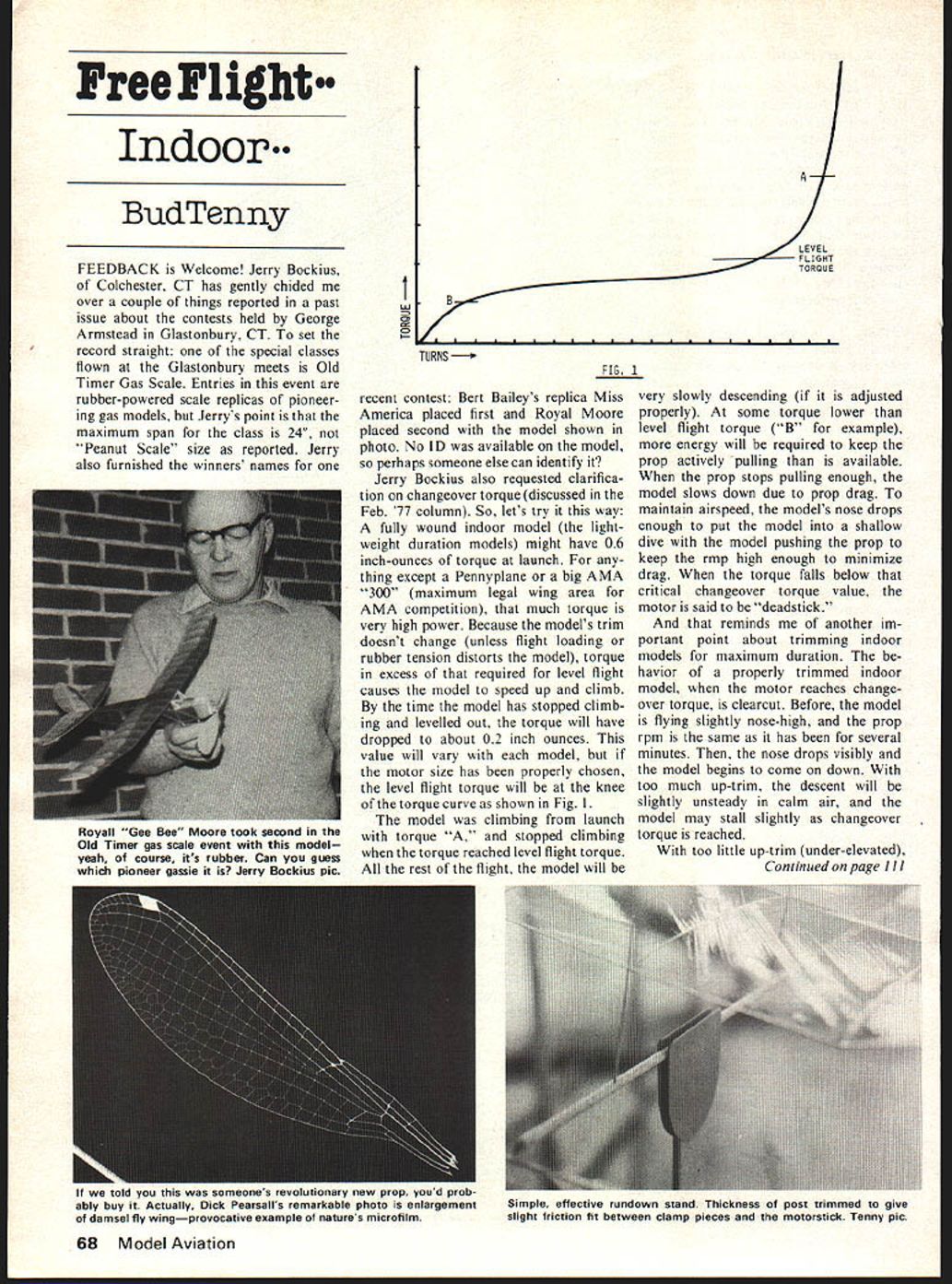
A fully wound indoor model (the lightweight duration models) might have 0.6 inch-ounces of torque at launch. For anything except a Pennyplane or a big AMA "300" (maximum legal wing area for AMA competition), that much torque is very high power. Because the model's trim doesn't change (unless flight loading or rubber tension distorts the model), torque in excess of that required for level flight causes the model to speed up and climb. By the time the model has stopped climbing and leveled out, the torque will have dropped to about 0.2 inch-ounces. This value will vary with each model, but if the motor size has been properly chosen, the level-flight torque will be at the knee of the torque curve as shown in Fig. 1.
The model was climbing from launch with torque "A," and stopped climbing when the torque reached level-flight torque. All the rest of the flight, the model will be very slowly descending (if it is adjusted properly). At some torque lower than level-flight torque ("B," for example), more energy will be required to keep the prop actively pulling than is available. When the prop stops pulling enough, the model slows down due to prop drag. To maintain airspeed, the model's nose drops enough to put the model into a shallow dive with the model pushing the prop to keep the rpm high enough to minimize drag. When the torque falls below that critical changeover torque value, the motor is said to be "deadstick."
That reminds me of another important point about trimming indoor models for maximum duration. The behavior of a properly trimmed indoor model, when the motor reaches changeover torque, is clearcut. Before changeover the model is flying slightly nose-high, and the prop rpm is the same as it has been for several minutes. Then the nose drops visibly and the model begins to come on down. With too much up-trim, the descent will be slightly unsteady in calm air, and the model may stall slightly as changeover torque is reached.
With too little up-trim (under-elevated), the model is a "lead sled" all the way down from level-flight torque, and the average prop rpm will be too high. Practice flying your model until you can recognize under- or over-elevation, and count rpm often enough to know when it is too high. Anyone who has flown much can recount at least one lost trophy because he carelessly ignored the too-high rpm of an under-elevated model, or the more subtle symptoms of over-elevation which rob time by allowing the model to "mush" or settle in a nose-high attitude. (More power is required to keep the model flying, so changeover torque is reached earlier in the flight.)
Nature Does It Better!
The gossamer beauty in the photo is a damsel-fly wing. Richard Pearsall of San Francisco, CA, describes the wing and his photo techniques: "It is of such beautiful structure that I thought you and your readers would like to see how Nature designed a 'microfilm' propeller/wing. The photo was made by placing the wing between two glass slides placed in the head of a photographic enlarger. A piece of F2 paper was then exposed for about three seconds. In real life the wing is about one inch long."
More Chances to Visit and Fly
- Glastonbury, CT
- Location: Glastonbury High School Gym.
- Dates and times: 8 a.m. to 5 p.m. on Feb. 18 and Apr. 22, 1979.
- Events: WW I Peanut combat, WW II combat, Flying Aces Scale, Old Timer Gas Scale, and others.
- Contact: George Armstead, Box 514, Glastonbury, CT 06033.
- Sooner Free Flight Society (Oklahoma City area)
- Location: National Guard Armory, 200 NE 23rd St., Oklahoma City, OK.
- Winter meets: Jan. 21, Feb. 18, and Mar. 18, 1979; 9 a.m. to 5 p.m.
- Events: HLG, Pennyplane, Easy B, Peanut Scale, and AMA Scale.
- Contacts: Al Bissonette, 6238 SE 15th, Midwest City, OK 73110; or Bob Leffler, 1143A Biloxi, Norman, OK 73071.
- Dallas, TX
- Location: Harry Stone Recreation Center, Ferguson & Milam, Dallas, TX.
- Schedule: 1 p.m. to 5 p.m. on the second Saturday each month.
- Common activities: HLG, Easy B, Pennyplane, and scale models.
Bud Tenny, P.O. Box 545, Richardson, TX 75080.
Transcribed from original scans by AI. Minor OCR errors may remain.

