
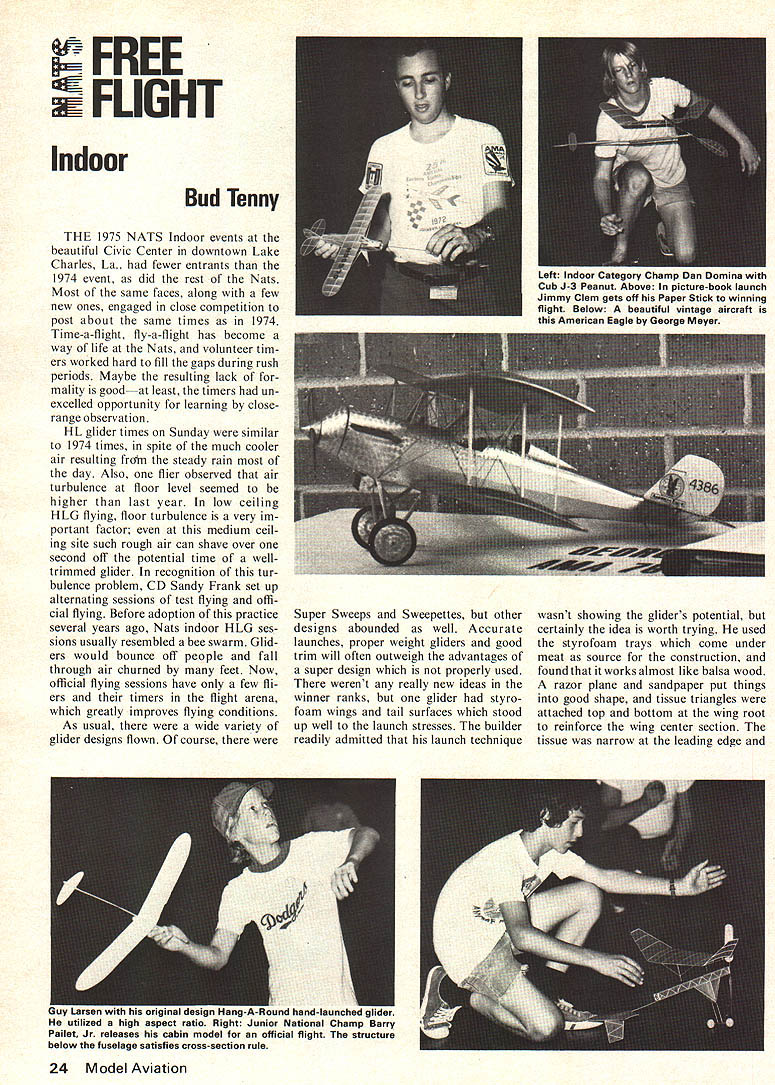
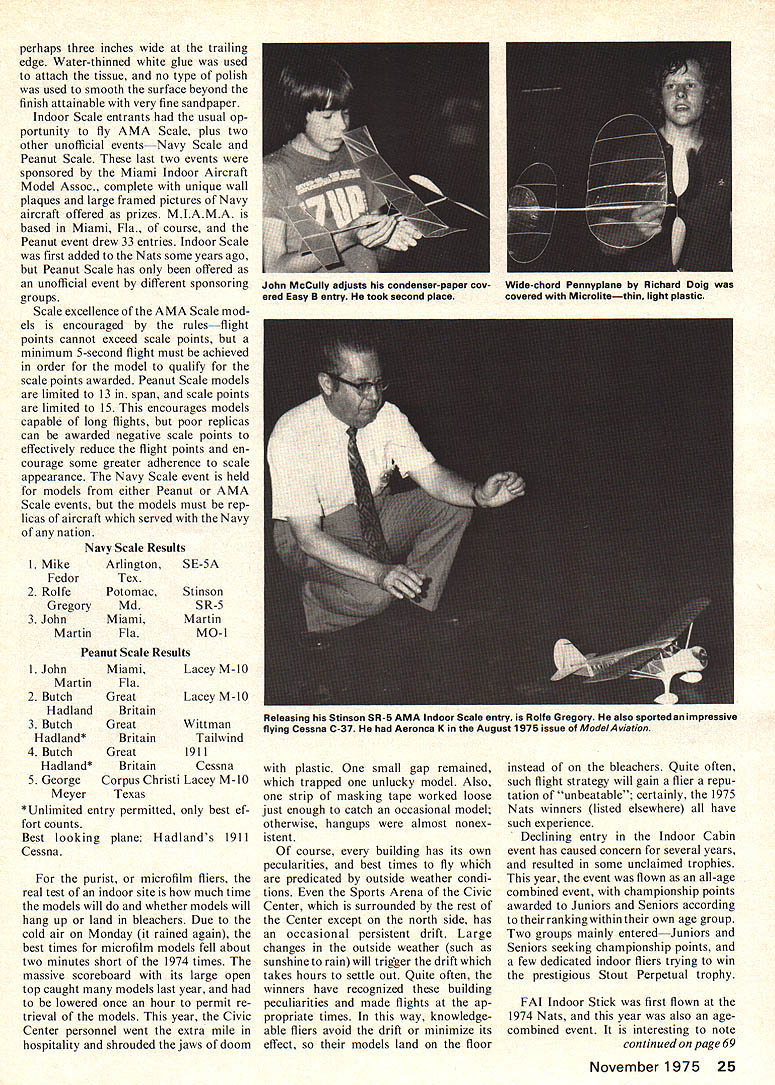
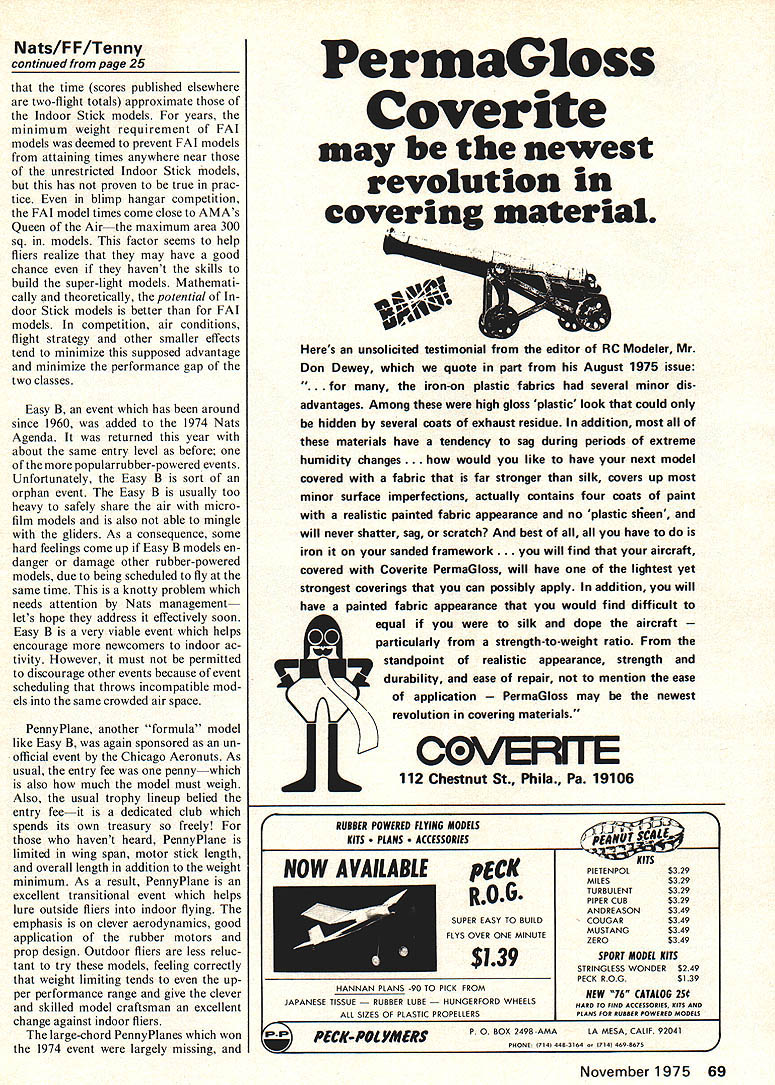
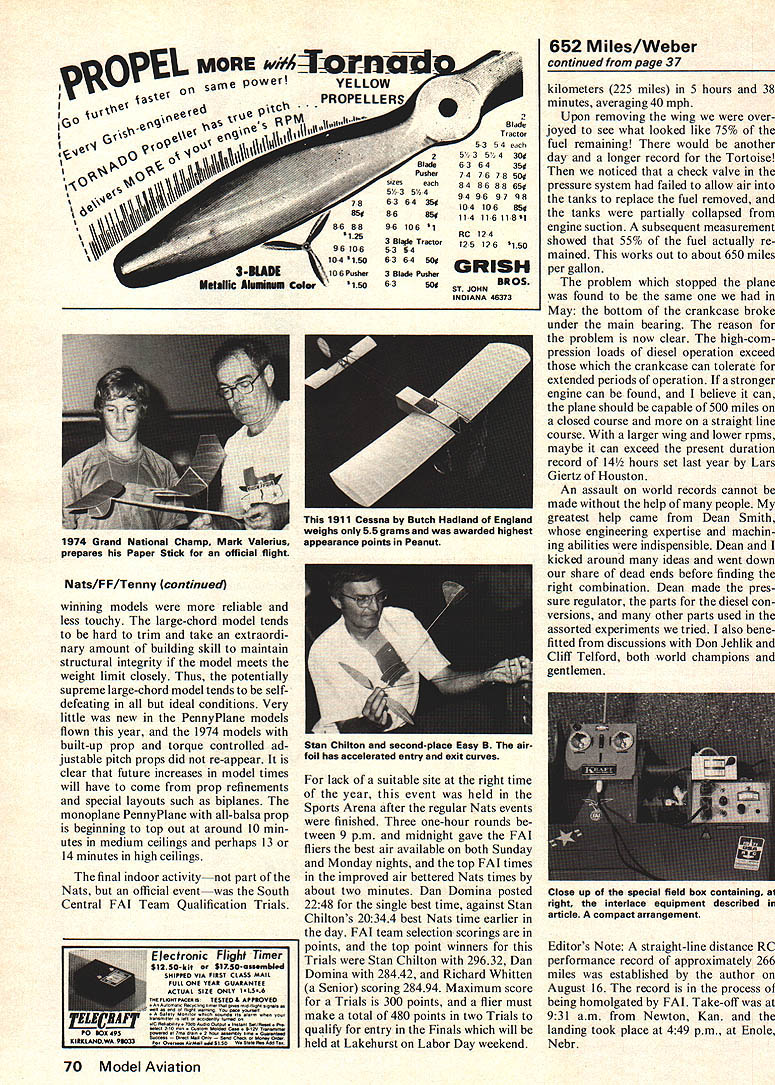
Free Flight: Indoor
Bud Tenny
THE 1975 NATS Indoor events at the beautiful Civic Center in downtown Lake Charles, La., had fewer entrants than the 1974 event, as did the rest of the Nats. Most of the same faces, along with a few new ones, engaged in close competition to post about the same times as in 1974. Time-a-flight, fly-a-flight has become a way of life at the Nats, and volunteer timers worked hard to fill the gaps during rush periods. Maybe the resulting lack of formality is good—at least, the timers had an unexcelled opportunity for learning by close-range observation.
HL glider times on Sunday were similar to 1974 times, in spite of the much cooler air resulting from the steady rain most of the day. Also, one flier observed that air turbulence at floor level seemed to be higher than last year. In low-ceiling HLG flying, floor turbulence is a very important factor; even at this medium-ceiling site such rough air can shave over one second off the potential time of a well-trimmed glider. In recognition of this turbulence problem, CD Sandy Frank set up alternating sessions of test flying and official flying. Before adoption of this practice several years ago, Nats indoor HLG sessions usually resembled a bee swarm. Gliders would bounce off people and fall through air churned by many feet. Now, official flying sessions have only a few fliers and their timers in the flight arena, which greatly improves flying conditions.
As usual, there were a wide variety of glider designs flown. Of course, there were Super Sweeps and Sweepettes, but other designs abounded as well. Accurate launches, proper weight gliders and good trim will often outweigh the advantages of a super design which is not properly used. There weren't any really new ideas in the winner ranks, but one glider had styrofoam wings and tail surfaces which stood up well to the launch stresses. The builder readily admitted that his launch technique wasn't showing the glider's potential, but certainly the idea is worth trying. He used the styrofoam trays which come under meat as a source for the construction, and found that it works almost like balsa wood. A razor plane and sandpaper put things into good shape, and tissue triangles were attached top and bottom at the wing root to reinforce the wing center section. The tissue was narrow at the leading edge.
Indoor Scale entrants had the usual opportunity to fly AMA Scale plus two other unofficial events—Navy Scale and Peanut Scale. The last two events were sponsored by the Miami Indoor Aircraft Model Assoc., complete with unique wall plaques and large framed pictures. Navy aircraft offered prizes. MIAMA is based in Miami, Fla. The Peanut event drew 33 entries.
Indoor Scale was first added to the Nats some years ago. Peanut Scale has offered an unofficial event under different sponsoring groups. Scale excellence is encouraged—AMA Scale models are encouraged; under the rules flight points cannot exceed scale points. A minimum 5-second flight must be achieved in order for the model to qualify. Scale points are awarded. Peanut Scale models are limited to a 13-inch span; scale points are limited to 15. This encourages models capable of long flights. Poor replicas can be awarded negative scale points, effectively reducing flight points and encouraging greater adherence to scale appearance. Navy Scale events were held for models either Peanut or AMA Scale; models must be replicas of aircraft that served in the Navy.
Navy Scale Results
- Mike Fedor, Arlington, Tex. — SE-5A
- Rolfe Gregory, Potomac, Md. — Stinson SR-5
- John Martin, Miami, Fla. — Martin MO-1
Peanut Scale Results
- John Martin, Miami — Lacey M-10
- Butch Hadland, Great Britain — Lacey M-10
- Butch Hadland, Great Britain — Wittman Tailwind
- Butch Hadland, Great Britain — 1911 Cessna
- George Meyer, Corpus Christi, Tex. — Lacey M-10
*Unlimited entry permitted; only best effort counts.*
Best looking plane: Hadland's 1911 Cessna.
For the purist, or microfilm fliers, the real test of an indoor site is how much time the models will do and whether models will hang up or land in bleachers. Due to the cold air on Monday (it rained again), the best times for microfilm models fell about two minutes short of the 1974 times. The massive scoreboard with its large open top caught many models last year, and had to be lowered once an hour to permit retrieval of the models. This year, the Civic Center personnel went the extra mile in hospitality and shrouded the jaws of doom with plastic. One small gap remained, which trapped one unlucky model. Also, one strip of masking tape worked loose just enough to catch an occasional model; otherwise, hangups were almost non-existent.
Of course, every building has its own peculiarities, and best times to fly which are predated by outside weather conditions. Even the Sports Arena of the Civic Center, which is surrounded by the rest of the Center except on the north side, has an occasional persistent drift. Large changes in the outside weather (such as sunshine to rain) will trigger the drift which takes hours to settle out. Quite often, the winners have recognized these building peculiarities and made flights at the appropriate times. In this way, knowledgeable fliers avoid the drift or minimize its effect, so their models land on the floor instead of on the bleachers. Quite often, such flight strategy will gain a fair reputation of "unbeatable"; certainly, the 1975 Nats winners (listed elsewhere) all have such experience.
Declining entry in the Indoor Cabin event has caused concern for several years, and resulted in some unclaimed trophies. This year, the event was flown as an all-age combined event, and resulted in some unclaimed trophies. The combined event, with 5-championship points awarded to Juniors and Seniors according to their ranking within their own age group. Two groups mainly entered—Juniors and Seniors seeking championship points, and a few dedicated indoor fliers trying to win the prestigious Stout Perpetual trophy.
FAI Indoor Stick was first flown at the 1974 Nats, and this year was also an age-combined event. Easy B, an event which has been around since 1960, was added to the 1974 Nats agenda. It was returned this year with about the same entry level as before: one of the more popular rubber-powered events. Unfortunately, the Easy B is sort of an orphan event. The Easy B is usually too heavy to safely share the air with microfilm models and is also not able to mingle with the gliders. As a consequence, some hard feelings come up if Easy B models endanger or damage other rubber-powered models, due to being scheduled to fly at the same time. This is a knotty problem which needs attention by Nats management—let's hope they address it effectively soon. Easy B is a very viable event which helps encourage more newcomers to indoor activity. However, it must not be permitted to discourage other events because of event scheduling that throws incompatible models into the same crowded air space.
PennyPlane, another "formula" model like Easy B, was again sponsored as an unofficial event by the Chicago Aeronuts. As usual, the entry fee was one penny—which is also how much the model must weigh. Also, the usual trophy lineup belied the entry fee—it is a dedicated club which spends its own treasury so freely! For those who haven't heard, PennyPlane is limited in wingspan, motor stick length, and overall length in addition to the weight minimum. As a result, PennyPlane is an excellent transitional event which helps lure outside fliers into indoor flying. The emphasis is on clever aerodynamics, good application of the rubber motors and prop design. Outdoor fliers are less reluctant to try these models, feeling correctly that weight limiting tends to even the upper performance range and give the clever and skilled model craftsman an excellent chance against indoor fliers.
The large-chord PennyPlanes which won the 1974 event were largely missing, and the 1975 Nats indoor events were held at the beautiful Civic Center in downtown Lake Charles, La. There were fewer entrants than the 1974 event, but the rest of the Nats was about the same. Most of the same faces, along with a few new ones, engaged in close competition. Times were about the same as 1974. Time-a-flight (fly-a-flight) has become a way of life. Nats volunteer timers worked hard to fill gaps during rush periods. Maybe the resulting lack of formality was good; at least timers had an excellent opportunity for learning close-range observation.
HLG and glider times Sunday were similar to 1974 times despite much cooler air resulting from steady rain that day. Also, fliers observed that air turbulence at floor level seemed higher than last year when the ceiling was low. In HLG flying, floor turbulence is a very important factor; at a medium-ceiling site such rough air can shave over a second off the potential time of a well-trimmed glider. Recognition of turbulence problems led CD Sandy Frank to set up alternating sessions—test flying and official flying. Before adoption of this practice several years ago, Nats indoor HLG sessions usually resembled a bee swarm. Gliders would bounce off people and fall through air churned by feet. Now official flying sessions have fewer fliers and timers, and the flight arena greatly improves flying conditions.
As usual, a wide variety of glider designs were flown. Super-Sweeps, Sweepettes and other designs abounded. Accurate launches, proper-weight gliders and good trim will often outweigh the advantages of a "super" design if not properly used. A glider with styrofoam wings and tail surfaces stood up well to launch stresses; the builder readily admitted his launch technique wasn't showing the glider's potential. Certainly the idea is worth trying. Styrofoam trays (the common meat trays) were cited as a source of construction material and were found to work almost like balsa. A razor plane and sandpaper put things in good shape. Tissue triangles attached to the top and bottom of the wing root reinforce the wing center section; a strip of tissue along the narrow leading edge was also used.
Indoor Scale entrants had the usual opportunity to fly AMA Scale plus two other unofficial events—Navy Scale and Peanut Scale. The last two events were sponsored by the Miami Indoor Aircraft Model Assoc., complete with unique wall plaques and large framed pictures; Navy aircraft offered prizes. MIAMA (based Miami, Fla.) ran the Peanut event, which drew 33 entries. Indoor Scale was first added to the Nats some years ago. Peanut Scale has been an unofficial event run by different sponsoring groups. Scale excellence in AMA Scale models is encouraged; rules state that flight points cannot exceed scale points. A minimum 5-second flight must be achieved in order for a model to qualify; scale points are then awarded. Peanut Scale models are limited to 13" span and scale points are limited to 15, encouraging models capable of long flights. Poor replicas can be awarded negative scale points, effectively reducing flight points and encouraging greater adherence to scale appearance. The Navy Scale event was held for models entered either in Peanut or AMA Scale events; models must replicate aircraft that served the Navy of any nation.
Navy Scale Results 1 Mike Arlington SE-SA Fedor, Tex. 2 Rolfe Potomac Stinson Gregory, Md. 3 John Miami Martin, Martin, Fla.
Peanut Scale Results 1 John Miami, Lacey M-10, Martin 2 Butch Great, Lacey M-10, Hadland 3 Butch Great, Wittman Hadland, Tailwind 4 Butch Great, 1911 Hadland, Cessna 5 George Corpus Christi, Lacey M-10, Meyer, Texas
*Unlimited entry permitted; best effort counts. Best-looking plane: Hadland's 1911 Cessna.
For purist microfilm fliers the real test of an indoor site is whether models will hang up or land on the bleachers. Due to cold air Monday and renewed rain, the best times for microfilm models fell about two minutes short of 1974 times. The massive scoreboard, with its large open top, caught models... winning models were more reliable and less touchy. The large-chord model tends to be hard to trim and take an extraordinary amount of building skill to maintain structural integrity if the model meets the weight limit closely. Thus, the potentially supreme large-chord model tends to be self-defeating in all but ideal conditions. Very little was new in the PennyPlane models flown this year, and the 1974 models with built-up prop and torque controlled adjustable pitch props did not re-appear. It is clear that future increases in model times will have to come from prop refinements and special layouts such as biplanes. The monoplane PennyPlane with all-balsa prop is beginning to top out at around 10 minutes in medium ceilings and perhaps 13 or 14 minutes in high ceilings.
The final indoor activity—not part of the Nats, but an official event—was the South Central FAI Team Qualification Trials.
For lack of a suitable site at the right time of the year, this event was held in the Sports Arena after the regular Nats events were finished. Three one-hour rounds between 9 p.m. and midnight gave the FAI fliers the best air available on both Sunday and Monday nights, and the top FAI times in the improved air bettered Nats times by about two minutes. Dan Domina posted 22:48 for the single best time, against Stan Chilton's 20:34 best Nats time earlier in the day. FAI team selection scorings are in points, and the top point winners for this Trials were Stan Chilton with 296.32, Dan Domina with 284.42, and Richard Whitten (a Senior) scoring 284.94. Maximum score for a Trials is 300 points, and a flier must make a total of 480 points in two Trials to qualify for entry in the Finals which will be held at Lakehurst on Labor Day weekend.
Transcribed from original scans by AI. Minor OCR errors may remain.

