
Free Flight: Indoor
Bud Tenny
Introduction
Don Abbott, of Stillwater, Oklahoma, questioned whether the dimensions shown on some indoor model plans were really what builders used. To quote Don: "It is hard for me to visualize being able to cut (and measure) balsa that precisely." Don referred to spars specified as tapered from .060" sq. to .030" sq., and wing ribs dimensioned at .030" x .020" cross-section.
Yes, it really can be done. Many of the old-timers routinely cut spars to the dimensions they specified on their plan sheets, often working "by eye" to achieve these results. It takes practice.
Cutting spars — simple and tapered
A simple spar, with no taper, can be cut using a straightedge and a sharp knife. To make a spar with a simple taper (the piece is tapered in width, with the other side of the strip uniform in thickness) requires practice in two areas: proper cutting technique and positioning the straightedge.
Four items should be stressed in this procedure:
- The straightedge must be held firmly in the exact position required to make the desired-size spar. (Note that the straightedge is no longer parallel to the edge of the balsa sheet but is canted to produce the desired amount of taper.)
- The knife blade must be very sharp.
- Make the cut as a series of two or three light cuts instead of attempting one mighty slash.
- The flat part of the blade must be parallel to the straightedge.
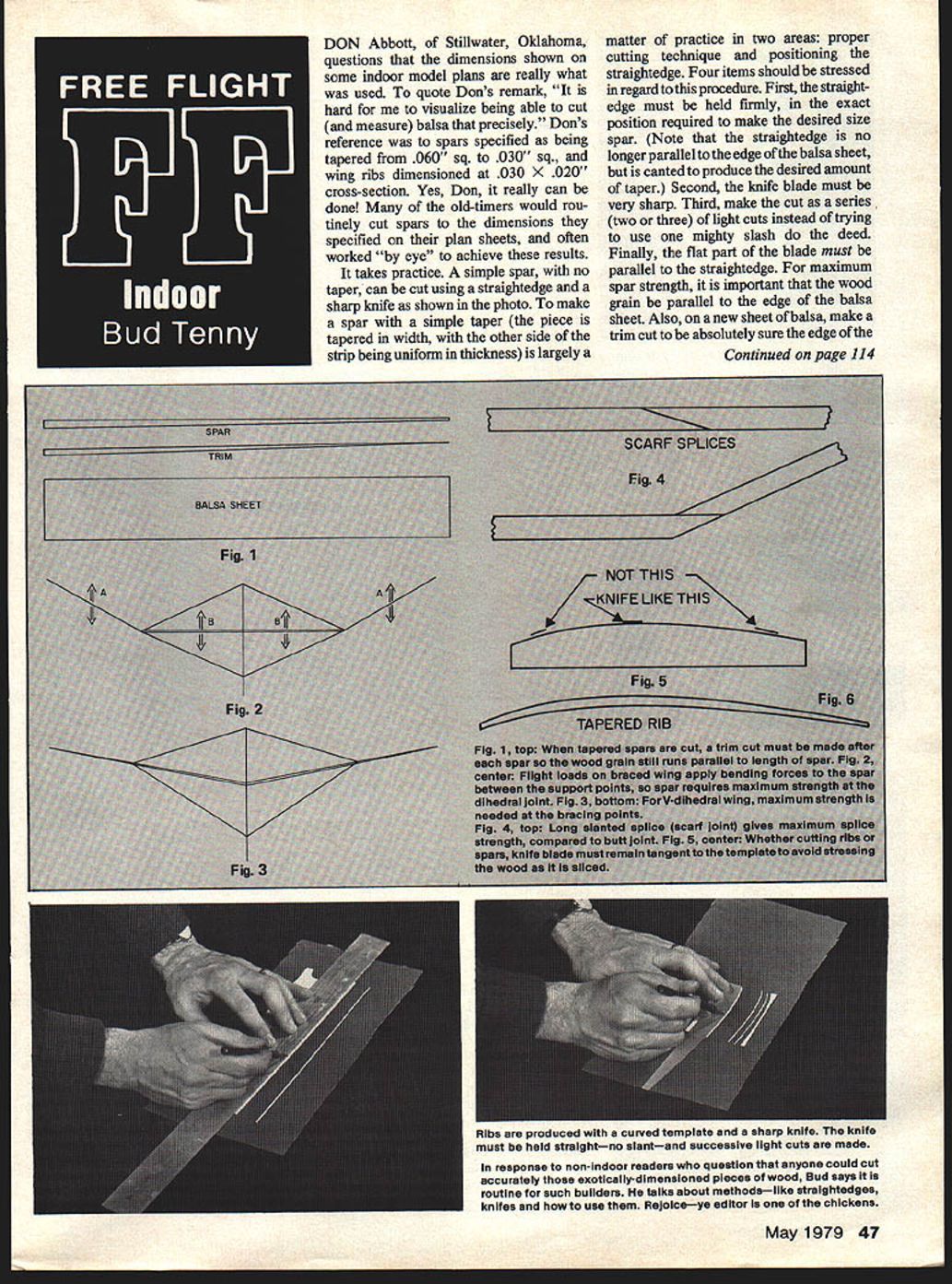
For maximum spar strength, the wood grain should be parallel to the edge of the balsa sheet. On a new sheet of balsa, make a trim cut to be absolutely sure the sheet edge is straight. Make the sheet as straight as possible; otherwise, the spar you cut will be tapered in a way you didn’t intend. After one spar is cut, the edge is no longer parallel to the grain, so cut another tapered piece (Fig. 1) to even up the sheet before cutting the next spar.
Double taper is harder. The double-tapered spar is achieved in two steps. First, the sheet of balsa is painstakingly sanded to the proper taper along its entire length. Then the second taper is created by cutting a tapered piece from the tapered sheet just as with the simpler spars. Don’t forget to "even-up" the sheet between spar cuts to keep the grain parallel to the length of the spar.
Many present-day fliers feel the double-tapered spar is not necessary except for prop spars. Their approach assumes that up- and down-loads on the wing and stabilizer represent the maximum stress conditions, so spar thickness (front to back) and spar weight can be minimized. This seems true except in collisions and steering.
Braced wings and spar loading
Before indoor models were braced, the wing spars supported the entire flight stress, and the point of maximum stress was at the junction between the wing post and wing spar. Spar loading then decreased toward the wing tips, with spars tapering from a maximum at the wing post to a minimum at the tip.
For braced wings: since the cabane and bracing wires transfer much of the flight loads directly to the wing post, the wing spar is supported at three points. Only flight loads between these support points (A and B in Fig. 2) can cause spar stress. Consequently, the strongest points on the wing should be at the dihedral joint (or at the bracing point if a simple dihedral is used, see Fig. 3). Therefore, the spar needs to be tapered smaller in both directions away from the support points.
A common compromise is to make the spar the same depth between wing post and support point and taper toward the tips. It is easier to make each such wing spar in four pieces—two pieces between wing post and dihedral joint, and one piece for each tip. The proper splice to use is a long slanted splice (scarf joint), which gives maximum splice strength compared to a butt joint (Fig. 4). This is shown for both straight spars and for a dihedral joint.
Measuring balsa
Once the spars are cut, measure them like any other structural member of similar size — use a machinist’s micrometer caliper or a dial indicator caliper. Use a delicate touch to avoid crushing the spar. One method to get the right thickness is to slowly close the calipers while moving the wood back and forth between the jaws; as soon as some drag is felt on the wood, take a reading. With practice, you can make very repeatable measurements.
Cutting ribs
Ribs are produced with a curved template and a sharp knife. The knife must be held straight—no slant—and successive light cuts are made. The blade should remain tangent to the template curve (Fig. 5). If this is not observed, the pressure of the cutting will often stress the rib and change the curvature.
Ribs can be tapered. The maximum stress is usually in the center of the rib, so logically the rib should be wider in the center. This can be accomplished by using two templates (Fig. 6) with different degrees of curvature. The major use for such extremes is on wide wing chords of FAI Indoor models, where weight saving is relatively more important than on smaller models.
Practical notes and encouragement
In response to non-indoor readers who question that anyone could cut such exotically dimensioned pieces of wood, Bud says it is routine for such builders. He talks about methods—like straightedges and knives and how to use them. Rejoice—ye editor is one of the chickens.
Many happy crashes.
Learning maneuvers: wingover, loop, inverted flight
To learn to loop:
- First learn the wingover. Wait until the wind is at the tail of the plane (to help maintain line tension during the maneuver), then pull up into a climb. Neutralize and let the plane continue to fly across the circle until it dives across the other side; then pull out (up). Practice the wingover until you can get it right over your head and make your pull-out at the same height as you entered the maneuver.
- Now try a loop. Do another wingover, but this time do not turn with the airplane. That was a loop. Tighten the loops gradually.
Notes on looping:
- Each loop adds a turn of twist into the lines. After six or eight loops, the controls will become stiff. Always unwind these twists after each flight.
- To perform consecutive loops, relax the up control each time the plane is climbing vertically. Gravity tends to pull each loop lower and you must adjust for this.
Once you can fly precise altitudes, do crisp wingovers and consecutive loops, you are already an accomplished pilot. If you want to get into stunt flying, combat, or master any stunt your plane is capable of, the greatest challenge of control-line flying is learning to fly inverted.
The challenge of learning to fly inverted has defeated many fliers because the controls are reversed when inverted (down is up and up is down). The traditional method—doing a half loop and then flying inverted—often exposes the beginner to slow flight and poor line tension, leading to failures.
A better method: memorize the sentence "If I get into trouble, pull full down." When you have that memorized you are ready to try inverted flight.
- Begin with a wingover. When the plane is overhead, pull down. You will come out flying inverted fast and with good line tension. You may panic and pull down immediately, but you will come back out flying right side up. Keep stretching the length of your inverted flights. It won’t be long until you can fly many laps inverted and then work on holding precise altitudes.
Once you have mastered inverted flight, the entire control-line hemisphere is open to you. The AMA rule book lists stunts used in competition that present good challenges. But once you learn to fly inverted, everything else is easier.
Contests coming
Indoor activity varies by area—some have monthly contests, others only major meets. Monthly activity often serves as warm-up for a big contest before the outdoor season.
Upcoming (announced in 1979):
- Tullahoma, Alabama: contest at Motlow College on April 1, 1979. Announcement appeared in FFFLIAR, a newsletter by Bill Mathews. Contact: Bill Mathews, 311 Poinciana Drive, Birmingham, AL 35209, ph. 879-5550.
- Chicago area: 6th Annual Midwestern States Indoor Free Flight Championships, April 21–22, 1979, Madison St. Armory, 9 a.m.–5 p.m. both days. Events:
- Saturday, April 21: Paper Stick, Indoor Stick, Indoor Cabin, FAI Indoor
- Sunday, April 22: HLG, Pennyplane, Novice PP, Manhattan Cabin, Peanut Scale, AMA Scale
Trophies will be given to third place, plus perpetual trophy cups for high point champions in each age class. The Wally Simmers Cup is awarded for high time in HLG, regardless of age. Contact: Chuck Markos, 1106 Montgomery Dr., Deerfield, IL, ph. (312) 945-9225 (listed as (321) in the announcement).
Bud Tenny, P.O. Box 545, Richardson, TX 75080.
Transcribed from original scans by AI. Minor OCR errors may remain.

