
FREE FLIGHT INDOOR
Bud Tenny
Box 830545, Richardson TX 75083
SCIENCE OLYMPIAD at the USIC
There will be a Science Olympiad (SO) competition at the 2001 US Indoor Championships (USIC). This will expose SO participants to our activities and perhaps result in some recruits for the AMA.
Tom Sanders of Midwest Products Co., Inc. will issue invitations to SO coaches, who will select the contestants.
Many helpers are needed for timing and other chores associated with the competition. All USIC entrants are invited to help. Those who do help will get a great deal of satisfaction and will learn things about modeling they never expected.
Junior Indoor Fliers
Up-and-coming junior indoor fliers in the Atlanta, GA area have the good fortune to be able to watch Parker Parrish develop his skills.
Parker flew in Cat. II record trials in November 2000 and posted times for five records that are now being homologated. These times are:
- 4:59 in MiniStick, flying a copy of Stan Chilton’s new MiniStick design (UFO).
- 7:50 in F1D Stick, with a copy of Darryl Stevens’ DRS 55 cm F1D.
- 10:45 in Easy B and Intermediate Stick, with a 0.6-gram copy of Larry Coslick’s 1992 USIC Easy B winner.
- 7:58 in Indoor Stick, again with the DRS 55 cm F1D (still flying with a 0.58-gram motor).
John Barker and others in the Atlanta area, please keep us up to date on Parker!
Web Site Reminders
Glenn Davison maintains a web site about indoor model airplanes at http://people.ne.mediaone.net/indoor/. This page has a lot of information about indoor aircraft in the US and around the world. Visit this site.
If you’re not already on the Indoor List, send your e-mail address to rten@metronet.com to receive any late-breaking news I receive.
Tim Goldstein has a very informative indoor page at http://indoorduration.com. His site concentrates on Easy B and F1D.
Electric Free Flight
At the start of the rules cycle that finishes December 31, 2001, Bob Wilder submitted a proposal that encourages development of electric-powered indoor free flight (FF) duration models. Beginning January 1, 2002, the event will be open for competition and eligible for national records.
Now is the time to develop your models so you can grab the record early in 2002! The model specifications are simple: the power can be no more than two nickel-cadmium 50 mA cells and the model must weigh no more than one ounce. There are no other restrictions or requirements.
From Indoor News and Views
“A Junior’s Analysis of the Junior Problem” — Nick Leonard Jr.
“One growing problem that has for years been looming is the lack of juniors flying indoor. Juniors have not completely disappeared from the scene. There is a group of them from the town of Smyrna [TN] that flies at Johnson City every year.
“This is a great program that has really brought much good to USIC. However, outside of this group there are perhaps five juniors in the US actively flying indoor. From what I have heard, at one point many years ago hundreds of people (and many juniors) would attend the indoor Nationals. What has happened to these hordes?
“I have much first-hand experience with those in my age group. In fact, I live with nearly forty of them during the school year. This contact has answered the question above very clearly. To answer it within a reasonable length, we should first define what an indoor flier has, rather than doesn’t have.
“Now, I will use F1D as the example here because I know more about them than other classes. Also, F1D is indoor carried out to the farthest point; the most extreme and therefore the best for illustrating my point.
“Personal properties: An F1D flier needs to have his wits about him. He needs to have extreme motor control in the hands. He must be accurate and motivated. He needs to be a bit of a perfectionist. He must be very patient. He must have a fairly long-term view of things; a long interest can firmly be on building and flying. I believe he must enjoy what he does.
“This is a moderately long list of requirements, but some of these are developed over time. This is where my observations bring the problem to light. Most American male teenagers are by nature rebellious. Many are more destructive than constructive. Laziness, lethargy, and video games plague nearly all.
“They generally have short-term goals and constantly need action or some sort of interest booster. Many despise school and thinking in general. Noise is a must. I had the ‘privilege’ of attending my first ‘dance party’ this last year, and it was ugly once more.
“An oppressively hot and humid atmosphere in the dark with bright lights flashing everywhere, all while being serenaded by what I can only describe as a sickening screeching excuse for music. But no one else thought this was bad. In fact, many rated it among the best they had attended.
“If this is a good time, then you have to admit taking the gym from an F1D prop at 100 feet inside the silent ETSU (East Tennessee State University) mini-drome while discussing a balance problem between the blades of your prop is worse than death.
“There is some evidence that the above characteristics are a large part of the cause. Teens of third-world countries are much closer in values to their American counterparts. They may have cleaner ideas of the value of actions. They certainly are not plagued by the curse of Nintendo.
“That may account for the fact in the last World Champs there was only one junior from west of Poland and why Romania has a full team of juniors competing for the three spots on their world team.
“However, there are still some American candidates left in the running. ‘Nerds’ like myself mostly. The development of a junior flier—there is a large and complete set of well-to-do candidates waiting to be introduced to the real problem areas.
“It is extremely difficult for a lone junior to accomplish much at all. A supporter, preferably a model builder, needs to be present. Whether it is a father, a friend, or a local flier, this position is critical. Indoor is not intuitive at all—a person needs to be shown the ropes, or at least have someone to muddle them out with.
“This is where we may lose almost all. Nearly all advanced juniors have some ‘partner’ that flies with them. I am extremely fortunate to have my father. The point is, a junior needs to have peers (or people) to cover and fly with.
“By answering the above question I have only defined the problem. Logically, one would next ask, ‘How can we solve this problem?’ This I cannot claim to have the answer to. In reality I do not even know if there is a solution to it.
“Indoor, and F1D in particular, is so difficult and time consuming that it takes a very rare combination of traits and chance. American junior F1D flying may be perpetually limited to very few, very remarkable juniors.
“I've lost track of who sent the following, but it touched me. Who will claim it?
“Do you remember? Have you ever collected tales of what pushed us over the edge into modeling? When I was about ten, there were no — repeat, no — hobby shops in my area of upstate N.Y., maybe N.Y. City.
“When we went to our big shopping town, Auburn, N.Y., there was a department store that had a hobby department. In those days, 25 cents was a lot of money for a kid. I had saved up a quarter and I bought a Whitman kit of a WACO D, which was the one with the flexible gun in the rear cockpit for sale to banana republics.
“In those days, the glue was in the kit — a little tube, and a glass vial with color in both ends holding banana oil. I built the airplane and used the banana oil to cover it. The banana oil dissolved the glue and it slumped into a pile of sticks. I cried for a week or two, but then came the real deciding moment.
“I saved up another quarter, and we went to Auburn and I bought the same kit again. Just stubborn and dumb, I guess. The time I asked questions about covering and got told about muffing I finished it and covered it, and I found it was beautiful to me! It would fly the length of the front porch! The decisive moment...
“My great experience happened after I built a JASCO R/C off-ground model. It took off the front porch with the light breeze about a tenth of the length of the porch, and gained a few feet of altitude. As the burst decayed, the model lost headway and altitude, and finally landed just behind the tail of the front porch. After that, I removed the wheels and hand-launched it hundreds of times. I was hooked.”
A Look at the Past — Who Are They?
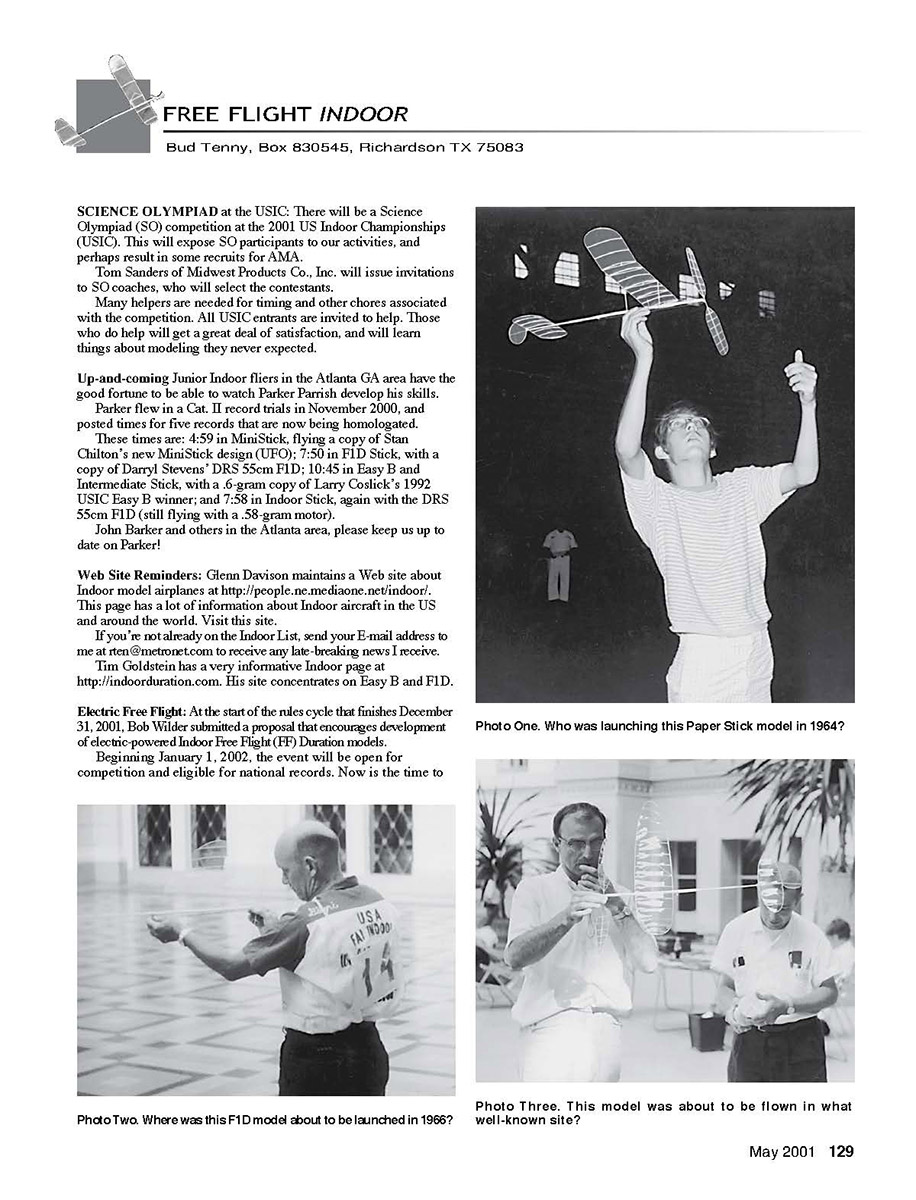
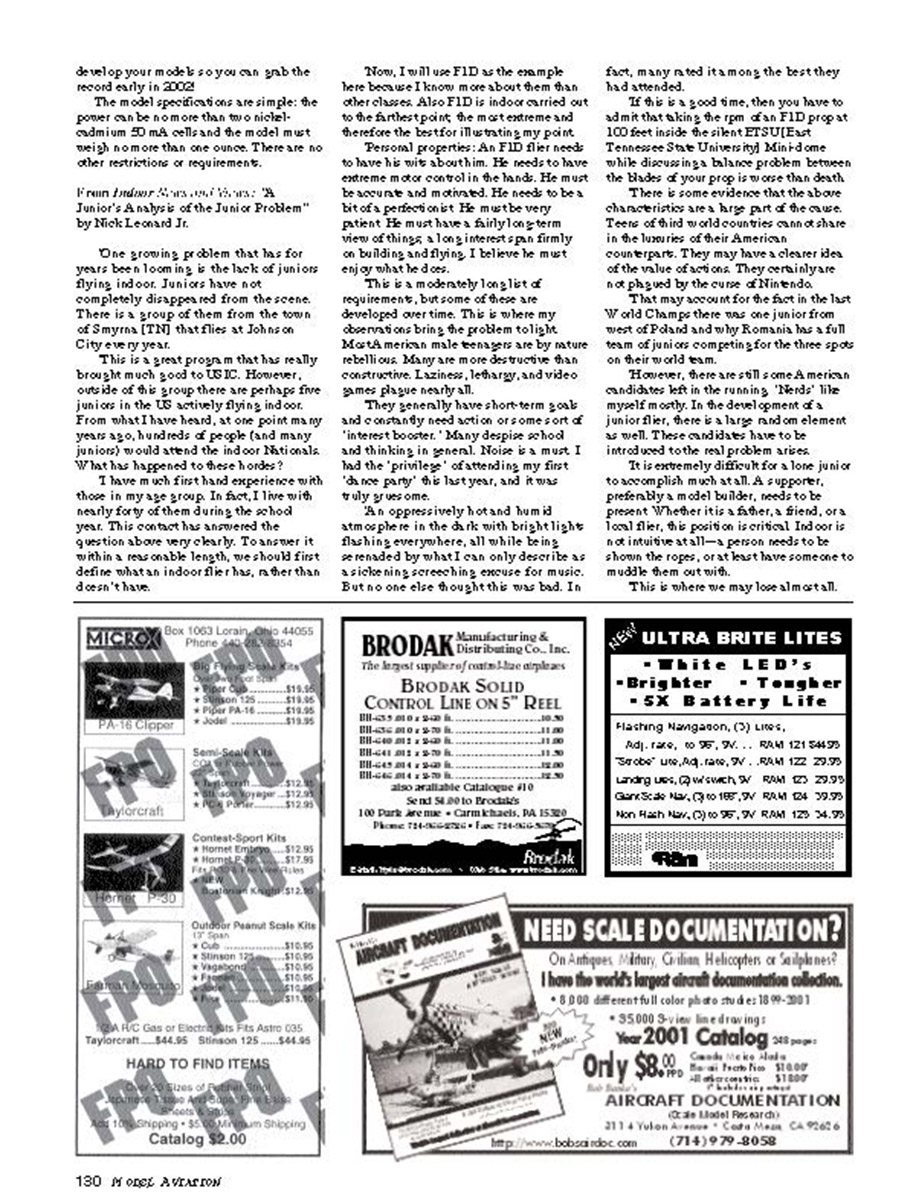
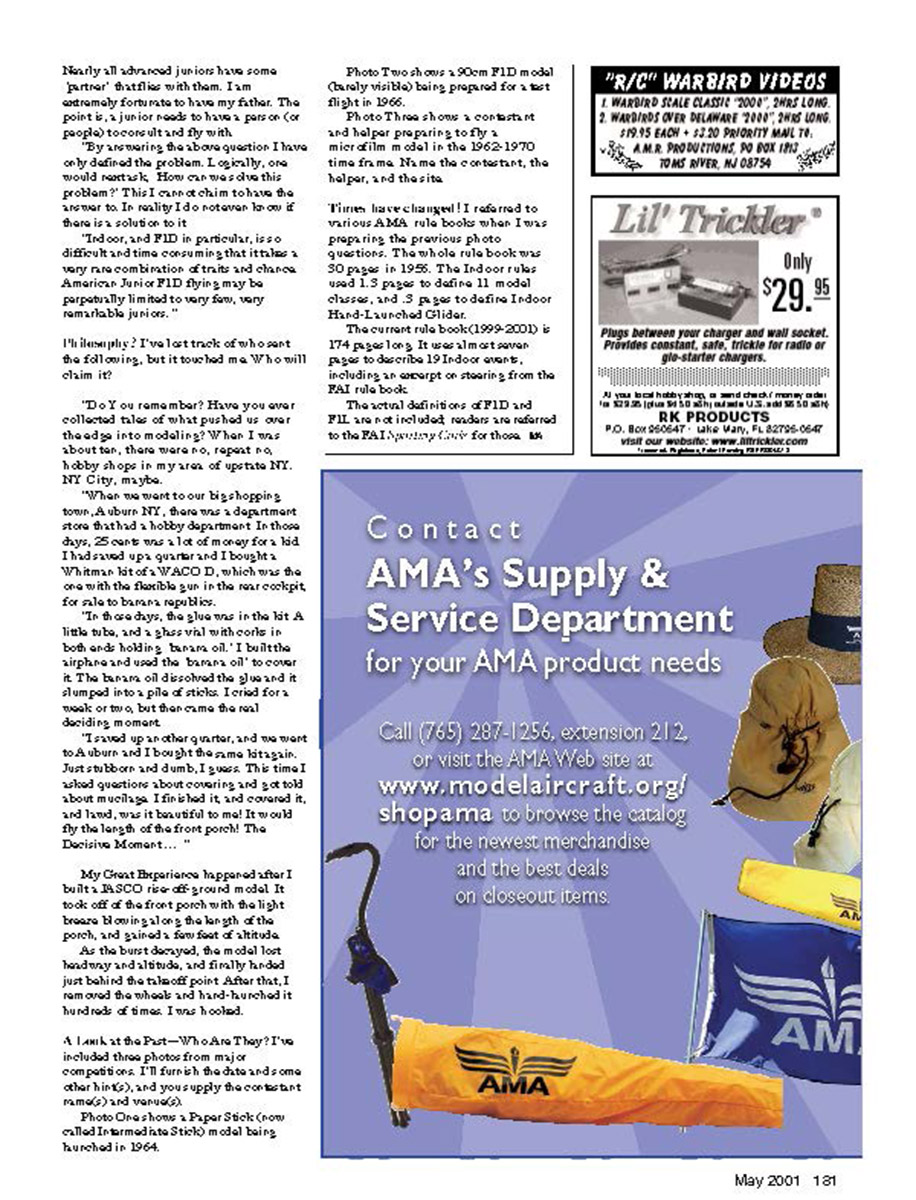
I've included three photos from major competitions. I'll furnish the date and some other hints; you supply the contestant name(s) and venue(s).
- Photo One shows a Paper Stick (now called Intermediate Stick) model being launched in 1964.
- Photo Two shows a 0.90 gm F1D model (barely visible) being prepared for a test flight in 1966.
- Photo Three shows a contestant and helper preparing to fly a microfilm model in the 1962–1970 time frame. Name the contestant, the helper, and the site.
Times have changed! I referred to various AMA rule books when I was preparing the previous photo questions. The whole rule book was 30 pages in 1956. The indoor rules used 13 pages to define 11 model classes, and 3 pages to define Indoor Hand-launched Glider.
The current rule book (1999–2000) is 174 pages long. It uses almost seven pages to describe 19 indoor events, including an excerpt on scoring from the FAI rule book.
The actual definitions of F1D and F1L are not included; readers are referred to the FAI rule book for those.
Transcribed from original scans by AI. Minor OCR errors may remain.

