
Free Flight Indoor - 2007/01
John Kagan [John_Kagan@hotmail.com]
Holiday gift guide for the FF modeler in your home
Since we are smack in the middle of the holidays and the building season, I figured it would be fun to look at some of the cool indoor free-flight (FF) gadgets that are available. As I’ve pointed out in previous columns, you don’t need special tools to build or fly an indoor FF model—but they certainly can make life easier.
Besides, as a friend once told me, there is only one real hobby: buying things. You might want to circle a few items and leave this magazine out in a conspicuous place!
A winder is probably the first thing to land in any FF modeler’s toolbox. You can theoretically wind sturdy propellers by hand, but a rubber winder does a much better job.
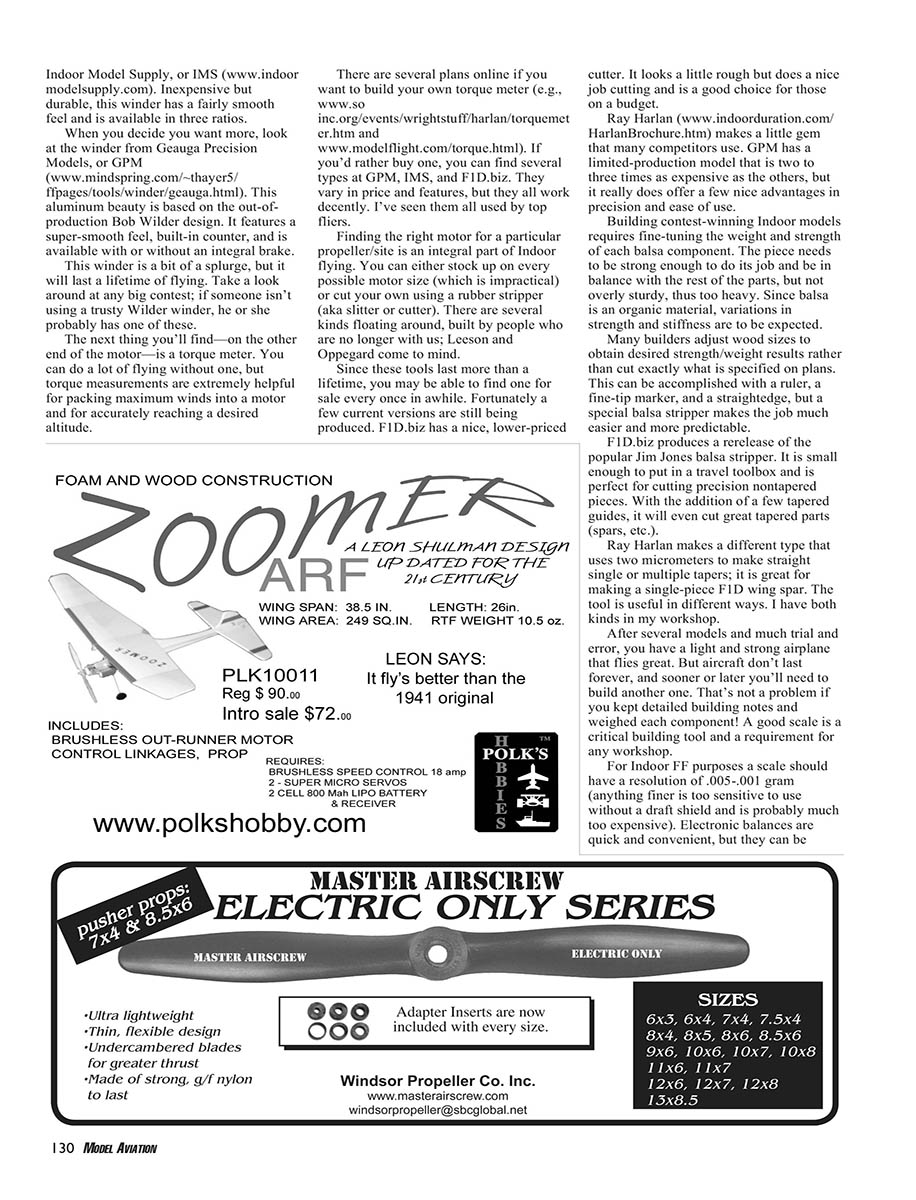
- A great start is the yellow plastic Knight & Pridham winder. It is available from several sources including F1D.biz (www.f1d.biz) and Indoor Model Supply, or IMS (www.indoormodelsupply.com). Inexpensive but durable, this winder has a fairly smooth feel and is available in three ratios.
- When you decide you want more, look at the winder from Geauga Precision Models, or GPM (www.mindspring.com/~thayer5/ffpages/tools/winder/geauga.html). This aluminum beauty is based on the out-of-production Bob Wilder design. It features a super-smooth feel, built-in counter, and is available with or without an integral brake. This winder is a bit of a splurge, but it will last a lifetime of flying. Take a look around at any big contest; if someone isn’t using a trusty Wilder winder, he or she probably has one of these.
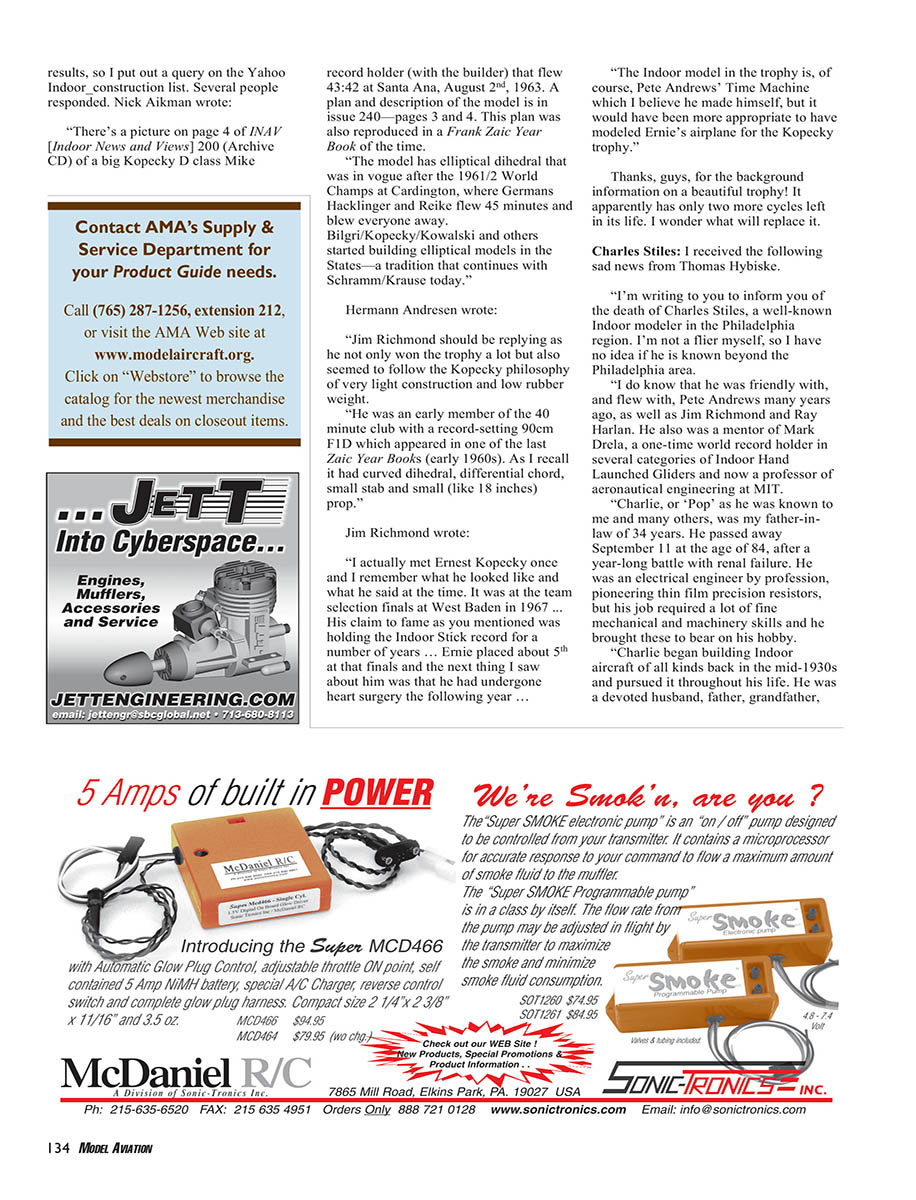
On the other end of the motor is the torque meter. You can do a lot of flying without one, but torque measurements are extremely helpful for packing maximum winds into a motor and for accurately reaching a desired altitude. There are several plans online if you want to build your own torque meter (e.g., www.soinc.org/events/wrightstuff/harlan/torquemeter.htm and www.modelflight.com/torque.html). If you’d rather buy one, you can find several types at GPM, IMS, and F1D.biz. They vary in price and features, but they all work decently. I’ve seen them all used by top fliers.
Finding the right motor for a particular propeller/site is an integral part of indoor flying. You can either stock up on every possible motor size (which is impractical) or cut your own using a rubber stripper (aka slitter or cutter). There are several kinds floating around, built by people who are no longer with us; Leeson and Oppegard come to mind. Since these tools last more than a lifetime, you may be able to find one for sale every once in a while. Fortunately a few current versions are still being produced.
- F1D.biz has a nice, lower-priced cutter. It looks a little rough but does a nice job cutting and is a good choice for those on a budget.
- Ray Harlan (www.indoorduration.com/HarlanBrochure.htm) makes a little gem that many competitors use.
- GPM has a limited-production model that is two to three times as expensive as the others, but it really does offer a few nice advantages in precision and ease of use.
Building contest-winning indoor models requires fine-tuning the weight and strength of each balsa component. The piece needs to be strong enough to do its job and be in balance with the rest of the parts, but not overly sturdy, thus too heavy. Since balsa is an organic material, variations in strength and stiffness are to be expected. Many builders adjust wood sizes to obtain desired strength/weight results rather than cut exactly what is specified on plans. This can be accomplished with a ruler, a fine-tip marker, and a straightedge, but a special balsa stripper makes the job much easier and more predictable.
- F1D.biz produces a re-release of the popular Jim Jones balsa stripper. It is small enough to put in a travel toolbox and is perfect for cutting precision non-tapered pieces. With the addition of a few tapered guides, it will even cut great tapered parts (spars, etc.).
- Ray Harlan makes a different type that uses two micrometers to make straight single or multiple tapers; it is great for making a single-piece F1D wing spar. The tool is useful in different ways. I have both kinds in my workshop.
After several models and much trial and error, you have a light and strong airplane that flies great. But aircraft don’t last forever, and sooner or later you’ll need to build another one. That’s not a problem if you kept detailed building notes and weighed each component! A good scale is a critical building tool and a requirement for any workshop.
For indoor FF purposes a scale should have a resolution of 0.005–0.001 gram (anything finer is too sensitive to use without a draft shield and is probably much too expensive). Electronic balances are quick and convenient, but they can be overloaded if you’re not careful. Mechanical scales are slower, but more tolerant of rough handling and less sensitive to air currents. If you hunt and are lucky, you can find great used lab-quality balances on eBay for reasonable prices.
There are decent lower-cost models available through sites such as www.balances.com. These work well for weighing model parts but can sometimes have repeatability and creep (change in measurement over time) problems that make such tasks as tying 16-gram F1D motors frustrating.
Mechanical balances are more time-consuming to use, but they don't exhibit creep and can have good repeatability. You can find plans online to make your own or get Ray Harlan's carbon-fiber beam balance. It's my choice for motor-making sessions.
Whether you are measuring balsa or rubber motors, a handheld thickness gauge is great to have. Some people use micrometers successfully, but they require a careful touch and it is easy to overcompress whatever you are measuring. A thickness gauge uses a spring-loaded anvil instead and is repeatable.
I have a pocket gauge from Sears (part number 15-0046-15). It doesn't look like Sears has this product anymore (at least not under that part number), but there are others like it on the Internet. You will generally need to open this kind of gauge and stretch out the spring a little to reduce the pressure it generates. This can be a little tricky, but it is worth the effort.
The preceding are just a few of the neat tools that can make indoor FF more enjoyable. Take a look at the sites I've listed for even more goodies.
Also included in this column:
- Origins of the Ernest Kopecky perpetual trophy
- A farewell to Charles Stiles
Ernest Kopecky
As I write this column I am in the final stages of preparation for the 2006 F1D World Championships. One of my tasks has been to pack and ship back the Ernest Kopecky perpetual trophy for the longest flight at the World Championships. Winning that award is different from meeting the competition because in F1D your total flight time is the top two flights combined.
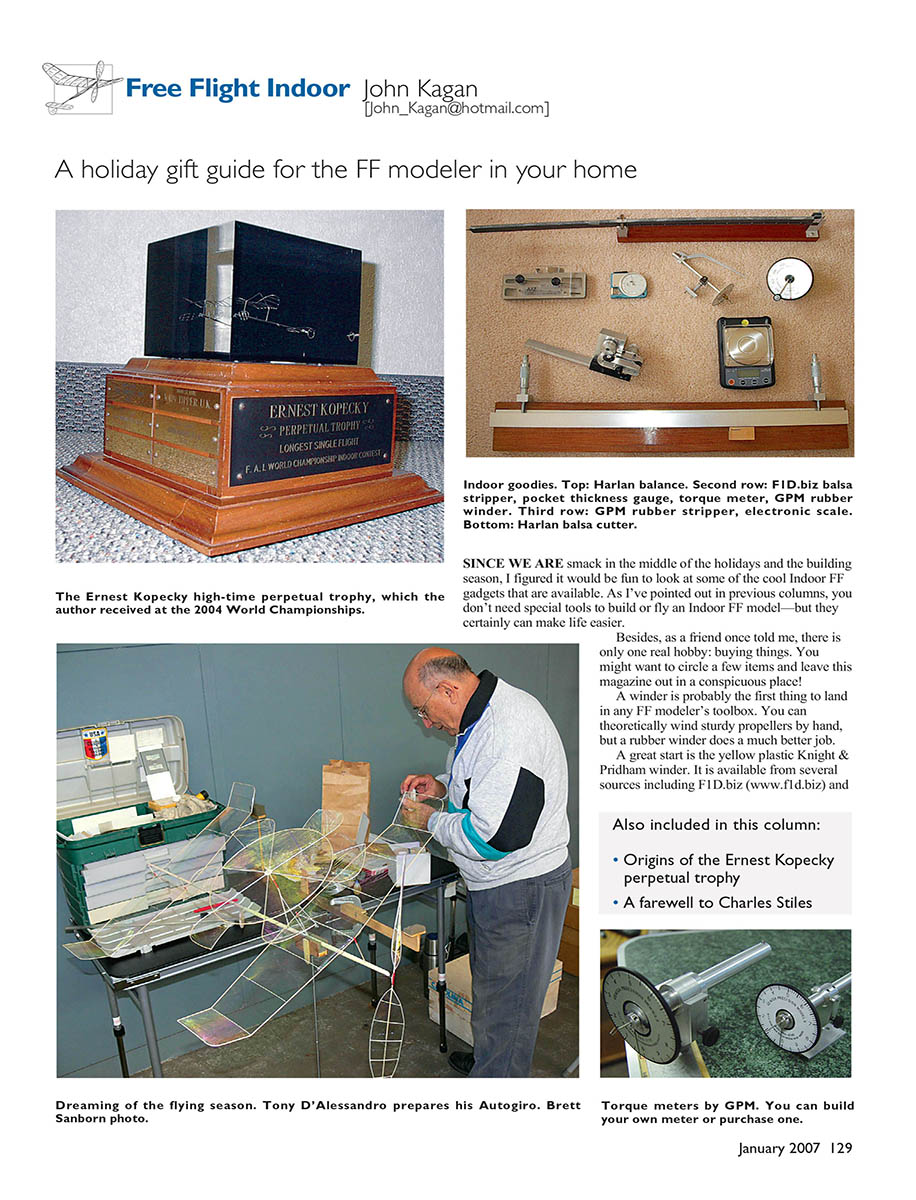
I had the honor of receiving this trophy at the 2004 World Championships, and it has graced my mantel for the last two years. There is a small card on the bottom that reads that the trophy and the case were constructed by Don Garafalow, and presented by the East Coast Indoor Model Club.
The model encased in the Lucite block on top is Pete Andrews' Time Machine. Sixteen of the 18 nameplates have been engraved so far, beginning with Karol Rybecky of the CSSR at Lakehurst in 1974.
It wasn't until I began putting the trophy back in its box that I started to wonder about its namesake. The Internet search engine Google didn't produce any results, so I put out a query on the Yahoo Indoor_construction list. Several people responded.
Nick Aikman wrote that there is a picture on page 4 of INAV 200 (Archive CD) of a big Kopecky D-class record holder (with the builder) that flew 43:42 at Santa Ana, August 2, 1963. A plan and description of the model is in issue 240—pages 3 and 4. This plan was also reproduced in a Frank Zaic Year Book of the time. The model has elliptical dihedral that was in vogue after the 1961/62 World Champs at Cardington, where Germans Hacklinger and Reike flew 45 minutes and were the talk of the event. Bilgri/Kopecky/Kowalski and others started building elliptical models in the States—a tradition that continues with Schramm/Krause today.
Hermann Andresen wrote that Jim Richmond should be replying as he not only won the trophy a lot but also seemed to follow the Kopecky philosophy of very light construction and low rubber weight. He was an early member of the 40-minute club with a record-setting 90 cm F1D which appeared in one of the last Zaic Year Books (early 1960s). As Andresen recalls, it had curved dihedral, differential chord, a small stab, and a small prop (like 18 inches).
Jim Richmond wrote that he actually met Ernest Kopecky once and remembered what he looked like and what he said at the time. It was at the team selection finals at West Baden in 1967. Kopecky's claim to fame was holding the Indoor Stick record for a number of years. Ernie placed about 5th at that finals and the next thing Richmond saw about him was that he had undergone heart surgery the following year. The indoor model in the trophy is, of course, Pete Andrews' Time Machine which Richmond believes Andrews made himself, but Richmond felt it would have been more appropriate to have modeled Ernie's airplane for the Kopecky trophy.
Thanks to everyone who provided background information on a beautiful trophy! It apparently has only two more cycles left in its life. I wonder what will replace it.
Charles Stiles
I received the following sad news from Thomas Hybiske.
"I'm writing to you to inform you of the death of Charles Stiles, a well-known indoor modeler in the Philadelphia region. I'm not a flier myself, so I have no idea if he is known beyond the Philadelphia area.
"I do know that he was friendly with, and flew with, Pete Andrews many years ago, as well as Jim Richmond and Ray Harlan. He also was a mentor of Mark Drela, a one-time world record holder in several categories of indoor hand-launched gliders and now a professor of aeronautical engineering at MIT.
"Charlie, or 'Pop' as he was known to me and many others, was my father-in-law of 34 years. He passed away September 11 at the age of 84, after a year-long battle with renal failure. He was an electrical engineer by profession, pioneering thin film precision resistors, but his job required a lot of mechanical and machinery skills and he brought those to bear on his hobby.
"Charlie began building indoor aircraft of all kinds back in the mid-1930s and pursued it throughout his life. He was a devoted husband, father, grandfather, and great-grandfather, which took much of his free time. Consequently, there wasn't much time left to compete, so he flew mainly for the pure joy of the hobby.
"A skilled builder, he flew often at Lakehurst (NJ) and other places around Philadelphia. He was a longtime member of the SOTS (Scale Old Timers Society) of Philadelphia and was known for his ability to make any fellow member's model fly regardless of how poorly constructed it was.
"I accompanied him many times to flying sessions, where he appointed me as his 'official winder,' spy, timer, and all-around gopher. I often saw the pure joy in his face as he carefully released his microfilm 'ship,' as he referred to them, and watched it corkscrew upward under the torque of the rubber motor.
"He was known for having his pocket protector stuffed with every imaginable pen, pencil, scale, tweezer, and screwdriver. On his eyeglasses he kept jeweler's magnifiers which were always at hand if needed.
"He was wise, kind, and generous and was known for often giving his models or tools to an admirer. Even at age 84, his hands were steady and calm, and his building skills were second to none.
"His death is no doubt a huge blow to indoor modeling in the Philadelphia area, but in keeping with his generous nature he requested that all of his aircraft, balsa, miles of rubber, propeller fixtures, and anything else used in building, of which there were huge amounts, be given to his friends and donated to his club upon his death.
"He has left behind boxes of microfilmed wings, lovingly stripped and inventoried rubber, stripped balsa, and dozens upon dozens of propellers and thrust bearings, which will no doubt help many area builders.
"If you knew Charlie, you no doubt liked him. If you didn't know him, you missed a one-of-a-kind, old-school builder." MA
Transcribed from original scans by AI. Minor OCR errors may remain.

