
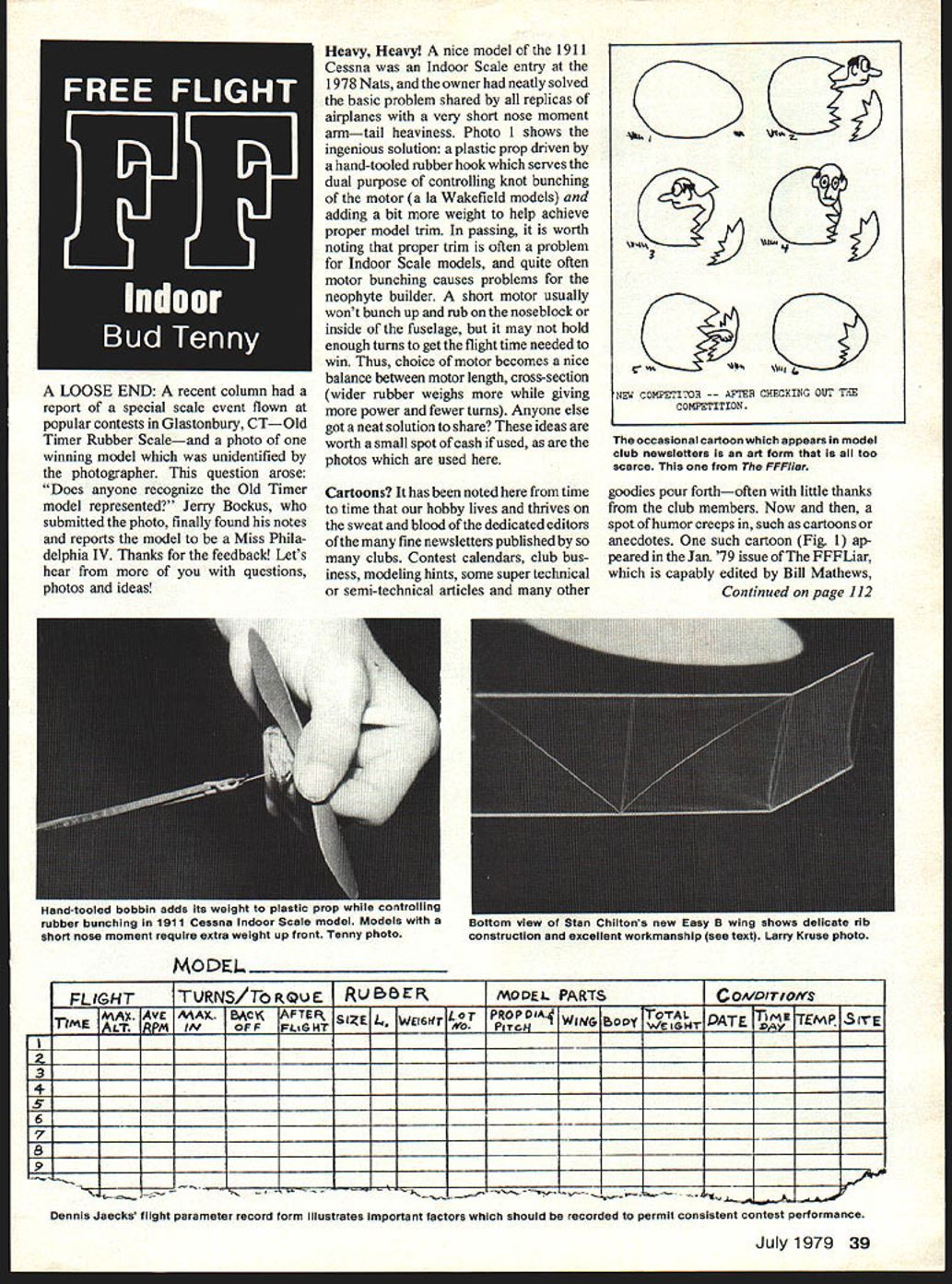
Free Flight: Indoor
Bud Tenny
A Loose End
A recent column reported a special scale event flown at popular contests in Glastonbury, CT — Old Timer Rubber Scale — and included a photo of one winning model that was unidentified by the photographer. The question arose: “Does anyone recognize the Old Timer model represented?” Jerry Bockus, who submitted the photo, finally found his notes and reports the model to be a Miss Philadelphia IV. Thanks for the feedback! Let’s hear from more of you with questions, photos and ideas.
Heavy, Heavy!
A nice model of the 1911 Cessna was an Indoor Scale entry at the 1978 Nats, and the owner had neatly solved the basic problem shared by all replicas of airplanes with a very short nose moment — tail heaviness. Photo 1 shows the ingenious solution: a plastic prop driven by a hand-tooled rubber hook which serves the dual purpose of controlling knot bunching of the motor (a la Wakefield models) and adding a bit more weight to help achieve proper model trim.
Proper trim is often a problem for Indoor Scale models, and quite often motor bunching causes problems for the neophyte builder. A short motor usually won't bunch up and rub on the noseblock or inside of the fuselage, but it may not hold enough turns to get the flight time needed to win. Thus, choice of motor becomes a nice balance between:
- motor length, and
- cross-section (wider rubber weighs more while giving more power and fewer turns).
Anyone else got a neat solution to share? These ideas are worth a small spot of cash if used, as are the photos used here.
Cartoons?
Our hobby lives and thrives on the sweat and blood of the dedicated editors of the many fine newsletters published by so many clubs. Contest calendars, club business, modeling hints, some super technical or semi-technical articles and many other goodies pour forth — often with little thanks from the club members. Now and then, a spot of humor creeps in, such as cartoons or anecdotes. One such cartoon (Fig. 1) appeared in the Jan. ’79 issue of The FFFLiar, which is capably edited by Bill Mathews.
The FFFLiar 311 Poinciana Dr., Birmingham, AL 35209. This newsletter is fairly new, very regular and usually very informative. Bill's labor of love benefits the Alabama FFFlyers, a group that is not a club in the usual sense.
Center of Gravity
For example, if four different weights were placed on a long board, each one would push down a different amount at a different place. But the total forces downward could be considered as a single force pushing down from whatever point along the board would be necessary to give exactly the same effect as the four different weights. That "resultant" point is called the Center of Gravity (CG).
Therefore any change of weight or location on the board will shift the balance point from the original CG location. A model is nose-heavy when the balance point is further forward in relation to the designed Center of Gravity.
Decalage (Note)
Baughman's Aviation Dictionary defines decalage as a difference in angles of incidence of the wings of a biplane or multiplane. It is measured by the acute angle between the chords in a plane parallel to the plane of symmetry. Rightly or wrongly, many modelers, including the author, have expanded the term to include monoplanes when referring to the difference in angles of incidence of the wing and stabilizer.
More on Wood Cutting
The May '79 column carried comments on balsa cutting, with some hints on achieving accuracy and strength. It seldom is appreciated just what wonders are achieved by some of the better craftsmen who build Indoor models. Stan Chilton, Wichita, KS, is one of these craftsmen. His more recent Easy B models have been turning times as high as 16 minutes in Category II sites (those with ceiling heights between 35 and 100 ft). Photo 2 shows some amazing balsa work on one of his Easy Bs — and explains why the model is well under 0.04 oz in weight.
The picture shows the underside of the wing, with visibly tiny rib cross-sections. Note that each main rib uses a second balsa piece across the bottom to help hold the curvature, and that a diagonal rib pattern is used to stiffen the wing. These ribs are less than 0.02" in maximum dimension, and appear to be a formidable cutting task.
It's Easy — almost.
Actually, all it takes to produce such a part is a very sharp knife, a steady and practiced hand, and very carefully selected wood. Wood selection is, in itself, a topic worthy of several columns, as it is one major ingredient separating the top builders from the competition. Each part must be just strong enough to carry its share of the load, with no excess to balloon the weight. Much more time is spent in choosing just the right piece of wood for a part than is needed to actually build the part.
A Maxim
Indoor models aren't hard to build; they are just different. No other type of model has so many applications of different techniques as Indoor models, yet few of the basic techniques are beyond the skill of most model builders. But two other problems rear their ugly heads:
- a preconceived notion of what one is capable of doing ("I could never do that!") becomes the classic self-fulfilling prophecy, and
- lack of information about how some of these tasks are accomplished by an experienced builder.
Hopefully, that is what this column is all about: sharing various techniques which aren't so obvious, and thus encouraging interested persons to try their hand at a part of model building which is inexpensive and still challenging enough for almost anyone.
Attention to Details
Small details "make or break" the Indoor modeler's efforts. Nowhere is this more true than in model trim and contest flying. A tiny shift in location of the model's CG or wing incidence will rob seconds to minutes from the model's performance. Changes in humidity, atmospheric pressure and air temperature all play a part. No one except a computer can remember all these details with enough clarity to duplicate previous successful flights, or make a good guess about how to set up a model to fly in a contest when inadequate time is available to make exhaustive test flights.
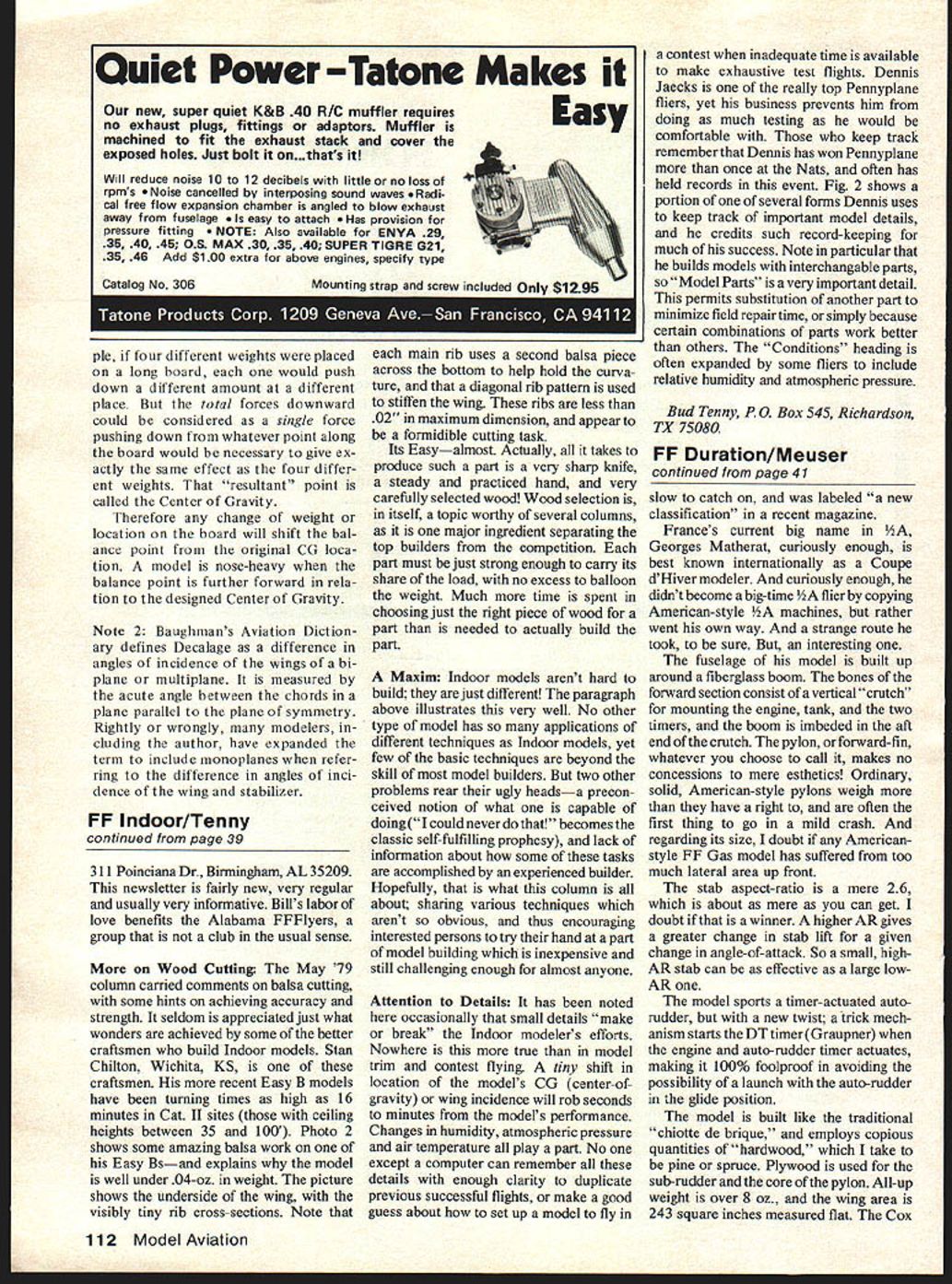
Dennis Jaecks is one of the really top Pennyplane fliers, yet his business prevents him from doing as much testing as he would be comfortable with. Those who keep track remember that Dennis has won Pennyplane more than once at the Nats, and often has held records in this event. Fig. 2 shows a portion of one of several forms Dennis uses to keep track of important model details, and he credits such record-keeping for much of his success.
Note items Dennis records:
- Model Parts (he builds models with interchangeable parts to permit substitution and minimize field repair time),
- Conditions (often expanded to include relative humidity and atmospheric pressure),
- Other important setup and performance details.
Bud Tenny, P.O. Box 545, Richardson, TX 75080.
Transcribed from original scans by AI. Minor OCR errors may remain.

