
Free Flight: Indoor
Bud Tenny
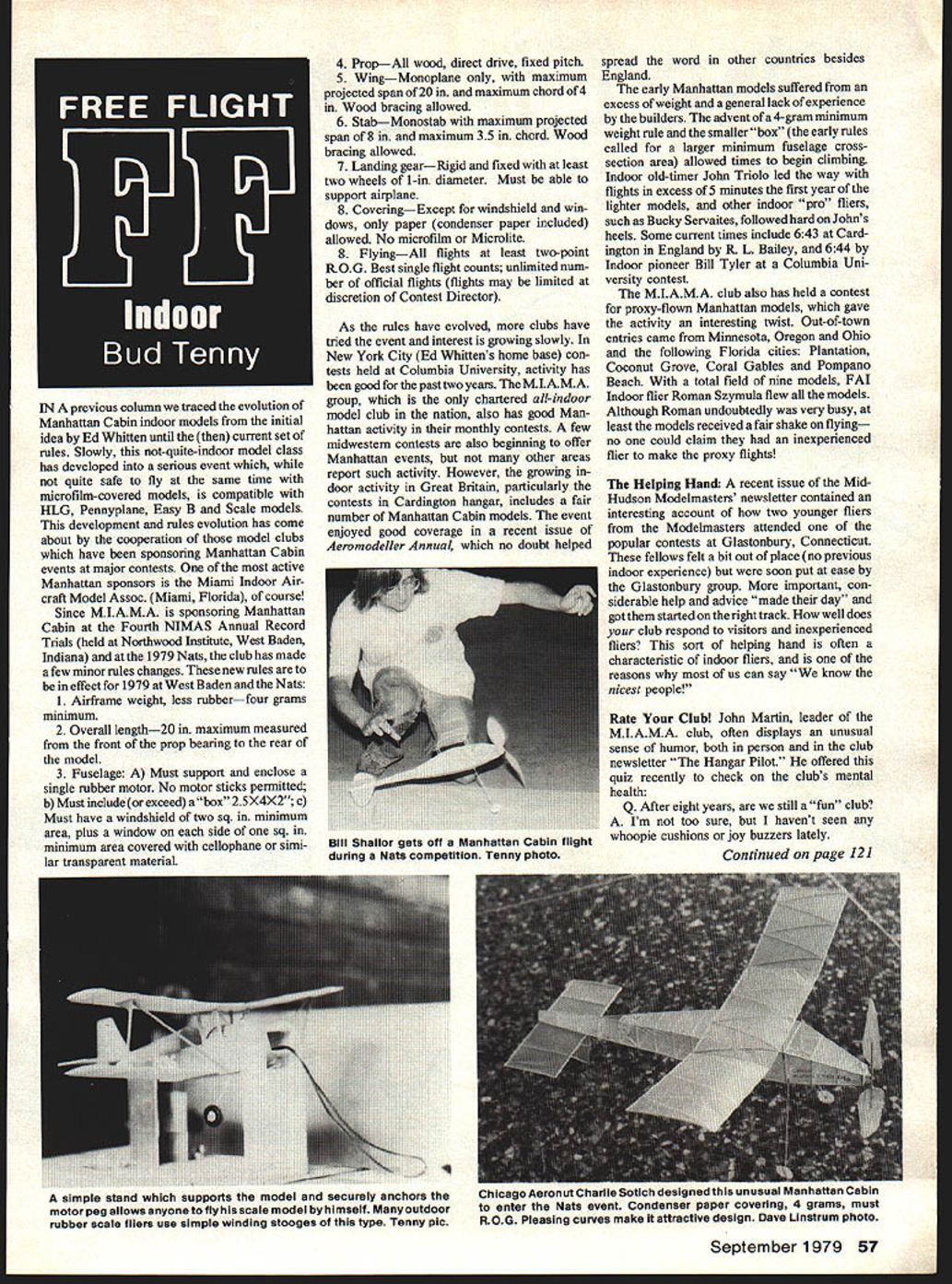
In a previous column we traced the evolution of Manhattan Cabin indoor models from the initial idea by Ed Whitten until the (then) current set of rules. Slowly, this not-quite-indoor model class has developed into a serious event which, while not quite safe to fly at the same time with microfilm-covered models, is compatible with HLG, Pennyplane, Easy B and Scale models. This development and rules evolution has come about by the cooperation of those model clubs which have been sponsoring Manhattan Cabin events at major contests. One of the most active Manhattan sponsors is the Miami Indoor Aircraft Model Assoc. (MIAMA), of course.
Since MIAMA is sponsoring Manhattan Cabin at the Fourth NIMAS Annual Record Trials (held at Northwood Institute, West Baden, Indiana) and at the 1979 Nats, the club has made a few minor rules changes. These new rules were to be in effect for 1979 at West Baden and the Nats.
Rules (as used at the 1979 West Baden NATS)
- Airframe weight (less rubber) — 4 grams minimum.
- Overall length — 20" maximum, measured from the front of the prop bearing to the rear of the model.
- Fuselage:
- a. Must support and enclose a single rubber motor. No motor sticks permitted.
- b. Must include (or exceed) a "box" 2.5" x 4" x 2".
- c. Must have a windshield of at least 2 sq. in. area, plus a window on each side of at least 1 sq. in., covered with cellophane or similar transparent material.
- Prop — All wood, direct drive, fixed pitch.
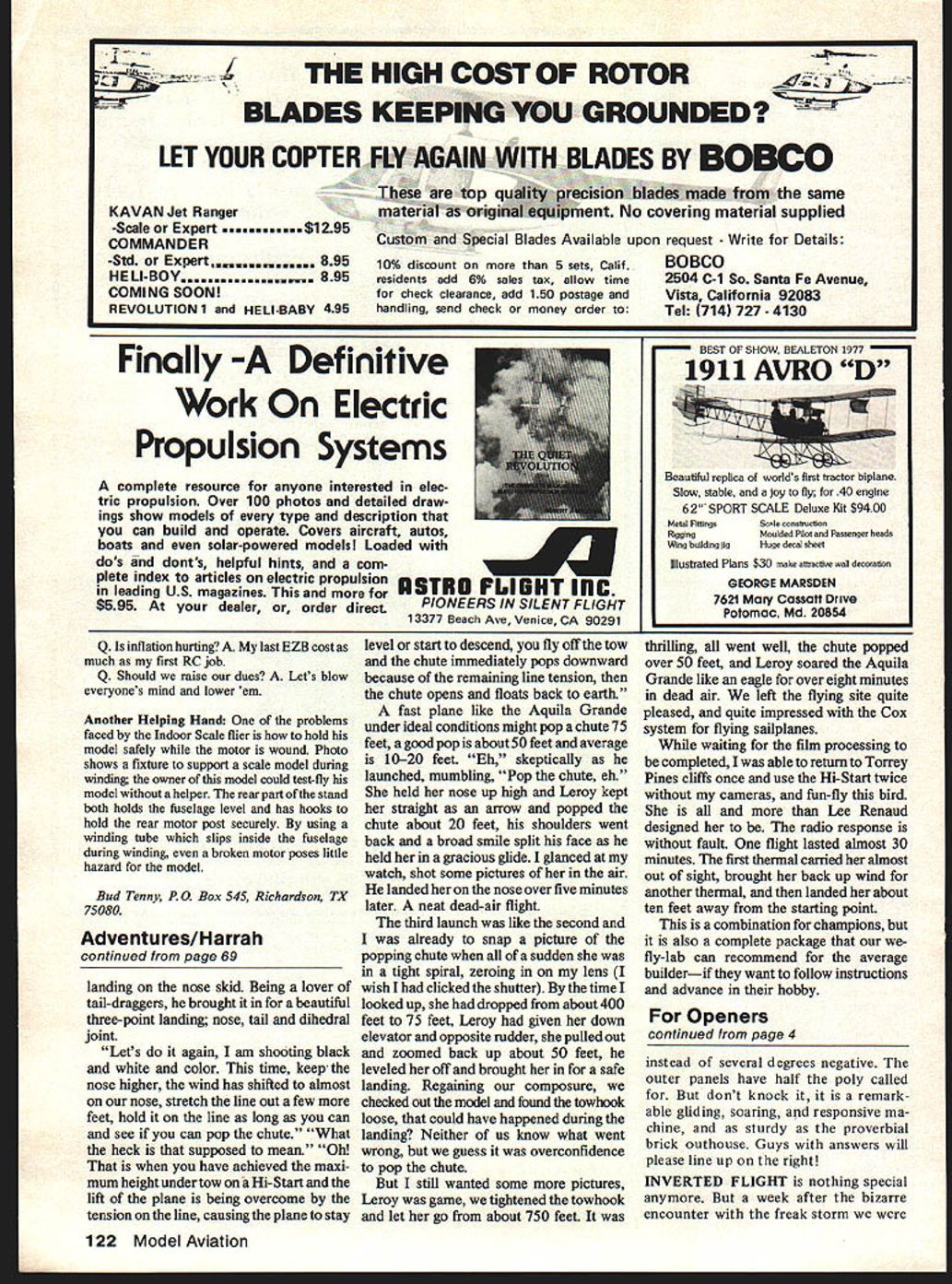
- Wing — Monoplane only; maximum projected span 20", maximum chord 4". Wood bracing allowed.
- Stab — Monostab; maximum projected span 8", maximum chord 3.5". Wood bracing allowed.
- Landing gear — Rigid and fixed with at least two wheels of 1" diameter. Must be able to support the airplane.
- Covering — Except for windshield and windows, only paper (condenser paper included) allowed. No microfilm or Microlite.
- Flying — All flights must be at least two-point R.O.G. Best single flight counts; unlimited number of official flights (flights may be limited at the discretion of the Contest Director).
As the rules have evolved, more clubs have tried the event and interest is growing slowly. In New York City (Ed Whitten's home base) contests held at Columbia University have shown good activity for the past two years. MIAMA, the only chartered all-indoor model club in the nation, also has good Manhattan activity in their monthly contests. A few midwestern contests are beginning to offer Manhattan events, but other areas report little activity. However, indoor activity is growing in Great Britain, particularly in the Cardington hangar, which includes a fair number of Manhattan Cabin models. The event enjoyed good coverage in a recent issue of Aeromodeller Annual, which no doubt helped spread the word internationally.
Early Manhattan models suffered from excess weight and a general lack of builder experience. The advent of the 4-gram minimum weight rule and the smaller "box" (early rules called for a larger minimum fuselage cross-section) allowed times to begin climbing. Indoor old-timer John Triolo led the way with flights in excess of five minutes the first year of the lighter models; other indoor "pro" fliers, such as Bucky Servaites, followed closely.
Some notable times include:
- 6:43 — R. L. Bailey, Cardington, England
- 6:44 — Bill Tyler, Columbia University contest
MIAMA has also held a contest for proxy-flown Manhattan models, which gave the activity an interesting twist. Out-of-town entries came from Minnesota, Oregon and Ohio and from the following Florida cities: Plantation, Coconut Grove, Coral Gables and Pompano Beach. With a total field of nine models, FAI indoor flier Roman Szymula flew all the models. Although Roman was undoubtedly very busy, the proxy flights were flown by an experienced competitor, so entrants received a fair shake.
Helping Hand
A recent issue of the Mid-Hudson Modelmasters' newsletter contained an account of two younger fliers from the Modelmasters who attended a popular contest at Glastonbury, Connecticut. The fellows felt a bit out of place (no previous indoor experience) but were soon put at ease by the Glastonbury group. Considerable help and advice "made their day" and got them started on the right track.
How well does your club respond to visitors and inexperienced fliers? This sort of help is often a characteristic of indoor fliers, and is one of the reasons why many of us can say, "We know the nicest people!"
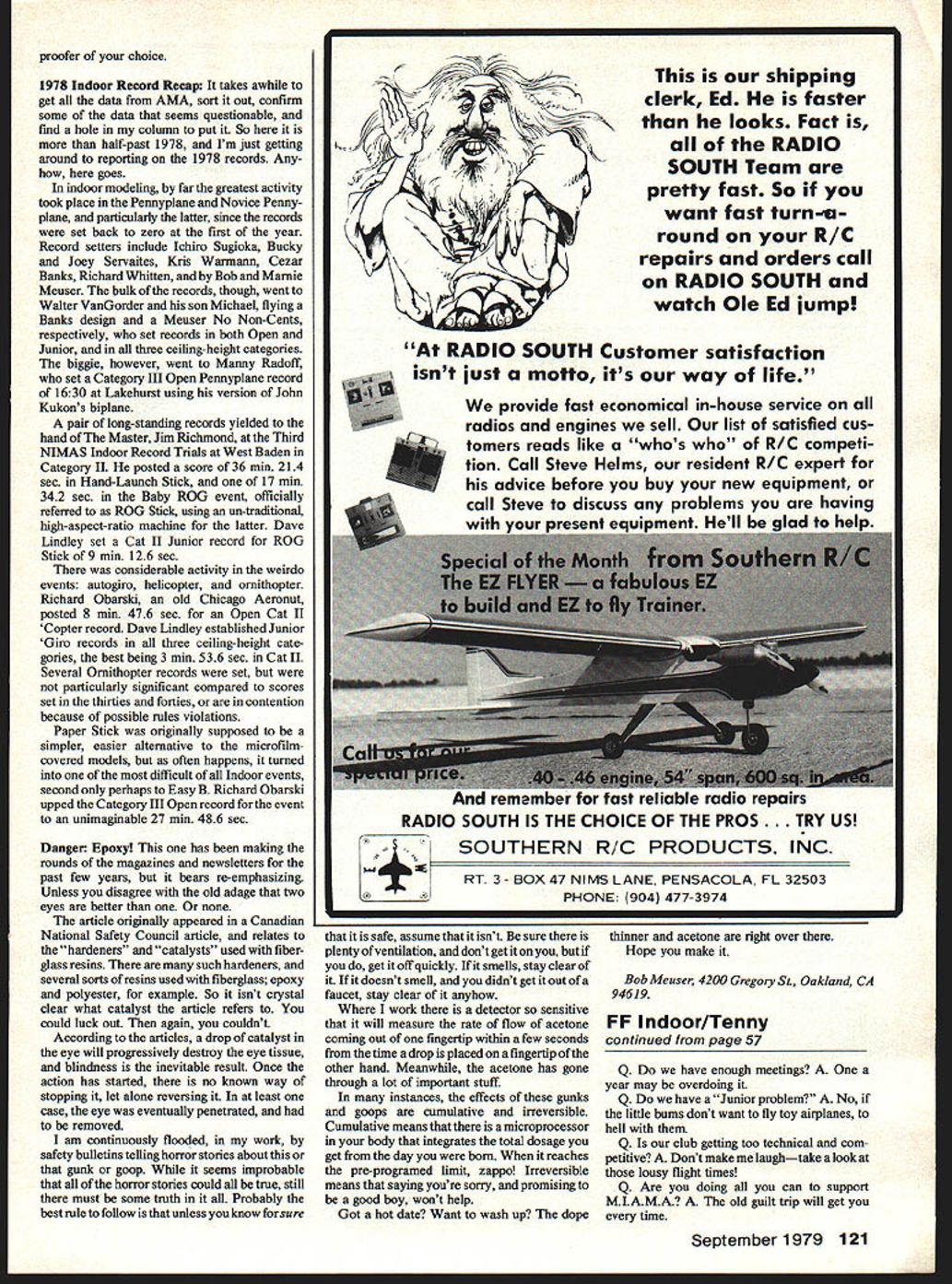
A simple stand that supports the model securely, anchors the motor peg and allows anyone to fly a scale model himself can be very helpful. Many outdoor rubber scale fliers use simple winding stooge–type devices.
Rate Your Club!
John Martin, leader of the MIAMA club, often displays an unusual sense of humor, both in person and in the club newsletter "The Hangar Pilot." He offered this quiz recently to check on the club's mental health:
Q. After eight years, are we still a "fun" club? A. I'm not too sure, but I haven't seen any whoopie cushions or joy buzzers lately.
Other quiz items and answers: Q. Do we have enough meetings? A. Once a year may be overdoing it.
Q. Do we have a "Junior problem"? A. No, if the little bums don't want to fly toy airplanes, to hell with them.
Q. Is our club getting too technical and competitive? A. Don't make me laugh—take a look at those lousy flight times!
Q. Are you doing all you can to support MIAMA? A. The old guilt trip will get you every time.
1978 Indoor Record Recap
It takes a while to get all the data from AMA, sort it out, confirm questionable items, and find space to report it. Here, belatedly, is the recap for 1978.
In indoor modeling, the greatest activity took place in Pennyplane and Novice Pennyplane, particularly the latter, since the records were reset to zero at the start of the year. Record setters include Ichiro Sugioka, Bucky and Joey Servaites, Kris Warmann, Cezar Banks, Richard Whitten, and Bob and Mamie Meuser. The bulk of the records, though, went to Walter VanGorder and his son Michael, flying a Banks design and a Meuser No Non-Cents, respectively; they set records in both Open and Junior and in all three ceiling-height categories. The big achievement went to Manny Radoff, who set a Category III Open Pennyplane record of 16:30 at Lakehurst using his version of John Kucko's biplane.
At the Third NIMAS Indoor Record Trials at West Baden, Jim Richmond posted two significant Cat II scores: 36:21.4 in Hand-Launch Stick and 17:34.2 in the Baby ROG event (officially ROG Stick), using an untraditional, high-aspect-ratio machine for the latter. Dave Lindley set a Cat II Junior record for ROG Stick of 9:12.6.
There was considerable activity in the "weirdo" events: autogiro, helicopter and ornithopter. Richard Obarski, an old Chicago Aeronut, posted 8:47.6 for an Open Cat II helicopter record. Dave Lindley established Junior autogiro records in all three ceiling-height categories, the best being 3:53.6 in Cat II. Several ornithopter records were set, though some are less significant compared to historical scores or are in contention due to possible rules violations.
Paper Stick was intended as a simpler alternative to microfilm-covered models, but it became one of the most difficult indoor events, second perhaps only to Easy B. Richard Obarski raised the Category III Open record for Paper Stick to 27:48.6.
Danger: Epoxy!
This safety item has circulated in magazines and newsletters for years, but it bears repeating. The account originally appeared in a Canadian National Safety Council article and concerns the "hardeners" and "catalysts" used with fiberglass resins. There are many such hardeners and several types of resins (epoxy, polyester, etc.), so it's not always clear which specific catalyst the article referred to. You might luck out—but you might not.
According to the article, a drop of catalyst in the eye will progressively destroy eye tissue, and blindness is the inevitable result. Once the action has started, there is no known way of stopping it or reversing it. In at least one case the eye was eventually penetrated and had to be removed.
I am frequently flooded, in my work, by safety bulletins telling horror stories about various gunk or goop. While it seems improbable that all the horror stories are literally true, there must be some truth in them. Probably the best rule is: unless you know for sure that something is safe, assume that it is not. Provide plenty of ventilation, avoid getting it on your skin, and if you do, get it off quickly. If it smells, stay clear of it. If it doesn't smell, and you didn't get it out of a faucet, stay clear of it anyway.
Where I work there is a detector so sensitive it will measure the rate of flow of acetone from one fingertip within a few seconds of placing a drop on the other fingertip. Meanwhile, the acetone has passed through a lot of important stuff.
In many instances the effects of these substances are cumulative and irreversible. Cumulative means there is a microscopically incremental dose that builds up over time. When it reaches the pre-programmed limit, zap. Irreversible means saying you're sorry won't help.
Got a hot date? Want to wash up? The dope thinner and acetone are right over there. Hope you make it.
— Bob Meuser 4200 Gregory St., Oakland, CA 94619.
Transcribed from original scans by AI. Minor OCR errors may remain.

