
Free Flight: Indoor
Bud Tenny
New "season" coming! Only a few areas have indoor flying all year round, so many of us have to wait for the cooler months before seriously planning any indoor activity. The time is approaching when contests and flying sessions will begin, so planning time is now. There are a number of different indoor activities which add spice and interest, so let's examine a few of them.
Postal Contests
Postal contests are model airplane contests conducted by mail—that is, each club or individual entered will fly his events at a local site under conditions agreed upon by all participants, then the results are mailed to the originating group or sponsor, the times compared, and the winners are then notified by mail. There is nothing like having to wait three weeks or longer to find out if you won the contest! While this kind of flying often takes place during the winter months, a few die-hards have access to indoor sites all year round. If you are one of these, and no one shows up for your flying sessions during the summer, why not try postal meets so you can still have some competition?
Who flies in postal meets? If you know someone in another area, send an invitation (or challenge, depending on how good you think you are!) and see if they will take you on. Otherwise, you may read of postal meets in club newsletters or similar sources. Finally, any clubs or individuals who wish to try postal flying may write this column to declare your intent. If someone has made a similar offer, we can get you together. If not, the challenge or invitation will be published in the next available column, along with your address and telephone number, if you wish. No telephone numbers will be published without specific permission. Let's try this out—all you can lose is the time it takes to write. The results of various matches can then be published here, and maybe we all will have some extra fun!
Some Postal Guidelines
- Invitations should be for a specific model class and should specify a range of ceiling heights.
- NIMAS (the National Indoor Model Airplane Society) has conducted an annual postal meet, using "fudge factors" to allow comparison between times flown under different ceiling heights.
- If there is interest in postal flying via this column, more will be printed about fudge factors as the need arises.
Cat. I Pennyplane
How about starting with Cat. I Pennyplane contests? Almost everyone has a Cat. I site available, and Pennyplanes and Easy Bs are the most popular models. Since the AMA Rule Book is deliberately vague about some aspects of Easy B rules, be sure to specify what you mean by an Easy B model!
Ceiling Dodgers
Many times a contest is won by a model which can maintain its cool while scrubbing on a flat ceiling or banging around in the rafters. It has been noted that such flying is like picking the best thermals in outdoor free-flight events! Consider disqualifying any model which touches the ceiling or any part of the building structure in such a way that the climb portion of the flight is prolonged. It takes a really good model, well adjusted and skillfully flown, to win under "no touch" rules. The prop/rubber combination is a whole new setup, and the really good fliers find a new dimension to their flying in such a contest.
Note that any indoor model can be used for Ceiling Dodgers (fit the model choice to the site), or those holding the event can specify one certain model type or design to fit the event to the needs of the group. To look at it another way, the ceiling-dodging concept will also make an otherwise poor site fairly acceptable. (In reality, indoor HLGs are "no touch" models—even if they just brush the ceiling or a light, the flight nearly always is spoiled.)
Special Events
#### Matchbox Contest How about a Matchbox Contest? This concept calls for careful design and construction, plus clever ideas. Any model which will fit into a standard box for common kitchen matches is eligible. Depending upon who sets up the rules, the model parts must fit in the box, or the assembled model must fit in the box. Under the "assembled" category, helicopters and very low aspect-ratio rubber-powered models have done well. A catapult glider built for a matchbox event is a lot of fun, but difficult to adjust. With the smallest piece of indoor rubber available, the glider moves so fast on release that it vanishes from sight! One has to get someone else to launch the model so it is possible to observe the trajectory and decide what adjustments need to be made.
#### Parlor Mites and Parlor Contests The "parlor mite" is basically a 10" span model intended to be flown in homes or very small sites, and may have any number of various rules depending on who holds the event. Micro-X, P.O. Box 1063, Lorain, OH 44055, has a kit which furnishes materials for three such models of differing design. This kit could be the basis for a "formula" contest, and is guaranteed to liven up a model club party. The San Diego Orbiters have a similar class which, despite fairly stringent rules, often has flights exceeding three minutes in a recreation center gymnasium.
#### A-6 Class Rules The rules for the A-6 class:
- Wing area: 30 sq. in. maximum.
- Motor stick length and prop diameter: 6" maximum.
- All materials to be readily available in hobby shops.
- All wood strip to be 1/16" square minimum, and sheet balsa parts to be made from 1/32" minimum thickness.
- Wing rib depth to be 1/16" minimum, wing covering to be tissue only, and models are to be rubber-powered only.
- Prop can be commercial plastic, or built from flat sheet balsa with blades mounted on a 1/8" square hub.
- Prop shaft to be 1/32" diameter wire, and the thrust bearing is to be 1/16" diameter aluminum tubing.
The Orbiters intended the A-6 model to be a group activity for the club rather than a project for the rank beginner. At the same time, beginner groups with experienced guidance can do well with the A-6 design in model building classes.
#### 30-Minute Glider Challenge Here is another fun model idea—given a specified set of materials, can you build a glider in 30 minutes? One set of rules specified that each contestant would be furnished:
- One 6-inch long piece of 1/16" x 1/8" balsa.
- One 2" x 6" x 1/32" balsa sheet.
No other materials, except for the choice of adhesive, are permitted. This includes the nose weight, which must be derived from the balsa and glue. This idea provides an interesting challenge, which should be thought out well in advance of the contest.
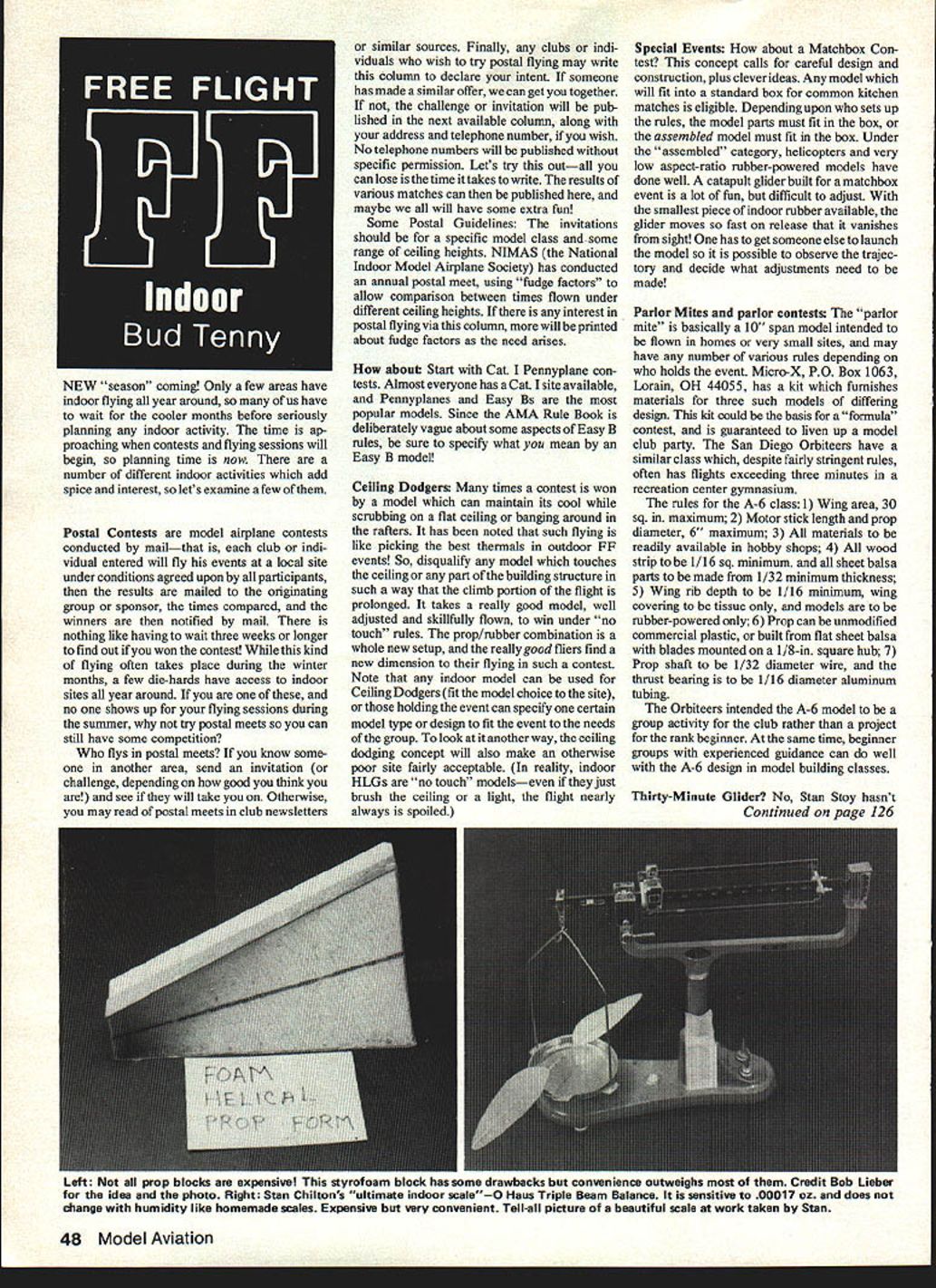
#### Styrofoam Prop Block Bob Lieber has suggested that expensive balsa blocks no longer need be used as prop blocks. He used a styrofoam block for forming balsa blades for Coupe d'Hiver models, but it also can be used for Easy B and Pennyplane props. Two precautions are necessary:
- The blades must be air-dried, since baking in an oven would melt or deform the styrofoam.
- The work surface should be protected by rubbing epoxy glue into the foam.
Bob uses expanded bead foam material, and offers the following advice about cutting the helix. Thin plywood or some other hard material is glued on the uncut block, both top and bottom, to guide the hot wire cutter (the top guide is visible in the photo). The cutter wire must be parallel to the end planes of the block during the whole cut. The cut surface needs no sanding; care in applying the epoxy glue will preserve the smooth surface.
Bud Tenny, P.O. Box 545, Richardson, TX 75080
Transcribed from original scans by AI. Minor OCR errors may remain.

