
Free Flight: Indoor
Bud Tenny
FEEDBACK Doug Dahlke, of Oshkosh, WI, wrote in response to the comments in the Dec. '79 column regarding "ceiling dodger" type flying. He was sharing a clipping from the December 1949 Flying Models magazine which also dealt with a type of ceiling dodging. The clipping related how Chet Lanzo flew a radio-controlled, microfilm-covered, rubber-powered model at the 1949 Nats. The model used tungsten wing bracing as an antenna which fed the radio signal to a 10" long piece of nichrome wire. The output of a 100-watt transmitter furnished power to heat the nichrome wire enough to change its length. The other end of the wire was attached to the model's rudder, so the turn radius varied when the transmitter was operating. Doug asked if this sort of scheme might be legal today. Although the matter might well end up before the Contest Board, I personally feel that the existing model rules would prevent the flying of such a model in competition. However, the Federal Communications Commission might well have some objections! Thanks for sharing, Doug.
HOORAY! We're going to have a World Championship at West Baden! The possibility was mentioned in a previous report covering FNART (the 1979 edition of the annual fly-in held by the National Indoor Model Airplane Society), but now a lot of hard work by several dedicated people has resulted in a proposal to hold the 1980 Indoor World Championship at Northwood Institute in West Baden, IN. The event, to be held June 20–24, 1980, kicks off a week-long extravaganza of indoor model flying that will have to be seen to be believed. Not only is the WCh the top flying event of any year, the rest of the weekly schedule is vying for attention.
The World Championship, with teams from many countries, is the modeling equivalent of the Olympics. Anyone who understands indoor modeling realizes that the Indoor WCh combines skill and strategy with models and a knowledge of indoor "weather" to yield perhaps the only model contest in which free flight models have very little dependence upon luck. True, there are indoor thermals, and there are things such as thermal inversions which may appear to affect model performance in unpredictable fashion. Only the really skilled fliers know how to use these factors in predictable ways.
What Else?
Well, when the international "flimsies" are put away, the First World Peanut Grand Prix will be held, sponsored by Doc Martin's Miami Indoor Model Airplane Association. This Peanut Scale contest will be CDed (or directed, or whatever) by Butch Hadland, from the UK. The rest of the week (that's right — a whole week) will be taken by NIMAS for the Fifth NIMAS Annual Record Trials (VANRT). The VANRT formula may be changed somewhat this year, but all those details remain to be worked out. Anyone who misses this week of modeling will regret it!
CO2 Models?
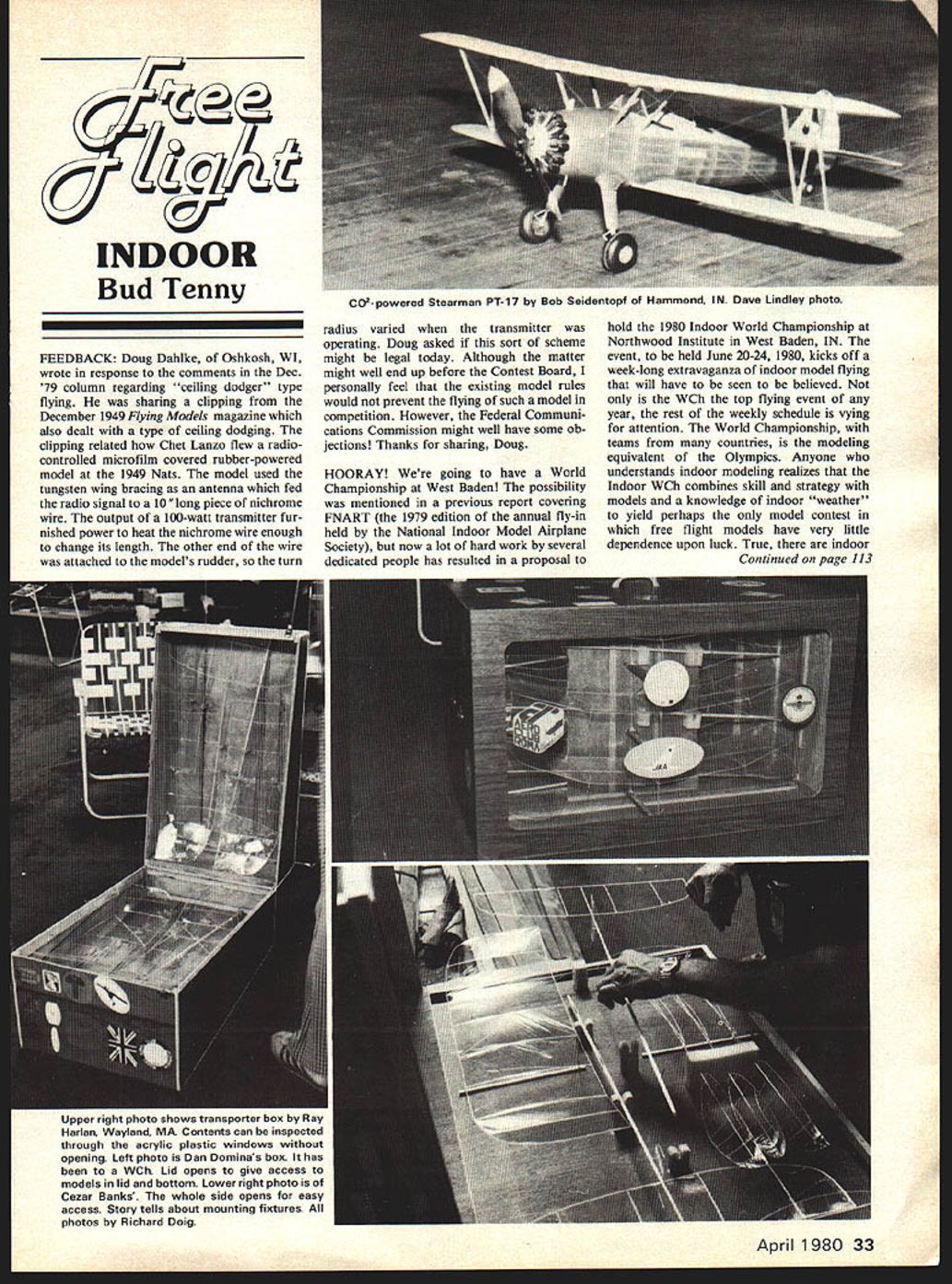
It has been mentioned before in this column that the newest and very tiny CO2 engines are turning up in indoor models. Photo 1 shows a very nice CO2-powered indoor scale model; a Stearman PT-17 by Bob Seidentopf of Hammond, IN. The model was flown at the annual Midwest Indoor Championships held in Chicago, IL. Although indoor purists doubtless will be very nervous over the intrusion of CO2 models into their airspace, this technology is a very interesting type of flying.
Model Boxes
The mention of a World Championship brings forth thoughts of model transportation problems. Everyone who has ever been associated with any WCh, no matter what type of model is involved, has heard horror stories (or hero stories, depending upon the viewpoint) of team members arriving with their models in tatters. Sometimes the stories are funny in retrospect; however, even if the models are successfully repaired, the team member involved has started with a handicap which is difficult to overcome.
What's Needed? Obviously, the desirable end result of any effort to transport model airplanes around the world is to arrive at the contest with the models totally undamaged. The major hazards are shock (dropped containers) and vibration (from various kinds of vehicular activity). Indoor models are also sensitive to temperature extremes, especially heat. Woe unto the unwary one who locks his indoor models in a rented car standing out in the summer sun! Such elevated temperatures will warp models quickly, and that is one of the very hardest types of problems to deal with, especially when one is thousands of miles from his friendly workshop.
International movement of any type of material brings forth another unexpected hazard — the Customs inspector. Not only is it a bother to open model containers, but indoor models can be damaged easily unless the box is opened in a room with low air circulation.
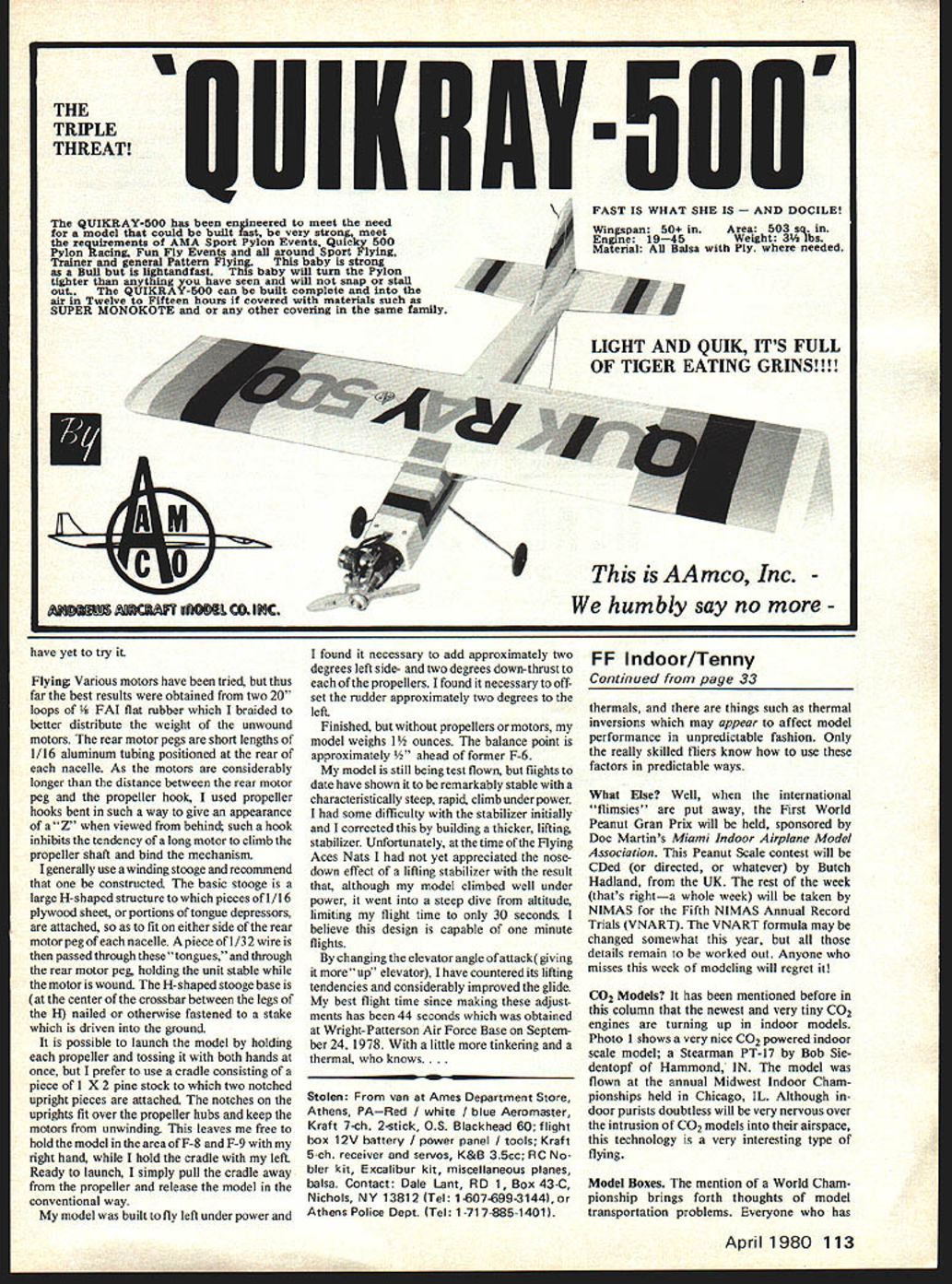
Take a Peek Mr. Inspector, Ray Harlan isn't the first to use the idea of a model box which is well-prepared for the curious customs inspector. Photo 2 clearly shows Ray's plexiglas inserts. It is very easy to show all of the contents of this box without opening, and the box's weight penalty is essentially the same as before adding windows. Two other aspects of indoor box design show in this photo — careful mounting of model parts along with clever packaging. The first ensures that the model parts cannot drift around inside the box, and the second allows more models to be carried in any given size box.
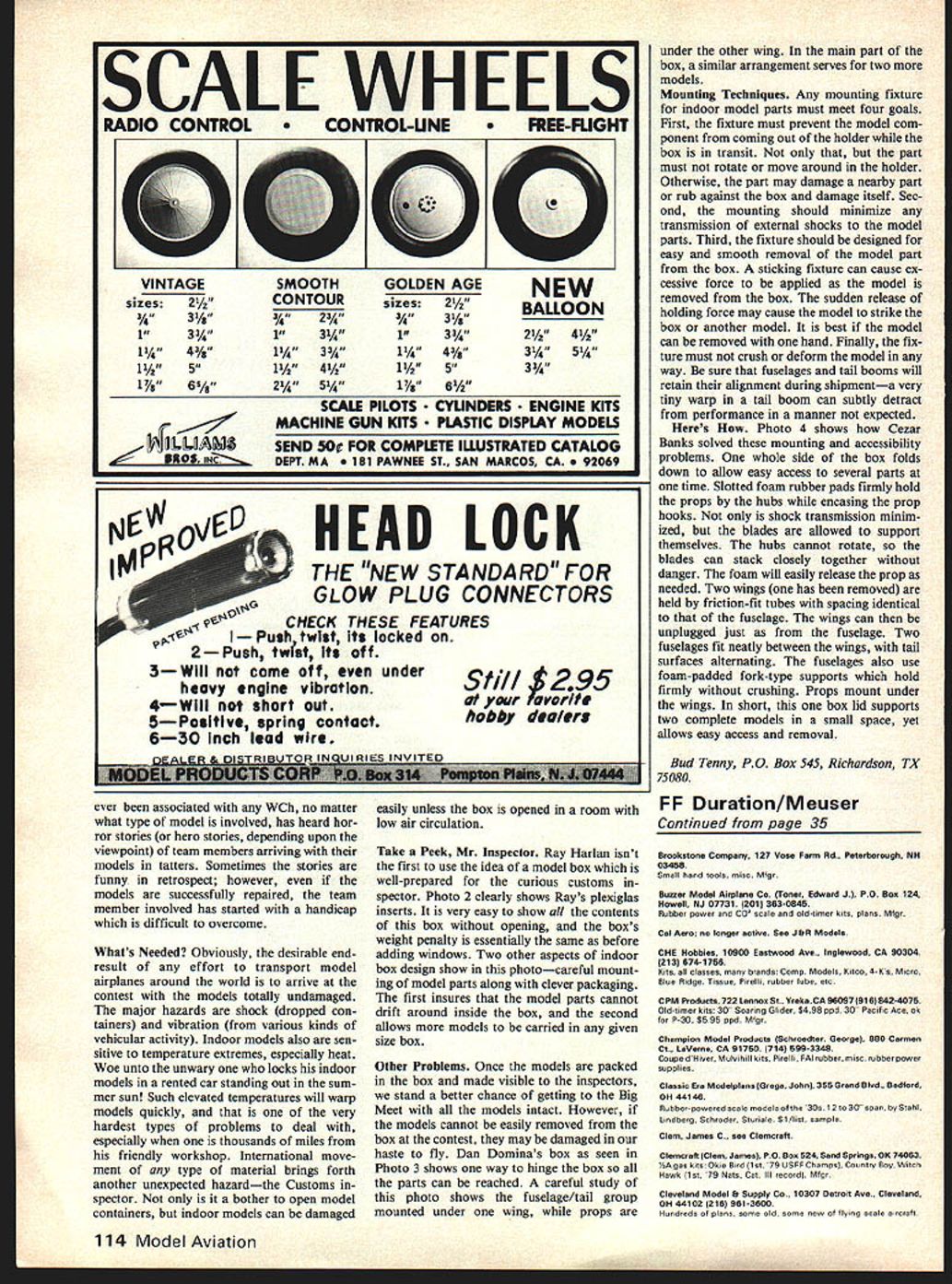
Other Problems Once the models are packed in the box and made visible to the inspectors, we stand a better chance of getting to the Big Meet with the models intact. However, if the models cannot be easily removed from the box at the contest, they may be damaged in our haste to fly. Dan Dominas' box as seen in Photo 3 shows one way to hinge the box so all the parts can be reached. A careful study of this photo shows the fuselage/tail group mounted under one wing, while props are under the other wing. In the main part of the box, a similar arrangement serves for two more models.
Mounting Techniques
Any mounting fixture for indoor model parts must meet four goals.
- Prevent the model component from coming out of the holder while the box is in transit. The part must not rotate or move around in the holder; otherwise, the part may damage a nearby part or rub against the box and damage itself.
- Minimize transmission of external shocks to the model parts.
- Be designed for easy and smooth removal of the model part from the box. A sticking fixture can cause excessive force to be applied as the model is removed from the box. The sudden release of holding force may cause the model to strike the box or another model. It is best if the model can be removed with one hand.
- Not crush or deform the model in any way. Be sure that fuselages and tail booms will retain their alignment during shipment — a very tiny warp in a tail boom can subtly detract from performance in a manner not expected.
Here's How Photo 4 shows how Cezar Banks solved those mounting and accessibility problems. One whole side of the box folds down to allow easy access to several parts at one time. Slotted foam rubber pads firmly hold the props by the hubs while encasing the prop hooks. Not only is shock transmission minimized, but the blades are allowed to support themselves. The hubs cannot rotate, so the blades can stack closely together without danger. The foam will easily release the prop as needed.
Two wings (one has been removed) are held by friction-fit tubes with spacing identical to that of the fuselage. The wings can then be unplugged just as from the fuselage. Two fuselages fit neatly between the wings, with tail surfaces alternating. The fuselages also use foam-padded fork-type supports which hold firmly without crushing. Props mount under the wings. In short, this one box lid supports two complete models in a small space, yet allows easy access and removal.
Bud Tenny, P.O. Box 545, Richardson, TX 75080
Transcribed from original scans by AI. Minor OCR errors may remain.

