
Free Flight: Indoor
Bud Tenny
Another really big show! It has already been noted elsewhere that the 1981 Indoor Nats will be held at West Baden, IN, in the super-site atrium of Northwood Institute. The Nats will be followed by another Peanut Grand Prix and the annual fly-in of the National Indoor Model Airplane Society (NIMAS). The Nats will lead off a really wild week of activity with a day of test flying and three days of competition. The Peanut Grand Prix will give the Peanut Scale fliers another crack at each other, both in relatively normal events and in the far-out fun events, which spring from the fevered imagination of John Martin of the Miami all-Indoor club, Miami Indoor Airplane Model Association (MIAMA).
What's a SNART? Finally, NIMAS winds up the week-long festivities by holding the Sixth NIMAS Annual Record Trials (SNART). Each year, this meet furnishes a change of pace for many modelers — mostly NIMAS members, but not limited to that group. The competition, for all events which have AMA record status, is unusual in that the fliers compete against existing records instead of against each other. This activity is called the NIMAS Index, and winning scores are computed by dividing the actual flight time by the existing record time. The result is that a winner may be flying an Ornithopter and the second-place model may be a Novice Pennyplane. This comes about when the flight times are compared to the record time; the Ornithopter flight may have boosted the AMA record by 5% (for a score of 1.05), while the Pennyplane flight may have been just under the existing record for a score of .995 (99.5% of the record time).
All other competition, which may include non-AMA events, is head-to-head competition in the usual manner. The unusual format at the Index competition gives another dimension to each flier's strategy; not only does he have to get the best possible flight from his model, he has to decide in which of several events his expertise is strongest. An unexpected by-product of Index flying is that it is much less cut-throat than normal competition. Everyone flies pretty much as the mood strikes, and everyone enjoys the activity more.
Indoor wood selection
One of the things which enhances the challenge of indoor modeling is to build models which fly better while weighing less. The time required to build a model is more than one might expect before he tries it. Of course, indoor models are built on various fixtures which improve the accuracy of the construction or make the job of handling small pieces of balsa easier, and it takes time to build the fixtures. Once the fixtures for a particular design have been built, that block of time is removed from the building time. The real chunk of time involved in building one of these models is the agonizing choice of which wood to use! However, since most indoor classes have no minimum weight rules, the strength of the wood in these models is of great importance. If a structure is built from really prime wood, it might be up to 25% lighter for the same strength.
What is strong wood? Balsa wood comes in an incredible range of density, from less than four pounds per cubic foot to over 15 pounds per cubic foot, and the very light balsa tends to be quite stiff compared to a similar weight of higher density balsa. There are two extremes in strength of materials for structures — we can consider that some given force applied to the structure will cause it to break. Of course, that is not the whole story. Glass is apparently very strong, in that we must exert relatively high force against (for example) the rim of a drinking glass before it breaks.
The key item is stiffness, since the glass apparently does not bend or deform noticeably before it breaks. When it does yield, the glass probably will shatter into tiny pieces. A similar plastic utensil may mash flat under much less force, and still not break. Which is stronger, the glass or the plastic copy? From a practical standpoint, either container is far stronger than it needs to be to fulfill the intended purpose of bringing liquid up to our lips. Neither the extra strength nor the stiffness of either container has meaning until there is some unusual event. A mere fall to the floor probably will destroy the glass, but the plastic item will bounce harmlessly around. A crushing force could permanently distort the plastic without spoiling its ability to quench our thirst.
Free Flight: Indoor (continued)
Continued from page 66
Back to indoor models. It appears that stiffness rather than ultimate strength may well be more important for the balsa we build into indoor models, and this is largely true. However, consider that if the model never had to shrug off more stress than that imposed by flight loads, it could be built very lightly. Not very many of us have the touch needed to handle an indoor model which is twice as strong as it needs to be if it could magically appear in flight fully wound, without being touched by human hands! Another factor is the type of ceiling in the site and the condition of the air.
A super-light, very stiff model quite possibly will not survive many flights under these conditions, especially if high drift brings out the steering balloon. The problem is that a very stiff structure can rather easily be bent beyond its limit during a rafter bounce or a steering attempt; usually, the model shatters. Let it bend!
Suppose the model is a bit more flexible? If so, it may well last much longer than the stiff model. So, how can I get a more flexible model which is still light and strong? The answer is to use heavier (more dense) balsa, believe it or not. Here's how: use (for example) six-pound balsa instead of four-pound balsa, and make the cross section of the wood small enough so that the structure weight is the same as before. Now, that is somewhat simplified, since balsa not only varies in density, but in strength and overall quality.
Before cutting a spar from any sheet of balsa, examine the sheet under a magnifying glass. Look for tiny cracks or discolorations which run perpendicular to the grain of the wood. These defects are called compression cracks, and they occur when one tree falls across another one on the ground. These areas are weaker than the undamaged wood, so that a wing spar cut from this sheet may break at one of the compression cracks.
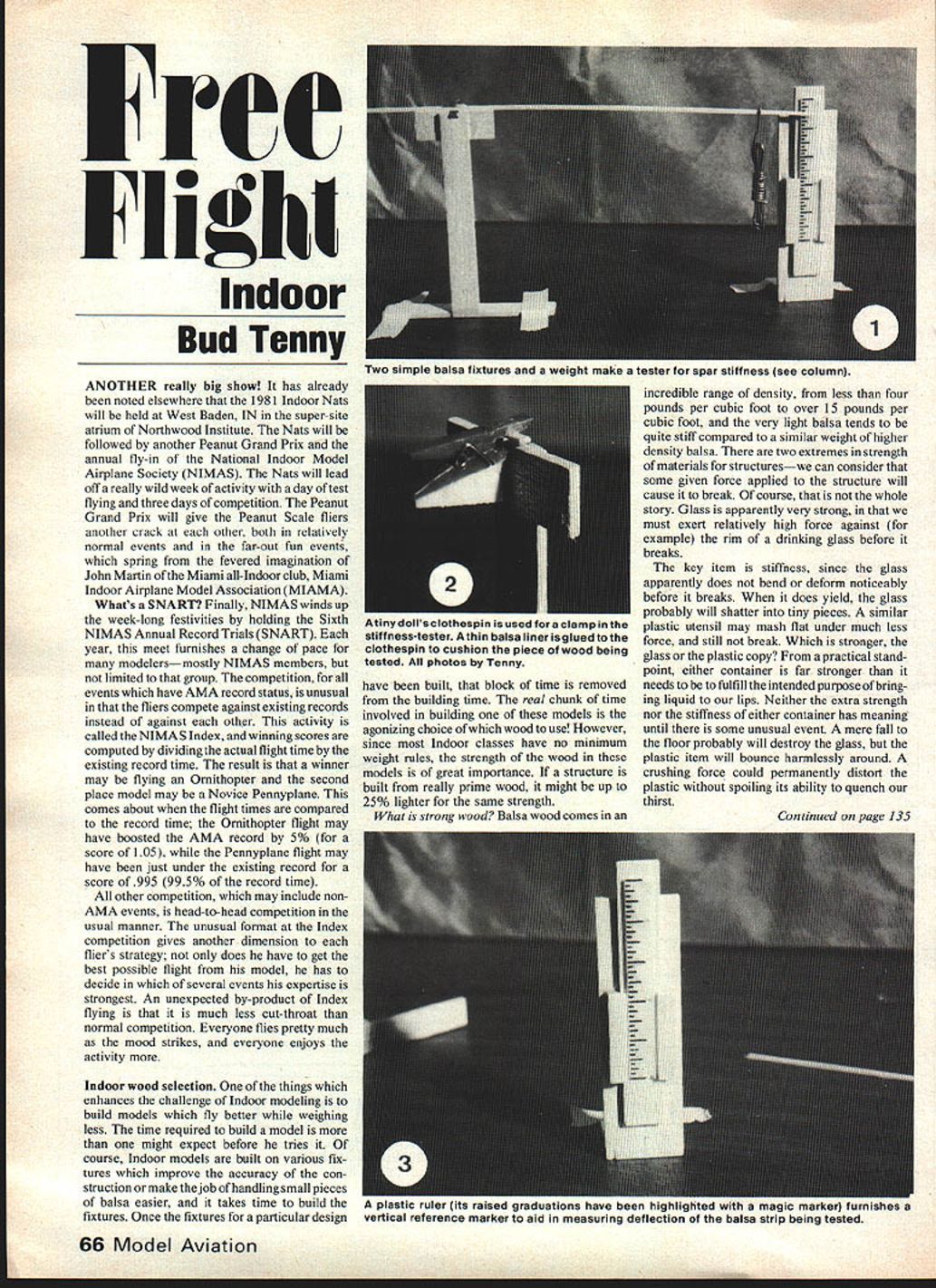
Can I test the wood, somehow? Go to the head of the class! Photo 1 shows a piece of spar wood being tested for stiffness. The stand on the left holds a balsa strip at a given height above the table, while the top of the scale is set even with the end of the balsa strip. Then, a weight is hung on the strip so that the amount of deflection caused by the weight can be measured. Of course, this is not an absolute measurement, so identical testing must be performed on each candidate strip and the results compared so you can judge the stiffness of spars cut from various sheets of balsa.
After a while, you get a feel for what is required, both from a strength standpoint and from a stiffness standpoint. Note that this test does not locate any stress points, soft points in the wood, or compression cracks which you may have overlooked. To find this type of defect, cut a test strip from the balsa sheet which appears to be best. Hold this strip by the ends and force it to bow into a deep curve. Soft areas in the wood will show up where the strip bends with a smaller radius, and it will snap at any compression cracks. If you created a stress point by nicking the wood as you cut the strip, it will fail at the stress point.
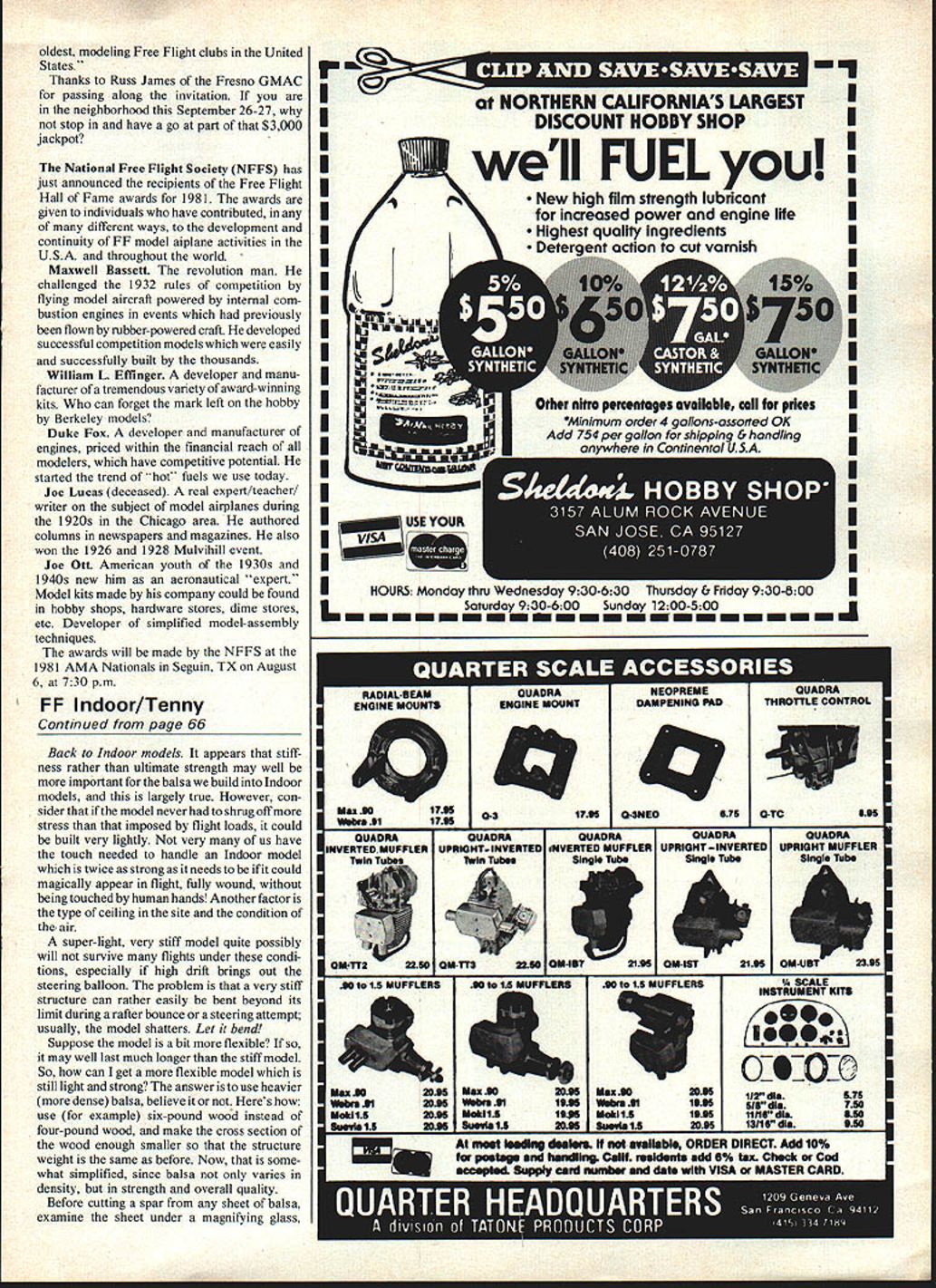
How can I make the tester? Photo 2 shows a closeup of the clamp which holds the strip for testing. The clamp is a tiny doll's clothespin, glued to the stand. If you look closely, you can see that a thin strip of wood, 1/16-in. long, has been glued to the inside of the clamp jaw. This strip avoids damage to the strip being tested by spreading the clamp force over a wider area, and by being as soft as the balsa strip. The bottom of the clamp is inset so it is level with the top of the bar, which also supports the strip.
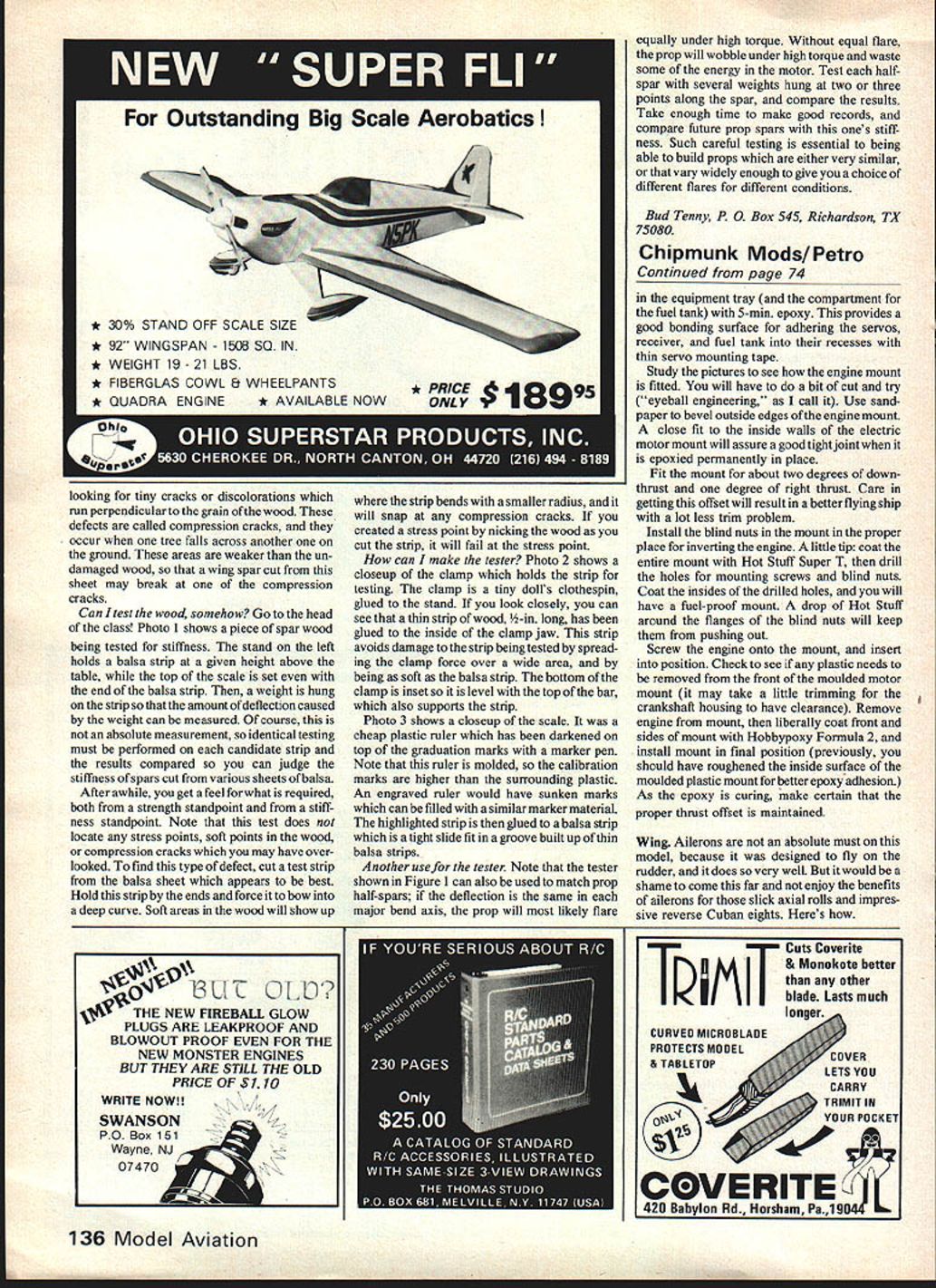
Photo 3 shows a closeup of the scale. It was a cheap plastic ruler which has been darkened on top of the graduation marks with a marker pen. Note that this ruler is molded, so the calibration marks are higher than the surrounding plastic. An engraved ruler would have sunken marks which can be filled with a similar marker material. The highlighted strip is then glued to a balsa strip which is a tight slide fit in a groove built up of thin balsa strips.
Another use for the tester. Note that the tester shown in Photo 1 can also be used to match prop half-spars: if the deflection is the same in each major bend axis, the prop will most likely flare equally under high torque. Without equal flare, the prop will wobble under high torque and waste some of the energy in the motor. Test each half-spar with several weights hung at two or three points along the spar, and compare the results. Take enough time to make good records, and compare future prop spars with this one's stiffness. Such careful testing is essential to being able to build props which are either very similar, or that vary widely enough to give you a choice of different flares for different conditions.
Bud Tenny, P.O. Box 545, Richardson, TX 75080.
Transcribed from original scans by AI. Minor OCR errors may remain.

