
Free Flight: Indoor
Bud Tenny
Book: Building and Flying Indoor Model Airplanes
What you always wanted to know about indoor flying will be answered by Building and Flying Indoor Model Airplanes, by Ron Williams. This Simon & Schuster publication has been eagerly awaited by all who knew about it, and has finally appeared. Order the book from your local bookstore; the paper-bound version is $12.50, and the cloth-bound version is $19.50.
Ron is a professor at Columbia University in New York City, teaching drawing to architecture students. He may be considered by some to be a relative newcomer to indoor flying, but he has tapped the expertise of several noted indoor fliers. The book is so well done that it may well be considered a definitive work. In fact, if enough of you buy it, it might be able to retire this column!
Report from Sweden
Indoor flying is slowly growing in Sweden, with Peanut Scale model activity the latest development. Sven-Olov Linden is one of the boosters of indoor activity in Sweden, and published plans of Peanut versions of Swedish aircraft in Allt om Hobby, a Swedish modeling journal.
Several years ago, when pennyplanes were beginning to be popular in the United States, a similar activity began in Sweden and is now doing well. The Swedish "pennyplane" class is called "25-öres," after a local coin which weighs somewhat less than a U.S. penny; all other rules are comparable to the U.S. Pennyplane class.
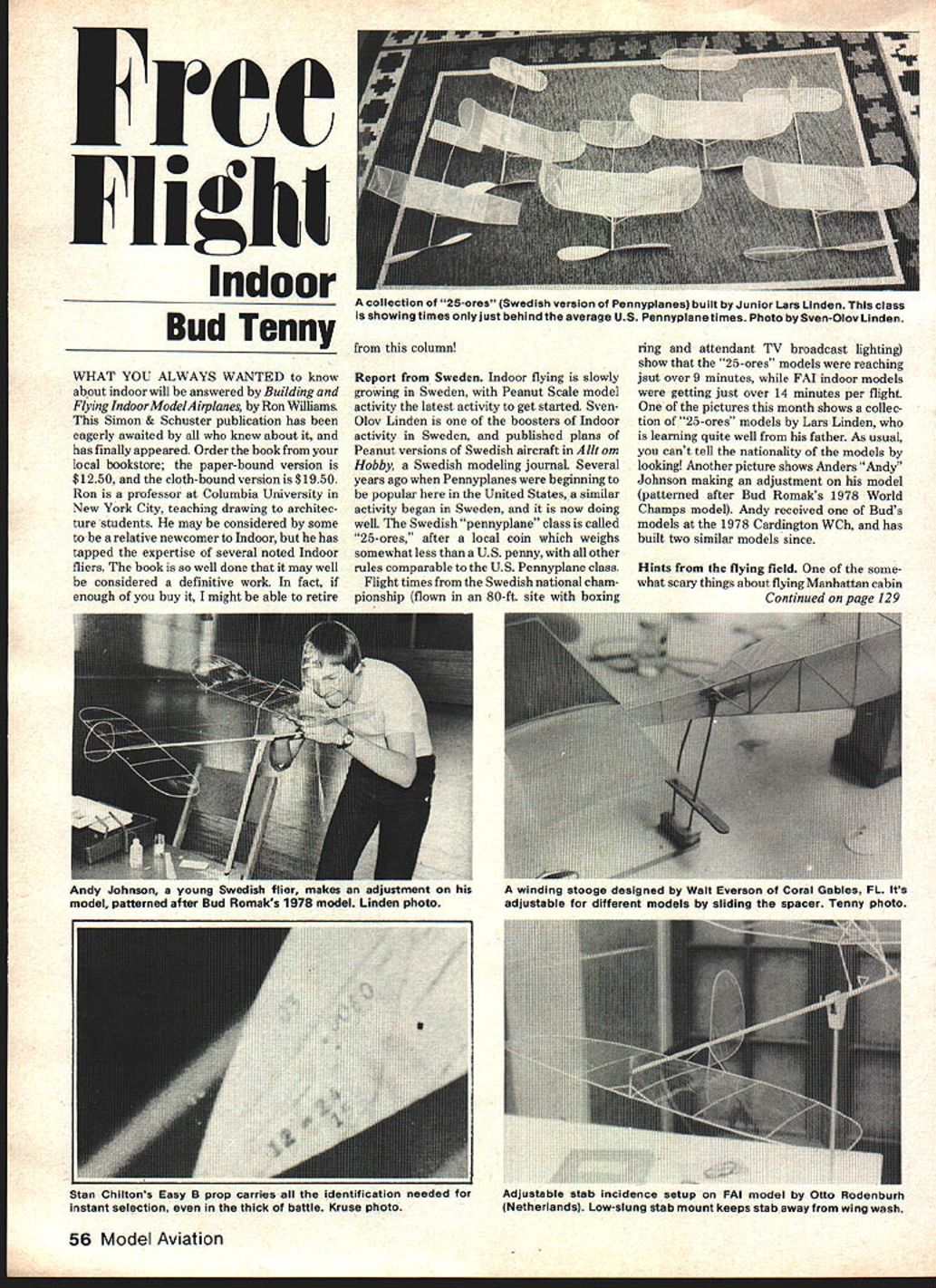
Flight times from the Swedish national championship (flown in an 80-foot site with a boxing ring and attendant TV broadcast lighting) show that the "25-öres" models were reaching just over 9 minutes, while FAI indoor models were getting just over 14 minutes per flight. One of the pictures this month shows a collection of "25-öres" models by Lars Linden, who is learning quite well from his father. As usual, you can't tell the nationality of the models by looking!
Another picture shows Anders "Andy" Johnson making an adjustment on his model (patterned after Bud Romak's 1978 World Champs model). Andy received one of Bud's models at the 1978 Cardington World Championships and has built two similar models since.
Hints from the flying field
#### Winding motors and using a stooge One of the somewhat scary things about flying Manhattan cabin models and the lighter Scale models is the problem of safely winding the motors. A trusted helper, experienced in handling such models, can hold the model and help with hooking the loaded motor to the prop and getting the noseblock safely in place. Many fliers prefer to use some sort of stooge or anchor for the model so they can wind the motor and fly without depending on someone else who may need to fly his own models.
Walt Everson, of Coral Gables, FL, uses a stooge with a special feature to help wind his Manhattan cabin model. Walt's stooge has two vertical wires that hold the rear motor peg, and they have an inward bend about halfway up from the base. This bend, coupled with a wood spacer that slides up and down on the wires, allows the "jaws" to open or close as the spacer moves. To release the model, Walt slides the spacer down so it forces the top ends of the wires apart enough for the model to be inserted or removed. With a bit of advance planning during construction, this type of stooge can be built to hold many different models. In this case, the height of the wires is set to match the model's landing gear height so the model is approximately level when set up to fly.
A word of warning: if you build any kind of model stooge, be absolutely sure it is strong enough to hold the model! A good test is to place a strong peg in the stooge, place a typical motor on the peg, and stretch-break the motor. If the stooge can withstand this, it will surely withstand normal wear and field usage, provided you have it safely anchored before hooking up the motor.
#### Mark your props! Unless you have only one prop of each design, there is always the chance of grabbing the wrong prop in the heat of battle. It is very advisable to have identifying marks on your props.
- Stan Chilton identifies his Easy B props with neat numbers showing in sequence (top to bottom): prop number, weight, diameter and pitch. Besides such comprehensive data on the item itself, record the prop number as part of the flight records of the model which uses that prop.
- Stan's idea of using a rubber stamp for Easy B props adds essentially zero weight but makes an indelible identification for the prop.
- A series of colored dots made by soft-tipped pens will work similarly for built-up, microfilm-covered props — either coded to your own system or simply as an ID that refers to a written record elsewhere for the exact details.
#### Trim the tail feathers Otto Rodenburg of the Netherlands uses an adjustable horizontal stabilizer. He gives credit to Dieter Siebenmann (Switzerland) for the basic tail layout and advocates using some kind of adjustment for the stabilizer.
Changing the wing incidence often involves changes in rigging, and it is otherwise difficult to make very small adjustments in wing incidence in a manner that will hold reliably. In the case shown, the stabilizer is permanently supported by a bipod at the leading edge, and the bottom of the fin is also stabilized by the stabilizer leading edge. The stabilizer pivots slightly around the joint at the bipod as the angle of attack is changed by sliding the rear stabilizer post in a small tissue socket.
The very fine degree of elevation control this adjustment affords is almost a luxury and allows a model to be fine-tuned for minor changes in site conditions. One other point about this arrangement: the underslung mount for the stabilizer lowers it enough to keep the stabilizer out of the wing's downwash under almost any flight conditions.
#### Keep up with the rules proposals! About this time last year, we awoke to find we had to fly under very unpopular Easy B rules, at least for the rest of 1980 and all of 1981. My own investigations showed that we didn't do our part — we, as fliers, gave the Free Flight Contest Board almost no guidance with regard to the rules proposals they had to consider in the 1978–79 rules cycle.
We are now in the final stages of a new rules cycle, and rules under consideration will become effective in 1982. Carefully examine all recent issues of Model Aviation (Competition Newsletter section), and continue to watch as the various cross-proposals are enacted. Contact the FFCB member for your district, and give him feedback on your desires! If you don't vote, it's not fair to complain about the election results.
Bud Tenny P.O. Box 545 Richardson, TX 75080
Transcribed from original scans by AI. Minor OCR errors may remain.

