
Free Flight: Indoor
Bud Tenny
An Important Proposal
Erv Rodemsky, current World Champion and CD of the recent Team Selection Finals, noted that most of the top fliers at the finals lost between one and six models during the meet. Although the flying conditions were not really good, he felt that the weather in the Santa Ana hangar wasn't a factor in the destruction derby, since the air wasn't turbulent, just cool.
So where did the models go? Erv felt that the models have evolved to a top level of efficiency for the rules we have, which necessitates an extra push by all the top fliers. As a result, the models spend more and more time near the ceiling, getting hung up or worse. Another factor which costs models is the relatively large wing area and long motor sticks. These two factors give a model that is harder to handle and needs a large box to transport — the minimum of six models one should have for top-level competition.
What's the solution? After a lot of thought and discussion with other fliers, the following proposal developed for an event called Santa Ana Stick:
- Wingspan — 60 cm (23.622 in.)
- Length excluding prop — 60 cm.
- Weight excluding rubber — 1 gram.
- Projected area of horizontal lifting surfaces — 1200 sq. cm (186 sq. in.). Biplanes must include the area of both wings.
- Motor weight — ½ gram.
- No gears for motors or mechanical gadgets to change prop pitch or flying surfaces. All configuration changes must be aeroelastic.
Why so drastic? Actually, the only drastic thing is the reduced rubber weight. Erv feels that even if the current model size is not reduced, the motor weight should be reduced. He arrived at that conclusion after several years of test-flying models with half-length motors. Such testing has two major advantages: the models can be flown on full torque—fully wound—without climbing to the top of a hangar, and without staying up over half an hour. Thus, both models and time are saved by short-motor tests.
In addition, Erv forecasts that the slightly smaller wing and (probably) much shorter motor stick will fit in a box which can be carried into the cabins of airliners during trips to contests. The model should be much stronger, with about a 5.5-in. wing chord. Even with the smaller wing chord and span, the wing loading should be about the same due to the lighter motor (about 0.7 grams lighter).
It has been said that this rule places a higher premium on having really good rubber, and this is true. In the long run we must admit that the only winners are those with both good luck and good rubber.
In retrospect, we must remember that the original reason for the change to 65 cm models (first try), and then one-gram 65 cm models, was to reduce the flight times so that organizers of World Championships would not have to furnish both staff and site for the relatively long time required to fly off a high-entry World Championship. Neither approach has worked, so the missing ingredient may well be to limit the amount of rubber. One thing for sure—we would have to learn a few things about handling rubber when it is wound to higher relative torque levels, and perhaps we will need to learn more about picking certain kinds of rubber.
One other aspect of the Santa Ana Stick has not been mentioned: the model fits existing rules, and in fact the smaller, stronger model might be exactly what is needed on cool, turbulent days and in low ceilings. With that in mind, we can assume that anyone who built one to the rules change wouldn't really be building an "orphan" model; it could still be quite useful.
Follow-up
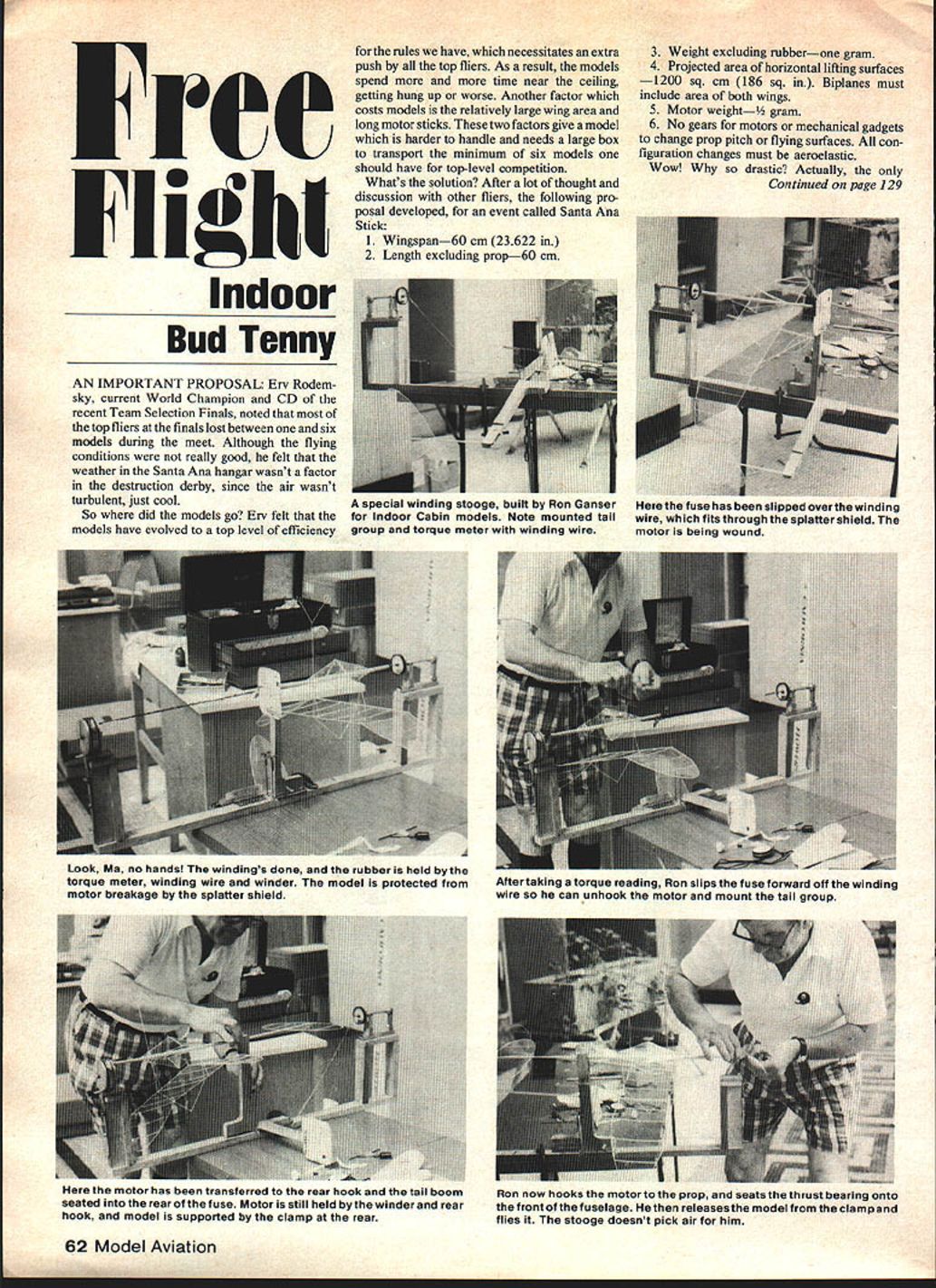
In a couple of past issues I discussed various field gadgets and methods of winding. I also requested that Indoor Cabin fliers tell us of their pet methods for safely winding their special beasts. The series of pictures with this column show the most elaborate scheme we've seen, but it really works well in spite of the apparent complexity. The photos show the fixture used by Ron Ganser at the 1981 West Baden Indoor Nats and at the NIMAS SMART event; I believe Ron said it was designed by someone else, and I forgot who. Sorry about that!
Look at the close-up of the basic fixture. Note the winding wire hanging from the torque meter, and the tail boom and tail assembly inserted in its holder. After mounting the tail group, a second holder is swung into place with the fuselage/wing assembly slipped over the winding wire and the winding wire slipped into the splatter shield. Although it may not show after printing, the motor has been hooked to the winding wire and was actually being wound when the picture was snapped. Note that it would be very unlikely for a motor broken during winding to damage the model, since the model is not rigidly fastened (the holder won't flinch!), and the splatter shield should catch the broken motor. Once the winding has been completed the motor is accessible for Ron to smooth out the knots, etc.
In the next photo Ron has just removed the splatter shield and moved the fuselage forward onto the motor. In the next-to-last picture, Ron has taken a final torque reading, unhooked the motor from the winding wire, swung the tail group into place, and transferred the motor to the model's rear hook. At this point, the model is fully wound, almost untouched by human hands. At any range of the game, Ron has been free to rest or do anything else he needed to without giving his helper a nervous attack or a cramp from holding the motor! Finally, Ron attaches the prop. After seating the thrust bearing properly in the front of the fuselage, all he has to do is loosen the clothespin-type clamp holding the rear of the model, lift it out, and go fly it. I watched Ron use this thing several times, and he seemed always in command, and much more at ease than is possible with the more usual two-man winding dance most fliers use. This gadget may not make Cabin more popular, but it sure makes it less scary to wind one!
Bud Tenny, P.O. Box 545, Richardson, TX 75080
Transcribed from original scans by AI. Minor OCR errors may remain.

