
Free Flight: INDOOR
Bud Tenny
Proposal follow-up
In the last column I reported on Erv Rodemsky's rules proposal for FAI Indoor models. Since that report, Erv built such a model and tested it in a ceiling just over 100 ft. high. After preliminary tests the rubber weight was increased from 1/2-gram to 3/4-gram. The model made a flight just over 21 minutes, dead-sticking near the ceiling. With subsequent flights using slightly different rubber the duration should approach 25 minutes. This is a positive indication that the proposal should work, and Erv plans to incorporate the new rubber-weight limitation in the proposal.
Congratulations, MIAMA!
The Miami Indoor Aircraft Model Association (MIAMA), the first and perhaps the only all-Indoor AMA Chartered Club, recently celebrated 10 years of continuous activity. It is almost the only model club with year-round indoor activity. Club strength for the 1980–81 season is approximately 20 Open-class fliers and eight Juniors. Good show!
Flying opportunities
- MIAMA contests at the Opa Locka Goodyear Blimp Hangar:
- January 10, 1982
- February 14, 1982
- March 14, 1982
- April 11, 1982
- May 9, 1982
- MIAMA Cat. I fun-fly sessions at Miami Dade Junior College:
- January 17, 1982
- February 21, 1982
- March 21, 1982
- April 18, 1982
- May 16, 1982
- For MIAMA information contact:
- Dr. John Martin, 3327 Darwin St., Miami, FL 33133
- Glastonbury Modelers (Glastonbury, CT) flying sessions:
- January 10, 1982
- February 7, 1982
- March 7, 1982
- April 4, 1982
- February and April sessions are contests; the other dates are fun-fly sessions.
- For details contact George Armstead, 89 Harvest Lane, Glastonbury, CT 06037.
After-meeting activity
Some model clubs liven up their meeting nights with impromptu contests. The San Diego Orbiteers run several classes for this purpose: A-6 Models, a limited-span HLG class, and paper airplane contests.
A-6 class rules:
- Maximum wing area: 30 sq. in.
- Maximum prop diameter: 6 in.
- Maximum motor stick length: 6 in.
- Strip size: 1/16 sq. in.
- Minimum sheet balsa: 1/32 in.
- No special indoor materials allowed
- Prop must use flat balsa sheet blades, or stock plastic prop is allowed
- Wing and tail rib minimum size: 1/32 x 1/16 in.
- Prop shaft minimum: 1/32 in. dia. wire
- Covering: tissue only
- Power: rubber only
The most recent A-6 contest was won by Cezar Banks with flights of 3:22 and 3:19 minutes in a small gym. The class began when the Orbiteers sent tissue and a plan out with their monthly newsletter; Fudo Takago supplied some Pirelli for the first contest. Even at the first meet, a number of different designs showed up—proving that ingenuity is alive and well in San Diego. The HLG class is reportedly limited to 6-in. span gliders; the meets are hard-fought events, and throwing one of those mini-gliders is an experience!
Paper airplane contests
Two classes:
- One Design: plan provided; no modifications permitted, but warping and other flight adjustments are allowed.
- Free Form: design it yourself; models must be built entirely from the provided 8 1/2 x 11 paper (tape and glue are allowed). Otherwise, cut and fold as needed.
Scoring: longest single flight in each class.
The Orbiteers' Second Annual Paper Airplane Contest had 12 entrants and was won by Orbiteers president Cezar Banks with an 11-second flight.
Club uses historic site
The Columbia Indoor Miniature Aircraft Society holds monthly flying sessions in the rotunda of the Low Memorial Library at Columbia University, New York City. The rotunda is octagonal in cross section and about 105 ft. high, usually with very good flying conditions. One of the regular fliers is Bill Tyler, a model aviation pioneer. Photos show Bill with his Manhattan Cabin model and a shot of another Manhattan flying past one of the many statues that decorate Low Library—meet Euripides, Greek dramatist.
New technology!
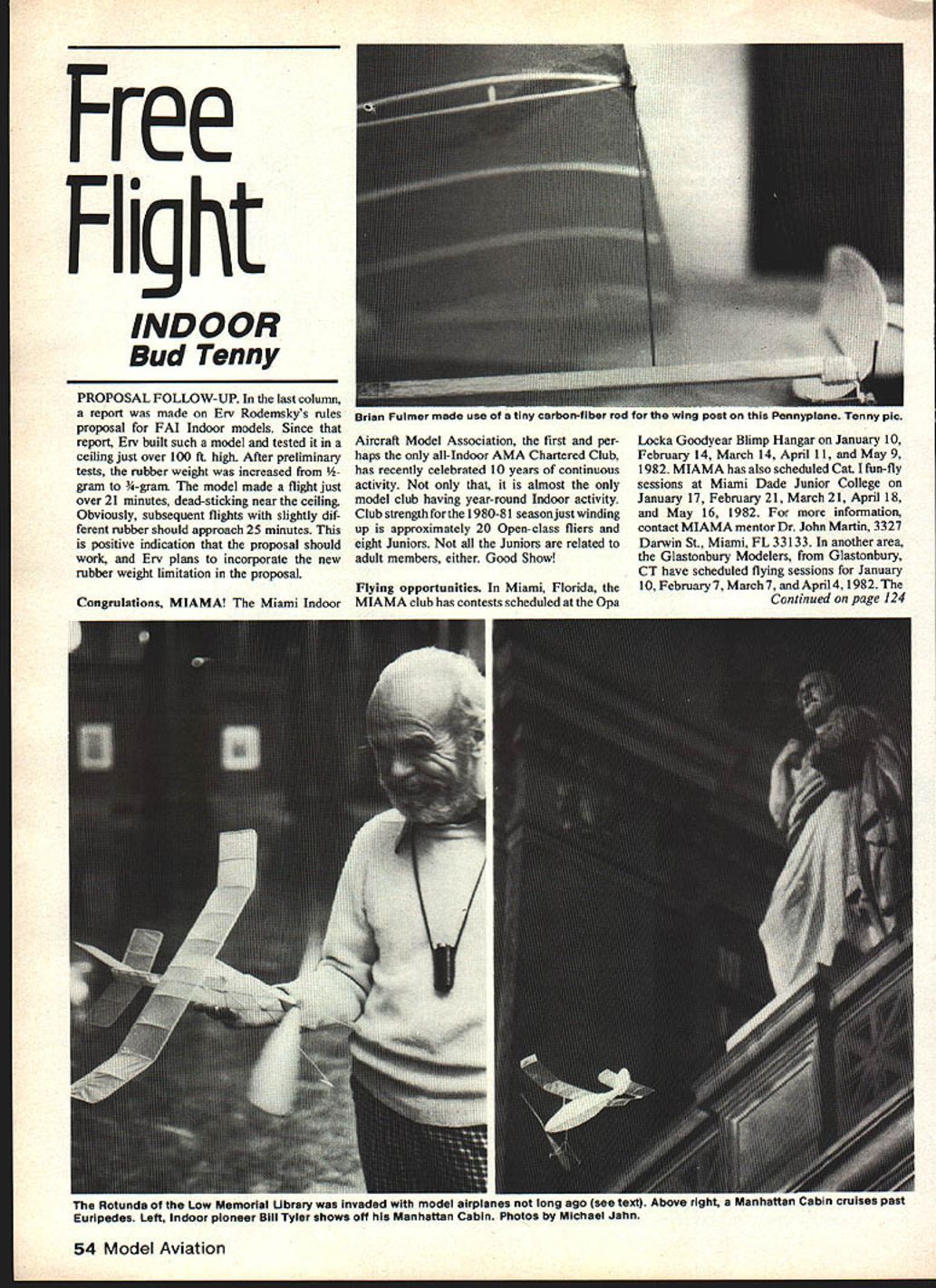
A close-up photo shows a unique wing post used by Brian and Bradley Fulmer. The post was made from carbon-fiber rod obtained as a special sample given to their father. This material may not be generally available except by special order, but the example shows the ingenuity of modelers—always alert for new materials and techniques.
Thank you, newsletter editor!
Each year I remind readers how much club members owe the editor of their club's newsletter. I receive many newsletters in trade and often see others. They range from single-page sheets announcing meetings and flying sessions to 10-page (or longer) issues with technical articles, hints, and plans. Clubs with winter-only indoor activity (and scale clubs) typically have very large newsletters with excellent plans and indoor hints. All this free information is a boon to club members—have you hugged your editor today?
Bud Tenny P.O. Box 545 Richardson, TX 75080
Transcribed from original scans by AI. Minor OCR errors may remain.

