
Free Flight: INDOOR
Bud Tenny
GOOD NEWS and bad news. The good news is that Indoor Week is set up for 1983; what we don't know is what type of event will be held during the first part of the week before the annual NIMAS bash — whatever John Martin decides to call it this time. Indoor Week will begin June 12, 1983 and last until June 19.
Now, for the bad news: that may be the last Indoor Week at West Baden, since Northwood Institute has decided to close that campus and sell the facilities. So, at this time, we have no idea if it will ever be possible to use that site after 1983.
More bad news. I recently received a letter from Ferdinando Migani in Italy. His news is that Pirelli rubber strip will no longer be produced. So, unless you find a cache somewhere, what you have is all you will have. Once again, we will be searching for good rubber to fly our models.
Interestingly enough, the term "good rubber" seems to mean different things to different people, and very few people even know how to test rubber to determine its ultimate potential.
So, what's good rubber? Obviously, we need a definitive, non-destructive test for rubber quality. Over the years, we have developed rule-of-thumb turn tables and other indicators of rubber quality. We all have been searching for knowledge of how to apply our rubber more effectively. What is really needed is a way to test rubber to its limits without breaking it.
I once did extensive rubber testing, and stopped when I realized that I had no really effective tests to measure what I was looking for. I finally came to realize this when I found a piece of rubber which was as good as any I had previously tried. Using the conventional tests, when I pushed this particular sample beyond normal limits, I found that it had perhaps 25% higher energy storage capability than any I had seen; it was by accident that I found out how good that rubber really was.
So, if there is anyone out there who is interested in designing a rubber test, now is the time! Just remember — each sample must be tested with no preconceived notion of what it "ought" to be capable, and you must discover, non-destructively, what the energy storage limit of that sample really is.
Model boxes
Periodically, we check out what other people do to protect their models when the models aren't in use. The ideal model box would be one that will hold more models than we will ever need at one meet, carry all those models without damage no matter how roughly we handle the box, and yet be easy to get the models into and out of. That's a tall order, and probably not possible without a bit of magic. Part of the problem is trying to mount the model components in a way that holds them safely but still allows easy removal.
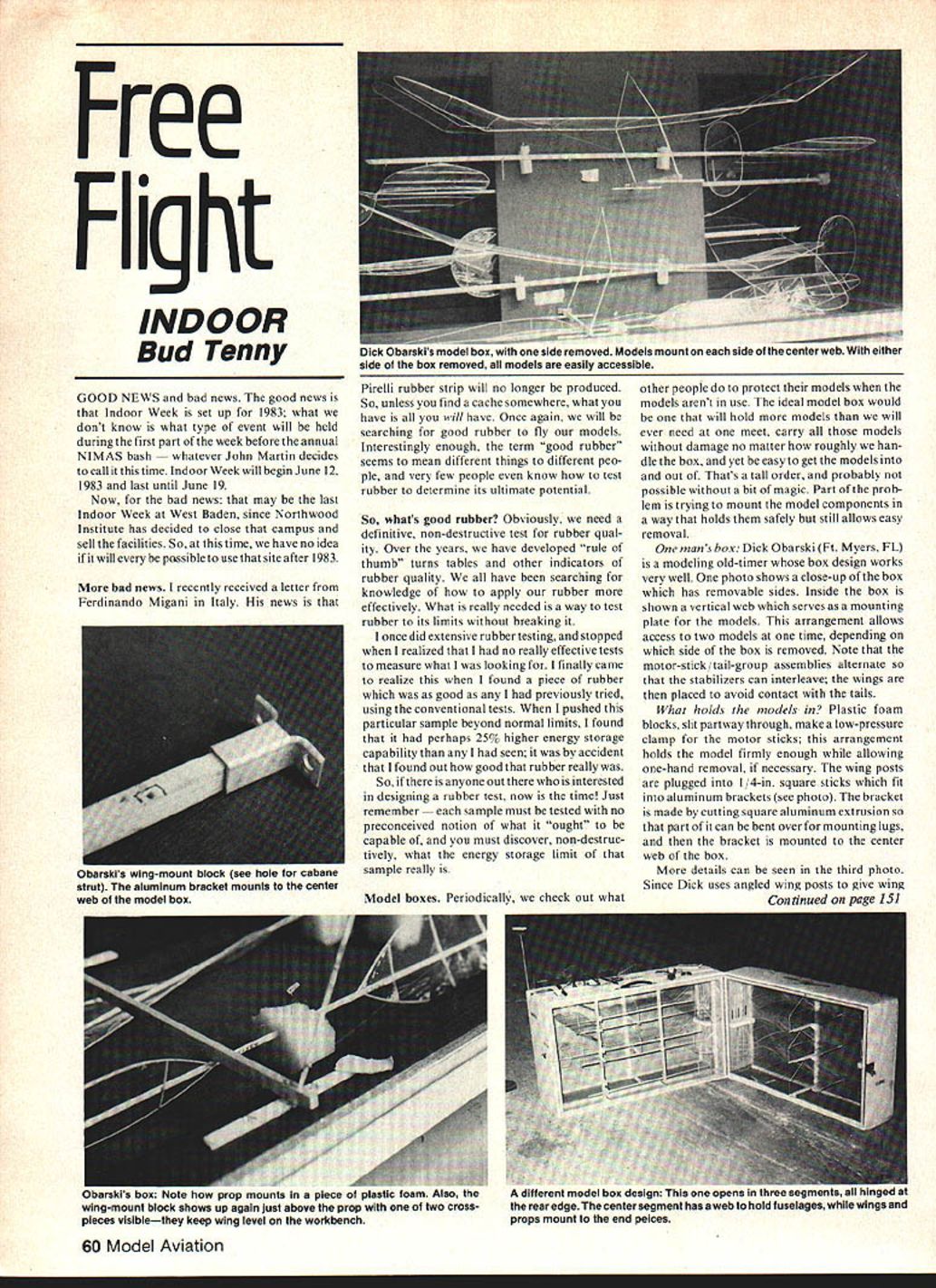
One man's box: Dick Obarski (Ft. Myers, FL) is a modeling old-timer whose box design works very well. One photo shows a close-up of the box which has removable sides. Inside the box is shown a vertical web which serves as a mounting place for the models. This arrangement allows access to two models at one time, depending on which side of the box is removed. Note that the motor-stick/tail-group assemblies alternate so that the stabilizers can interleave; the wings are then placed to avoid contact with the tails.
What holds the models in? Plastic foam blocks, slit partway through, make a low-pressure clamp for the motor sticks; this arrangement holds the model firmly enough while allowing one-hand removal, if necessary. The wing posts are plugged into 1/4-in. square sticks which fit into aluminum brackets. The bracket is made by cutting square aluminum extrusion so that part of it can be bent over for mounting lugs, and then the bracket is mounted to the center web of the box.
More details can be seen in the photos. Since Dick uses angled wing posts to give wing offset, note that the posts go through the mount block at an angle. The 1/16 x 1/4 balsa crosspiece serves as "feet" for the wing assembly when it is removed from the box during model assembly at the contest. Also in that photo is another plastic foam block, this one holding a prop. The writing on the prop spar is to identify the prop. Marking props and other related components is an excellent idea, since it helps to avoid mistakes when assembling models when you're in a hurry.
Another approach: The fourth photo shows the box used by Sal Cannizzo (Staten Island, N.Y.) at the 1972 Cardington World Champs. This basic design has been around a long time and is also very handy. The box consists of three pieces hinged together. The two end pieces form a box in themselves, while the center piece is a hollow shell with a center web. The usual mounting scheme is as shown, with wings in the end pieces and the motor stick/tail group mounted to the center web.
This box was also covered with plastic foam to help cushion the box from handling shocks. A later innovation helped overseas travelers at customs stations: a battery-powered interior light and thick plastic windows in the box allow customs officers to see the box contents without its being opened.
Club meeting fun
Many model clubs in the country have mini-contests to wind up their meetings and (perhaps) get more members out to meetings. The San Diego Orbiters have been particularly innovative in this area, and other clubs may wish to try something similar. For example, their contests have included:
- Miniature rubber-powered models built to their A-6 formula — about half the size of an Easy B, with strict size and construction limitations. The A-6 models are usually flown in a gymnasium, with times around three minutes per flight.
- An annual paper airplane contest, with two classes:
- "One Design" class — airplanes built to a particular plan with the club furnishing instructions and materials.
- "Free Form" class — entries constructed from one 8-1/2 × 11-in. sheet of paper. Tape, glue, and paper clips can be used, and the paper can be cut and spliced as necessary.
- 6-in. span Hand Launched Gliders, usually flown in very low ceilings.
One other event, apparently not tried by the Orbiters, is the Matchbox Model. In this event, the usual rule is that the model must fit into an ordinary kitchen matchbox, assembled and ready to fly. Any type of model, either glider or power, can be used, with the single high-time being the winner.
The limited model
Several years ago, the Tech Model Aerofliers of MIT, a club originated by Professor Larrabee of the Aeronautical Engineering department, flew what could be the ultimate in encouraging innovative model design. In this class, the contestant was furnished the following materials:
- One piece of 1/32-in. sheet balsa, 12 in. long
- One piece of 1/8 × 1/4 balsa, 12 in. long
- A 6-in. diameter plastic prop and shaft
- Aluminum tubing for prop bearing
- Thread and glue
The idea was to design the model ahead of time, then build it at the contest from the materials provided. This event has produced a number of very unusual designs in the past and sounds like a real fun thing. Much of the innovation comes from pre-planning how to cut the sheet balsa so as to get best usage of the wood and still produce a winning model.
Florida contests
The Miami Indoor Aircraft Modelers Association (MIAMA), one of the first all-indoor clubs in the nation, holds indoor contests and fly-ins almost year-round. Their 1983 season schedule includes a series of contests at Miami Dade South College on:
- January 16, 1983
- February 27, 1983
- March 27, 1983
- April 24, 1983
The meets all are run on Sunday, from 9 a.m. to 5 p.m. In addition, the club usually has a fly-in at other sites in the area, and the group flies Peanut Scale, AMA Scale, Easy B, Penneyplane, HLG, and occasionally other events such as ROG.
Bud Tenny, P.O. Box 545, Richardson, TX 75080.
Transcribed from original scans by AI. Minor OCR errors may remain.

