
Free Flight: INDOOR
Bud Tenny
A Unique Opportunity!
Dave Erbach is the Event Director for an International Ornithopter Postal Contest for flights made between December 1, 1982 and December 1, 1983. Flights entered in this unusual and challenging event can be made at any indoor contest sanctioned by FAI or any affiliated national organization (such as AMA). If you have seen an earlier announcement of this event, note that Indoor Model Supply (Lew Gitlow) has donated $100 for cash prizes, raising the total prizes to $80 for first place and $50 for second place.
In addition, a $35 prize in merchandise is offered for the highest flight made by a model built from the Indoor Model Supply ornithopter kit. More information and a set of rules can be obtained by writing to Dave at 1738 St. Marys Road, #702, Winnipeg, Manitoba R2N 1G8, Canada. Entry is free, and this is an interesting way to enjoy the challenge and frustrations of flapping-wing flight.
One thing for sure—an ornithopter is always a crowd-pleasing sight. If they work properly, people are awestruck; if they fail, the sight is really funny!
Are ornithopters hard to fly? Man's earliest flight attempts centered on wing-flapping, and the lack of success is due to the poor power efficiency (compared to props) inherent in mechanically displacing air with reciprocal motion. Model ornithopters (has there ever been a full-scale, man-carrying ornithopter except in science fiction and fantasy stories?) are an extra challenge to produce lightweight mechanisms strong enough to handle the power required. Perhaps this International Postal Contest will produce some advances in materials which will greatly advance the art.
More flappers!
At least two countries are holding special events in conjunction with Dave's International Postal meet. In England, Reg Parham, who flew biplane flappers, is organizing activities there. In Japan, Shigeyoshi Nonaka ("father" of indoor flying in Japan) is organizing the All Japan Ornithopter Championship. This is reputed to be the first contest for ornithopters in more than 40 years. Mr. Nonaka hopes to push his model to six minutes; if he does, this will be a 50% advance in the state of the art!
More rules for Indoor Week
The previous column (April 1983 MA) gave the special rules to be used in the Second United States Indoor Championships for the Rubber Speed and Kit-Plan Scale events. The following rules will be in effect for Manhattan Cabin and Bostonian Cabin:
Manhattan Cabin
- Airframe weight (sans rubber): minimum 4 grams.
- Overall length: 20 inches maximum, measured from front of prop bearing aft.
- Fuselage:
- Must support and enclose a single rubber motor. No motor sticks.
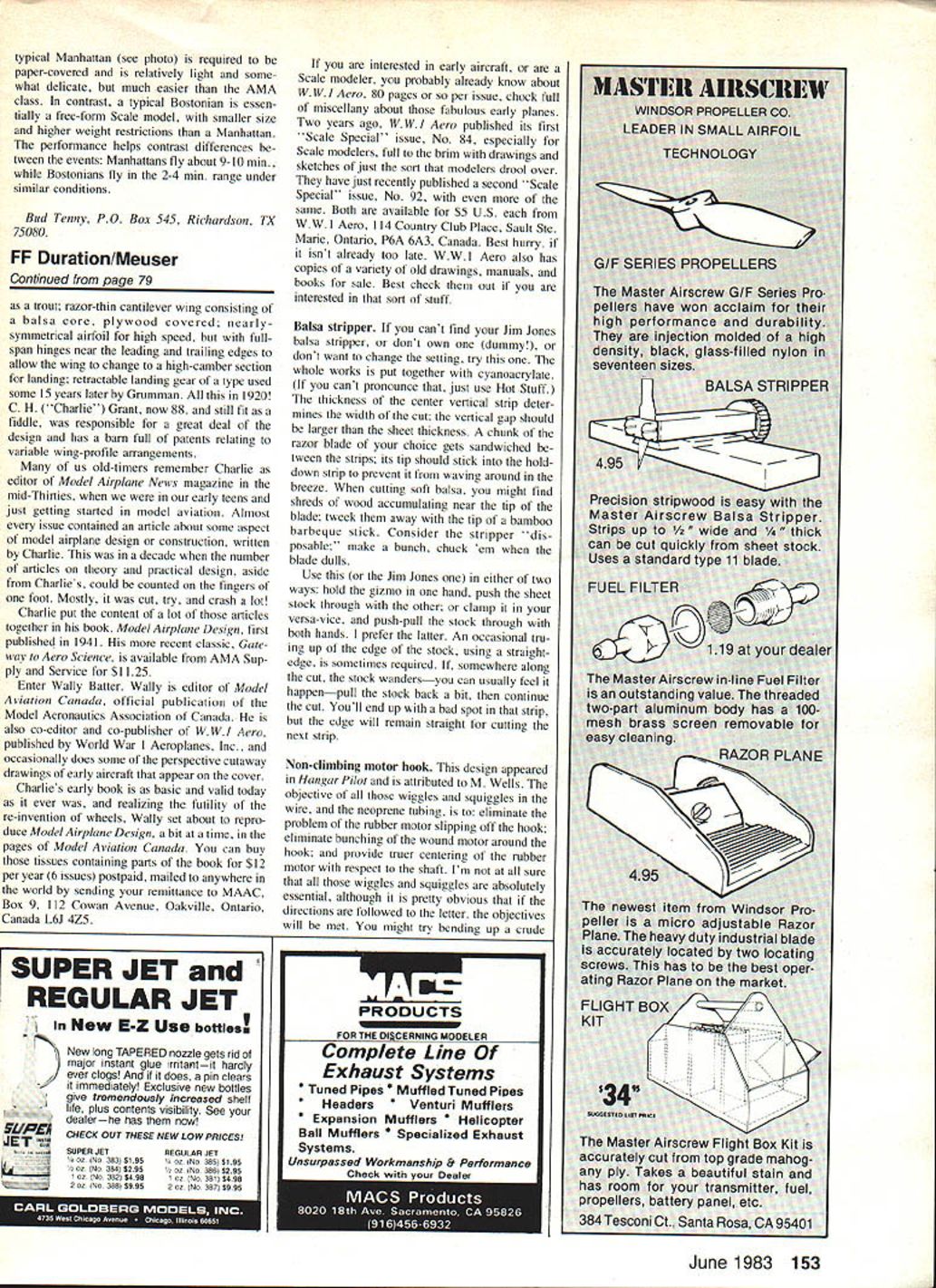
- Must include or exceed a theoretical "box" measuring 2.5 x 4 x 2 in.
- Must have a windshield of 2 sq. in. minimum area, plus a window on each side of 1 sq. in. minimum area covered with cellophane or similar transparent material.
- Prop: All wood, direct drive, fixed-pitch.
- Wing: Monoplane with maximum projected span 20 in. and maximum 4-in. chord. Wood bracing allowed.
- Stab: Monostab with maximum projected span 8 in. and maximum 3.5-in. chord. Wood bracing allowed.
- Landing gear: Rigid and fixed with at least two wheels of 1 in. minimum diameter. Must be able to support airplane.
- Covering: Except for windshield and side windows, only paper (including condenser paper) or Microlite allowed (no microfilm).
- Flying: All flights at least two-point ROG. Best single of unlimited number of official flights is counted.
- Charisma Factor: The judge rates each model on how the model appeals to him, based on construction neatness, scalelike details, uniqueness of design, etc. A 1.0 to 1.2 rating is used. Two models may be given the same rating; models are rated against each other, not against the 1.0 to 1.2 scale.
- An unlimited number of official flights is allowed, with the total of full seconds of the best three official flights multiplied by the Charisma Factor.
Bostonian Cabin
- Maximum projected span(s): 16 in.
- Maximum wing chord(s): 3 in.
- Maximum propeller diameter: 6 in.
- Power limited to one or more rubber motors.
- Minimum weight without rubber motor(s): 7 grams.
- Maximum overall length is 14 in., measured from the front of the propeller bearing.
- Fuselage must contain a theoretical "box" measuring 1.5 x 2.5 x 3 in. or larger; the longerons of which must both support the motor(s) and form, or exceed, the box requirement. No motor stick allowed. The fuselage must have a forward windshield and a window on each side, each of which must equal or exceed 1 sq. in.
- Landing gear must be fixed, with two or more minimum-diameter 0.75-in. wheels, and rigid enough to support the model to a hand-glided landing.
- ROG takeoffs are required on all official flights.
- Charisma Factor: The judge rates each model on how the model appeals to him, based on construction neatness, scalelike details, uniqueness of design, etc. A 1.0 to 1.2 rating is used. Two or more models may be given the same rating. The models are not rated against each other, but against the 1.0 to 1.2 scale.
Vintage Model Notes: The Spin III
The Spin III handles wind well. The combination of sweepback, dihedral, and low center of gravity makes it very stable. I will caution you, however, when trimming and flying vintage-type models, to watch the amount of power you try to fly them on. Use as little power as possible to get the model to climb slowly. Excessive speed on this type of aircraft causes radical flight patterns.
I've been using a Cox .049 engine with a wood 8-4 propeller, and I have had good results. The engine will not turn that propeller too fast. A Davis Diesel conversion was used at one point very successfully.
If you haven't tried it before, it is a good idea to keep a flight log book on your Spin III. By recording the fuel amounts, flight times, flight pattern, and weather conditions, you will be able to closely predict future flights. The Fokker's rigging should be inspected and repaired regularly to maintain proper trim and strength. The vibration of the engine and occasional snags from sticks on landing will tend to loosen the rigging and the nuts and bolts. This may allow the model to go out of trim. The log book will tell you where everything should be before each flight.
Once trimmed for flight, you can spend as much time detailing the Spin III as you wish. The dummy engine, fuel tank, and so on can be made from wood and tubing. They add a lot of realism as would a pilot. For detailing and documentation, the resources listed on the plans are worth looking into. Check the library; it may unexpectedly turn up something.
I would hope you will try the Spin III. If not, use it as inspiration to build that one special model you've always wanted. It's worth all the time you put into it as you watch it circle overhead.
FF Indoor/Tenny Continued from page 77
Second United States Indoor Championships (Indoor Week)
Oops! The previous column, which told all about Indoor Week (June 12–19, 1983) failed to tell how to enter, so let's repeat some and add to it. The Second United States Indoor Championships is sponsored by the National Free Flight Society (NFFS) and the National Indoor Model Airplane Society (NIMAS), and will be held the first four days of Indoor Week. The site is the atrium of Northwood Institute at West Baden, IN.
Times are scheduled for practice flying on Sunday, June 12 followed by 15 AMA and special events running through 1 p.m., June 15. Beginning immediately thereafter is the Fourth Peanut World Grand Prix, which runs for 24 hours. Following the Grand Prix will be ENART, the annual NIMAS event, which runs until sometime Saturday, June 18, 1983.
For more information about the U.S. Indoor Champs and to get entry blanks, send a SASE to Tony Italiano, 1655 Revere Dr., Brookfield, WI 53005. Entry deadline to avoid late entry fee is June 1, 1983 postmark. For entry in the NIMAS ENART, get entry blank and info from Dr. John Martin, 3327 Darwin St., Miami, FL 33133. For entry of proxy-flown Peanuts in the Grand Prix: Mike Arak, 10900 SW 61 Court, Miami, FL 33156. For more details on the Kit-Plan Scale event, contact Martin Varney, 1020 N. Wood, Griffith, IN 46319.
Join up!
By the way, to compete in the Indoor Champs, you must be a member of AMA (you already are, or you wouldn't be reading this), and either NFFS or NIMAS (Juniors and Seniors excepted). If you call yourself a Free Flighter and you aren't a member of NFFS, then you are cheating yourself and all other FFers! Two reasons why:
- NFFS is actively involved in many activities which help perpetuate the activity; your dues money helps insure that you will always be able to fly the most challenging kind of miniature aircraft.
- If your name is on the NFFS rolls, this is proof of interest in Free Flight. Of necessity, certain AMA deliberations are affected by the relative number of participants in each category (FF, CL, RC, etc.). They can't count you if you're not signed up, and thus it hurts us all. To a lesser degree, this is true for NIMAS also.
To join NFFS, write Hal Woods, 707 2nd St., Davis, CA 95616. For info for NIMAS—Bud Tenny, P.O. Box 545, Richardson, TX 75080.
NFFS Publications
Part of the on-going service of NFFS for the Free Flight buff is an impressive array of plans and other technical publications which have been gathered and made available for purchase. To obtain a list of what's available, send SASE to Fred Terzian, 4888 Moorpark Ave., San Jose, CA 95129.
Why so many cabin classes?
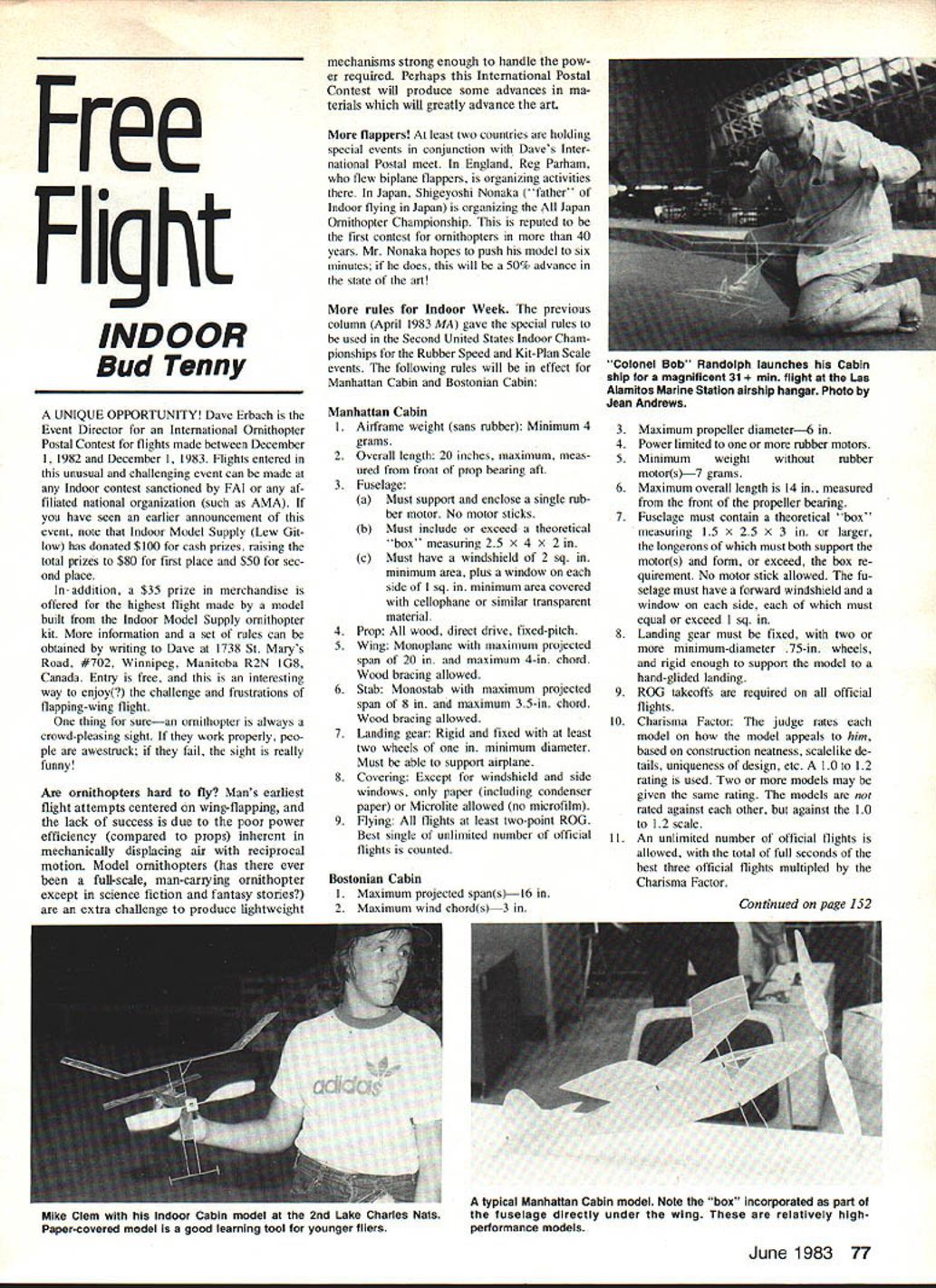
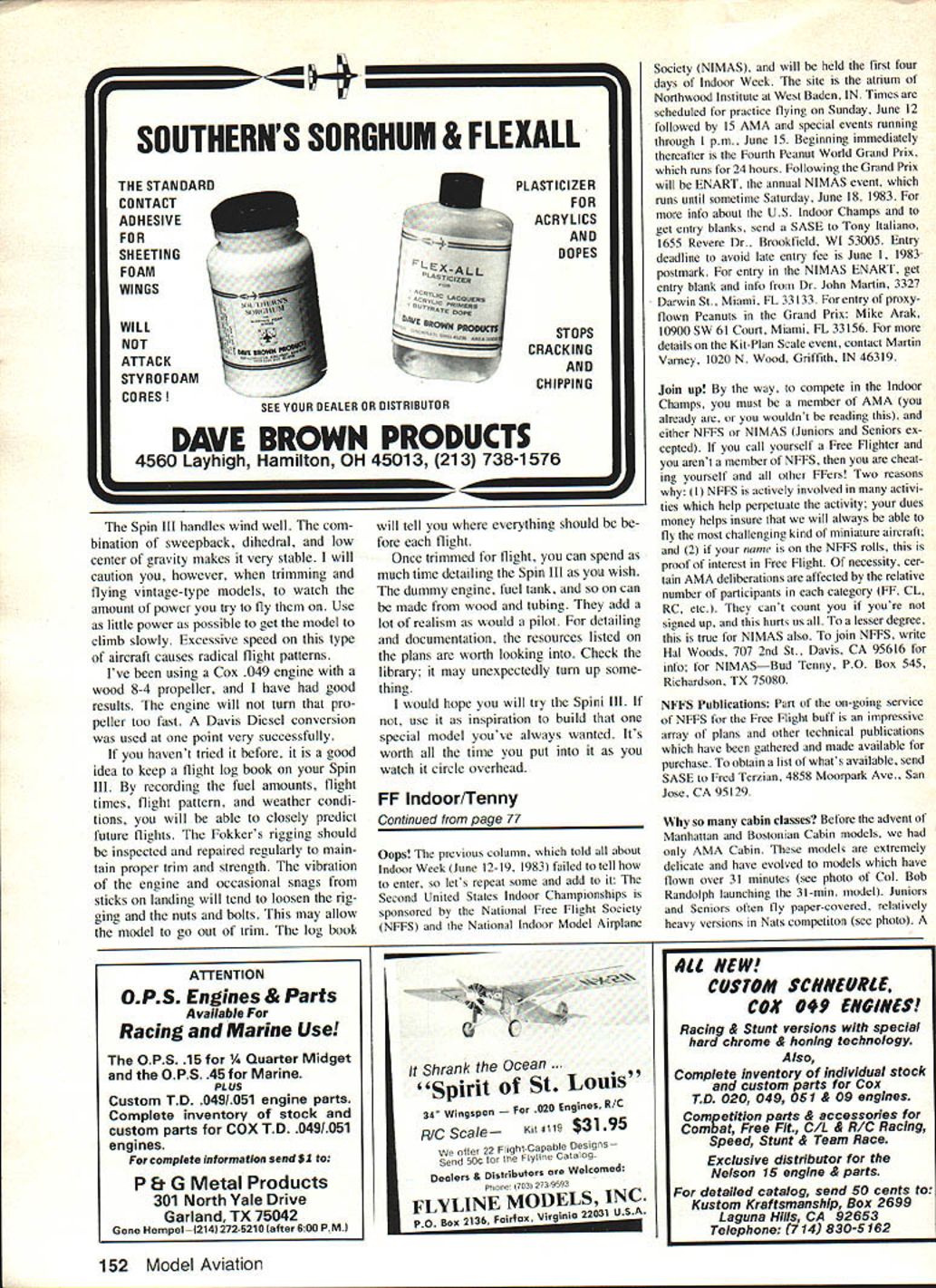
Before the advent of Manhattan and Bostonian Cabin models, we had only AMA Cabin. These models are extremely delicate and have evolved to models which have flown over 31 minutes (see photo of Col. Bob Randolph launching the 31-min. model). Juniors and Seniors often fly paper-covered, relatively heavy versions in Nats competition.
Bud Tenny, P.O. Box 545, Richardson, TX 75080.
Transcribed from original scans by AI. Minor OCR errors may remain.

