
Free Flight: INDOOR
Bud Tenny
Different strokes. Sometimes we get all wound up in our regular competition events to the neglect of the unorthodox events and some of the offbeat non-AMA events. Examples include:
- Helicopter, Ornithopter, Autogyro
- Grapenut Scale, A-6, Towline Glider
While there is nothing wrong with concentrating on competition events, we miss out on the change of pace and the different challenge of these other events. Several clubs around the country have included one or more special events in their contest and Fun-Fly schedules, often with good success.
For example, the MIAMA club in Miami, FL, has helped pioneer a number of specialized scale events, notably Peanut Scale. Doc "Genial John" Martin's unusual (read "invincible") leadership has guided the 24-hour-long World Peanut Grand Prix series to its present success. Recently, Doc got MIAMA started on Autogyros—both scale and non-scale machines. Their recent club events also included Pistachio Scale (a smaller-than-Peanut class, limited to 8 in. wingspan or 6 in. overall length). To keep things hopping, John has announced a special event for Pistachio Scale, called the '83 GNATS; it will be held as part of the Fourth World Peanut Grand Prix at West Baden, IN on June 17, 1983.
Meanwhile, in New York, Ed Whitten and Ron Williams have been active with their Record Trials and contests held in the Rotunda of Low Library on the Columbia University campus. Besides regular AMA events (no gliders because of the building's glass), they have flown 35 cm Stick and canard pushers. Since Ed Whitten is the "daddy" of both Manhattan Cabin and Bostonian Cabin, this group has helped pioneer these events. Last year, when there was much discussion about down-sizing FAI Stick models, one contest at Columbia ran a special event to try out one set of proposed FAI rules.
The canard pusher rules used at Columbia may interest some; they make for a fun event. The key points were:
- No minimum weight
- No maximum dimensions
- Forward (canard) surface(s) must be 50% or less in area of rear (main) surface(s)
- No stabilizer (stab) to the rear of main surfaces allowed
- Propellers must be to the rear (pusher configuration)
- Rubber-powered only
Response to those rules produced a wide diversity of models, ranging from a 1.2 g condenser-paper-covered model using an Easy B wing to a 12 g fully legal Bostonian. Flight times reached as high as 11½ minutes, and one model climbed so well it rocketed to the top of the building and landed in a light fixture on its very first flight.
The Columbia group is notable for its range of talent and experience: former Indoor World Champion Pete Andrews; longtime aviation artist and indoor pioneer Bill Tyler; juniors Mark and Lisa Ferguson; Ed Whitten (stock broker and publisher of The New York Indoor Times, a free newsletter circulated to indoor fliers on the East Coast, and author of a Beginner column "Junior Flight!" for Model Aviation); Ron Williams (Columbia professor and author of Building and Flying Indoor Model Airplanes, Simon & Schuster, 1981); John Zaic (one of the founders of Zaic Model Supplies); Doug Barber (a hardworking newcomer to indoor modeling); and pioneers Bill Sinram, Frank Haynes, and Don Garofalow. This diversity produced contest flight times such as 13–16 minutes in Easy B, 14+ minutes in 35 cm Stick, 7+ minutes in Pennyplane, and about 4 minutes in Manhattan Cabin. For perspective, the Low Library Rotunda is just over 100 ft high but relatively skinny—only 75 x 75 ft. Times are good when drift is low, but the small dimensions and many obstacles can make activity frustrating at other times.
Rules misunderstanding?
Although rules matters are not usually covered here, one current indoor rules proposal has raised concerns in at least one newsletter and in personal discussions I have had. This is IND-84-2, by Jack Carter of Racine, WI. The proposal would establish seven beginner classes of graduated difficulty and is fairly complex. The point to stress is that Jack's proposal is to create a set of Provisional classes, which has no effect upon the normal operation of AMA or the existing competition class structures. So, if you have been worried about flooding the existing field with a bunch of new model classes, this proposal would not do that.
Speaking of rules—in case you have been too busy to notice, the new Indoor Contest Board is in the second phase of considering its first slate of proposals. It is appropriate for every indoor modeler to review the existing proposals and contact his District representative (addresses are given in the AMA "Competition Newsletter" section of this magazine) and tell him how you feel about each proposal. If you don't, you have no complaint coming if he votes for rules you don't like!
Many of you will remember the utter horror we all felt when the "all-micro" Easy B was adopted a few years ago; no one wanted it, but no one told the Free Flight Contest Board it was a bad idea. Since no one opposed it, it passed and had to be rescinded due to its total unpopularity. Speak up!
USIC update
Two events of interest have been added to the attractive venue lined up for the United States Indoor Championships (USIC), sponsored by the National Free Flight Society and the National Indoor Model Airplane Society.
- An open forum on indoor rules will be held at 8:00 p.m. on Monday, June 13, 1983. The forum chairman is AMA Contest Board coordinator Don Lindley, who places no restrictions on the kind of indoor rule discussion that may take place, but he requests that complaints be accompanied by constructive, well-thought-out alternatives whenever possible.
- On Wednesday evening during the banquet following the Indoor Championships, the keynote speaker will be Bob Champion, a retired chief test pilot for NASA. Mr. Champion has years of experience as a test pilot, including flying high-speed aircraft, STOL aircraft, and the Rogallo-wing aircraft which NASA tested as an early spacecraft recovery scheme.
Ornithopter followup
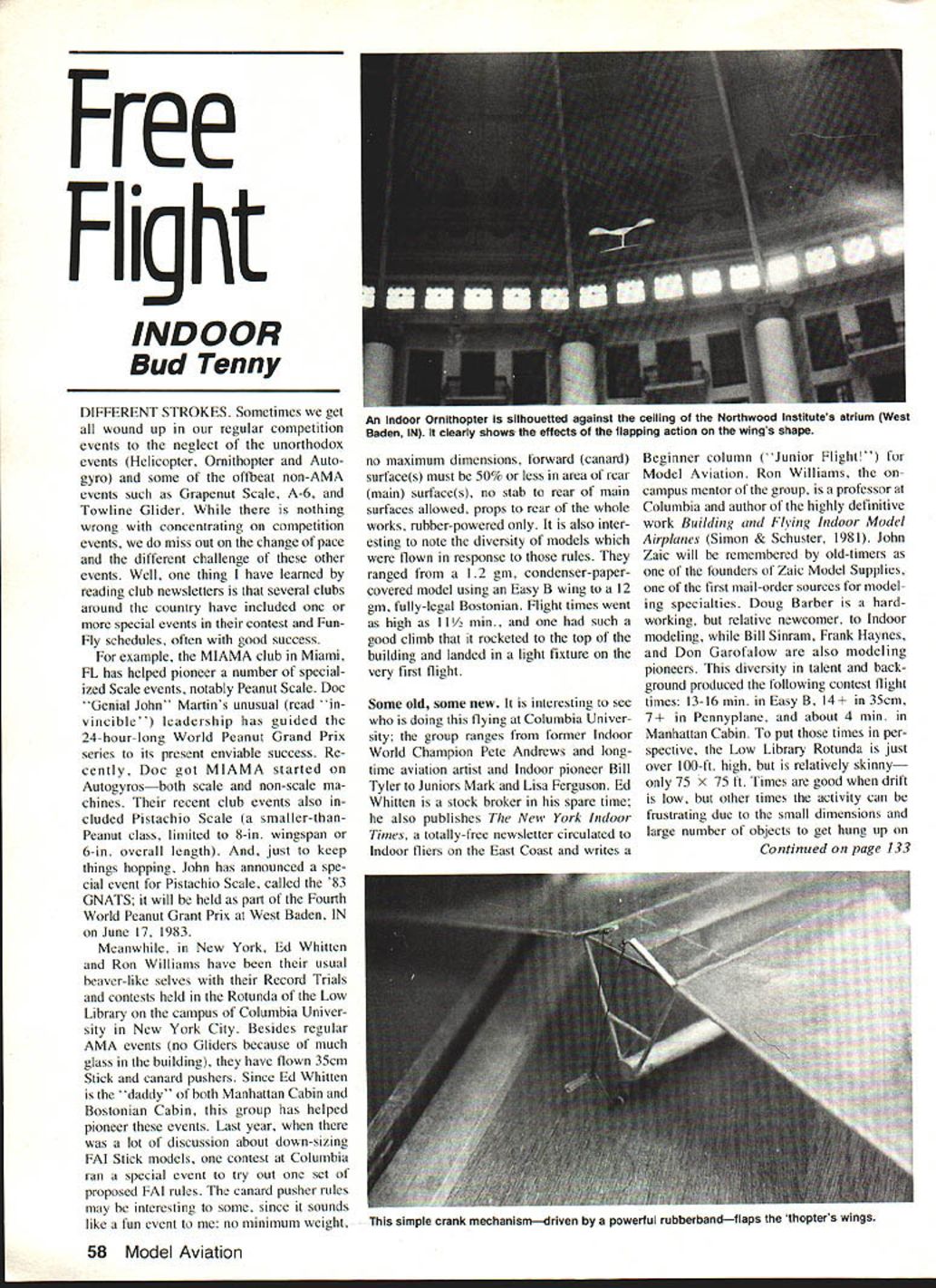
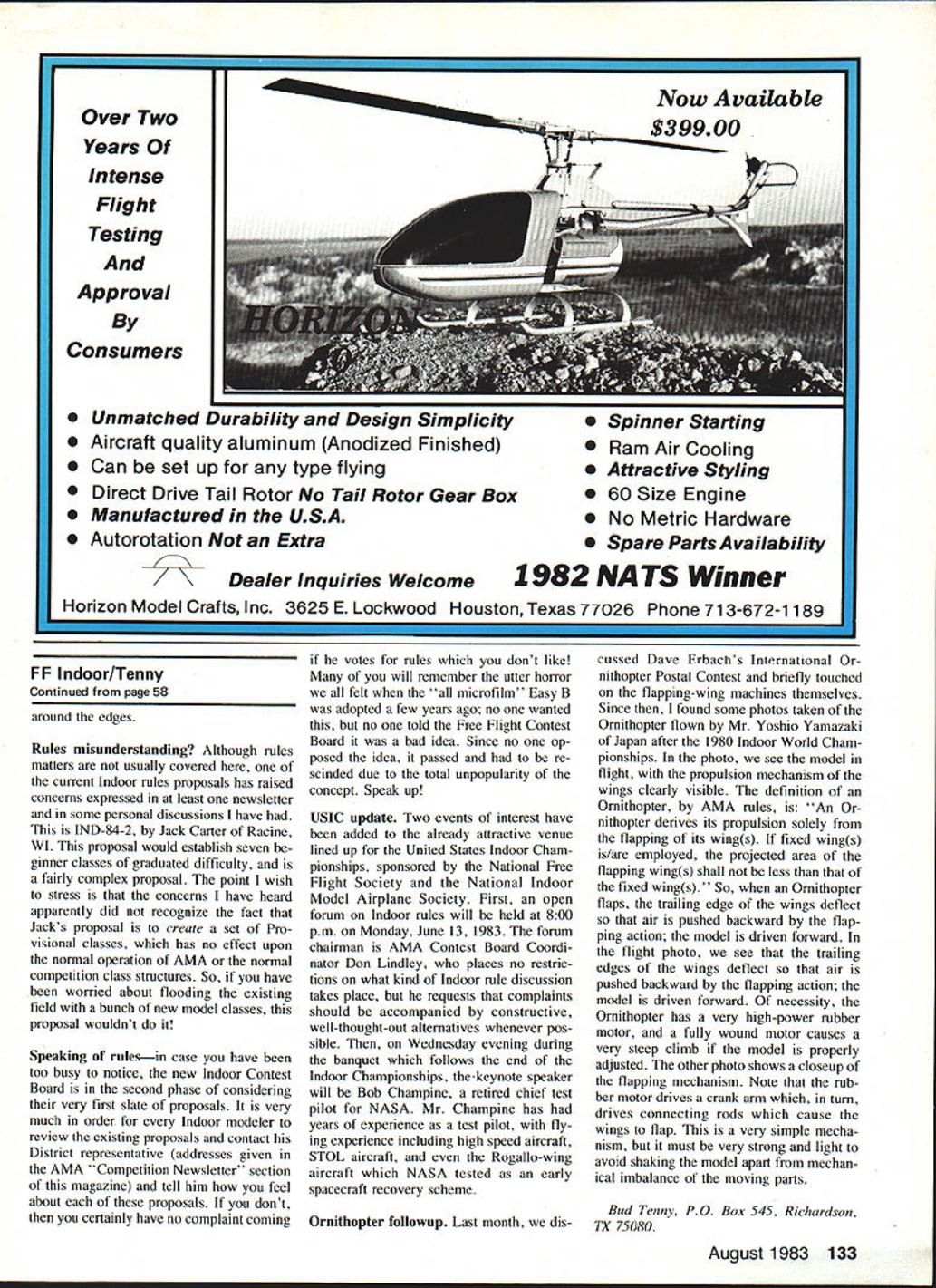
Last month we discussed Dave Erbach's International Ornithopter Postal Contest and briefly touched on flapping-wing machines. Since then I found photos of the ornithopter flown by Yoshio Yamazaki of Japan after the 1980 Indoor World Championships. The flight photo shows the model in flight with the wing propulsion mechanism clearly visible.
By AMA definition: "An Ornithopter derives its propulsion solely from the flapping of its wing(s). If fixed wing(s) are employed, the projected area of the flapping wing(s) shall not be less than that of the fixed wing(s)."
When an ornithopter flaps, the trailing edge of the wings deflects so that air is pushed backward by the flapping action, driving the model forward. The design therefore requires a very high-power rubber motor, and a fully wound motor causes a very steep climb if the model is properly adjusted. A closeup shows the flapping mechanism: the rubber motor drives a crank arm which, in turn, drives connecting rods that cause the wings to flap. The mechanism is simple but must be very strong and light to avoid shaking the model apart from mechanical imbalance of the moving parts.
Bud Tenny, P.O. Box 545, Richardson, TX 75080.
Transcribed from original scans by AI. Minor OCR errors may remain.

