
Free Flight: Indoor
Bud Tenny
LOOK SHARP! That applies two ways to the Rubber Speed event: first, it is often run for short periods on a fixed schedule, so be sure you don't miss it. Second, flight judges need to watch carefully to be sure a model hasn't "cut" a pylon.
Rubber Speed (Circle/Peanut Speed)
A new event on the scene at a few contests is called Rubber Speed, Circle Speed, or Peanut Speed — the challenge is the same. The rules call for two pylons placed 20 ft. apart, and the model is required to take off and make two complete circles around the pylons. The score is based on the elapsed time required for the model to complete two full laps — the faster the model, the lower the time and the better the score.
"Aw, that's easy!" So it would seem, but it hasn't proved as easy as it sounds. Quite a few people tried the event at ENART, but only five managed to complete the course. The basic problem is that it's fairly easy to get a model to fly controllably around the pylons at slow speed, and it isn't really much harder to get a model to fly somewhat faster. The trick is to load up an otherwise docile model with a lot of rubber and get it to remain "in the groove" while the heavy rubber does its best to shed prop blades. (Remember, you will probably try it with some model you have around, and the model may not have enough ground clearance to ROG with the larger prop that could absorb the power better.)
It's a design problem. Anyone who wins this event consistently will likely build a special model for it. Several problems must be handled simultaneously — problems related to how airplanes fly. Remember the question, "What makes an airplane climb — the throttle or the elevator?" If you trim an airplane for level flight, advancing the throttle makes it climb and throttling back makes it descend. So an airplane with fixed trim can be very sensitive to power setting.
Experienced free-flight modelers know that certain flight adjustments are speed-sensitive, some are power/torque-sensitive, while a few are useful over a broad range of power or speed conditions. For example: thrust adjustments are more effective during the power burst; stab (stabilizer) tilt has about the same effect over a broad range of speeds; and rudder or elevator trim is quite speed-sensitive.
Can it be done?
Yes. I saw two or three models that came close, and I am sure regular competition will produce models substantially faster than those flown at ENART. Below is an analysis of what happened at that contest.
Results at ENART
- Brian Varney (Junior) — 5.25 seconds for two laps. Brian's model was roughly a small HLG wing with almost no dihedral and a wad of rubber driving a 5-inch plastic prop.
- Mike Arak — 7.36 seconds. His model was similar in layout to Brian's but larger and less controllable.
- Butch Hadland — 8.67 seconds. Butch flew a very nice Fokker Peanut Scale model that flew quite fast and, more importantly, had a consistent, flat left turn that minimized wasted motion.
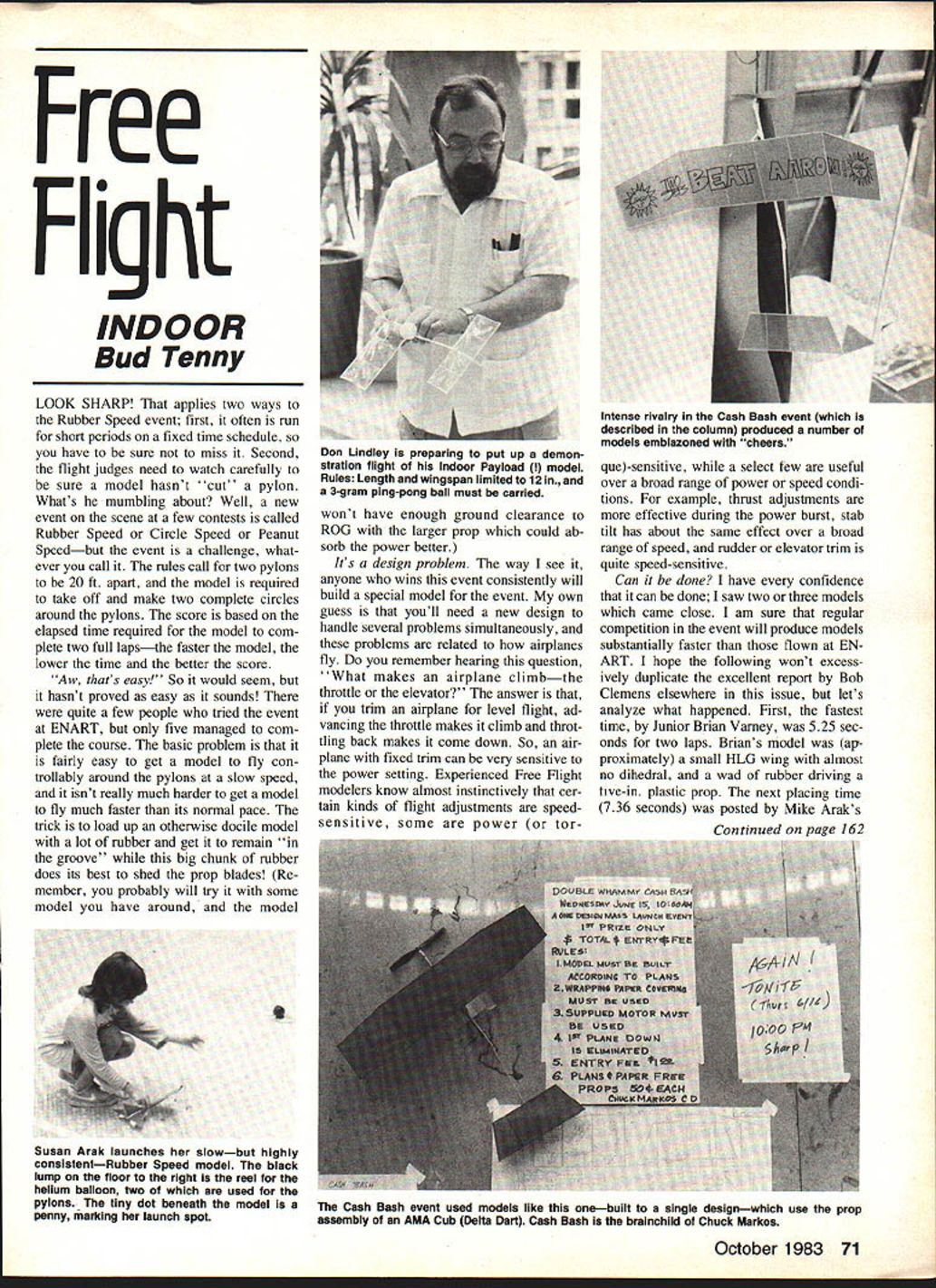
- Susan Arak — 14.54 seconds. Susan added wheels to an AMA Cub and produced a quite docile model.
A word about "wasted motion": Martin Varney (Brian's father) won the Peanut Speed event at the U.S. Indoor Champs earlier in the week with the same Folkerts Racer that won last year. That model had a ferocious zoom and was near the top of the 100-ft. site by the time it passed the second pylon on the second lap. It appeared much faster than Butch's Fokker, but it looked almost uncontrollable. Butch's consistent, flat turn allowed him to cover the course with minimal wasted motion.
Design considerations
Since I haven't personally tried the event, these are speculative suggestions based on observed behavior:
- The model should be as light as possible — to maximize acceleration and to minimize required lift.
- Choose airfoils for low lift and low drag. Consider having tail surfaces contribute to lift to help control zoom.
- Flight adjustments must hold a constant flight-circle diameter, keeping the circle as close to the pylons as possible.
- Because the model must ROG (rise off ground), give special attention to takeoff to assure repeatable direction and controlled launch. If the model veers on takeoff it may miss rounding both pylons, or the circle will have to be widened to include both pylons.
CD (Contest Director) hints
- Provide two pylons placed 20 ft. apart. Charlie Sotch, who designed this event and has directed it at West Baden, uses two helium-filled balloons and their strings as pylons. This works well because models are usually not damaged by hitting a string or balloon as they might be by a more substantial marker.
- Balloons are easy to move onto the floor for the short half-hour periods (held at two-hour intervals) that the event is scheduled.
- Two persons are required to run the event: the timer stands in line with the balloon strings to judge the start and end of the required two laps, while a second judge watches to ensure the model does not turn inside either pylon.
Indoor Payload?
Yes — that is being tried in the Chicago area, with Del Ogren and Don Lindley making demonstration flights. The rules are simple: the model has maximum span and overall length limitations of 12 inches, and the model must carry a ping-pong ball as payload; the maximum duration wins. A ping-pong ball weighs about 3 grams, while a typical model might weigh about 1 gram. The demo model shown by Don Lindley is a straightforward design similar in layout to most Pennplane models.
Another fun class — One-design "Cash Bash"
Some recent club meetings and small contests have tried unusual classes. One such event surfaced at West Baden promoted by Chuck Markos: an 18-inch-span one-design built to plans furnished by Chuck, using the same prop assembly as the AMA Cub. The event consisted of repeated mass launches where the first model to land is eliminated. Rewind and relaunch are then called for a very short time after the last model lands. Aaron Markos won the event; several competitors had inscribed their models "Beat Aaron!" The models are easily adjusted and fly very well, often exceeding one minute per flight.
Bud Tenny P.O. Box 545 Richardson, TX 75080
Transcribed from original scans by AI. Minor OCR errors may remain.

