

Free Flight: Indoor
Bud Tenny
Good news — sites and West Baden
GOOD NEWS FIRST! The last column told a tale of woe—how the New York City area fliers were looking gloomily toward the loss of two of their regular sites. Although they have not replaced the Nassau County Arena in Long Beach, the latest word is that they have reestablished contacts to allow flying in the Low Library Rotunda at Columbia University. Then, in Florida, John Martin's MIAMI club has again been able to schedule activity in the Goodyear Hangar at Opa Locka Airport in Miami.
Best of all! This really tops off the good news—Indoor Week is on again at West Baden! Those of us who have flown there can rejoice with gusto—although the Atrium was sold, the new owner will restore the building to its former hotel status. John Martin got right on top of the situation and has already booked the week of June 19, 1984. We will report the details when they are available, but we may now be able to look forward to another number of years of activity in one of the world's best indoor sites.
Correction (OOPS)
Now for the OOPS! The 1st column went into a lot of detail about rubber testing, especially the Dennis Jaecks adaptation of Fred Pearce's stretch testing. The OOPS is that where it said: (F2-F3)/2 + (F3-F4)/2 + ......, etc., the series should read: (F2 + F3)/2 + (F3 + F4)/2 + ......, etc. The end expression of the series should read ((Fn+1) + Fn)/2.
Those of you with a mathematical background probably already spotted the errors, but I don't have an excuse! And if we don't get it right this time, drop me a card, and I'll send you a marked-up copy of the original report.
Rubber testing — Pearce/Jaecks stretch-test
If you are interested in designing a new rubber test, the Pearce/Jaecks stretch-test has an important ingredient worth stressing. This test makes a preliminary stretch to a force (tension) calculated from the rubber weight and loop length, then calculates a new force limit based on those results. That is a critical ingredient—the maximum force is not based on tabular results generated from tests on other samples, but on the response of that particular sample to stress. I feel that any rubber test must include that type of evaluation to be really useful. Failure to do the preliminary test makes it almost impossible to locate rubber which is better than the samples used to establish the tabular "limits" sometimes used.
Winder (and the mystery winder)
This is no OOPS! In the last column, we also talked about torque meters and showed a picture of the new design by Cezar Banks. One of our esteemed editors asked this: "Now tell us about the winder in the background!" Well, that is a winder which has been manufactured by Bob Wilder for several years—20:1 ratio and built-in turns counter which cleverly imposes no drag. It is one of the smoothest I've used, and it sells for $34.50 plus $2 postage and handling: Wilder Model Machine Works, 2010 Boston Irving, TX 75061.
Prop/Rubber combinations
Indoor fliers soon develop a feel for picking useful prop/rubber combinations, but getting a really good combo depends on having close control of the rubber cross-section. It is rare to find rubber strip with uniform thickness, so experienced fliers use two controls: they depend upon having uniform-width strips, and the motors are classified using weight per unit length.
So, it all boils down to this—we need uniform-width strips to reduce the variables when we try to choose a better prop/rubber match for a given model and ceiling.
Rubber strippers
For years, we have been searching for ways to cut uniform rubber strip at a price we can all afford. There have been numerous "inventions" to accomplish this, but the fact remains that expensive machinery does best; indoor suppliers who cut their own rubber strip are expected to have good machinery, and they usually do. However, unless your favorite supplier sets up shop at the contest (like at West Baden), you can't get the exact size you need when you need it. So, almost every serious flier has one or more ways to strip rubber right at the contest.
The earliest "homemade" rubber stripper I ever heard about was Bilgris'. This was made a lot like some balsa strippers: an L-shaped block held a knife against the rubber which was pulled through the slit. We'll have a photo of an improved Bilgris-style stripper next time. The first rotary cutter I know about was the Roto Shear, which was built from two machined rollers which had matching cutters interdigitated to form rotating shears. This precision-machined tool and the sets of rollers would cut about eight fixed sizes from 1/16-in. flat Pirelli. It had several disadvantages—it could not be sharpened, there was no possibility of making strips slightly smaller or larger than the built-in size, and it would handle only 1/4-in.-wide rubber.
Finally, if you could get exactly the size you did want from one of the cutter sets, you also got two or three other sizes you didn't want, in the same pass!
Vilim Kmoch of Yugoslavia made a Roto Shear-type of cutter with which he adjusted rollers. It came with many very thin "washers" in one of two diameters from which you assembled the cutters. If you assembled one roller beginning with (for example) eight .006-in.-thick, large-diameter washers, followed by alternating layers of eight small- and large-diameter washers, and made the other roller with an exact mirror image, the two rollers would overlap to form a rotary cutter.
After assembly came an agonizing trial-and-error period while you adjusted the pressure on the washers and the amount of overlap until a satisfactory cut was made. Although you could make several very precise sizes (washers came in three thicknesses), this method was still fairly crude and was tedious. The adjustment phase consumed several feet of precious rubber. Other advantages were that Vilim's shear could be sharpened and could be stripped, and in the U.S. there was less than one supplier of any type.
The current high-tech strippers cut rubber off the side of any size of rubber strip in much the same way that meat slicers in the grocery store cut sandwich meat and cheese. They make infinitely variable-width cuts of acceptable accuracy and excellent repeatability — if the wide strip has good uniformity in width. They can be resharpened a significant number of times without disassembly, and the blades are replaceable.
Are they perfect? No, they are awkward to hold and have no built-in means of mounting. But if you are clever and lucky, you can find a place to mount them with a C-clamp so you can turn the handle with one hand and feed the rubber with the other, as fast as you can turn the crank. The strip you cut will be as accurate as you can set the adjustments — which takes practice. If the parent strip varies greatly in width (not common, but not very rare, either), the baby strip will also vary, unless you can meticulously adjust the two guides to exactly compensate.
The first such stripper (see the photo) was much smaller than the latest ones and was available in 1972 from Ryszard Czechowski of Poland. Czechowski later made an improved version which was about twice as large, but it has been unavailable for some time.
Another photo shows the latest rotary stripper to become available: Ray Harlan, 15 Happy Hollow Rd., Wayland, MA 01778, $82 postpaid anywhere in the U.S. The major changes over earlier units are improved guides with micrometer adjustments calibrated in thousandths of an inch (.001).
A sharpening set consisting of a 4-in.-square hard Arkansas stone and a bottle of honing liquid is available for $6, postpaid if ordered with the stripper, $1.50 additional postage, otherwise.
This discussion has gotten too long, so we'll wrap up the rubber stripper bit next time, including a summary of the advantages and disadvantages of various stripper types.
Measuring rubber — micrometers and calipers
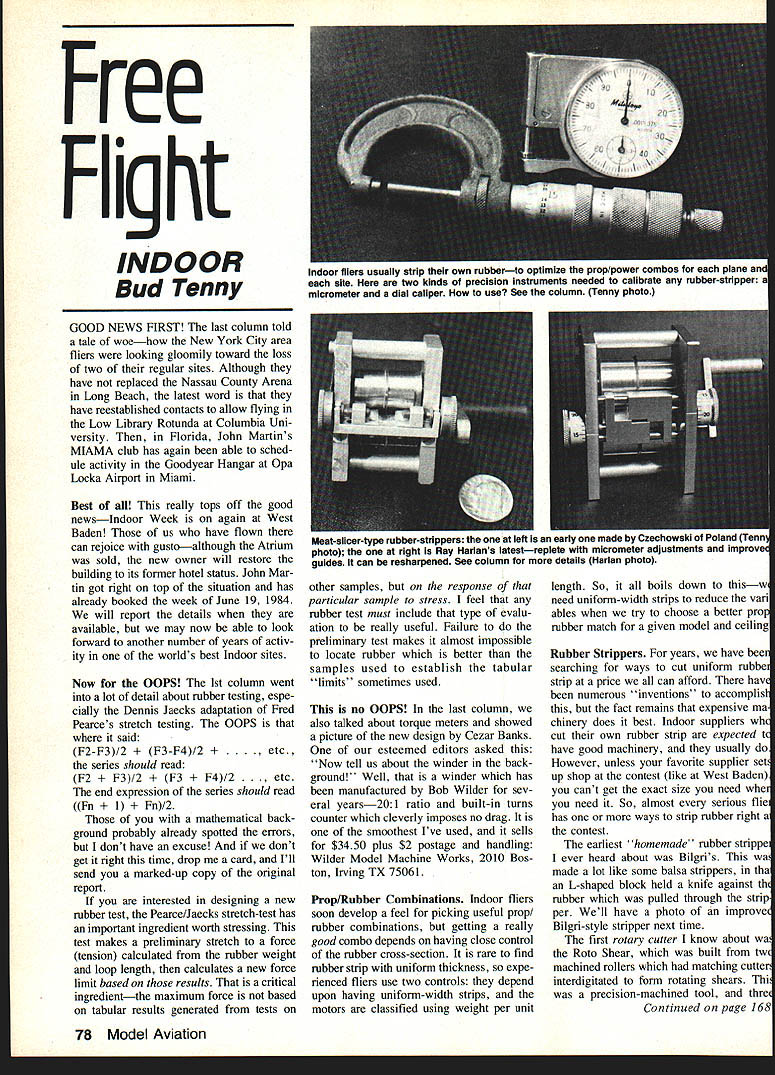
What size rubber did I cut? One thing is needed to calibrate most strippers and check the output of others — micrometer calipers. The last photo shows two styles — a dial micrometer and a machinist-style micrometer. Most dial micrometers have internal springs which are too strong to measure rubber strip accurately, so many users remove or weaken the spring. My personal preference is the machinist's micrometer; I started with this type. In either case, I take the measurement by closing the jaws while sliding the rubber back and forth between the jaws. Read the value at the point where you feel a smooth drag on the rubber. This requires a fine touch and practice, but it has an added benefit. If you hold the setting and check the rubber once in several places, width variations almost too small to measure accurately can be found — if you care.
Bud Tenny, P.O. Box 545, Richardson, TX 75080.
Yet another space-age material
Getting into a bag of potato chips nowadays is enough of a chore, but have you encountered some of the mailing envelopes that are going around? Impossible to tear! The material looks sort of like doped silkspan, but it's far stronger. Alas, it is too heavy for any Free Flight application I could think up. However, Ed Lidgard thought a bit further: he splits the stuff down to whatever thickness he needs.
According to Ed, the name of the material is something like Tyvek—I can't read his writing too well—and is a synthetic-fiber paper made by American Excelsior. The only commercial application he knows of is for mailing envelopes. As produced, it is .006 to .008 in. thick. He peels the stuff apart, then takes the thicker half and peels that apart, and finally works it down with a knife to a thickness of .001 to .002 in., and a weight about equal to that of tissue. But it is light years ahead of tissue in strength. The application: an inside covering for rubber-power fuselage tubes. (But if you get some of the stuff in your hands, you'll probably figure out a dozen applications, right off.) Ed sticks it to balsa by applying Titebond to both surfaces, then "cross-linking" it (I guess he means "curing") it with a MonoKote iron. The smooth surface, which is out, is given a coat of thin dope to make it lube-proof.
Record-breaking Indoor Cabin model
Bob Randolph tallied up his eighth Indoor Cabin record last July at Santa Ana with a flight of 33 min., 37 sec. Here is his story about it:
"My last two Cabin records were made with removable pods, to which the landing gear was attached. Test flights were made with the delicate pod replaced by a flat plate having the same weight and drag as the pod. I learned from this that the drag of a flat plate is only slightly greater than a streamlined form having the same cross section at indoor-model speeds, and that a flat disc can be built much lighter. Thus the Thin Man was born, and it came out with a total weight of only .00325 oz. I had intended doing comparative tests using a double-cone pod, but the model with the disc flew very well, setting the record on its third flight. Then, I was fortunate enough to win the FAI Team Selection Finals, and so I have had to concentrate on preparations for the World Champs. Additional Cabin-model development will have to wait. I'm sure that, with the use of more boron filament, I could get the weight down even more."
You have to read the rule book rather closely to figure out how the Thin Man qualifies as a Cabin model, but it does. The rubber motor is enclosed in a balsa tube, to which the disc is attached. The disc is covered on both sides with microfilm with a tiny balsa spool separating the two surfaces. The rules require that a Cabin model have a "built-up, enclosed fuselage," and it is a little hard to see how a balsa tube qualifies as a "built-up, enclosed fuselage." However, a lot of Cabin models have been built that way, so it is probably OK.
Bob Meuser, 4200 Gregory St., Oakland, CA 94619
Transcribed from original scans by AI. Minor OCR errors may remain.

