
Free Flight: Indoor
Bud Tenny
Good news, again!
As I was typing this column, Tony Italiano called to say that he had finally worked out the details on Indoor Week. The site will be the Michigan State Fair Coliseum in Detroit. Indoor Week, which includes John Martin's Peanut Bash, will run from Sunday, June 17 through Friday, June 22, 1984.
If this is the first you've heard of this, you will want to know that Tony will send you a flyer and entry blank if you send him a business-sized SASE. Those of you who sent one in response to the last column need not repeat—you should have your info before you see this, due to publication lead times.
Easy B feedback
A couple of columns back, I showed a picture of Doug Barber's loooong Easy B built to approximate the Easy B models flown in England. Aside from the excellent handling shown by the model, I was amazed by the 15-minute flight from this 1.75-gram model. Doug responded by sending me a copy of the Low Ceiling Indoor Rules for the Northern Area of Great Britain. Their Easy B rules are of particular interest:
- Wing — max. span 18 in. projected; 3-in. max. chord, monoplane only.
- Tail area 30 sq. in. max.
- Wing and tail to have straight outlines only.
- Prop — max. diameter 14 in.; no variable pitch or flaring mechanism. Spar to be center of blade; solid wood construction.
- Motor stick and tail boom to be solid construction only.
- Minimum weight without rubber to be 1.2 grams.
- Wood bracing may be used.
- Any covering material allowed.
Doug relates that participation in Easy B soared to new heights after adoption of that rule. In fact, the air became so crowded at the smaller sites that they have suggested the following addition:
- Power may be either:
- Any rubber weight, but flights limited to seven-minute maxes; or
- Max. rubber weight 0.6 g, plus 0.6 g ballast in the form of a spacer between rubber and rear hook, with no maximum flight-time limit.
Either power class is scored on the basis of the best two of six flights.
HLG rules
The British low-ceiling rules for HLG are somewhat different:
- Wingspan 13 in. max, with 35 sq. in. max area.
- Overall length 13 in. max.
- Tail span 6½ in. max.
- Weight 3 g minimum.
Models which do not meet these specifications can be flown for awards, if they break the existing site record.
More on rubber test
Once rubber has been tested by one of the methods described here previously, the data has to be converted to energy in foot-pounds per pound. If you have access to a sensitive indoor scale, Dick Obarski suggests that the energy integration be done as follows:
- Using the same graph paper as you will use for the test results, draw a rectangle using the same scale as you will use in plotting the test data. That is, if the Pounds Force scale will be .75 in. = one pound, and the Stretch scale will be 1 in. = 10 in. stretch, draw and cut out a rectangle 3 in. × 4 in. to represent 4 pounds force × 40 in. stretch. This rectangle then represents 40 × 4 or 160 inch-pounds. Divide 160 ÷ 12 to get 13.33 foot-pounds. A typical weight for this rectangle is 0.0233 oz., which is proportional to 13.33 foot-pounds.
- Plot the energy release from the test on another piece of the same graph paper and cut out the graph along the curve and the coordinate axes. Weigh the graph and compute the energy release this way:
- Energy (ft.-lb.) = (weight of energy graph (oz.) × 13.33) ÷ weight of test rectangle (oz.)
- Convert to foot-pounds per pound of rubber:
- Energy (ft.-lb./lb.) = Energy (ft.-lb.) × (16 oz./lb.) ÷ weight of rubber sample (oz.)
Dick also cautions that stretch-testing of rubber fails to show up one undesirable characteristic of some rubber — grapevining. You may have seen some rubber which felt and tested good; but, when you wind and start to come in, little pigtails pop out to the side all over the motor. Rubber with this characteristic usually cannot be used unless you are both skilled and lucky in getting the grapevining under control.
Instant CD!
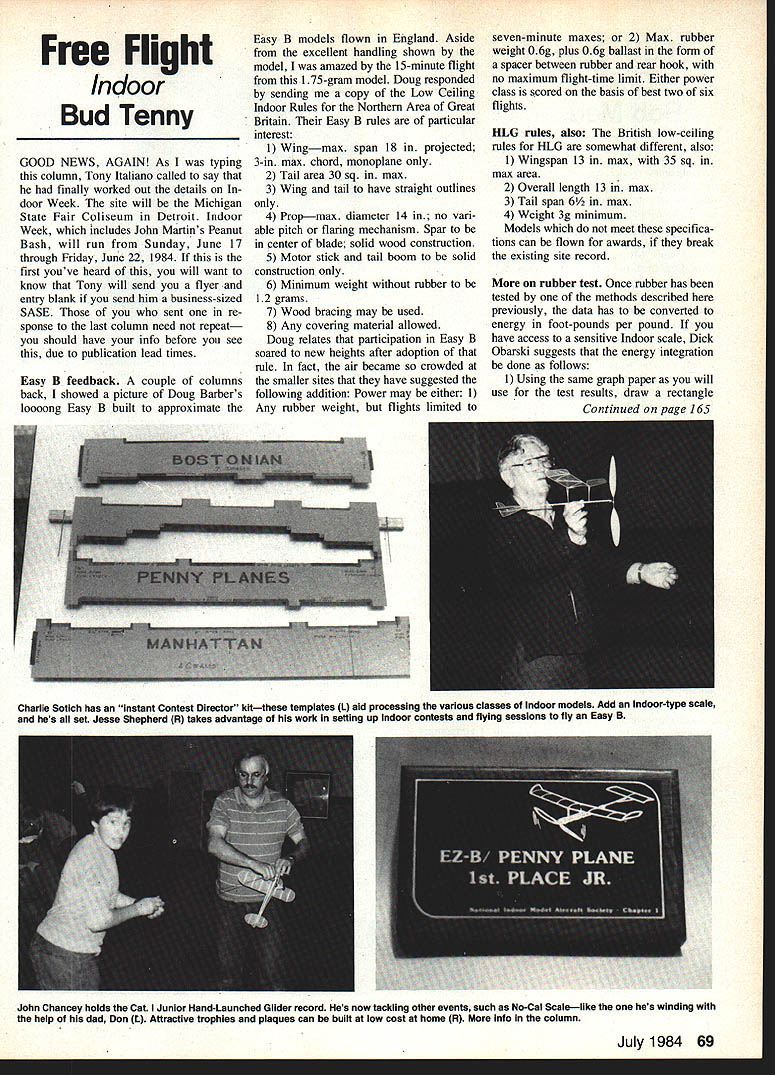
Charlie Sotich, of the Chicago Aeronuts, is prepared to CD a contest at the drop of a hat. If you've not had to face the problems of an Indoor CD, there are things to weigh and measure, etc., while processing various Indoor model classes. Charlie always has some sort of scales with him, but the really handy thing he brings to a meet is his set of processing templates.
Besides a special set for Bostonian, Pennypalme and Manhattan Cabin, he has one general-purpose template which covers almost all the odds and ends left over. On these special templates, Charlie has measured (and labeled) places to check wingspan, stab span, prop diameter, "box" size for Bostonian and Manhattan, etc.
Processing models
It works this way: first, know the rules, and apply them uniformly and fairly! When you CD a meet, you need to check all the models flown. With templates like Charlie Sotich uses, the contestant is required to check his own model while the CD watches. If he can't get the model to fit inside the template, he sure can't blame the CD! Also, the CD no longer has to worry about the possibility of breaking a model, if the contestant does his own checking.
A salute!
I have often mentioned Doc Martin's MIAMI club, which has nearly year-round Indoor activity. Well, in Bedford, TX, thanks to Jesse Shepherd (prime mover), Walt Kulzer (contact man) and Ed Turner, we find regularly scheduled and sanctioned Indoor contests in the gymnasium of Boys' Ranch. This group activity spans all kinds of Indoor activity, with heavy emphasis on Indoor Scale. However, special events are held for younger and inexperienced fliers, and each contest includes the Easy B/Pennypalme and HLG, plus opportunity for record attempts in all classes.
Scale fliers come from as far as Houston, and Stan Chilton (Wichita, KS) has set a number of records there, adding to the list of records held by local fliers.
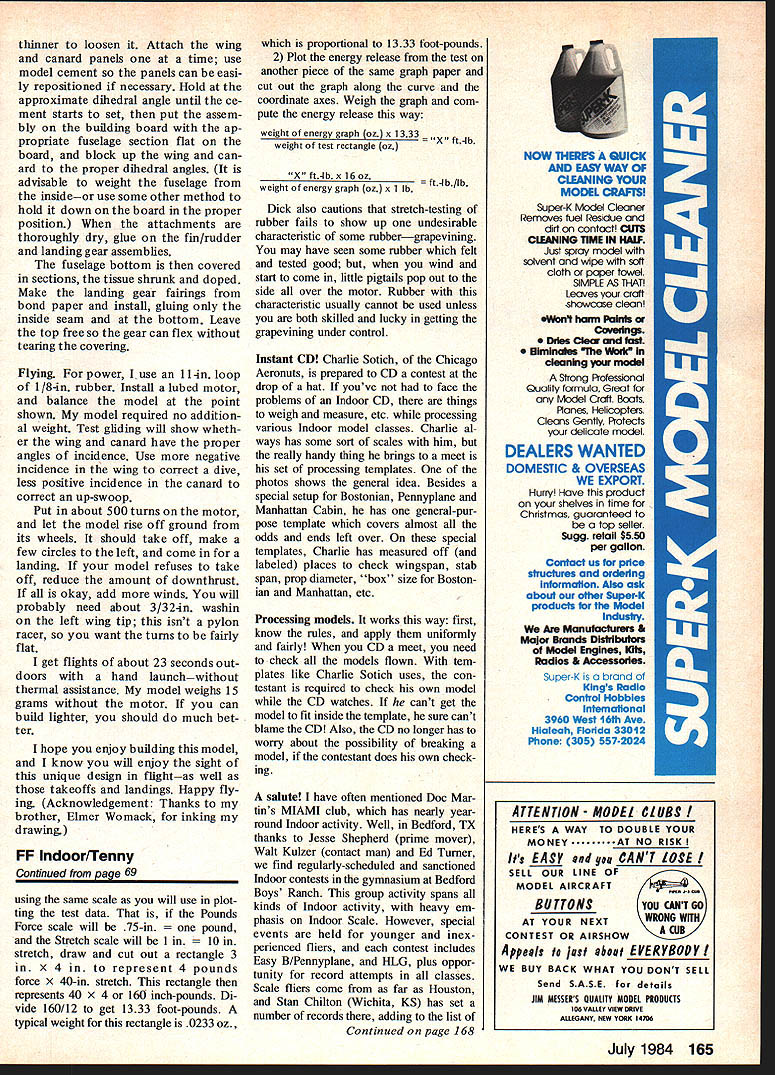
Just to show you that Jesse manages to do some of his own flying, another of the photos shows him with his Easy B model. The activity is sponsored by the Ft. Worth Plainsmen, one of the older FF clubs in the Southwest. The activity has grown enough to more than support a fairly healthy rental fee for the site. In addition, Jesse considers his group to be NIMAS Chapter No. 1 (National Indoor Model Airplane Society).
Another photo shows that this isn't just a bunch of grownups — John Chancey and dad Don Chancey are winding John's No-Cal Scale model. John has twice set the Junior Indoor HLG record at the Boys' Ranch and is moving into other kinds of Indoor flying also.
Trophies, anyone?
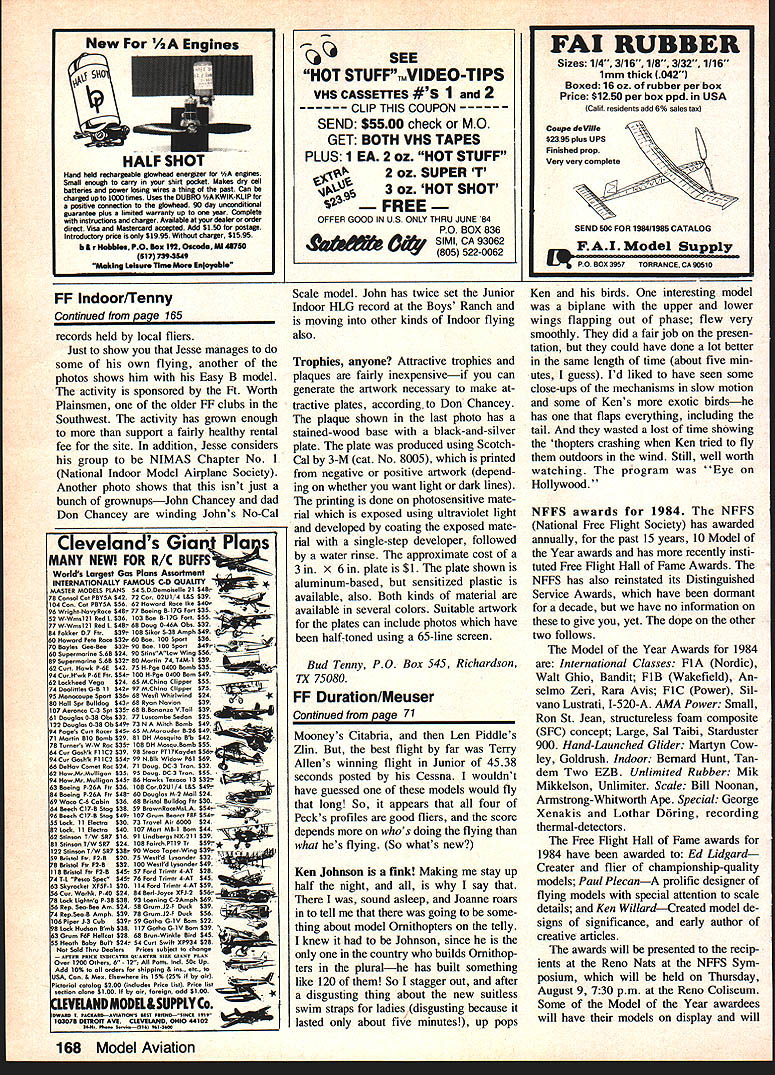
Attractive trophies and plaques are fairly inexpensive — if you can generate the artwork necessary to make attractive plates, according to Don Chancey. The plaque shown in the last photo has a stained-wood base with a black-and-silver plate. The plate was produced using Scotchcal by 3-M (cat. No. 8005), which is printed from negative or positive artwork (depending on whether you want light or dark lines). The printing is done on photosensitive material which is exposed using ultraviolet light and developed by coating the exposed material with a single-step developer, followed by a water rinse. The approximate cost of a 3 in. × 6 in. plate is $1. The plate shown is aluminum-based, but sensitized plastic is available, also. Both kinds of material are available in several colors. Suitable artwork for the plates can include photos which have been halftoned using a 65-line screen.
Bud Tenny P.O. Box 545, Richardson, TX 75080.
Transcribed from original scans by AI. Minor OCR errors may remain.

