
Free Flight: Indoor
Bud Tenney
A TRIBUTE There recently was a joint meeting of the AMA Executive Council and the chairmen of the Contest Boards. This meeting has been fully reported elsewhere, but I want to remind all AMA members what a fine group of leaders AMA has. The Contest Board meetings ran from 8:00 a.m. to 10:30 p.m., with two meal breaks and two other short breaks, and the Executive Council meeting continued far past midnight. This kind of concentrated effort is difficult to maintain, but it produces excellent results. I can't imagine any other organization or business being able to assemble this kind of talent for pay, let alone free!
What's wrong with Indoor? Maybe nothing! However, I hear a lot of comments about little things—things that can affect some of the model classes. One problem is that we don't have a reliable source of good rubber. Several people have been working on this, but it's a tough nut to crack. One major problem is that rubber strip isn't produced as an energy source, so no manufacturer really knows how to make what we need. In fact, not all of the top fliers agree on just what good rubber has to be! If anyone has about $2 million to spare, he or she could afford the research and experimentation to build good rubber. Even then, the total market for years wouldn't amortize the research costs.
What about condenser paper? A number of people have reported that condenser paper isn't being made any more. Although the suppliers still have stock, we can imagine that Paper Stick and Easy B models would soon fade from the scene for lack of a covering material that meets the existing rules. Some fliers are beginning to talk about rules modification to permit other types of covering, but no one has submitted a proposal to accomplish this. Actually, condenser paper is supposed to be easier to use than other coverings. It is so prone to react to humidity that only superb craftsmen are able to build models that don't warp.
The new plastic films that have displaced condenser paper in electronic manufacturing have superior characteristics for model covering. One problem is that handling very light plastic appears to be more difficult than working with more traditional covering materials. It has been suggested that microfilm-handling techniques will work very well. It seems to me we have a golden opportunity here: if microfilm techniques (covering frames, etc.) will work, newcomers can learn covering techniques for microfilm without worrying about 'clumsy' holes!
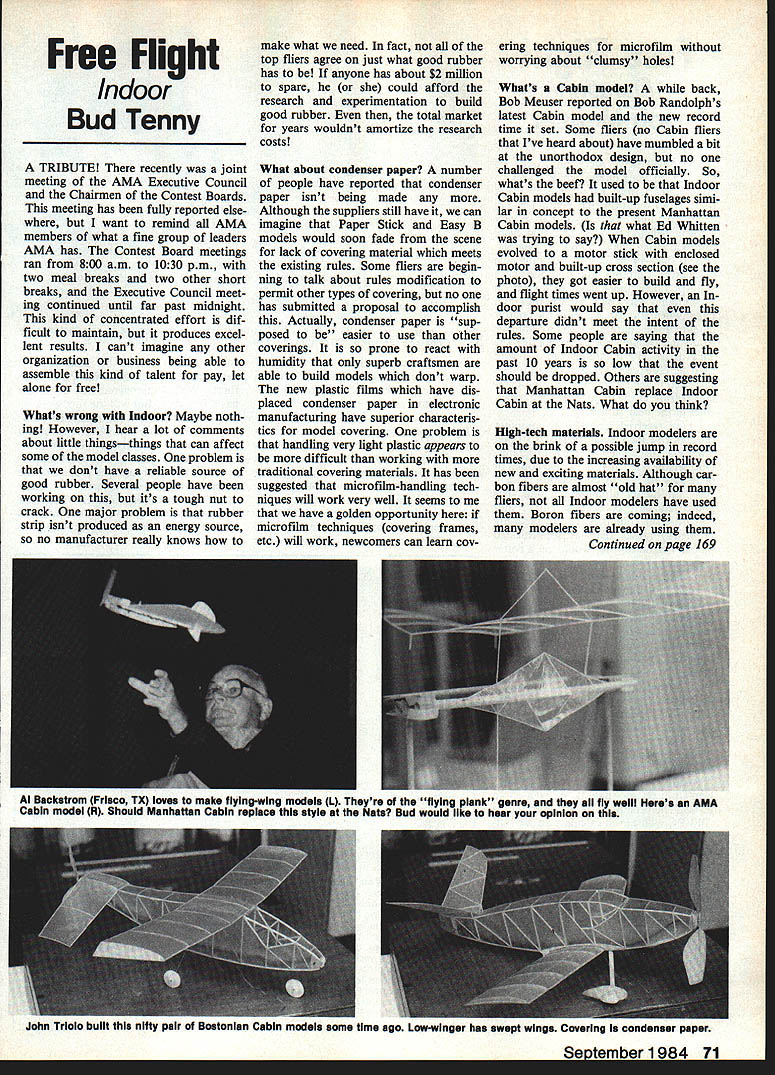
What's a Cabin model? A while back Bob Meuser reported on Bob Randolph's latest Cabin model and the new record time it set. Some fliers (no Cabin fliers I've heard about) have mumbled a bit at the unorthodox design, but no one challenged the model officially. So, what's the beef? It used to be that indoor Cabin models had built-up fuselages similar in concept to the present Manhattan Cabin models. When Cabin models evolved to a motor stick with enclosed motor and built-up cross section, they got easier to build and fly, and flight times went up. However, an indoor purist would say that even this departure didn't meet the intent of the rules. Some people are saying that the amount of indoor Cabin activity in the past 10 years is so low that the event should be dropped. Others are suggesting that Manhattan Cabin replace Indoor Cabin at the Nats. What do you think?
High-tech materials Indoor modelers are on the brink of a possible jump in record times, due to the increasing availability of new and exciting materials. Although carbon fibers are almost old hat for many fliers, not all indoor modelers have used them. Boron fibers are coming; indeed, many modelers are already using them.
Each new high-tech material requires some special handling and/or building techniques, and the race is on to develop reliable, low-weight building methods using these materials. Help! If you are using carbon or boron fibers, new plastic films, or any other materials which improve your models, tell us about it!
A word of warning Howard Haupt is the editor of El Torbellino, the newsletter of the San Diego Orbiteers. In a very recent issue he printed the following warning:
"Boron is a glass-like material and can be very brittle. Being brittle, it can shatter and cause small sharp slivers. These slivers can penetrate the skin with ease, but will not work their way back to the surface. Once under the skin, these slivers are at least a minor irritant, at worst a danger to the heart or lungs if they work their way into the bloodstream.
"Modern boron fiber is pretty well behaved, for it will break cleanly when bent sharply with pliers. One must take care to dispose of the scrap ends that are broken off. Little pieces of boron cannot be left lying about on the worktable or floor."
Two ways were discussed to ensure proper disposal of all boron scrap ends:
- Have a small bottle on your table which is the repository of all boron scrap as you work with the material. As you break the end off with the pliers, continue to grip it with the pliers and drop it into the bottle.
- Place masking tape on the end of the boron you are trimming. After breaking off the end with the tape attached, dispose of it in a wastepaper basket.
Bostonian This year Manhattan Cabin became an official event, and the rush is on to set records in all four AMA ceiling categories and three age classes. That unifies all the activity with standard rules. Now, from Ed Whitten's New York Indoor Times, we get this set of "official" rules for Bostonian:
- Maximum projected wingspan(s) 16 in.; maximum wing chord 3 in.
- Maximum propeller(s) diameter 6 in.
- Power limited to rubber motor(s).
- All surfaces double-covered.
- Minimum weight, without rubber motor(s): 7 grams.
- Maximum overall length 14 in., excluding propeller(s).
- Fuselage must contain or exceed a theoretical "box" measuring 1½ x 2½ x 3 in., the longerons of which must both support the motor and form, or exceed, the box requirement. No motor sticks are allowed. Fuselage must have a forward windshield and a window on each side, each of at least one square inch in area.
- Landing gear must be fixed, with at least two wheels of ½-in. minimum diameter, and rigid enough to successfully support the model to a hand-glided landing.
- Rise Off Ground from at least two wheels is required in all takeoffs on all official flights.
- Charisma Factor — The judge rates each model on how the model appeals to him, based on construction neatness, scale-like details, unique features of design, etc. A 1.00 rating up to 1.30 is used. Two models may be given the same rating. The models are not rated against each other, but against the 1.00 to 1.30 scale.
- An unlimited number of flights is allowed, with the total (in full seconds) of the three best flights multiplied by the Charisma Factor determining the model's score.
- More than one model may be entered, but only one prize to an entrant will be awarded.
Ed Whitten has said that "Bostonian Cabin models are Flying Scale models ... except that there is no full-sized, man-carrying version!" Two photos of models built some time back by John Triolo are shown; perhaps you can see what Ed means. You might notice one design that resembles those two models—John cleverly arranged the designs to accommodate full-length motors for best rubber usage.
More from Bedford
One of the regulars for sessions at Bedford Boy's Ranch, Bedford, TX, is Al Backstrom (Frisco, TX). Al flies some indoor Scale, but his flying-wing models are really fun to watch. The model he is launching in the photo is in the "flying-plank" style. These use nothing except a reflex airfoil for stability, but this model doesn't seem to lack stability. It can hit the ceiling and recover with very little loss of altitude—far better than most Scale models and better than some serious indoor models!
Bud Tenney, P.O. Box 545, Richardson, TX 75080.
Transcribed from original scans by AI. Minor OCR errors may remain.

