
Free Flight: Indoor
Bud Tenny
Did I do that?
The previous column (September 1984) talked a lot about the current state of Indoor and the rules proposals that had not been made. Well, they have been made now, and the first impression is that someone could have gotten the ideas for them from that column. Alas, the realities of magazine publishing proved otherwise: the proposals were already "in the mill" before my column was written, and others were drafted a month earlier.
I'm a few days late starting this column, and have only now gotten the first feedback from the last one. The rules proposals in hand were already being considered before my column appeared, and more are coming.
Boron fiber safety
The previous column reprinted an article from El Torbellino, the newsletter of the San Diego Orbiteers, which spelled out the dangers of mishandling boron fiber and suggested safe ways to control boron fragments. Since then I have discussed boron with two different members of the Indoor Contest Board (ICB). Both had suffered injury from boron fragments; one still has a problem he suspects is boron-related.
He had a fragment in his finger that he thought he removed completely. Since then his finger has become numb, so it's possible a small piece worked its way deeper into the finger.
So far there has been no formal proposal to ban boron on safety grounds. Where do you draw the line between safety rules and individual rights? Do you outlaw X-Acto knives because people cut themselves? My ICB contacts indicate they are beginning to seriously consider safety restrictions on boron. If you have strong feelings either way, contact your District ICB representative. You can find his address in the "Competition Newsletter" section of Model Aviation.
We should avoid haste. A bright spot: boron is not toxic. The major danger seems to be infection at the wound site and the remote possibility of tiny pieces entering the bloodstream. Also consider consistency: if boron were restricted, what about other modeling materials? Fumes from capacitor (condenser) paper processing, paints, spray adhesives, and solvents are also hazardous in concentrated form.
Rules proposals
Although the official listing of all rules proposals will appear in the "Competition Newsletter" section, here is a preview of the Indoor proposals we know about. After you read the official listings and exact wording, contact your ICB representative and let him know what you think. If you don't tell the Contest Board what you want, don't gripe about the rules you get.
#### New procedures As announced in the September 1984 "Competition Newsletter" (p.117), there will no longer be a Cross-Proposal procedure to "edit" rules proposals under consideration. Instead, direct your suggestions in writing to your District ICB representative, who can forward them to the ICB Chairman. Sending suggestions to your District representative ensures your interest is on record; the Chairman will then work with the person who made the original proposal. Final votes will be scheduled early enough so that rule books are in hand by January 1 of the year the rules take effect.
#### Indoor-specific proposals (preview)
- Allow Paper Stick (Easy B) models to be covered with some kind of commercial plastic, based on the premise that condenser paper may become scarce. Microfilm also would be allowed.
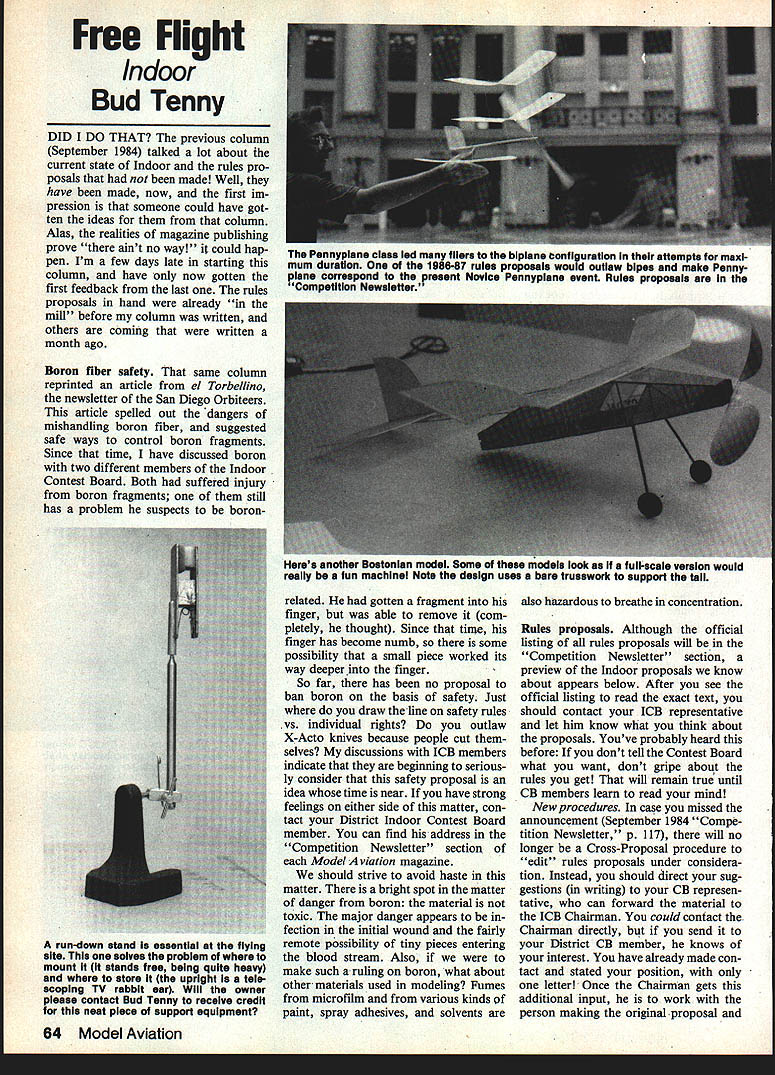
- Eliminate the standard Pennyplane event and leave Novice Pennyplane as the entry-level event.
- Reclassify the new paper stick event as an intermediate-level event (proposal from the same person suggesting plastic replacement for Paper Stick).
- Redefine Indoor Cabin to allow no rigid internal structures and permit motor sticks; create a microfilm-covered event similar to the current Manhattan Cabin event but twice as large. This would align Indoor Cabin models with what old-timers contend was the event's original intent.
#### Two general proposals affecting Indoor
- Establish a new age classification: split the present Junior class into Elementary (through age 12) and Junior (13 through 15). Proposed by an educator who runs model-flying classes in schools; intended to create an arena for younger students whose skills haven't matured to mid-teen levels.
- Establish regular competition "engine" classes for electric models. The smallest electric class is intended to correspond to 0.1 cu. in. displacement internal combustion engines. This level of power will likely be considered suitable for Indoor use, so expect to see electric models indoors—probably Control Line, but sharing the airspace with free flight.
Column feedback
Two specific responses came from the most recent column.
- Tony Sutter (Corpus Christi, TX) spoke in favor of the old-style Cabin models: "I have been interested in Indoor Cabin models since 1935, and have won some trophies with built-up cross-section fuselages. I believe the Indoor Cabin event, with the new high-tech materials, would be capable of good times. Three-gram Pennyplanes are doing 16 minutes, and look at the number of contestants! I believe the Indoor Cabin model should be held to the original intent of the rules: the fuselage must contain or exceed the cross section of L/100, and the longerons must support the motor or form. No motor sticks or tubes allowed. Landing gear must support the plane unaided in a three-point or at-rest position."
- John Berryman (Denver, CO area) reported that, as of a year ago, a particular supplier of condenser paper had no plans to stop production. Although most modern capacitors use plastic film, certain very large oil-filled types used in the power industry still use condenser paper. This information has been passed to Indoor suppliers to verify. If production continues, proposals to allow plastic covering will need to be reevaluated. Berryman also emphasized his preference for condenser paper over plastic. So while many builders like plastic covering, not everyone does.
Rumored proposals
Some Indoor proposals being discussed in the Midwest (still formative) include:
- Change the Paper Stick class to a plastic-covered Stick class limited to 100 sq. in. area, with a maximum length and a one-gram weight. Careful design could make this model fit FAI events; it could serve as an entry-level FAI model and a test bed for new designs.
- Add a maximum length, minimum weight, and plastic covering allowance to Easy B.
- Convert the present Indoor Cabin class to Manhattan Cabin, including the perpetual trophies at the Nats.
Watch Model Aviation for the official listings of rules proposals, and communicate with your Contest Board representative.
Contest announcements
Whenever lead times permit, I announce contests and flying sessions for clubs around the nation. If your club schedule doesn't appear here, you may have forgotten to send it.
One of the most active and well-organized Indoor clubs is the Miami Indoor Aircraft Model Association (MIAMA), based in Miami, FL. Dr. John Martin, MIAMA organizer, publishes a whimsically informative newsletter called The Hangar Pilot. The latest issue lists the following contests and sessions for fall and winter:
- Miami Dade South College: October 13, 1984 and December 9, 1984 — 9 a.m. to 5 p.m.
- Miami Dade South College: February 10, 1985 — 9 a.m. to 5 p.m.
- MacDill AFB (two-day contests, tentative): November 10–11, 1984; January 12–13, 1985; March 9–10, 1985; May 11–12, 1985.
- World Inter-Grants (Pistachio Scale): Miami Dade, April 13–14, 1985.
Even for confirmed meets, call 305-858-6363 to confirm contest status before making an out-of-town trip.
Indoor Week next year?
Since West Baden passed out of our area, we haven't found a site suitable for another NIMA/NART to round out the week. The Detroit site rental is prohibitive unless many more contestants attend. What we need is a venue with near-maximum ceiling in at least one category and suitable nearby housing—ideally a college campus where contestants could stay in dormitories. If you have site ideas, check them out and contact one of us.
The future of Indoor Week is in your hands—don't let us down!
Contacts
- Bud Tenny, P.O. Box 545, Richardson, TX 75080.
- Dr. John Martin, 2180 Tigertail Ave., Miami, FL 33133.
- Tony Italiano, 1655 Revere Dr., Brookfield, WI 53005.
Transcribed from original scans by AI. Minor OCR errors may remain.

