
Free Flight: Indoor
Bud Tenny
A WARNING! A number of times in the past I have reported how Stan Chilton and others keep special records on rubber motors. Part of the whole scheme was to store motors in paper envelopes as soon as they were made up. Batch identifications, motor length, weight, test results and flight performance were all recorded on the envelope. It turns out that using paper envelopes is an oops! Stan noticed that older motors had changed characteristics drastically — all bad changes. He has decided that treatment chemicals left in the paper are responsible.
Art museums have a similar problem and specify acid-free material to use for framing mats. Stan has now changed from paper envelopes to plastic ziplock bags, which have the added advantage of providing airtight storage. So, if you are using paper envelopes for storage (as I have been for years), now is a good time to change. Yes, the motors I have stored are rotten, too!
A related warning is appropriate: if you are flying in a cold site this winter, you may keep the motors warm in your pocket. If so, don't put the motors in the same pocket as your loose change! In particular, copper seems to have a devulcanizing effect on rubber, and it may not take long for some damage to occur.
Several years ago I conducted some rubber tests using a smooth brass hook on the winder. I experienced a lot of early breakage with rubber which normally would absorb higher stress under other circumstances. The motors were breaking right at the knot, where the rubber contacted the brass. I believe that the rubber under tension, coupled with rubber lube, accelerated the failure of the rubber. I got the clue to this when I found a used motor stuck to a penny; the rubber had become gummy where it contacted the coin.
Contest Announcements.
The MIAMA club's contests, which were listed as tentative last time, have been confirmed: Miami Dade South College, 9:00 a.m. to 5:00 p.m., February 10, 1985; MacDill AFB, March 9-10, 1985; two-day Pistachio Proxy meet at Miami Dade, April 13-14, 1985; and a two-day meet at MacDill AFB, May 11-12, 1985. It is important that you call 305-858-6363 to get a pass reserved for you at the MacDill AFB meets. Call the same number (Dr. John Martin) before leaving home to be sure the meet is actually being held.
The Willamette Modelers Club, Willamette, OR has meets scheduled for February 10, March 3 and March 11, 1985 at Willamette High School, 9:00 a.m. to 3:00 p.m. The events on February 10 and March 3 are Easy B, Pennyplane, HLG, AMA and Peanut Scale, Bostonian, P-24, Earle Moorhead Events, and Specialty. The March 11 meet has the Bostonian following Scale classes: Peanut, AMA, WW I Scale, WW II Scale, and Profile Scale. The contact person for these meets is Bob Stalick, 5066 NW Picadilly Circle, Albany, OR 97321, phone 503-928-9101. Most of the events use AMA rules, but some special rules are involved.
Activity in the New York area has usually included flying in the Low Library Rotunda at Columbia University in New York City. This fall it was not possible to make arrangements to renew the activity. The difficulty has been resolved, and sessions are now scheduled through March. For information on dates and events, call Ron Williams (212-722-5262) or Ed Whitten (212-724-0282).
Other activity in the Northeast: In Massachusetts, call Ray Harlan, 617-353-4013 for news about activity through May 1985.
In New Jersey (Glassboro), contact Larry Peters at 601-887-1404 for info on flying sessions and contest activity.
Contest activity in the Kansas City, MO area seems to be mostly Scale, but some fun-fly sessions are available in February and March 1985. Contact Roger Schroeder, 4111 W. 98th Street, Overland Park, KS 66207, phone 913-648-4265.
Two contests in the Oklahoma City National Guard Armory are planned for February 17 and March 17, 1985. Contact Bill Baker, 1905 Peter Pan, Norman, OK 73069, phone 405-329-1018.
In the Ft. Worth–Dallas area, contact Jess Shepherd, 2713 Summit View, Bedford, TX 76021, phone 817-282-3770.
Monthly activities are held by the San Diego Orbiteers at the Colina Del Sol Community Center. Contact Chuck Dugan at 619-448-1373.
Proxy flying is where some (or all) of the models are sent in the mail and flown by local fliers. Scale modelers, in particular, are eager to get involved in this type of activity. John Martin of the MIAMA club has been particularly active in sponsoring this sort of thing. If you are into Pistachio Scale, you still have time to enter the World Proxy Pistachio Inter-Chats. This contest is part of the activity mentioned above for April 13-14, 1985, at Miami Dade South. If you haven't heard of Pistachio Scale, a Pistachio Scale model is an under-grown Peanut Scale model (eight-inch maximum span or six-inch maximum overall length). Get an entry blank and rules from John Martin, 2180 Tigertail, Miami, FL 33133.
Packing the model for transporting is always a chore, but John Martin says that Pistachio is easier than most, due to the small model size. He offers these suggestions:
Suggested packing instructions.
- The most successful boxes are a little larger than cigar boxes and made of wood or heavy cardboard. Also, the cardboard box-within-a-box has been successful.
- Attach your model from its three strongest points to the bottom of the box. Paper strips held down by tape or pins will hold your model. Masking tape makes a good hold-down if you double over the tape (sticky side in) where it contacts the model. Do not make the loops too tight!
- Do not use any soft material against the model! Styrofoam, excelsior, or cotton will squash your model when the box gets compressed.
- Secure all loose pieces! Documentation, rubber motors, and prop should all be in a separate box fastened tightly to the bottom of the model's box.
- To get your model back: include return postage, return address label, and instructions for mounting the model in the box. It will take quite a while to return.
Proxy instructions — include the following on a separate sheet so your proxy flier can get the most out of your model:
- Is it trimmed? (The meet will be held in a 27-ft.-high gymnasium.)
- What direction does it fly?
- How large are the circles?
- Do they get larger or smaller as the motor unwinds?
- How many turns will the motor take?
- Are there special trim problems?
- What do you try if it doesn't fly?
- Describe the launch technique and include any special instructions you need.
Do not send an untrimmed model!
Condenser paper hints.
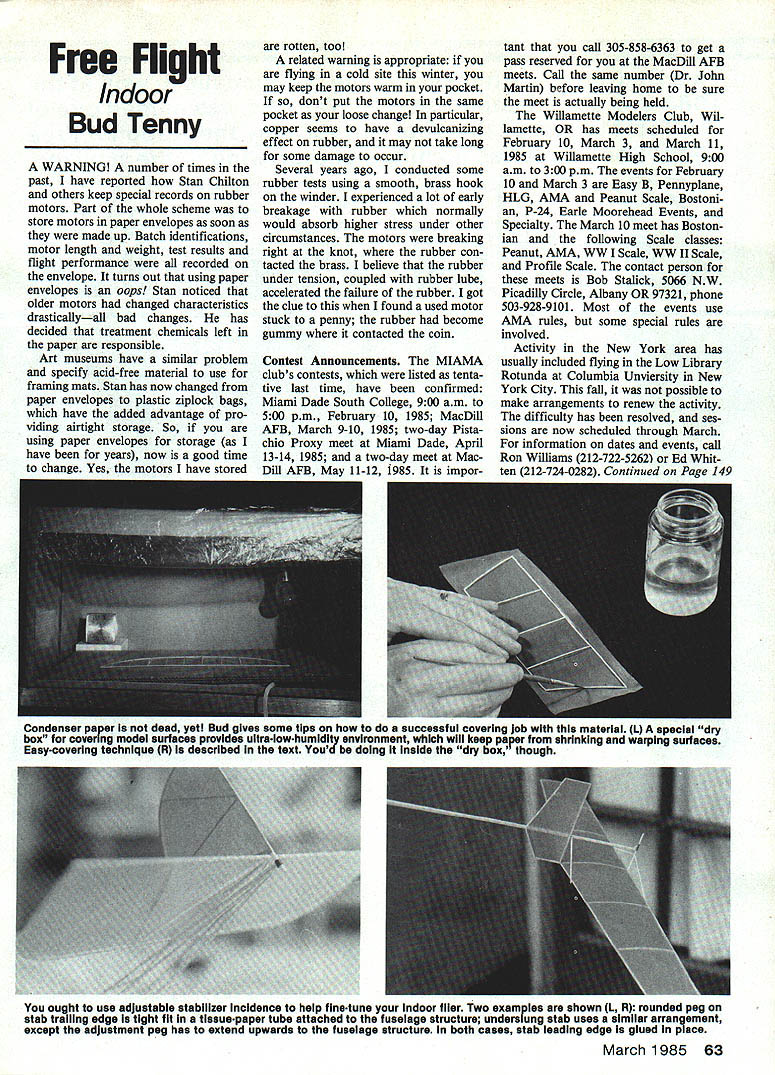
Condenser paper will still be with us for at least another year, regardless of the outcome of rules proposals now under consideration. So, let's review at least a couple of ideas about handling condenser paper. The major fault with this material is that it shrinks — usually enough to kill a model's trim. In general, the only way to avoid shrinkage is to be sure the paper is drier than it is ever likely to be when you attach it to the model.
One method is to pre-dry the paper and structure in a drying box. The view is into a box large enough to hold the entire surface being covered. A hygrometer (relative humidity meter) is in one corner of the box. A plastic curtain closes the front of the box, except where your hands enter to do the covering. A light bulb furnishes heat to dry the paper and framework, and light to work by. Additional heat is generated by a heating pad under the cardboard work surface.
Place the structure to be covered and the condenser paper inside the box, close the curtain, and start heating. When the relative humidity is down to around 10%, slip your hands under the curtain and cover the part. When the part re-enters the real world, the paper will sag somewhat, unless the home atmosphere is as dry as inside the box. I have had models outlast their usefulness using this technique. One caution: if the humidity inside the box doesn't fall rather quickly, the box itself may be damp. It will have to be dried out to work properly.
Another easy covering technique: trim the condenser paper oversize and lay the outline upside down on the paper. Apply adhesive to both excess areas of the surface and press it down onto the paper. Rock the airfoil forward so that the leading edge touches and apply adhesive, then do the same at the trailing edges. If you attach ribs to the paper, do that last.
Flight trim.
Adjustable stabilizers are useful for most indoor models as a fine adjustment. One method is to use an adjustable stab when the tail group mounts on top of the fuselage or tail boom. Another approach is to undersling the stab to get it below the downwash from the wing. Only the rear edge is adjustable in this setup, and the edge of the rudder serves as part of the front mount. This setup was used by Otto Rodenbaugh (Holland) at the 1980 VNAFT in West Baden. (A photo of the entire model appears in the January 1985 column on page 62.)
Bud Tenny, Box 545, Richardson, TX 75080.
Transcribed from original scans by AI. Minor OCR errors may remain.

