
Free Flight: Indoor
Bud Tenny
Sad news
Just before I started this column, I received word that Dennis Jeacks had suffered a fatal heart attack. I will personally miss Dennis' friendly and helpful spirit. Not only did he help me with my own modeling, but he willingly shared ideas and information for publication. Unlike some of us who range from uptight to preoccupied during competition, Dennis remained on an even keel. He flew almost nothing except Pennyplane and showed the rest of us how. As a near-beginner, he advanced the state of the art of monoplane Pennyplanes as far as anyone, then turned to biplanes. His Category III 1600 Pennyplane flight (West Baden, June 18, 1983) remains unsurpassed.
While most of us realize the importance of an organized and methodical approach to contest flying, Dennis tried to reach an optimum for every factor, even if the potential gain was only 2% or 3% from each factor. Dennis: we will all miss you and many of us still need your counsel!
Indoor Week news
The U.S. Indoor Championships will be held June 18–20, 1985 at the Niagara Falls International Convention Center Arena in Niagara Falls, NY. This site has not been used for a contest before, but it has very impressive specs.
Venue features:
- Floor area: oval, 260 ft. x 310 ft.
- FAI ceiling measure: 67 ft.; open girders extend the absolute ceiling to over 75 ft.
- Retrieval available for models that land in girders: catwalks and a "cherry-picker."
- Chairs, tables, and helium will be furnished; bring your own balloons, models, and tools.
This site is neither as high as West Baden nor is housing and food as convenient as West Baden, but it should be a great meet. There are many opportunities to fly:
- 12 AMA Duration events
- Two Scale events
- MIAMA Peanut Grand Prix
Official flying times:
- Tuesday and Thursday: 8:00 a.m. to 8:00 p.m.
- Wednesday: breaks early to accommodate the traditional banquet
- Test flying: 7:00 a.m. to 8:00 a.m. each day
Sightseeing options for families include Fantasy Island, museums, parks, boat rides, an art gallery, and an aquarium. Canada is just across the bridge.
Entries and deadlines
By the time you read this, you will have about one month to get entry blanks for the U.S. Indoor Champs and return your entry by the May 1, 1985 (postmark) deadline. After that date, a late entry fee will be charged.
To get your entry blank and information packet:
- Send a business-sized SASE to USIC, 1655 Revere Drive, Brookfield, WI 53005.
For details of the MIAMA Peanut Grand Prix and an entry blank:
- Send another SASE to Dr. John Martin, 2180 Tigertail Ave., Miami, FL 33133.
- Entry deadline: June 20, 1985 (no late entry fee).
Indoor rules shakeout
The April 1985 MA published the results of the Indoor Contest Board Initial Vote. Twelve of the 25 proposals on the Initial Ballot were defeated. This simplifies the final selection considerably and removes most of the conflicts mentioned previously. The final vote is due by May 1, 1985.
You need to reread the surviving proposals (as published in the October and December 1984 issues) and give your feedback to your Indoor Contest Board representative. Several of you did very well with the notes you sent me; these comments are useful in giving me an idea of feelings around the country. I hope that you also wrote to your own representative. I am obligated by ICB guidelines to follow guidance only from District VIII. So, if you didn't contact your own ICB representative, you weren't represented in the Initial Vote.
Plastic covering?
One of the surviving proposals would substitute plastic covering for paper in the Paper Stick event, also changing the name to Intermediate Stick. If this proposal passes, we need to learn how to cover with these super-light films. Special techniques will be worked out as the inventiveness of indoor modelers comes into play. Those who have worked with Microlite have a head start, but many microfilm covering tools can be adapted for applying plastic coverings.
One of my favorite microfilm covering techniques may be useful for all but the lightest wing or stab frames:
- Transfer the microfilm to a secondary hoop which has flexible ends made of soft aluminum strip.
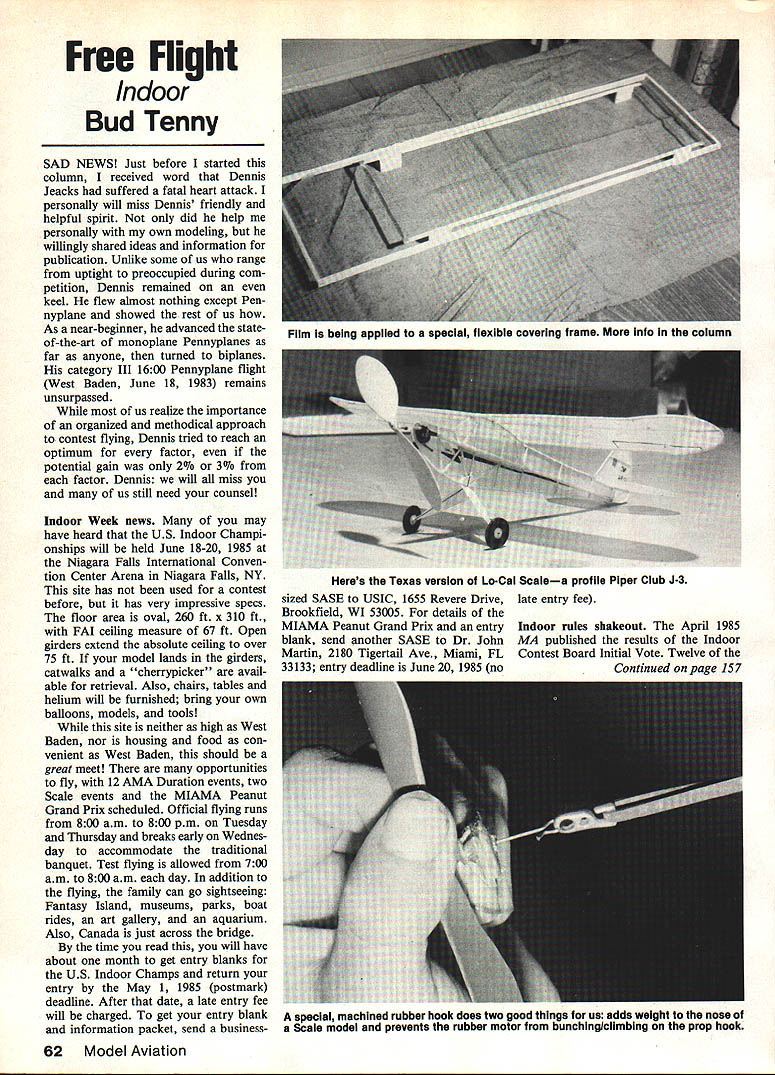
- Support the covering frame above the work table and bend the ends so the film is curved downwards; this makes a trough which approximates the airfoil curve.
- Lay the wing upside down on the film and use a very fine brush to apply water to the frame and ribs.
- Start with the center rib and work outward to the tips along the spars. Moisten about two inches of spar at one time, then move to another two-inch segment (for example, two inches of the front spar on one side of center, then the corresponding part of the rear spar).
- Do the other side of the front and rear spars to balance the expansion of the wood.
- Apply water to each rib as you reach it, being careful to avoid distorting the frame or misaligning the rib.
Once the water has dried, the frame will shrink slightly and the film will relax into tiny wrinkles near the ribs. Turn the frame upside down and cut the wing loose from the rest of the film, and it is ready to add dihedral and bracing.
This covering method is the most stress-free I've used for microfilm. It may not be as easily workable for plastic covering if the adhesive is applied first (see below). One of the photos shows how the flexible frame is loaded with microfilm. The flexible frame is coated with thinned rubber cement which is allowed to dry until all visible solvent is gone. A larger microfilm frame is rested on top, "covering" the frame. The film will immediately adhere to the rubber cement, and the frames can be separated.
What adhesive?
Ray Harlan suggests that a proper spray cement can provide a lighter adhesive for plastic films and condenser paper than brushed-on adhesives. He recommends, in order:
- 3M Super 75
- 3M Super 77
- Grumbacher 548 spray
These generate fine, transparent sprays which can be uniformly applied. Ray cautions that all such products must be used with very good ventilation—open windows and fresh air.
He suggests applying the spray in low room lighting with strong cross lighting so the spray pattern is visible and can be controlled easily. Use a single pass for narrow wings and two passes (leading edge and trailing edge) for wide wings. The adhesive will remain tacky for several hours; if the plastic doesn't go on correctly, you can gently pull it loose to try again.
Covering technique
Ray Harlan suggests placing the wing flat on the board over a traced outline and tack-gluing it in place if necessary. The plastic can be applied using a light balsa frame to lower it over the wing, or two people can hold the corners of the plastic sheet.
If you choose the flexible frame described above, the sprayed wing frame should be bowed so that the center rib contacts first. This requires a steady hand and practice.
Once the film is in place on the wing, use a small soldering iron with a fine chisel tip to trim the excess film. This is easier and neater than even a sharp blade, and it seals the edge of the film to prevent tears.
Good luck! If you develop any other methods, please share them.
Other photos
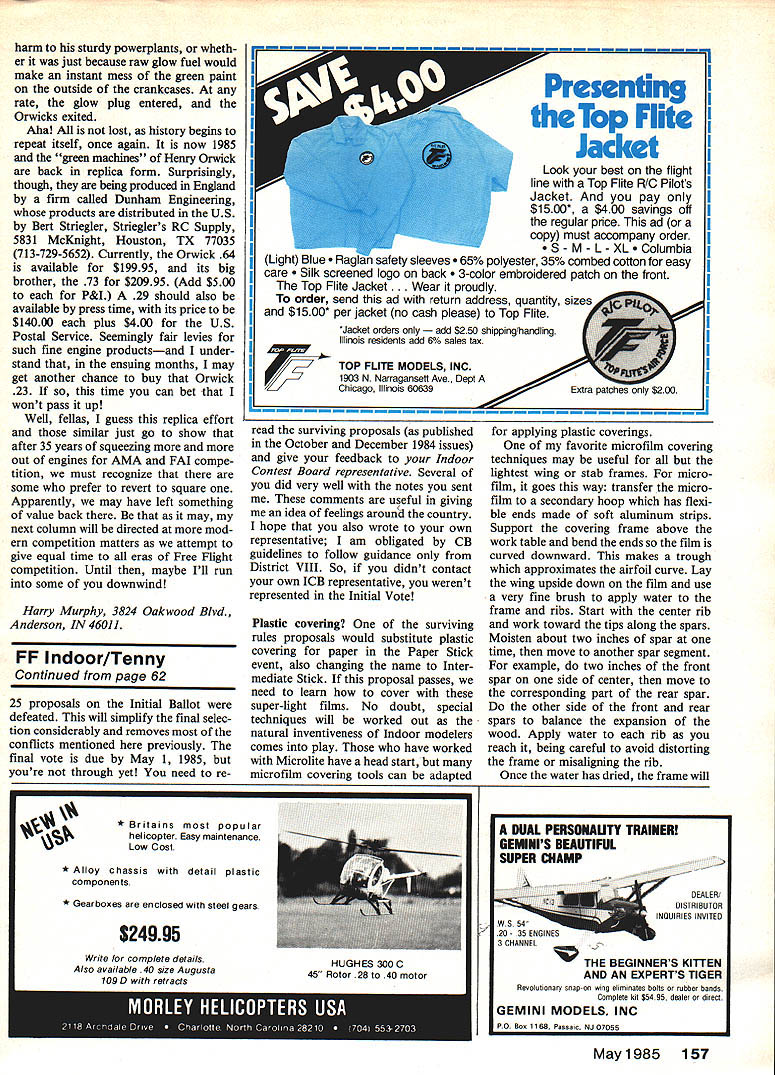
Scale fliers in several areas are flying profile scale models such as the one shown. These are typically single-covered fuselages with motor sticks to support the prop and motor. The model shown is being flown at Bedford Boy's Ranch in Bedford, TX.
Solve two Scale model problems at once!
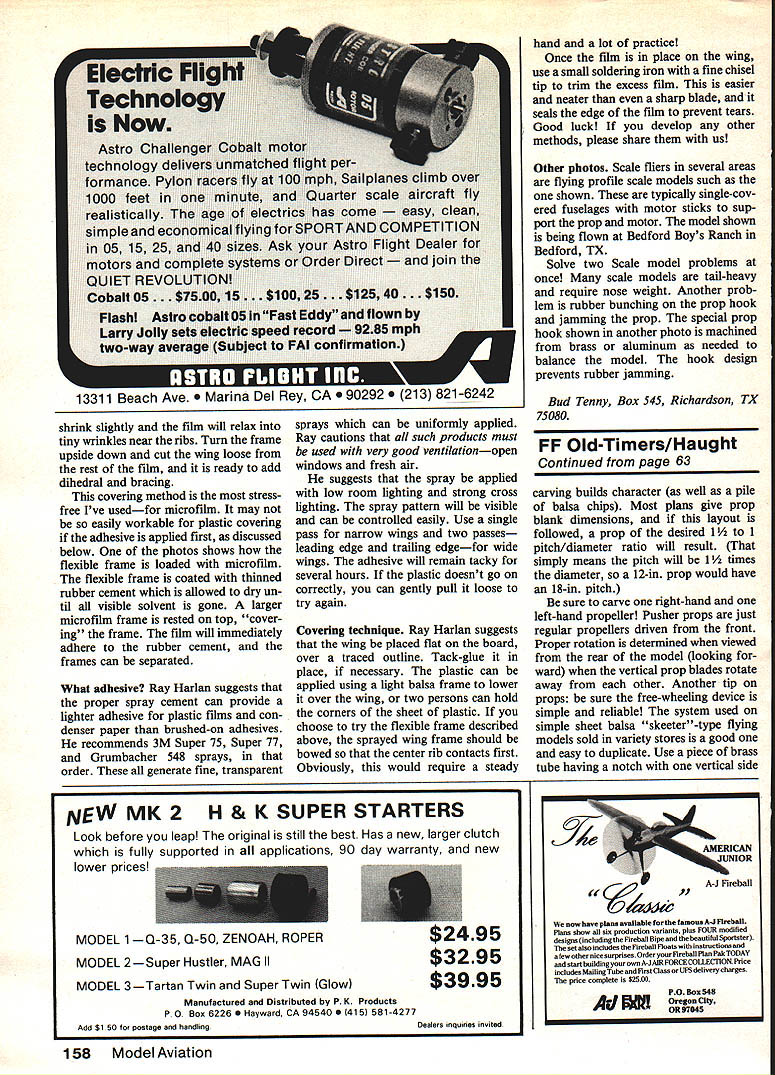
Many scale models are tail-heavy and require more weight. Another problem is rubber bunching on the prop hook and jamming the prop. The special prop hook shown in another photo is machined from brass or aluminum as needed to balance the model. The hook design prevents rubber jamming.
Bud Tenny Box 545 Richardson, TX 75080
Transcribed from original scans by AI. Minor OCR errors may remain.

