
Free Flight: Indoor
Bud Tenny
A BIG SUMMER! My last two columns have commented on the early and thorough planning already done for the 1986 Nats, especially with regard to scheduling indoor events. The other big indoor meet of the summer is the U.S. Indoor Championships, sponsored by the National Free Flight Society. Tony Italiano, NFFS' indoor ramrod, has announced that the USIC will be held at the same site as last year — the convention center in Niagara Falls, NY. This was an excellent site and last year's meet a well-managed contest. The announced date for the next USIC is June 17-19, 1986, and it should be a good warmup for the Nats.
On the other hand, the planning for the 1986 Lake Charles Nats, which has been done, should insure an excellent contest. One of two very good sites will be used: either the Civic Center in downtown Lake Charles or the Burton Coliseum. Both have similar floor area and approximately the same hangup hazards, but the Coliseum has a higher ceiling. Start building now for these contests!
The care and feeding of props
Last time, we started talking about prop wobble. We usually can prevent most prop wobble by careful construction and attention to detail. Once the prop is built, there are many things to check which may cure the problem. However, to quote Dick Kowalski, "Sometimes a prop just wobbles its way to glory!"
Fix it or replace it? In general, it is hard to look at a prop and tell if it will wobble. We only learn this by flying it. A visual inspection of an offending prop may show the problem, so here is a checklist:
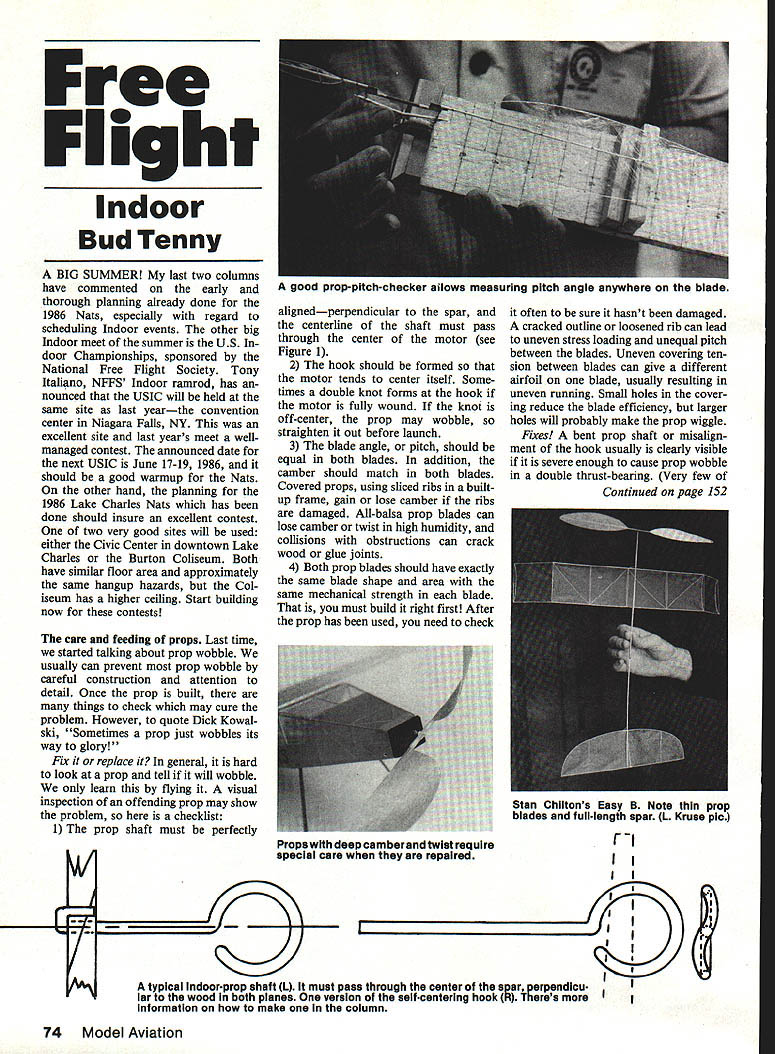
- The prop shaft must be perfectly aligned — perpendicular to the spar, and the centerline of the shaft must pass through the center of the motor (see Figure 1).
- The hook should be formed so that the motor tends to center itself. Sometimes a double knot forms at the hook if the motor is fully wound. If the knot is off-center, the prop may wobble, so straighten it out before launch.
- The blade angle, or pitch, should be equal on both blades. In addition, the camber should match in both blades. Covered props, using sliced ribs in a built-up frame, gain or lose camber if the ribs are damaged. All-balsa prop blades can lose camber or twist in high humidity, and collisions with obstructions can crack wood or glue joints.
- Both prop blades should have exactly the same blade shape and area with the same mechanical strength in each blade. That is, you must build it right first! After the prop has been used, you need to check it often to be sure it hasn't been damaged. A cracked outline or loosened rib can lead to uneven stress loading and unequal pitch between the blades. Uneven covering tension between blades can give a different airfoil on one blade, usually resulting in uneven running. Small holes in the covering reduce blade efficiency, but larger holes will probably make the prop wiggle.
Fixes
A bent prop shaft or misalignment of the hook usually is clearly visible if it is severe enough to cause prop wobble in a double thrust-bearing. Thus you can get a completely true-running prop on a single bearing. Shaft/spar misalignment can be spotted easily from the side as the prop is driven by a few turns in a short motor. Be sure this problem is not caused by the shaft/spar joint having been broken loose. Correct any other problems you find by "tweaking" wherever necessary!
Automatic-centering hooks
Automatic-centering hooks can be made many ways, but my favorite is shown in Figure 2. The side view shows a traditional round hook with the shaft centerline passing through the center of the hook. The end view shows how to form the back edge of the hook in an "S" curve. This bend tends to force the rubber toward the center of the hook rather than riding up into a crooked knot.
The hook is most easily formed using round-nose pliers to make the round hook. Dashed lines in the side view show where to grip the hook with conventional needle-nose or duck-bill pliers to form the "S" curve. Align the tips of the round-nose pliers with the shaft centerline and twist clockwise to make the "S" curve. It may take two or more tries to get just the right curve, since music wire tends to spring back. After getting the "S" curve just right, inspect the hook closely to be sure the alignment has not changed.
Prop-pitch gauge
Use a prop-pitch gauge to measure pitch in both blades and be sure both blades are at the same angle. If the gauge is adjustable, check pitch angles at two or three places on each blade to be sure blade twist is equal in both blades. One of the photos shows an adjustable pop-pitch gauge being used to check setting on a torque-variable-pitch prop. If you care to make your own gauge, note the following features:
- The prop shaft is provided with a fixed reference point to insure exact measurements.
- Provision is made to measure blade angle at one-inch intervals. Both blades must be checked at the same radius, and the angles must match closely.
- The blade-angle protractor should have increments of one degree and be constructed solidly enough to insure repeatable measurements.
Repairs
Repairs made to damaged prop blades must be carefully made to avoid changes in stiffness of the structure. In particular, application of a thin coat of glue at a fracture in a prop spar can affect the flaring characteristics of the prop. Cyanoacrylate glue can also stiffen a structure unless used sparingly. Finally, damaged all-balsa blades must be very carefully repaired to restore the exact blade shape.
Two photos show two extremes which illustrate the concepts involved. One is of a Bostonian prop with very deep camber and curvature. Any damage which changes the camber will obviously affect how well the prop runs, as will innocuous application of a glue which shrinks, thereby pulling in additional camber. The photo of one of Stan Chilton's Easy Bs gives a clear view of a full-length prop spar. Stan uses very soft, light wood, sanded very thin, for prop blades. The full-length spar is necessary to control the blades under power and to allow the model to climb without damaging the prop blades. Repair of this type of prop is very delicate and must be done on the block used to build the prop initially.
Next time! The prop wobble issue will be carried to construction techniques which minimize prop wobble and other inefficiencies.
Bud Tenny, P.O. Box 545, Richardson, TX 75080.
Transcribed from original scans by AI. Minor OCR errors may remain.

