
Free Flight: Indoor
Bud Tenny
A Salute
Once a year I try to remind you how lucky you are if your club has a newsletter. I get many club newsletters each month, and many of them show a strong labor of love. Even the smaller ones, which report local club news, announce contest and meeting dates, and report contest results, appear faithfully. The more elaborate (spell that thicker) newsletters carry plans, design and theory articles, philosophy, nostalgia, safety articles, and whimsy.
Club newsletters are informative, timely, funny, and enjoyable; they are published on a shoestring, appreciated by the members, and seldom supported by contributions. And those readers who don't contribute are the ones with the most suggestions about which topics should be published!
Let's review a few of these gems. Some are usually available only to club members, but most editors send complimentary copies to AMA HQ and trade with other newsletters. By the way—if you think newsletters fall into a "black hole" at AMA HQ, you're wrong! Every single issue of every newsletter is circulated to several staff members who initial them after reading. After a newsletter has made the rounds, it is bundled off to clubs, Model Aviation contributing editors, etc., thus seeing further service.
Newsletters of Interest
- The New York Indoor Times (Ed Whitten) and The Hangar Pilot (Dr. John Martin) are both almost 100% indoor-oriented. Both have regional news, plans, and informal record listings. Both editorialize somewhat and both actively support local and regional flying and stress active searches for more and better indoor sites. Perhaps the most fun of all—both actively support experimental classes and "fun" models.
- The Bat Sheet (no pun intended) comes from the Strat-O-Bats MAC of Seattle, WA.
- WMC Patter is published by the Willamette Modelers Club, Willamette, OR.
- The Thumb Print comes from The Thermal Thumbers of Metro Atlanta, GA.
- The Dope Bucket has mostly club news and schedules and may be circulated mostly to club members—kind of a beacon in the wilderness.
- The Okie Free Flight Flyer, published by Bill Baker in Norman, OK, is heavily into nostalgia but is handled in a breezy, folksy manner; recommended for old-timers. Not much indoor content.
- Free Flight News is an international newsletter of high quality and repute that comes from England and primarily covers FAI-class material.
All these newsletters include indoor material when available or appropriate; some are general coverage unless the title indicates free flight content.
Where to Get Them
- The New York Indoor Times — $5 for 10 issues; Ed Whitten, P.O. Box 176, Wall St. Station, New York, NY 10005.
- The Hangar Pilot — $5 for eight issues; Dr. John Martin, 2180 Tigertail Ave., Miami, FL 33133.
Flying (Outdoors)
A 6-3 prop is recommended. Use Dacron lines approximately 25 to 30 ft. long. Wait for a reasonably calm day.
Use full power on the engine, just slightly on the rich side. When the plane is released, you want to have full-up control initially to keep the nose up. After sufficient speed is built up, however, go to neutral control and let the model take off by itself.
Do not let the model climb too high and go slow, as line tension will be reduced or lost, and you will lose control. Pay particular attention to where the wind is coming from, and do not let the model climb into the wind until you are used to it.
Good luck with your model. Watch for the full-size Tsunami, for it will be in the 1987 Peach State Indoor Championships. (See address above for Thermal Thumbers' contact.)
Scheduling and Listings
As usual, I will be happy to list your scheduled activity if you can get me word with the required lead time of approximately three months. If you want a listing but can't schedule that far in advance, send me a contact name and possible time frame.
Easy B "No-No"
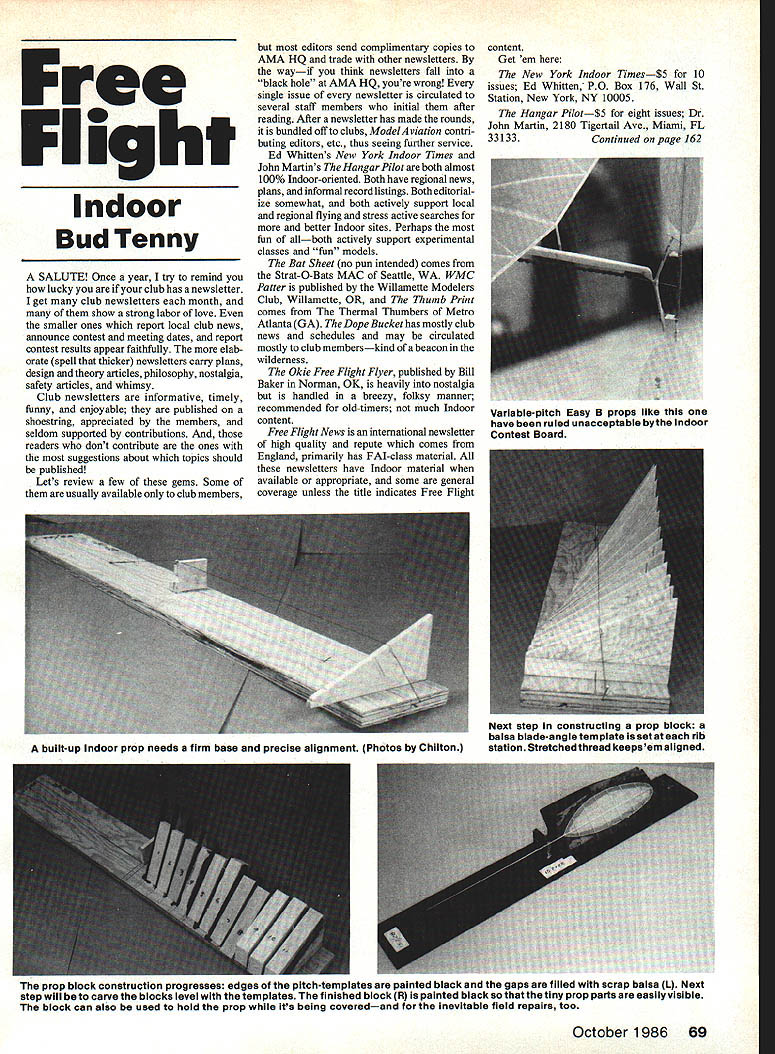
One of this month's photos shows an Easy B with a variable-pitch prop which was flown at the 1982 Indoor World Champs. Most of you will have seen (August 1986 MA) that the Indoor Contest Board has interpreted the AMA rules to mean that variable-pitch and variable-diameter props are not acceptable on Easy B models. If you read the notice closely, you also realize that this is a temporary ruling, pending confirmation by a vote of the Indoor Contest Board.
If you fly Easy B, you should tell your ICB member how you feel. If only those against this interpretation express themselves, the ICB would have to reverse the ruling. If you agree with the ruling, say so to other people who might complain. The ICB can't make rules you like without knowing what you want.
Prop Blocks and Covering
I promised to talk about prop blocks and covering this time, but there is a limit on how many photos I can use in a single column. The prop block I will describe was made by Stan Chilton; if any of you can document where the basic technique came from, I'll be happy to give you credit.
The traditional prop block is carved from a single block, which is difficult to do accurately and is somewhat inflexible if you want an unusual pitch distribution. Stan's block starts with a rigid base, longer than the finished prop will be. The basic idea is to construct an angled support that creates the proper blade angle at each rib station, with a central fixture to align the shaft and prop hub with the hook.
Construction overview:
- Mount a tip template and center fixture on a plywood base.
- Stretch an arced string between two staves to establish the baseline for the prop shaft.
- Install all blade station templates, each just touching the string guide.
- Paint each blade-angle template black and glue filler blocks of balsa in place against the templates.
- Carve the blocks level with the templates (down to the black paint).
- Paint the finished block black to give better visibility to the white balsa prop frames.
- Build and cover the blade right on the block so it dries in place and to minimize stress on its fragile structure.
The final result is a flexible, accurate prop-block setup suitable for unusual pitch distributions and careful covering.
Unfinished Business
Last time I showed a wide-blade Novice Perlynape prop by Jim Clem and promised some performance figures. The prop/model combination has been very consistent and has set Category I (26-ft. ceiling) and Category II (31-ft. ceiling) records of 81.1 and 90.2 seconds, respectively. The same setup was flown at the U.S. Indoor Championships and took sixth with 10:39 (67-ft. ceiling).
Next time, I'll have more details on prop blocks and covering techniques.
Bud Tenny Box 545, Richardson, TX 75080.
Transcribed from original scans by AI. Minor OCR errors may remain.

