
Free Flight: Indoor
Bud Tenny
U.S. Indoor Championships (USIC)
The U.S. Indoor Championships (USIC), sponsored by the National Free Flight Society (NFFS) and the National Indoor Model Airplane Society (NIMAS), is set for June 4–6, 1987 in the mini-dome at East Tennessee State University, Johnson City, TN. If you haven't received an entry blank and meet info, send a business-sized SASE to:
- Tony Italiano
1655 Revere Dr. Brookfield, WI 53005
The site is a 122-ft-high dome with a floor area equal to a football field. Housing is available in a nearby college dormitory with air-conditioned rooms at reasonable rates. In addition to the NFFS events, Doc Martin and the MIAMA club are repeating their Peanut Grand Prix. For Grand Prix details, send an SASE to:
- Dr. John Martin
2180 Tigertail Ave. Miami, FL 33133
Note: The normal USIC entry deadline is May 10, 1987. Late entry is possible at a premium. Try to get your entry in on time. Also, each event must have a minimum of four entries or it will be canceled. (The Gathering of Butterflies event requires six entries in either section.)
Events and Awards
- USIC awards trophies for every AMA Indoor event except Helicopter.
- Separate Junior and Senior classes in HLG, Pennyplane, and Novice Pennyplane.
- Junior/Senior combined entry available in Indoor Stick, Easy B, Intermediate Stick, and Peanut Scale.
- Bostonian Cabin is held as an additional regular (trophy) event.
- Peanut Speed and Unlimited Speed winners receive cash prizes.
Special events:
- A/1 Old Timer: For microfilm-covered models widely published between January 1, 1934 and December 31, 1942.
- No-Cal Scale: Held late on the last day as a mass-launch event.
Pennyplane flights are scored separately within the regular USIC events. Winners divide 85% of the entry fee total in descending amounts: 35%, 29%, 15%, 10%, and 5%.
The USIC Grand Championship Award goes to the flier with the best total of scores from seven events chosen by the flier from the regular events. This is a comprehensive contest and should be supported by all indoor fliers who can possibly attend.
The USIC is the brainchild of Tony Italiano and has grown into the world's most impressive indoor contest. A World Championship may have more prestige, but where else can you go for a total "indoor fix"? Don't miss it if you can help it!
Membership / Entry Discounts
Join NFFS! If you join NFFS and enter the USIC, you save $1 over entering as a nonmember. NFFS membership is $15. NIMAS and NFFS members get a $16 discount on the first USIC event and $1 off each additional event. Membership also gets you the NFFS Digest, an excellent Free Flight newsletter with recent issues featuring indoor coverage.
Newsletters
A previous column listed several club newsletters with indoor coverage or parent clubs having regular indoor activity.
- Wasatch Flyer: Newsletter of the Wasatch Free Flight Association (Salt Lake City area). Subscription: $10 per year. Send money to Frank Anderson, 6137 Dee Park Dr., Salt Lake City, UT 84118.
- Indoor News: An excellent international indoor newsletter published three times per year by Jorgen Korsgaard, Ahornweg 5, D-2397 Ellund-Handewitt, West Germany. Cost listed as "60.- Dkr." If that isn't clear, write to Jorgen and ask. This English-language newsletter gives broad international coverage, including U.S. news. The November 1986 issue had extensive coverage of the 1986 Indoor World Championships, three-views of top WCh models, and plans for several beginner-class models.
Flying Sessions / Scheduling
I'm working with about nine weeks of lead time. Below are sessions beginning in April, plus contacts for areas that have had sessions earlier in 1987.
Newsletter editors and contest directors: I can publish your flying session and contest dates if I receive the information in time. Guideline: because this column is bimonthly, aim for 12 weeks' notice. If the date isn't firm that soon, I can note planned sessions and provide a contact for details. This brings in more fliers and out-of-town visitors.
#### California sessions
Curt Stevens has developed access to Santa Ana MCAS based on solid documentation of AMA membership and auto insurance. If you plan to be in his area for any sessions, contact Curt well ahead of time to find out required documentation:
- Curt Stevens
P.O. Box 25108, Marguerite Pkwy., Suite B-160 Mission Viejo, CA 92692 Telephone: (714) 240-8433
Local contests (California): April 7–8; May 2–3; August 1–2; September 5–6; October 3–4; November 7–8; December 5–6, 1987.
Bigger meets (California): FAI Regional June 6–7, 1987; Team Selection Finals July 3–5, 1987.
Regional Sessions (FF Indoor / Tenny)
- Connecticut: Glastonbury — April 5 and May 3, 1987. Contact George Armstead, 89 Harvest Lane, Glastonbury, CT 06037; telephone (203) 633-7836.
- Florida: Miami — Dr. John Martin, 2180 Tigertail Ave., Miami, FL 33133; telephone (305) 858-6363.
- Georgia: Cumming (Atlanta area) — April 26, 1987. Contact Norm Purdy, telephone (404) 428-1390.
- Massachusetts: Cambridge — April 4 and May 2, 1987. Contact Ray Harlan, 15 Happy Hollow Rd., Wayland, MA 01778; telephone (617) 353-4013.
- New Jersey: Palmyra and Glassboro — Contact Al Mikarian; telephone (609) 929-6573.
- New York: Chappaqua — Art Maiden; telephone (914) 760-2284.
- New York: New York City (Columbia University) — Ed Whitten; telephone (212) 724-0282.
- New York: Pearl River — Don Ross, 38 Churchill Rd., Cresskill, NY 07626.
- New York: Peekskill — April 1 and 21, 1987. Contact Scott Smith, R.D. #1, Box 290, Athens, NY 12015.
- Pennsylvania: Philadelphia — Doug Barber, 146 Stratton House, Maple Glade, NJ 08052; telephone (609) 235-5318.
- Texas: Dallas/Ft. Worth — Jesse Shepherd, 2713 Summit View, Bedford, TX 76021; telephone (817) 282-3700.
- Utah: Salt Lake City area — Jim Rhoades, 682 N. 1400 W., Salt Lake City, UT 84116; telephone (801) 364-5106 (Utah State Aeromodellers). Frank Anderson, telephone (801) 966-3973 (Wasatch Free Flight Association).
- Washington: Seattle — Jean Stubbs; day telephone (206) 655-0872 (Boeing Hawks) / Kevin Collins; telephone (206) 868-8273 (Strat-O-Bats).
Pistachio Scale
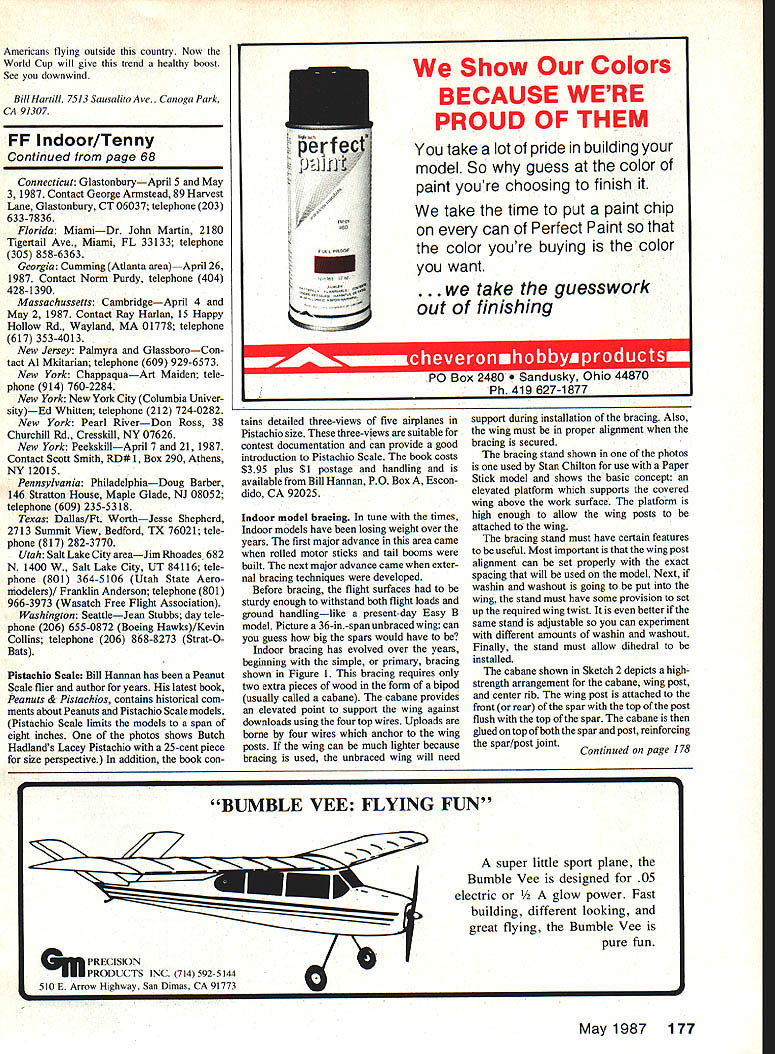
Bill Hannan, a longtime Peanut Scale flier and author, has published Peanuts & Pistachios. The book contains historical comments about Peanut and Pistachio Scale models. Pistachio Scale limits models to an eight-inch span; one photo shows Butch Hadland's Lacey Pistachio with a 25-cent piece for size perspective. The book also contains detailed three-views of five airplanes in Pistachio size suitable for contest documentation and as an introduction to Pistachio Scale.
Cost: $3.95 plus $1 postage and handling. Available from:
- Bill Hannan
P.O. Box A Escondido, CA 92025
Indoor Model Bracing
Indoor models have been getting lighter over the years. Early advances included rolled motor sticks and tail booms; the next major advance was development of controlled bracing techniques. Before bracing, flight surfaces had to be sturdy enough to withstand flight loads and ground handling—like a present-day Easy B model. Imagine a 36-in. span unbraced wing: the spars would have to be very substantial.
Indoor bracing evolved beginning with simple (primary) bracing. This bracing requires only two extra pieces of wood in the form of a bipod (usually called a cabane). The cabane provides an elevated point to support the wing against downdrafts by using four top wires. The bracing allows the wing to be made much lighter, but the unbraced wing needs support during installation of the bracing. The wing must be in proper alignment when the bracing is secured.
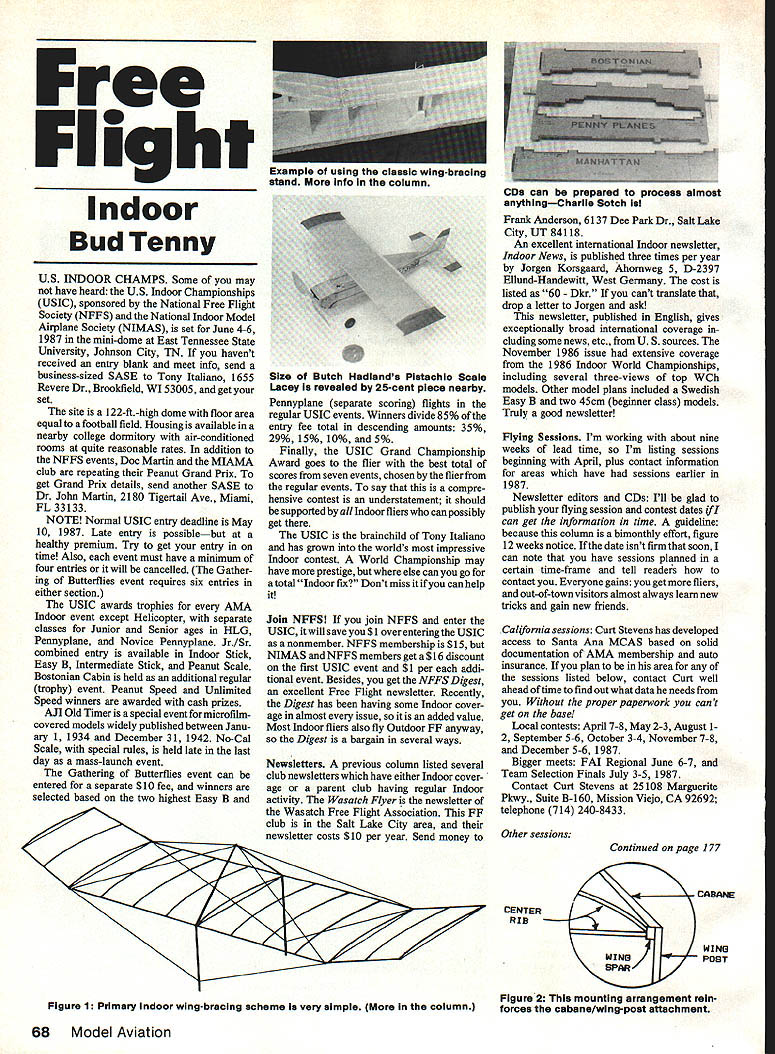
The bracing stand we use at Stan Chilton's for the Paper Stick model shows the basic concept: an elevated platform that supports the covered wing above the work surface. The platform is high enough to allow the wing posts to be attached.
A useful bracing stand must allow:
- Proper wing post alignment with the exact spacing used on the model.
- Holding enough of the model to put in the required washout.
- Experimentation with different amounts of washout and washout shims.
- Installation of dihedral.
The cabane depicted in Sketch 2 shows a high-strength arrangement for the cabane, wing post, and center rib. The wing post is attached to the front (or rear) of the spar with the top of the post flush with the top of the spar. The cabane is then glued on top of both spar and post, reinforcing the spar/post joint.
Next time: an adjustable bracing stand suitable for most model sizes, and several bracing schemes.
- Bud Tenny, P.O. Box 545, Richardson, TX 75080.
Transcribed from original scans by AI. Minor OCR errors may remain.

