
Free Flight: Indoor
Bud Tenney
NFFS Awards
Each year, the National Free Flight Society singles out several persons and models for special recognition. The following persons were nominated to the Free Flight Hall of Fame for 1987:
- Vic Cunningham, Sr.
- Dr. John Martin, Jr.
- Walt Mooney
- James Patterson
- Charlie Werle
- Don Zipoy
Of special interest to indoor fliers are the nominations of Doc Martin and Walt Mooney.
John Martin was nominated in these words: "Recognized leader in the promotion of Peanut Scale activity, initiator of the Peanut Grand Prix, and an all-around coordinator of Indoor activity in the Florida area."
Walt Mooney's nomination read: "A most prolific designer and documenter of Rubber Peanut Scale models. When you think of Peanut Scale, you automatically think Mooney." I applaud both these selections; both gentlemen are outstanding in their respective areas of activity.
The Indoor Model of the Year is Jerry Nolin's Serendipity EZB. This model holds the AMA Category IV Easy B Open record and won Easy B at the 1986 U.S. Indoor Champs at Niagara Falls. The committee's decision was very hard, as there were two other very good nominations.
More newsletters
- Ornithopter Modeler's Society — Newsletter published by Roy White, Rt. 1, Box 241, Catawissa, MO 63015. Membership dues: $7 per year. If you are interested in ornithopters, the Society needs you.
- The Spring issue of Flapper Facts features an article about ornithopter experimentation by Dipl.-Ing. (FH) Horst Handler, translated from the original German by Walter Eberach. Two ornithopter plans and other items fill out the issue.
- Hangar Rash — Newsletter of the Denver Area Indoor Model Airplane Association. Editor: John Berryman, 1866 S. Sedalia Circle, Aurora, CO 80017. Cost: $5 per year.
- El Torbellino — Published by Howard Haupt, 3860 Ecochee Ave., San Diego, CA 92117, for the San Diego Orbiteers. Cost: $10 yearly. The Orbiteers are consistently inventing new kinds of fun models and work to bring new fliers into the fold. This is one of the most respected free flight clubs in the country.
Site surveys
A couple of columns back I requested that site information be sent in, since I hope to compile a new list of active indoor sites. Les Shaw, of the Denver Area Indoor Model Airplane Association, is the first (and only, to date) respondent. The DAIMAA site is Balch Field House at the University of Colorado.
Site facts:
- Ceiling: 48 ft. (Category II) with dirty rafters and a scoreboard; a 50 x 200 ft. floor area where the ceiling is at least 40 ft. high.
- Total floor area: 100 x 200 ft. (three basketball courts side by side).
- Conditions: Normally drafty but acceptable for most models.
- Main virtue: Available 12 to 13 times a year at no cost. Les rates it as the best site available.
For dates or more information, contact Les Shaw at 995 McIntire St., Boulder, CO 80303; phone (303) 499-0946. How about all you other clubs? Tell us about your site!
Flying updates
- The Santa Ana hangar venue (Justin Indoor Model Airplane Club) has been slightly modified.
- The July 4 weekend meet will be an FAI regional meet with full motors.
- The Labor Day meet will be the FAI team-selection finals.
International meet
The Contest of Flémalle, Belgium — an international indoor event with proxy entries invited — will be held in August 1987. For details, contact F. L. Van Hauwaert, 1 Grand Place, Box 52, 4100 Flémalle, Belgium. (Announcement courtesy of Bill Hannan's Outreach Sheet. Order information: Bill Hannan, P.O. Box A, Escondido, CA 92025.)
Oakland Cloud Dusters arise!
Any ex-member of the Cloud Dusters or anyone knowing how to locate ex-members is requested to contact George Xenakis, 1288 Oak Knoll Drive, San Jose, CA 95129; phone (408) 996-0650. The Cloud Dusters are holding a fiftieth-anniversary banquet on Saturday evening, June 13, 1987, at Shenanigan's Restaurant, Oakland, CA.
Hand-Launched Glider (HLG) tips
I seldom get feedback or tips from HLG fliers, so there hasn't been much in the column. I do have a few of my own, so listen up!
One of the most discouraging things you can see is your (almost) perfectly trimmed HLG breaking the glide with a tiny stall that quickly decays after losing a couple of feet of altitude. Check your wings for a slight warp, especially near the tip. You should have equal, but slight, washout (negative angle of attack) in both tips.
What happens is that minor turbulence causes one tip to stall slightly, breaking the glide path. Your glider should be coming in slightly nose-high for minimum sink rate, so any kind of stall is deadly. Not only does the model lose altitude, it takes a while to get back "on the step" again. For the same reason, never warp the tip trailing edge down to try to control turn!
Adjustments to consider:
- Tip weight
- Stabilizer (stab) tilt
- Rudder
Note:
- Turn generated by stab tilt is essentially independent of model speed; tip weight is nearly so.
- Rudder adjustment is very speed-dependent, so as the model slows to get on the step, it may lose turn and stall.
More on bracing
I had promised to discuss both bracing and a special bracing setup this time, but other concerns ate up space, so let's hold the bracing schemes and just examine the bracing fixture and how to use it for field repair.
The complete rig consists of:
- A fuselage cradle (Figure 1)
- Two multipurpose stands (Figure 2)
- A tail boom stand (Figure 3)
These parts allow you to install any kind of wing and tail bracing on almost any size model, as well as set the rig's geometry. Since the rig is modular, it will fit into a reasonably sized box, so you can take it to the contest for field repair as needed.
Size limits are dictated by the distance between the vertical wires in Figure 2: that distance should be at least 1/4 in. longer than the widest wing chord you expect to have. The height (length of the vertical wires) must be enough to raise a wing section as high as needed during bracing or the main set.
How big are the stands? My set is 8 in. to the top of the wires and 7 1/2 in. between wires. A stand 10 in. tall and 9 1/2 in. wide should accommodate even the fattest FAI wings and work with almost any size indoor stick you are brave enough to build!
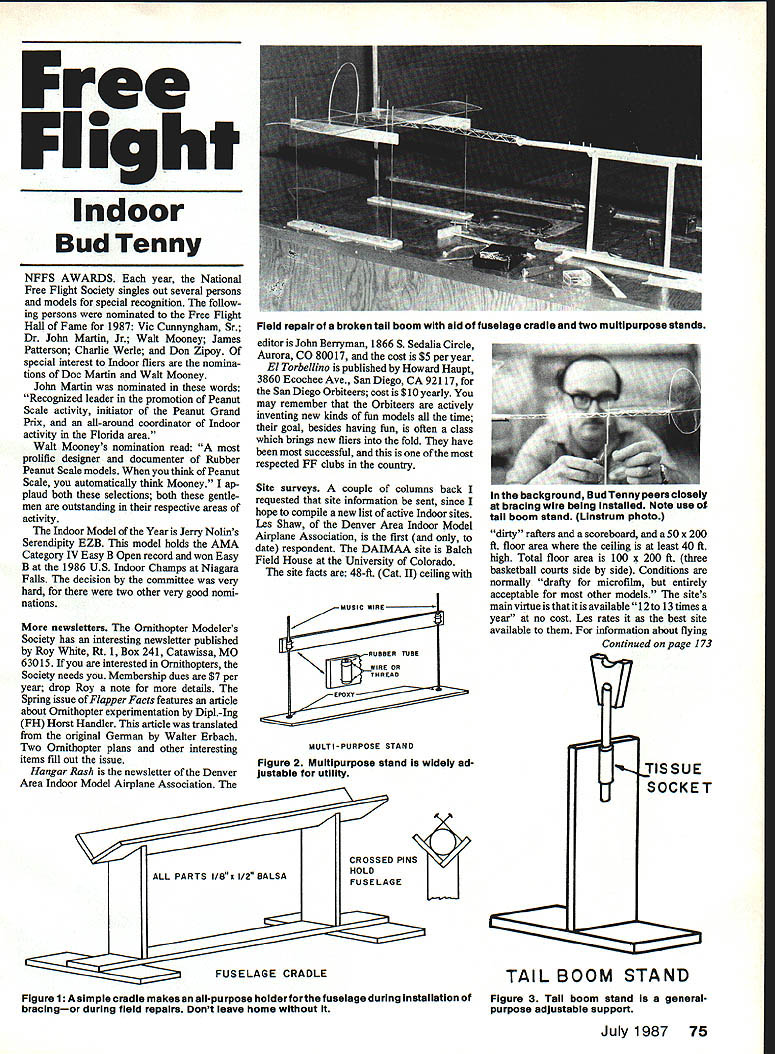
One photo shows the stands in use for field repair—note the gap in the built-up tail boom. The work surface needs to be fairly flat; in this case it is my FAI model box. By careful adjustment of height and position, the raw ends of the boom were mated and repaired. The whole repair process, including setup of the stands, took about 20 minutes. Incidentally, because the built-up boom could not be repaired so precisely, the model trim was still right after the repair!
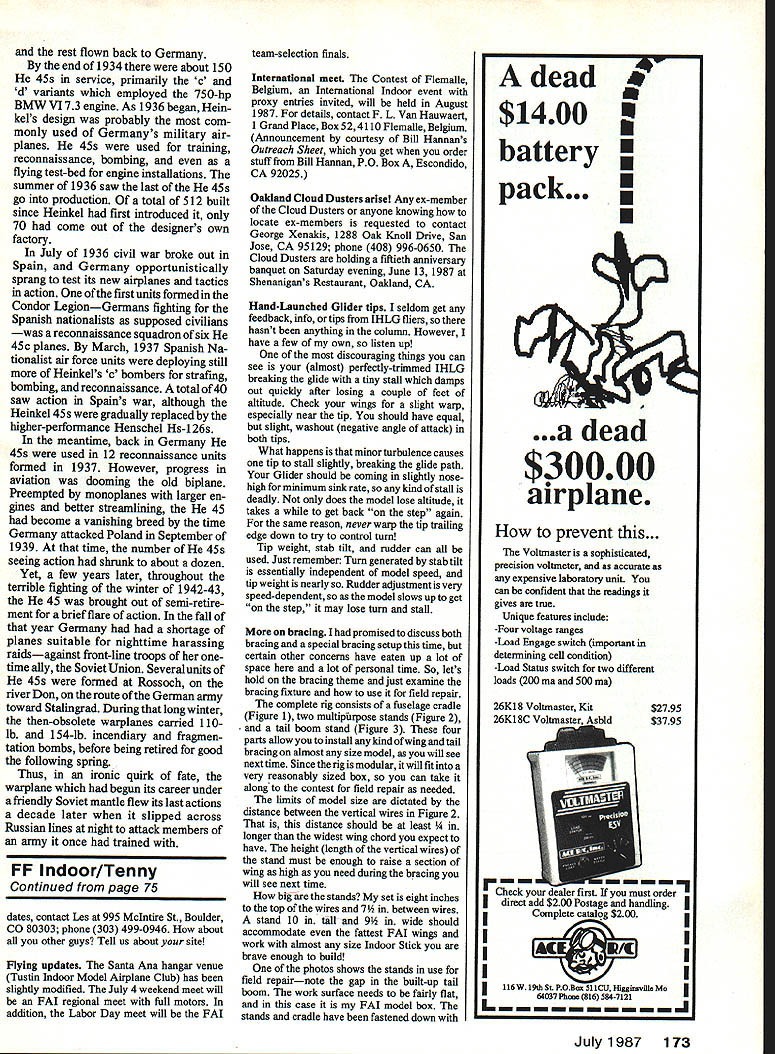
Another photo shows me installing tail bracing, using the tail boom stand to stabilize the boom and reduce handling stress. Next time: bracing schemes (I promise).
Bud Tenney, P.O. Box 545, Richardson, TX 75080.
Transcribed from original scans by AI. Minor OCR errors may remain.

