
Free Flight: Indoor
Bud Tenny
Successful USIC and Nats
The United States Indoor Championships (USIC) had 96 contestants and the Nats had 68. In view of earlier (late 1986, early 1987) concerns by a few AMA officials that "indoor fliers don't support their events anymore," these entry lists are heartening. In particular, a breakdown of the USIC entry list by region is noteworthy in that the participation was not just local fliers — many contestants traveled a long way to attend.
- West (California): 2
- Southwest (Texas): 5
- South: 32
- Midwest: 36
- Northeast: 15
- Canada: 9
A similar, but smaller, distribution of fliers attended the Nats, including at least one from Arizona and a few from Nebraska. It is interesting to note that the Canadians fielded more than half as many USIC entrants and far more Nats contestants than the Northeast did. The Northeast has many more active fliers who live much closer to both contests than the Canadians.
The lesson is twofold: it takes a site that is at least acceptable, confirmed scheduling, and good meet management to make the effort and expense worthwhile. The USIC management team has an enviable five-year track record, and this year's site looked excellent. That it proved to be a world-class site (an effort is under way to schedule the 1988 World Championships there) is just icing on the cake. Rick and Melody Doig have essentially revolutionized Nats Indoor management, offering top-notch procedures.
The '87 Nats site had been used once before and proved to have an almost perfect Category II ceiling height. A long list of records were set there, confirming the site's value. If many national records are set during heavy competition, the site has to be good.
Steering feedback
The most recent column reported on various problems associated with balloon steering. Those who read the steering material circulated on ModelNet will realize that part of the problems are associated with improper storage of the balloons when not in use, and model retrieving at inappropriate times. The following comments came from Don Slusarczyk in response to the September column:
"I can honestly say that this whole steering controversy is blown way out of proportion. There is no problem in steering at all. People are creating a problem where none ever existed. The rules are very clear about when you can steer and what the intent of steering is: Steering must only be used to avert collision with the structure of a building, its contents or other models."
"Nor do I find the Contest Board's interpretation hard to understand: 'Steering is intended to alter the direction of flight and the general location of a model which is approaching the structure of a building.'"
"If there is any problem with steering, it is because some Contest Directors and timers believe that people should not steer, and anyone who does steer is cheating in some form.
"The people who steer are not cheaters; we are people who take pride in our workmanship and do not care to see our models hit or land on various obstructions, possibly causing loss or damage to the model. What's so wrong with that?"
NFFS announcement
The National Free Flight Society (NFFS) is accepting nominations (deadline December 31, 1987) for 10 Models of the Year—1988—and for the Free Flight Hall of Fame.
- Send model nominations to: Jon Zeisloft, 5411 W. October Way, W. Valley City, UT 84120. Phone: (801) 964-8633.
- Send Hall of Fame nominations to: Anthony Italiano, 1655 Revere Dr., Brookfield, WI 53005. Phone: (414) 872-6256.
NFFS is also calling for papers for the 1988 Symposium. Send an outline of your proposed paper to Hermann Andresen, 738 E. Palmaire, Phoenix, AZ 85020. Hermann will serve as editor for the '88 Symposium, with Sal Fruciano as assistant editor. The year 1988 will be the twenty-first anniversary of the NFFS Symposium.
Sympo '87
Sympo '87, the twentieth anniversary edition of the National Free Flight Symposium ("Sympo"), continues the proud tradition of previous reports. The range of topics is broad, with emphasis on design and analysis. Two studies of particular interest to indoor fliers are:
- "Ornithopter Wing Design" by Frank Kieser
- "Aeroelasticity: Examples, Causes, and Cures" by Hewitt Phillips
In addition, a plan for Jerry Nolin's "Serendipity Easy B" model is available ($13 for NFFS members, $14 for nonmembers, plus $2 postage and handling). For any serious free flight modeler, it is a must for your library.
Flying opportunities
The following dates are those I have received so far. For any area not covered here, try obtaining session information from contacts listed in previous columns.
The Denver Area Indoor Model Airplane Association began its indoor activity with "public service" sessions at Balch Fieldhouse, University of Colorado, on September 13, 1987. The service activity is to teach indoor modeling skills to freshman Aerospace Engineering Sciences students at the University of Colorado. Tentative dates:
- Fun Fly — December 4 and 18, 1987
- First 1988 dates — January 8 and 22, 1988
For confirmation and information: Les Shaw, phone (303) 499-0946; John Berryman, phone (303) 337-2936.
New York City area: December 6, 1987. Contact: Ed Whitten, phone (212) 724-0282.
Bracing wrap up
The following material refers to column items as far back as May 1987. Review those references if needed.
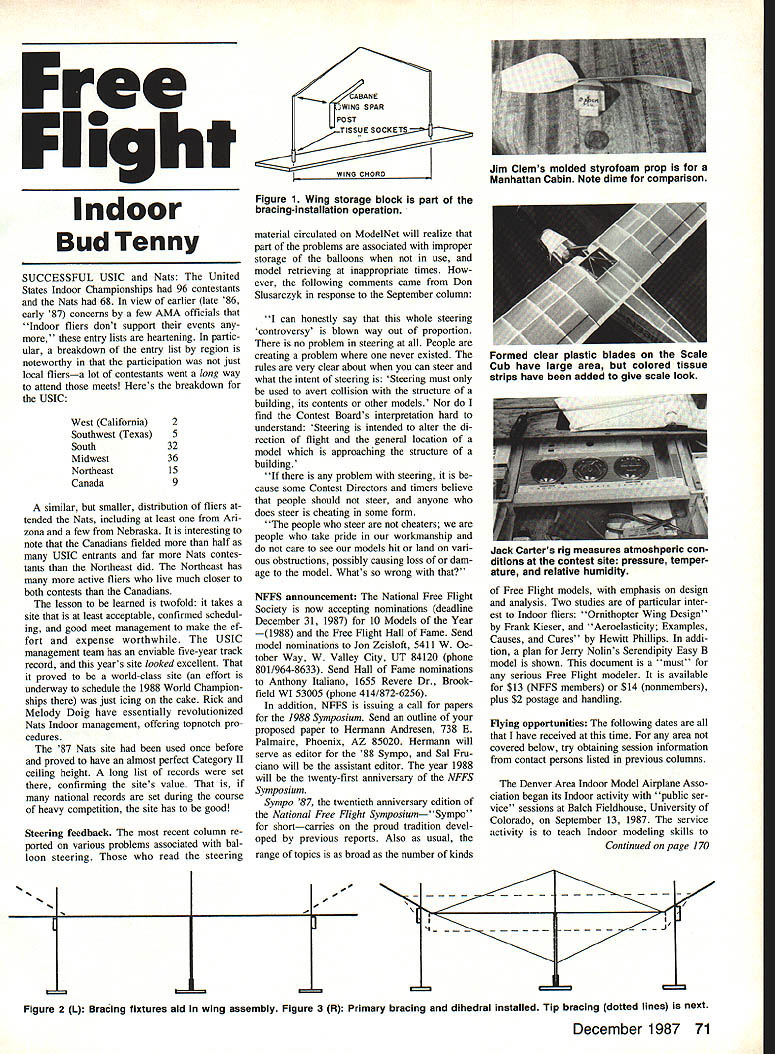
Begin with the multipurpose bracing fixtures described in the July 1987 issue. The starting point for wing bracing with the fixtures is the wing mount block, which will fasten the finished wing in the model box.
- Assemble the mount block with a cabane and two wing posts flat on the board. The cabane bevel should have an internal overhang so the cabane can also glue to the wing spar (as described in the May 1987 column). This increases the strength of the wing/cabane joint.
- Insert the post/cabane assembly into the sockets and anchor the block in the center of your work area.
- Set up the adjustable stands on either side of the cabane assembly, with the support bars about two inches lower than the top of the posts. Slide the covered wing between the posts and let it rest on the two stands. Raise the stand bars and the wing until the wing center section is flat and the spars are just touching the bottom of the cabane (see the front view referenced in the May column).
- Measure to verify the wing is perpendicular to the posts, then glue the wing to the post and cabane. Note: if your wing uses a center dihedral brace, install the dihedral before putting the wing into the fixture.
- Move the stands out to just beyond the tip dihedral (if used). Now is the time to install washin and washout if you use them. I make a tiny nick in the bottom of the left leading-edge spar and the right trailing-edge spar, and gently crack the spars so the required twist is installed without bending stress in the spars. Be sure to reinforce the spars at the nicks by allowing a drop of glue to soak into the nicked area. Similar techniques can be used to install tip dihedral.
- Install the primary bracing and the secondary bracing (if used; see the September 1987 column).
- Finally, move the stands near the tip, using them to support the tip dihedral while the glue joints dry. Adjust the tilt of the supports to install any washin or washout used in the tips, and install tip bracing if used.
Next time, the bracing wrap up will continue with bracing philosophy, weight saving, bracing repair, adjustment reliability, etc.
Photos and notes
John Brunken has only built one model airplane — a flawless Piper Cub weighing just about four grams. The neat part is its transparent plastic prop blades, which have quite a bit of area. John attached tissue strips to the plastic, making it look like a scale prop was installed. It took his unusual camera angle to show both the tissue and the plastic clearly. Meanwhile, I guess John thought Indoor Scale was too easy — he hasn't been out to another flying session!
Bud Tenny P.O. Box 545, Richardson, TX 75080
Transcribed from original scans by AI. Minor OCR errors may remain.

