
Free Flight: Indoor
Bud Tenny Box 545 Richardson, TX 75080
Upcoming events
As you read this, Indoor World Champs / U.S. Indoor Champs week will either be about to start or actually under way. Here's what's coming:
- Saturday, May 28 and Sunday, May 29 — World Championship practice 7:00 a.m. to 2:00 p.m.; two World Championship competition flights between 2:00 p.m. and 8:00 p.m. (no rounds).
- Monday, May 30 — Practice flights 7:00 a.m. to 11:00 a.m.; flights #5 and #6 from 11:00 a.m. to 6:00 p.m. The banquet begins at 8:00 p.m.
- Tuesday–Wednesday — F1D Open International Meet (same schedule as Sunday).
- Thursday–Saturday — U.S. Indoor Champs; banquet begins at 7:00 p.m. on Friday.
Unfinished business: carbon-fiber prop hub
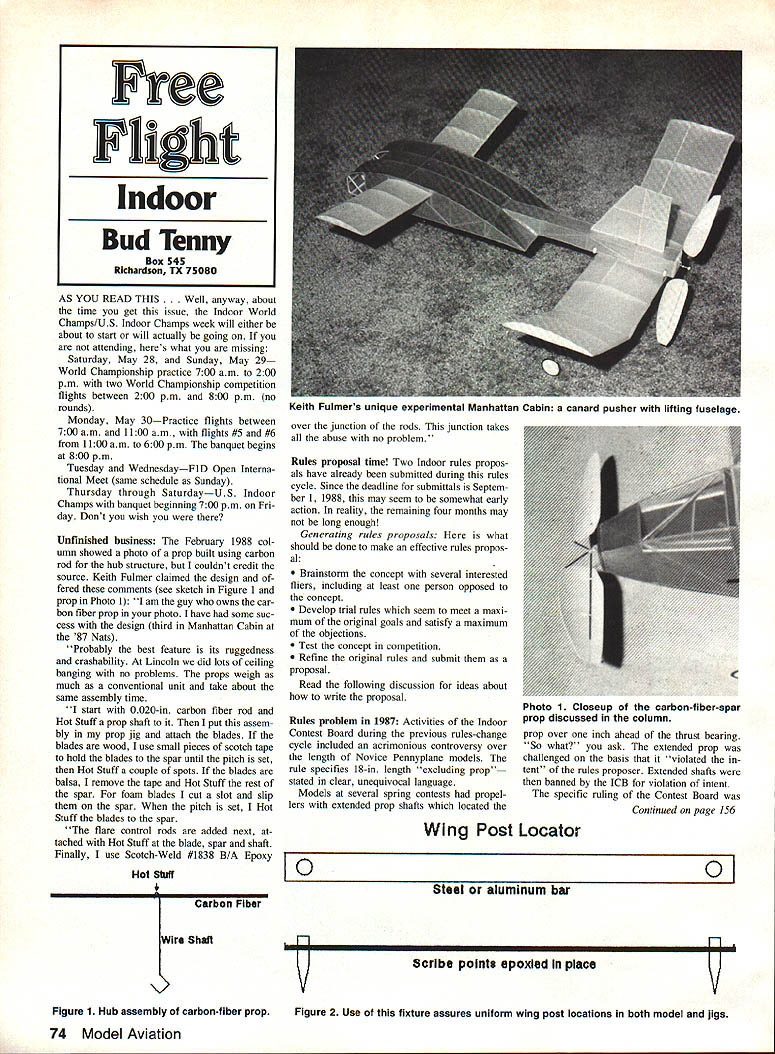
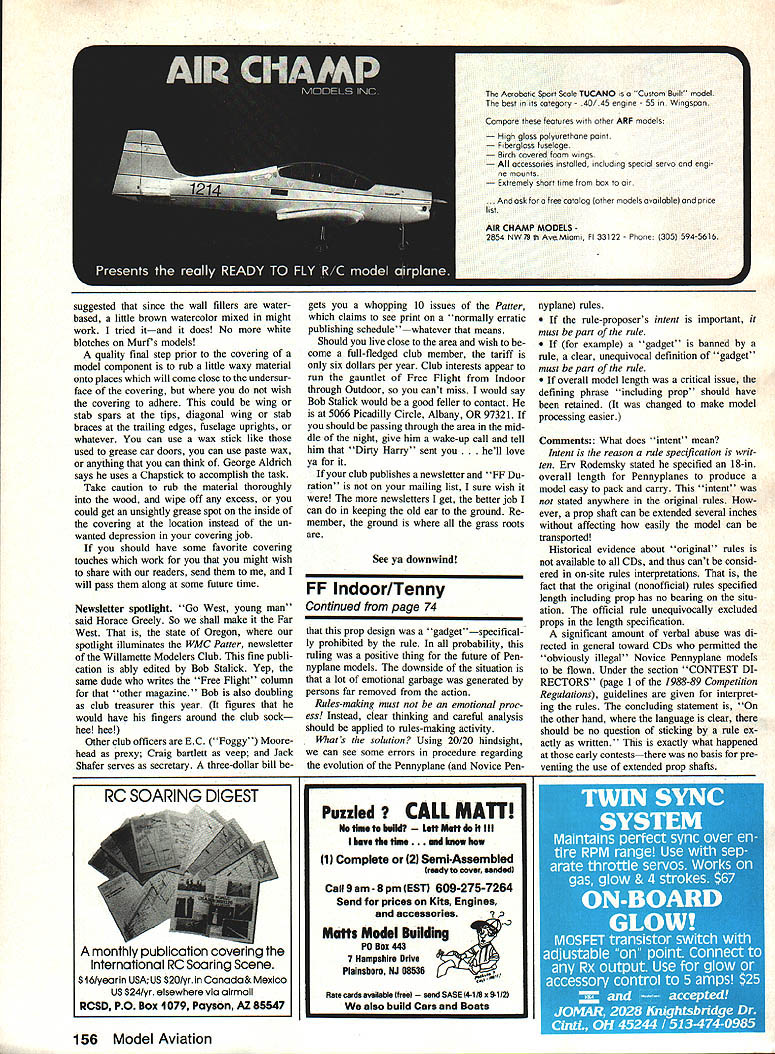
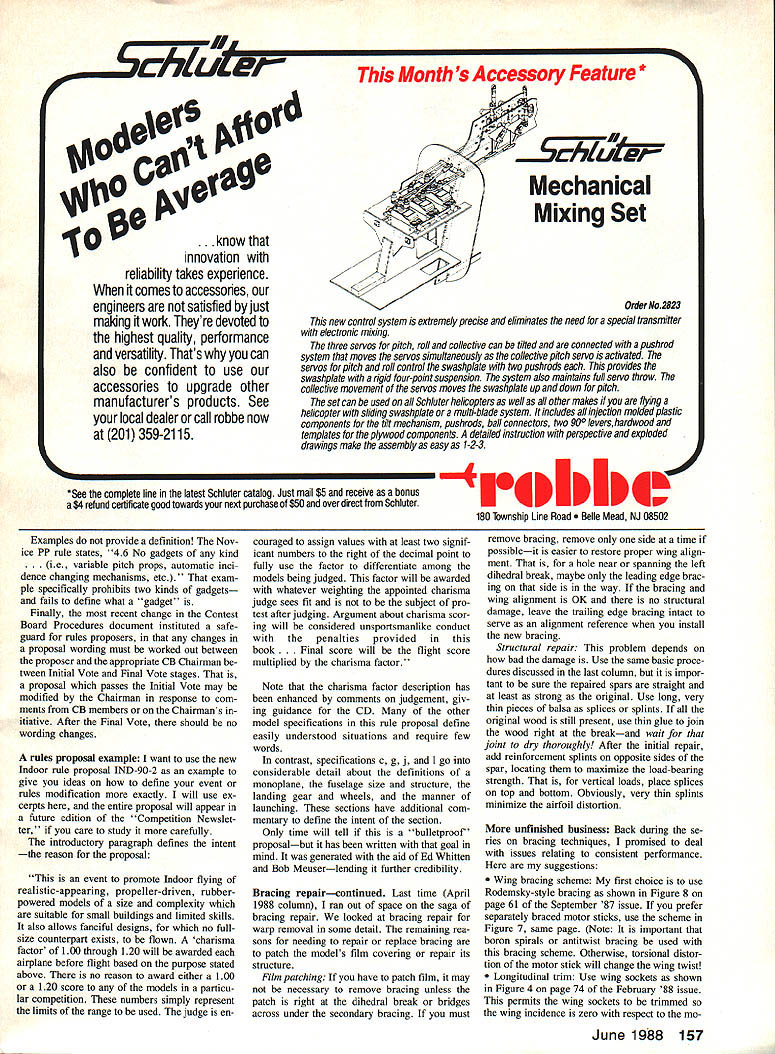
The February 1988 column showed a photo of a prop built using carbon rod for the hub structure but I couldn't credit the source. Keith Fulmer claimed the design and offered these comments (see sketch in Figure 1 and Photo 1):
"I am the guy who owns the carbon-fiber prop in your photo. I have had some success with the design (third in Manhattan Cabin at the '87 Nats). Probably the best feature is its ruggedness and crashability. At Lincoln we did lots of ceiling banging; no problems. The props weigh much the same as a conventional unit and take about the same assembly time.
"I start with 0.020-in. carbon-fiber rod and Hot Stuff prop shaft to put the assembly in my prop jig and attach the blades. If the blades are wood, I use small pieces of Scotch tape to hold the blades to the spar until the pitch is set, then Hot Stuff a couple of spots. If the blades are balsa, I remove the tape and Hot Stuff the rest of the spar. For foam blades I cut a slot and slip them on the spar. When the pitch is set, I Hot Stuff the blades to the spar.
"The flare control rods are added next, attached with Hot Stuff at the blade, spar and shaft. Finally, I use Scotch-Weld #1838 B/A epoxy on the fiber wire shaft."
Rules proposal time
Two Indoor rules proposals have already been submitted during this rules cycle. Since the deadline for submittals is September 1, 1988, it may seem somewhat early to act; in reality the remaining four months may not be long enough.
Generating effective rules proposals — recommended steps:
- Brainstorm the concept with several interested fliers, including at least one person opposed to the concept.
- Develop trial rules that meet the original goals and satisfy the maximum number of objections.
- Test the concept in competition.
- Refine the original rules and submit them as a proposal.
Read the following discussion for ideas about how to write and defend a proposal.
Rules problem: 1987
Activities of the Indoor Contest Board during the previous rules-change cycle included an acrimonious controversy over the length of Novice Pennylane models. The rule specifies 18-inch length excluding prop, stated in clear, unequivocal language. At several spring contests, models had propellers on extended prop shafts which located the prop more than an inch ahead of the thrust bearing.
The extended prop was challenged on the basis that it "violated the intent" of the rules proposer. Extended shafts were then banned by the ICB for violation of intent. The specific ruling of the Contest Board was that this prop design was a "gadget" — specifically prohibited by the rule. In all probability, this ruling was a positive thing for the future of Pennylane models. The downside was a lot of emotional conflict generated by rules-makers removed from on-site action.
Rules-making must not be an emotional process. Clear thinking and careful analysis should be applied to rules-making activity.
#### Intent and definitions Using hindsight, some procedural errors are apparent in the evolution of the Pennylane (and Novice Pennylane) rules. If the rule-proposer's intent is important, it must be part of the rule. If (for example) a "gadget" is banned by a rule, a clear, unequivocal definition of "gadget" must be included.
If overall model length is a critical issue, the defining phrase "including prop" should be retained if that was the proposer's intent. (It was changed in the past to make model processing easier.)
What does "intent" mean? Intent is the reason a rule specification is written. For Pennylanes the reason was to produce a model easy to pack and carry. That "intent" was not stated in the original rules. A prop shaft can be extended several inches without affecting how easily the model can be transported, so intent alone is not always decisive.
Historical evidence about the original rules is not available to all Contest Directors and thus cannot be used in on-site interpretations. The original (nonofficial) rules specifying length including prop cannot be used to override the official rule that excluded the prop.
A significant amount of verbal abuse was directed at Contest Directors who permitted the "obviously illegal" Novice Pennylane models to be flown. Under the section "CONTEST DIRECTORS" (page 1 of the 1988–89 Competition Regulations), guidelines are given for rule interpretation. The concluding statement is: "On the other hand, where the language is clear, there should be no question of sticking by a rule exactly as written." That is exactly what happened at those early contests — there was no basis for preventing the use of extended prop shafts.
Examples do not provide a definition. The Novice Pennylane rule states, "4.6 No gadgets of any kind ... (i.e., variable-pitch props, automatic incidence-changing mechanisms, etc.)." That example specifically prohibits two kinds of gadgets — and fails to define what a "gadget" is.
Finally, the most recent change in the Contest Board Procedures document instituted a safeguard for rules proposers: any changes in proposal wording must be worked out between the proposer and the appropriate CB Chairman between Initial Vote and Final Vote stages. A proposal that passes the Initial Vote may be modified by the Chairman in response to comments; after the Final Vote there should be no wording changes.
A rules proposal example (INDO-90-2)
I want to use the new Indoor rule proposal INDO-90-2 as an example to illustrate how to define an event or rules modification more exactly. The introductory paragraph defines the intent — the reason for the proposal:
"This is an event to promote indoor flying of realistic-appearing, propeller-driven, rubber-powered models of a size and complexity which are suitable for small buildings and limited skills. It also allows fanciful designs, for which no full-size counterpart exists, to be flown. A 'charisma factor' of 1.00 through 1.20 will be awarded by the charisma judge to models entered in this event."
The proposal encourages assigning values with at least two significant digits to the right of the decimal point to fully use the charisma factor to differentiate models. The factor will be awarded at the discretion of the appointed charisma judge and is not subject to protest after judging. Argument about charisma scoring will be considered unsportsmanlike conduct with the penalties provided in the rule book. Final score will be the flight score multiplied by the charisma factor.
Note that the charisma factor description has been enhanced with guidance for the Contest Director. Many other model specifications in the proposal are concise and require few words; some sections (monoplane definition, fuselage size/structure, landing gear and wheels, manner of launching) go into considerable detail and include commentary to define intent.
Only time will tell if this is a "bulletproof" proposal, but it was written with that goal in mind. It was generated with the aid of Ed Whitten and Bob Meuser, lending it further credibility.
Bracing repair — continued
Last time (April 1988 column) I ran out of space on the saga of bracing repair. We looked at bracing repair for warp removal in some detail. Remaining reasons for repairing or replacing bracing are to protect the model's film covering or to repair its structure.
#### Film patching If you have to patch film, it may not be necessary to remove bracing unless the patch is right at the dihedral break or bridges across the secondary bracing. If you must remove bracing, remove only one side at a time if possible — it is easier to restore proper wing alignment. For a hole near a spar or spanning the leading-edge break, make the repair one side at a time. If the bracing is sound and the film covering alignment is correct and there is no structural damage, leave the trailing-edge bracing intact to serve as an alignment reference when you install the new bracing.
#### Structural repair How you proceed depends on the severity of the damage. Use the same basic procedure discussed in the last column, but be sure repaired spars are straight and at least as strong as the originals. Use long, very thin pieces of balsa as splints. If all the original wood is still present, use thin glue to join the wood right at the break and wait for that joint to dry thoroughly. After the initial repair, add reinforcement splints on opposite sides of the spar, locating them to maximize load-bearing strength. For vertical loads, place splints on top and bottom. Very thin splints minimize airfoil distortion.
More unfinished business
Back during the series on bracing techniques I promised to deal with issues relating to consistent performance. I will present my suggestions on achieving consistent performance in the next column.
Transcribed from original scans by AI. Minor OCR errors may remain.

