
Free Flight: Indoor
Bud Tenny Box 545 Richardson, TX 75080
Contests and flying opportunities
The data below has been gathered since the last column. If an area is not represented, refer to my January 1989 column for possible contact information in that area.
California — Santa Ana
- The Santa Ana hangar is being refurbished; availability will be limited and uncertain.
- The first weekend of each month will be sanctioned in case of availability.
- Contact: Curt Stevens, 25108 Marguerite Parkway, Mission Viejo, CA 92692; phone (714) 240-8433.
California — San Diego
- Monthly sessions in Cat. I.
- Contact: Howard Haupt, 3860 Ecochee Ave., San Diego, CA 92117.
Iowa — Cedar Rapids
- Approximately weekly flying sessions all winter; 34-ft. ceiling.
- Contact: Paul McIlrath, 1524 48th St. N.E., Cedar Rapids, IA 52402; phone (319) 393-4677.
Oklahoma — Oklahoma City
- Sessions at the National Guard Armory in Oklahoma City.
- Scheduled dates: January 22, February 19, 1989; March date not yet set.
- Contact: Jim Belson, 4933 N.W. 29th, Oklahoma City, OK 73129; phone (405) 946-1093.
Utah — Salt Lake City
- Sessions at Brighton High School on the following dates: January 4, 18; February 1, 15; March 1, 15, 29; April 12, 1989.
- Contact: Rocky Russo, 1425 Kensington Ave., Salt Lake City, UT 84105.
Fun models
Indoor modelers are endlessly inventive, and a wide variety of unusual events have been developed for fun flying. A recent and successful concept is the Federation ROG ("Skinny Minnie," Model Aviation, May 1987). Tony Becker staged a team competition for these models at the U.S. Indoor Championships; competition was fierce and results were better than expected.
- Federation ROG (briefly): 30 sq. in. model, 6-in. diameter plastic prop, 31 grams minimum weight. This class offers opportunities to develop flight strategy and adjustment skills.
The San Diego Orbiteers have been particularly inventive. Their A-6 class shows promise for club fun sessions. A-6 rules are:
- 30-sq.-in. wing area maximum.
- 6-in.-diameter prop; either unlightened plastic commercial prop or built from flat 1/32" sheet.
- Motor stick 6 in. long maximum.
- All spars minimum 1/16" square; all ribs minimum 1/32" × 3/32".
- Model must be covered with tissue; no special indoor materials may be used.
Matchbox models: The matchbox model concept requires the model to fit in a kitchen matchbox. Some rules require the assembled model to fit in the box; others allow the model to be stowed in pieces and assembled for flight.
Cigarette-carton class: Models are assembled from a cigarette carton and must carry a U.S. 25-cent piece internally and perpendicular to the line of flight. Models are timed. A mandatory ROG takeoff sample time several years ago was 90 seconds under a 40-ft. ceiling.
Historical note: The cigarette-carton class was originated in 1950 by Professor Gene Larrabee at MIT with Richard Baxter, Lloyd Lisher, Henry Jex, and Walt Mooney.
Postal contests and Fudge Factors
Postal contests were once common: Indoor fliers in one area would challenge fliers in other areas to Postal contests. The challenge usually specified a task and participants mailed their results. If you hold a Postal contest, here are NIMAS "Fudge Factors" to allow fair comparisons across different ceiling heights.
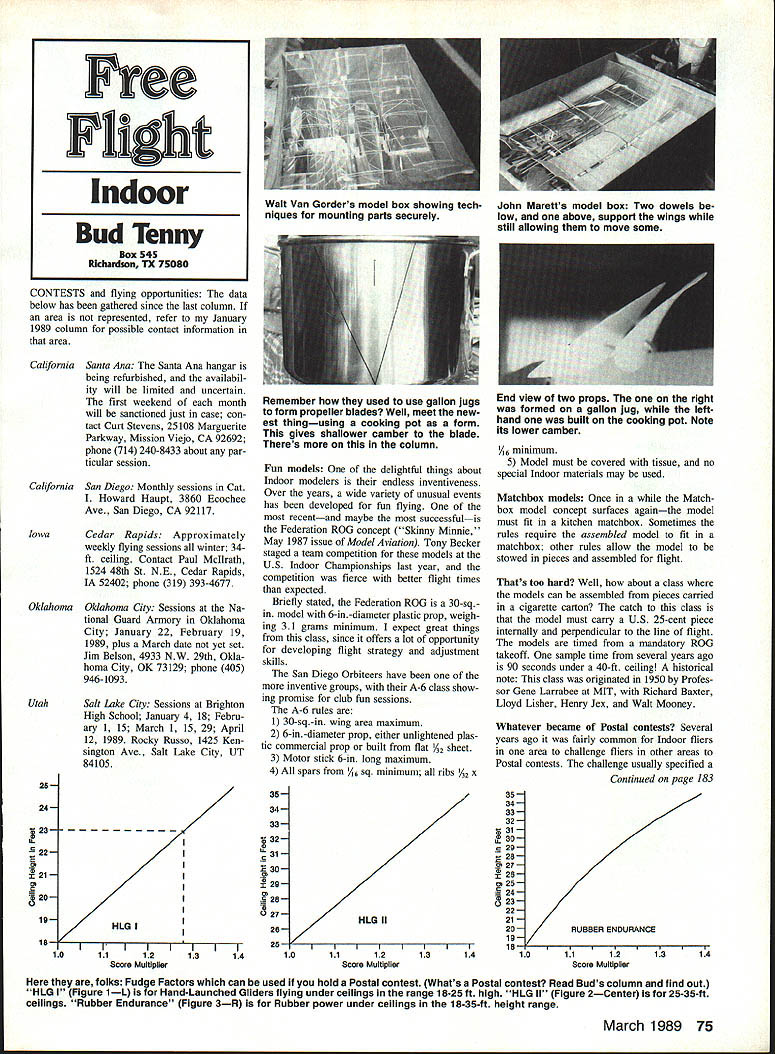
Note: "HLG I" is intended for hand-launched gliders under ceilings in the range 18–25 ft. "HLG II" is for 25–35 ft. ceilings. "Rubber Endurance" is for rubber power under ceilings in the 18–35 ft. range.
Table 1 — HLG (18–25 ft)
- 18 ft.: 1.39
- 19 ft.: 1.33
- 20 ft.: 1.28
- 21 ft.: 1.22
- 22 ft.: 1.16
- 23 ft.: 1.13
- 24 ft.: 1.05
- 25 ft.: 1.00
Table 2 — HLG (25–35 ft)
- 25 ft.: 1.40
- 26 ft.: 1.36
- 27 ft.: 1.32
- 28 ft.: 1.28
- 29 ft.: 1.24
- 30 ft.: 1.21
- 31 ft.: 1.16
- 32 ft.: 1.12
- 33 ft.: 1.08
- 34 ft.: 1.04
- 35 ft.: 1.00
Table 3 — Rubber Power (18–35 ft)
- 18 ft.: 1.394
- 19 ft.: 1.374
- 20 ft.: 1.354
- 21 ft.: 1.333
- 22 ft.: 1.313
- 23 ft.: 1.291
- 24 ft.: 1.269
- 25 ft.: 1.247
- 26 ft.: 1.225
- 27 ft.: 1.202
- 28 ft.: 1.179
- 29 ft.: 1.155
- 30 ft.: 1.130
- 31 ft.: 1.105
- 32 ft.: 1.080
- 33 ft.: 1.054
- 34 ft.: 1.027
- 35 ft.: 1.00
So why not try Postal meets? If you do, share the results with us via this column.
Model boxes
My previous box discussions (May, October 1988 and January 1989) dealt with boxes intended to be shipped as luggage. In a box meant for travel everything must be anchored so components can't drift and damage other parts. If you can give the box careful handling during transportation, things don't need to be tied down so well and the box doesn't need to be as strong. This more casual approach is reflected in two boxes shown this month.
- Walt Van Gorder's box: A traditional, more secure approach. Motor sticks, props, and tail assemblies are either plugged in or secured in foam-rubber clamps. Wings plug into tissue sockets anchored to the box.
- John Marett's box: A more relaxed approach. Fuselage components use similar anchor points, but wings rest on wooden dowels running across the box. A removable dowel above the wings keeps them from moving too much, while allowing a little side-to-side and vertical play. This approach is easier to use—no struggle to mount wings into posts or sockets. Ensure the inside-the-box lid fits tight enough to prevent accidental removal.
Props
Remember how gallon jugs were used to form propeller blades? A newer method uses a cooking pot as a form, producing a shallower camber. Camber in a jug-style blade is fixed by the radius of the mold form; change the form radius to change camber.
- The Jones cork block form has a 3.1-in. radius (used in previous props discussed).
- A cooking pot used as a second form had a 4.75-in. radius, producing noticeably less camber.
With limited testing time, the lower-camber prop (made on the cooking pot) seemed to work better at Johnson City. As for my results, I still need to learn to prevent the motor from bunching at the rear hook!
Closing note
When responding to advertisers, mention that you read about them in Model Aviation.
Transcribed from original scans by AI. Minor OCR errors may remain.

