
Free Flight: Indoor
Bud Tenny Box 545, Richardson, TX 75080
HOW MANY Indoor fliers depends on who you ask. The September 1988 issue of the AMA's National Newsletter showed membership statistics for 1988: 120,960 total members; 2,002 Free Flighters; and 261 Indoor fliers.
About one-fourth of all the Indoor fliers in AMA (61) entered Indoor at the Virginia Nats, and over one-third of them (135) flew at Johnson City last year. Typically, Texas is something of an "Indoor desert," but the first 1989 Dallas/Ft. Worth Indoor contest had 7% of all the AMA members entered. Finally, Indoor News and Views, which over a 20-year span typically reaches about one-quarter of U.S. Indoor fliers, currently has just over 300 U.S. subscribers — I guess it suddenly got a lot wider coverage!
The AMA presented these statistics "as food for thought." Maybe we should end these comments the same way.
What is an Indoor flier, anyway? I don't know the "official" AMA definition, but it seems to me that everyone who flies Indoor events in sanctioned contests is an Indoor flier. Just because someone also flies FF, CL, or RC, does that keep him from being an Indoor flier? One way we could do our own count of Indoor fliers: if someone from every AMA-sanctioned Indoor contest would send me a photocopy of the entrant list, we could compile a list by AMA number and count them up!
Now is the time. If you are an NFFS member, you got to see some neat drawings of the world's largest Indoor-type model — the human-powered Daedalus airplane (October 1988 issue of the NFFS Digest). If you aren't a member, you can keep missing out — or you can join NFFS. Send $15 ($7.50 for age 18 and under) to NFFS, 6146 East Cactus Wren Rd., Scottsdale, AZ 85253.
All Free Flight and Indoor fliers really owe it to themselves to support NFFS — the only organization that sponsors both FF and Indoor contests. Also, don't forget the Digest and Sympo (the annual Free Flight Symposium Report). These two publications make a lot of good material available to us.
Speaking of the Free Flight Digest, editor Bob Messer needs articles — both FF and Indoor. Send your input to Bob at 4200 Gregory St., Oakland, CA 94619.
The big show is coming again! The 1989 United States Indoor Championship is set for June 1–4, 1989, at Johnson City, TN. Those who have flown in the minimodel fieldhouse at the University of Tennessee at Johnson City know this is one of the top four or five sites in the world. This is one of the most prestigious indoor meets in the world, and may be the most hotly contested. Twenty official events and some unofficial events are on the schedule. Send a #10 SASE to USIC, 1655 Revere Dr., Brookfield, WI 53005 to get more details and an entry blank.
"It isn't fun anymore, so I quit." Bill Baker, original and long-time editor of the Okie Free Flight Flyer, began issue #34 (mailed January 7, 1989) with that comment. Bill's efforts have helped the Indoor, FF, and Old-Timer folks keep up with their world for several years. He promised issue #35, but that was the end.
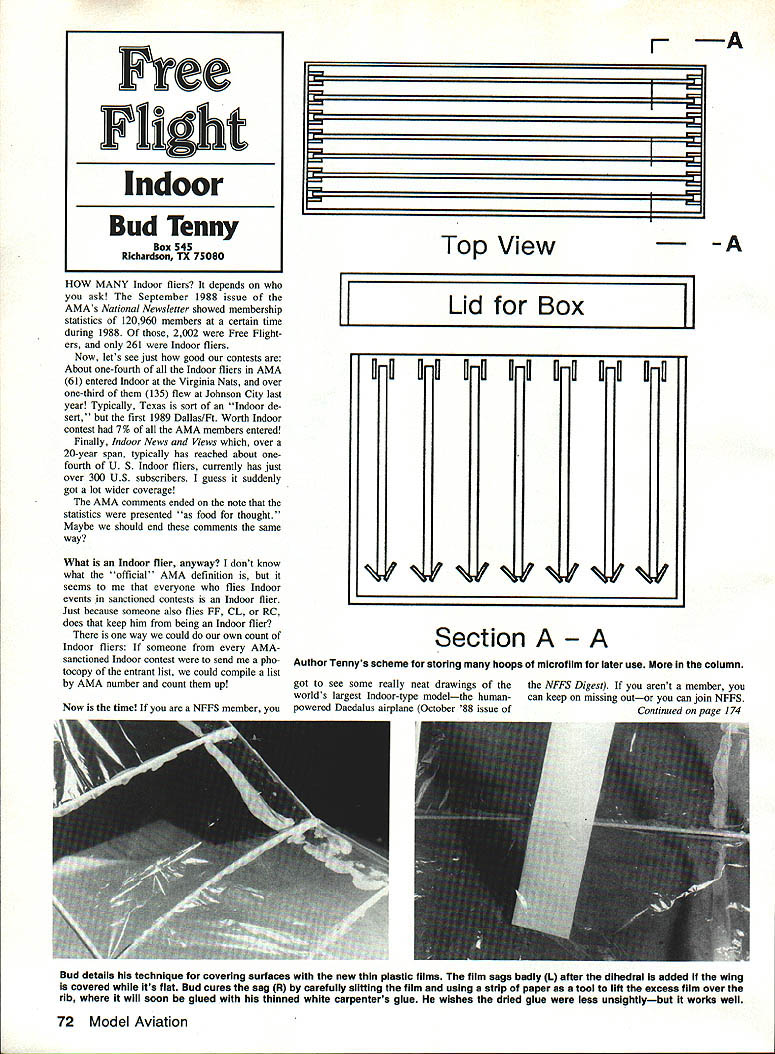
Microfilm storage box
The time is here for microfilm pouring — at least it always works better for me in the winter. I have many microfilm hoops of different sizes, so storage size is at a premium. My solution is high-density storage in a long box.
Find a box with suitable inside dimensions; mine is about 31 in. long (inside), a good length for FAI wings. Make hoops about 1/2 in. shorter than the box length and about 1 1/2 in. narrower than the box depth. Mounting uses a "V" of 1/4 x 1 in. strips glued to the box ends to support the bottom edge of each hoop. At the top, place similar strips parallel to the hoop with about 3/8 in. clearance. More clearance lets hoops rattle; less clearance makes inserting and removing hoops hazardous.
Covering with plastic films
The superlight films now used on Pennylanes, Easy B, and Intermediate Stick can be difficult to work with because of static cling and a tendency to float in the slightest breeze. The film has two major advantages: its weight is between condenser paper and microfilm, and it is stronger and more dimensionally stable than condenser paper.
Covering techniques used for microfilm or condenser paper will work. I chose a condenser-paper technique: cut a piece of film about 2 in. larger than the surface in both directions and tape the edges to the work surface.
Although unsightly, greatly thinned white carpenter's glue works well as adhesive. With the wing upside down on the film, begin at the center of the trailing edge and work toward both tips, gluing the trailing edge to the film. Since this leaves the leading edge up in the air, trim the glued part of the trailing edge loose, allowing the wing to begin dropping onto the film.
As the wing comes down, it will tuck. Eventually the leading edge must be propped up; a CP strip and the film then glue the ribs to the film. The covering will be snug and mostly smooth — until dihedral installation. If slack film results at the dihedral, cut it loose just outside the dihedral rib. Slip a thin paper in the slot to help work the loose edge up over the rib and smooth out wrinkles before gluing. The result is similar to a three-piece covering but requires no special fixtures.
The P-24 model
I have seen a P-24 Condor model fly, and it flew very well. These models are used by the Denver Area Indoor Model Airplane Association in special classes for aeronautical engineering freshmen at the University of Colorado. The model was stable and flew slowly enough to be easily controlled. Anyone interested in building the model should write to Mac Model Aircraft Company, 359 South 110th East Ave., Tulsa, OK 74128; phone 918-437-5490.
Contests and flying sessions
Thanks to many newsletters for the information below. If you are in the same area and can give a week's advance notice, I will list your activities in the first possible issue.
- California — Santa Ana: The Santa Ana hangar is being refurbished; availability will be limited and uncertain. The first weekend of each month will be sanctioned just in case. Contact Curt Stevens, 25108 Marguerite Parkway, Mission Viejo, CA 92692; phone (714) 240-8433 about any particular session.
- California — San Diego: Monthly sessions. Contact Howard Haupt, 3860 Ecocene Ave., San Diego, CA 92117.
- Colorado — Denver: Contact Les Shaw, phone (303) 499-0946 for session schedules.
- Connecticut — Glastonbury: Contact George Armstead.
Transcribed from original scans by AI. Minor OCR errors may remain.

