
Free Flight: Indoor
Bud Tenny Box 545 Richardson, TX 75080
Sad news
About the time this was being typed, word came that modeling pioneer Tony Becker died recently. I always enjoyed working with Tony, who had many good ideas and a boundless enthusiasm for models. Tony's latest project was promoting the Federation ROG—one of the most challenging unofficial events to come along in some time. Modeling has lost another friend, and we will miss him.
Federation ROG
Speaking of Federation ROG, early in the development of the class some fliers felt that no one would top five minutes with one. Wrong again! David Aronstein did 5:07 with his Liberty Bell Federation ROG in the Delta hangar in Tampa, FL on New Year's Day, 1989. Is anyone ready to predict another time that won't be beaten?
How much lead time?
I periodically mention the lead time I need to get anything into a specific issue. MA's publisher has admonished me to send this off before I leave for the USIC at Johnson City, which will leave me about one day to pack the models so I can head out May 31. You can compute weeks now, add about two additional weeks, and you still must get something in at the last minute. Call evenings at 1-214-235-4035.
Is anyone out there?
David Hodges (34337 Road 168, Visalia, CA 93291; telephone 1-209-798-1963) is hoping to make contact with anyone in the southern San Joaquin Valley who would be interested in indoor flying at the gymnasium of the College of the Sequoias in Visalia. David is an ex-modeler coming back to the activity after 53 years and got hooked into Indoor almost by accident.
NFFS Top 10 models
Two of the 1989 NFFS awards were for Indoor subjects: Earl Hoffman's Symphony (Intermediate Stick model) and Ron Williams' book Building and Flying Indoor Model Airplanes. Congratulations to Earl and Ron for these awards. Although Ron's book has been out of print for a while, Ed Whitten reported Ron was hoping to get another printing of this definitive work so that more beginners can have access to it.
New indoor activity
Two new clubs have been setting up indoor sessions and generating fresh opportunities.
- Indoor Model Association of River City (INMARC)
- Founder/editor: Burr Stanton, 9210 Darley Dr., Louisville, KY 40241.
- Burr edits the INMARC newsletter, which presents several helpful hints for beginners. The group is small but actively seeking additional members and better sites.
- TOPMAC Free Flight Flyers — Heartlands, U.S.A.
- AMA Charter #2357, SAM Chapter #71.
- Jack Koehler is club president and editor of TOPMAC Topics. The newsletter (six or seven sheets printed both sides) contains plans, technical articles, contest reporting, and an extensive contest calendar covering events in Oklahoma, Kansas, Nebraska, Missouri, and Illinois. For anyone in that region the newsletter is strongly recommended.
- Subscription (non-club members): $10 per year. Send a check to Jack Koehler, 3425 Arrowhead Rd., Topeka, KS 66614. Jack is also the contact for contests and flying sessions; phone 1-913-272-8439.
What Junior problem?
Quoting Jack Koehler from a contest report in TOPMAC Topics: "The only real—but anticipated—disappointment was the usual lack of Junior and Senior fliers. Still, yours truly doesn't believe the converging of ages into Junior and Senior fliers by combining events, or combining Senior with Open, is the answer. TOPMAC will continue to have separate events for Junior, Senior, and Open. I have to feel such financially unjustified events myself. I believe we must separate the ages to encourage Juniors and Seniors to participate in model aviation contests."
CDs: Are you listening?
---
Free Flight: Indoor (Jug props, pegs, and true‑pitch blocks)
Bill Henderson Ottawa, Canada
Bill Henderson has followed the recent series on jug props and shared calculations covering blade camber, pitch distribution, and prop design. The charts presented here are a subset of Bill's data; his derivations and calculations are not shown. A future column may discuss the theory to make pitch-distribution design easier.
Blade camber
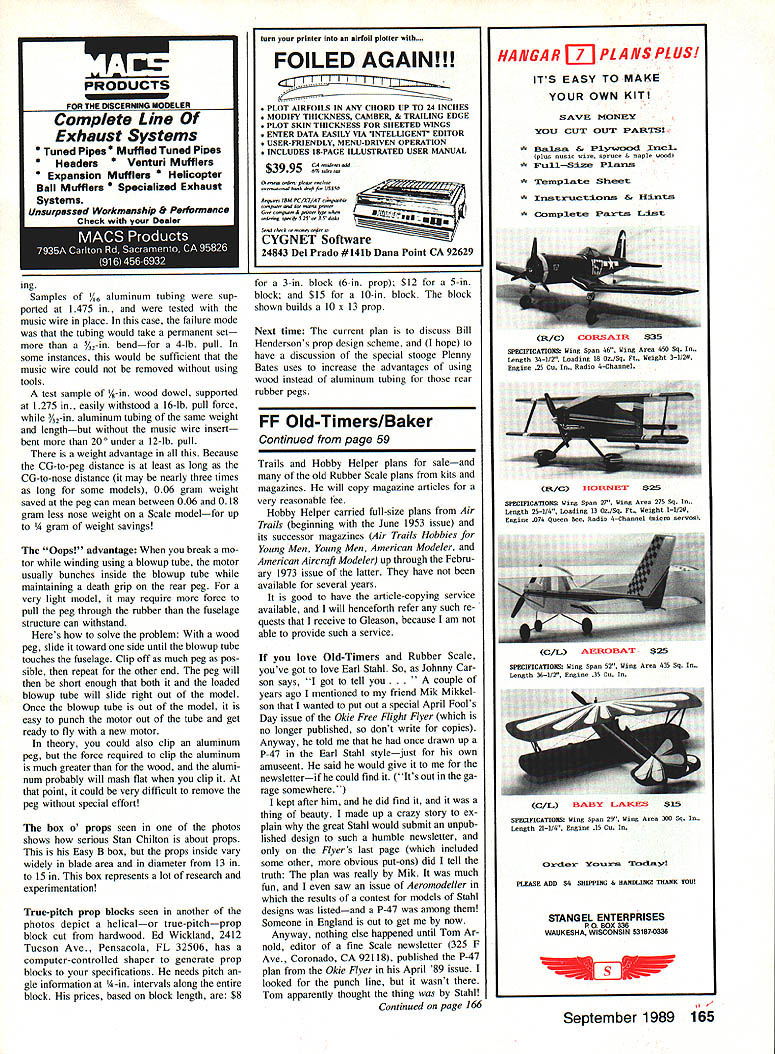
Bill's first contribution relates to the camber produced on any given prop form. He provided blade camber percentages for different blade widths and form diameters (tables not reproduced here).
True (helical) pitch design
Bill also described a design method that produces a prop close to true—or helical—pitch. With this method:
- The design pitch appears at the blade root and at the tip.
- Pitch in the center of the blade will be somewhat higher than at the hub and tip, so both tip and hub are slightly washed out relative to the center. Some designers consider this advantageous.
Sample parameters Bill calculated (tables referenced):
- Table 2: Sample assumes a preformed blade cut from a 6‑oz plastic beeper cup. For rounders the cup has a top diameter of 3.125 in. and a bottom diameter of 2.625 in. (2.875 in. average). The sample is a 6‑in. Bostonian prop with a hub length of 2.5 in., placing the blade root at 0.5 in. radius.
- "Setup angle" refers to the angle set into the pitch gauge when mounting the blades and is defined at the center of the blade segment. For the props in Table 2 it is 1.75 in. (center).
- "Can angle" is the angular offset of the blade centerline when cutting the blade from the side of the cup. The calculations assume the blade segment is vertically centered on the cup side.
- Table 3: Parameters for Manhattan and Easy B props of 14‑in. diameter with blade segment lengths of 6 in.; setup radius is 4 in.
- Table 4: Covers 12‑ and 22‑in. Novice Pennsylvania props; setup radius is 3.5 in.
Rear rubber pegs for Scale, Manhattan Cabin, and Bostonian
Plenny Bates is an innovative peg maker who measures repeatedly and tries new ideas. On Don Lindley's suggestion, Plenny laminated hardwood rear pegs for Scale, Manhattan Cabin, and Bostonian models to match the same strength as 1/16‑in. aluminum tubing. Key findings:
- The hardwood laminate was 2% heavier than the same strength 1/16‑in. aluminum tube.
- For a given length, 1/16‑in. aluminum tubing is about 25% heavier than a standard round toothpick.
Strength tests (Plenny's calibrated tester):
- Toothpick samples were supported so only 1/8 in. was tested.
- Toothpick weight 0.095 g — broke just under 7 lb. force.
- Toothpick weight 0.080 g — broke at 5.2 lb.
- Toothpick weight 0.085 g (scrupulous-looking) — broke at 2.8 lb. Plenny said he would not have used that one, but 2.8 lb is more than a motor made from 1/16‑in. rubber would exert during wind-on.
- 1/16‑in. aluminum tubing samples were supported at 1.475 in., tested with music wire in place. Failure mode: tubing took a permanent set (more than a 3/32‑in. bend) for a 4‑lb pull. In some instances the music wire could not be removed without using a heat gun.
- A 1/8‑in. wood dowel, supported at 1.275 in., easily withstood a 16‑lb pull.
- 1/32‑in. aluminum tubing of similar weight/length—but without music wire—bent more than 20° under a 12‑lb pull.
Weight advantage: Because the CG‑to‑edge distance is at least as long as the CG‑to‑nose distance (and may be nearly three times as long for some models), saving 0.06 g at the peg can mean 0.02–0.18 g less nose weight on a Scale model—for up to 1/4 g of weight savings overall.
The "Oops!" advantage (peg removal when motors bunch)
When a motor breaks while winding inside a blowup tube, the motor often bunches and grips the rear peg. For very light models, it may require more force to pull the peg through the rubber than the fuselage can withstand. Plenny's solution with a wood peg:
- Slide the peg toward one side until the blowup tube touches the fuselage.
- Clip off as much peg as possible on that side.
- Repeat for the other end.
When both tabs butt at the loaded blowup tube, the tube will slide right out of the model. Once out, punch the motor out of the tube and fit a new motor.
Clipping an aluminum peg is theoretically possible, but aluminum requires more force and will likely mash flat, making removal difficult without special effort.
Props and true‑pitch blocks
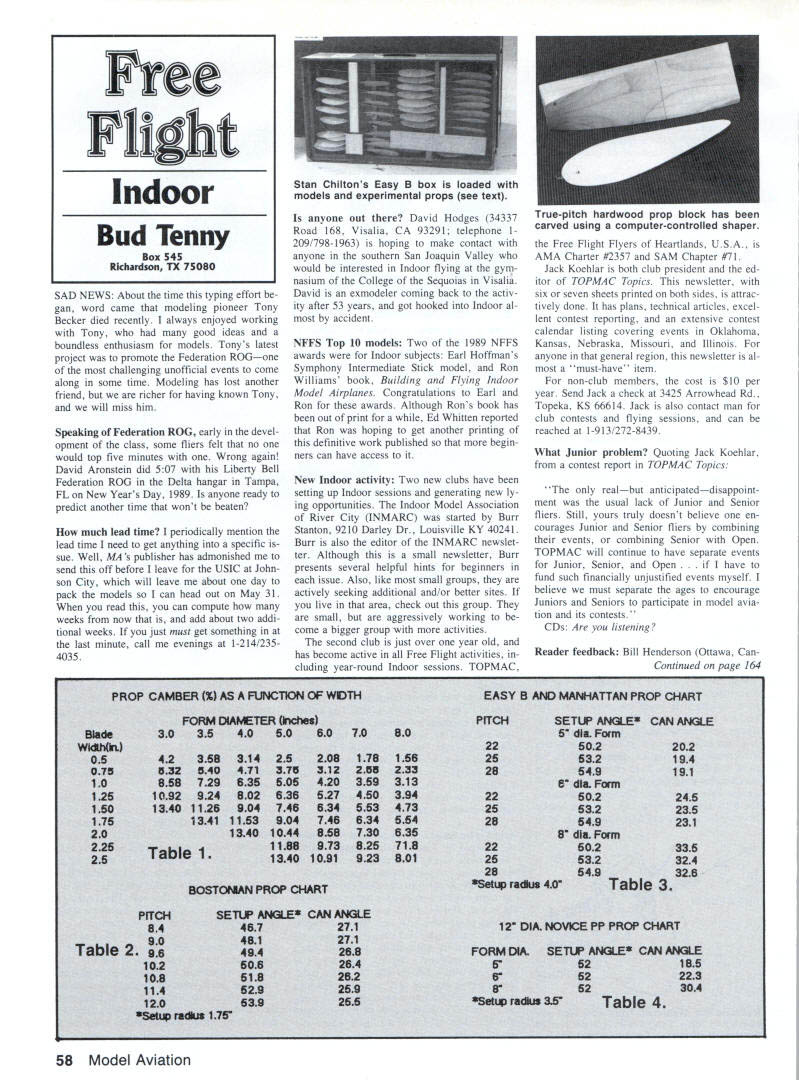
- Stan Chilton's Easy B box shows serious experimentation: props inside vary widely in blade area and diameter from 13 in. to 15 in.
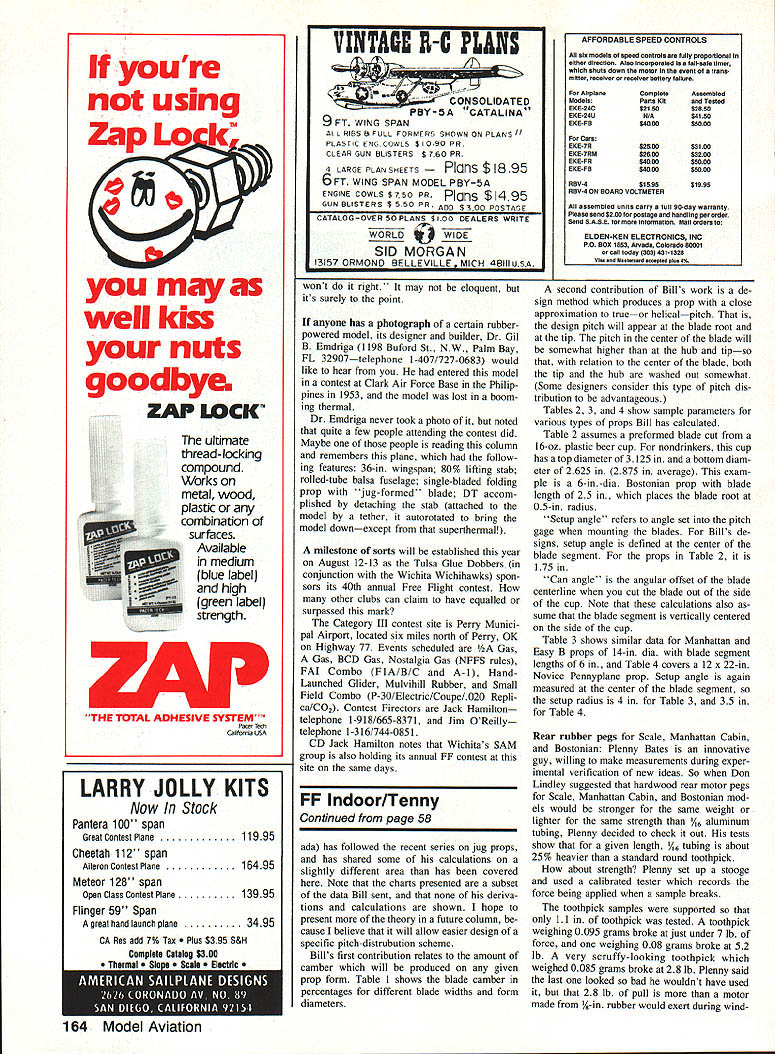
- True‑pitch prop blocks: Ed Wickland (2412 Tucson Ave., Pensacola, FL 32506) uses a computer‑controlled shaper to generate prop blocks to specification. He needs pitch angle information at 1/4‑in. intervals along the entire block. Prices by block length:
- $8 for a 3‑in. block (for a 6‑in. prop)
- $12 for a 5‑in. block
- $15 for a 10‑in. block
The block shown builds a 10 x 13 prop.
Next time
The plan is to discuss Bill Henderson's prop design scheme and, if possible, to include a discussion of the special stopper Plenny Bates uses to increase the advantages of using wood instead of aluminum tubing for rear rubber pegs.
Good luck and happy flying.
Transcribed from original scans by AI. Minor OCR errors may remain.

