
Free Flight: Indoor
Bud Tenny Box 545 Richardson, TX 75080
Corrections
FALSE INFO! I have been gently reminded that I made a couple of mistakes in the report of the U.S. Indoor Championships (September 1989 MA). First, Dave Linstrum tells me that Jim Thornberry was flying an RTF Guillows Jetstream in the Rubber Speed event instead of a Sleek Streak as I said. I am not familiar with the Jetstream, but Dave says, "There are substantial aerodynamic differences between the two, and the Sleek Streak is probably not as good a choice for a Speed model."
The second goof was that I said Vic Gagliano built the balloon-launched Glider, but Otto Curth set me straight: the Glider was built by Vito Garofalo.
Prop design
In my previous column (September '89), there were some charts showing "jug prop" designs by Bill Henderson. The major advantage of Bill's design method is that in one pass you calculate a can angle which gives a prop with the design pitch at both ends of the blade. The center part of the blade will have somewhat higher pitch. Stated another way, the tip and hub areas of the prop are washed out with respect to the center of the blade. Some fliers feel that this is the most efficient pitch distribution, but I've never seen any test results proving any pitch distribution scheme is best.
Design formulas
Figure 1 shows the basic can configuration used by Bill to derive his design method. Shown is an angle can (having a diameter of D) with the usual angled centerline for the prop layout on the side. The can-angle derivation is based on computing the "pitch-angle difference" (PAD) at each end of the prop blade. This is the same as the angular difference between two planes tangent to the can at lines L1 and L2.
Step-by-step:
- Compute the required blade angle BL for a given prop at the tip and the root of the blade segment. The formula is familiar:
- Pitch angle = ARCTAN (PITCH / (2 * pi * R))
where R is the radius at the blade station being computed.
- Compute the PAD across the blade:
- PAD = (angle at hub) − (angle at tip).
- Compute the can angle A using this formula:
- ARCCOS A = (pi * D * (PAD/360)) / L
where D = can diameter and L = blade segment length.
- The blades must be glued to the spar at the angle in the middle of the blade:
- Setup angle = [(angle at hub) + (angle at tip)] / 2
A Novice Pennplane prop
Assume that you need a 12-in.-dia., 18-in.-pitch prop, which has two blades five inches long. This makes the hub radius 1 in. and the tip radius 6 in., so that the two blade angles are:
- Hub angle (HA) = ARCTAN (18 / (2 * 3.1416 * 1)) = 70.70°
- Tip angle (TA) = ARCTAN (18 / (2 * 3.1416 * 6)) = 25.50°
The PAD for this blade is:
- PAD = 70.70° − 25.50° = 45.20°
The can angle A9 for a nine-inch-diameter form is:
- ARCCOS A9 = (3.1416 * 9 * (45/360)) / L = 44.70°
For a five-inch-diameter form:
- ARCCOS A5 = (3.1416 * 5 * (45/360)) / 5 = 66.70°
Note: The can angle computed by (3) is the angle from the vertical; more often, the can angle is referenced to the horizontal plane. To compute the traditional angle, subtract the result obtained from (3) from 90°.
The setup angle for either blade is:
- Setup angle = (70.70° + 25.50°) / 2 = 48.10°
This setup angle must be used in the center of the blade, which is 2.5 in. outboard of the hub radius (one inch), or at a 3.5-in. radius. Figure 2 shows this assembly setup.
The torque burner
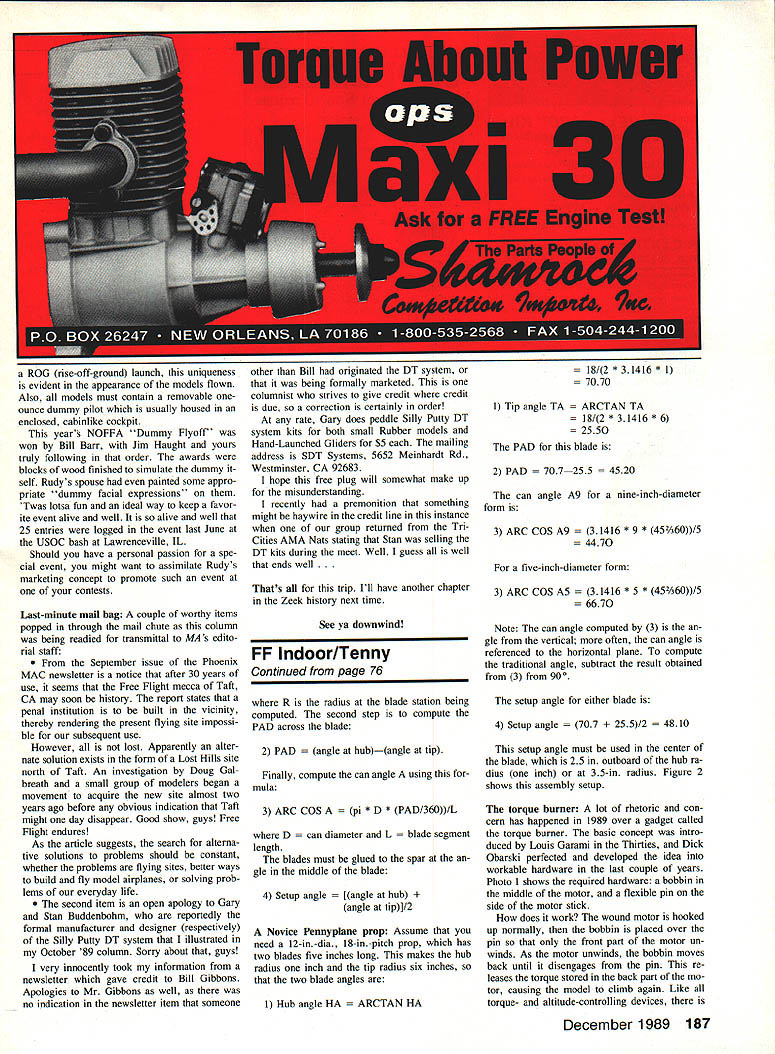
A lot of rhetoric and concern occurred in 1989 over a gadget called the torque burner. The basic concept was introduced by Louis Garami in the 1970s and the idea was developed into workable hardware by a number of people over the years. Photo 1 shows the required hardware: a bobbin in the middle of the motor, a release hook in the middle of the motor, and a flexible pin on the side of the motor stick.
How does it work? The wound motor is hooked up normally, then the bobbin is placed over the pin so that only the front part of the motor unwinds. As the motor unwinds, the bobbin moves back until it disengages from the pin. The release then allows the back part of the motor to run off, causing the model to climb again. Like all torque- and altitude-controlling devices, there is a definite art to reliable application. Dick seems to have reached this point, for his Easy B did very well at contests where it was permitted to fly. (The torque burner was not allowed for Easy B at the USIC and the Nats after the respective CDs decided it acted as a brake.)
Contest poll on torque burners
At the suggestion of Don Lindley, Contest Board Coordinator, all Easy B contestants at the U.S. Indoor Championships were polled for their opinions regarding the use of the torque burner with Easy B models. The results were as follows:
- Eleven opinions in favor of allowing torque burner use with Easy B.
- Two fliers expressed a "don't care" attitude.
- Two fliers favored allowing torque burner use if a second "gadget-free" Easy B class is established.
- Twenty-seven contestants opposed torque burner use in Easy B.
Canada has adopted U.S. Indoor rules (they have no input to the U.S. rules development). A similar poll there strongly supported having two Easy B classes, an unlimited class and a limited class.
Note: The Indoor Contest Board has voted on and approved a rules interpretation—effective January 1, 1990—which disallows torque burners in Easy B. This was reported in the October '89 edition of the "Competition Newsletter"—page 11 (although the effectivity date was erroneously listed as "immediately"—this was corrected in the November "Competition Newsletter"). (RMcM)
A novel Manhattan Cabin
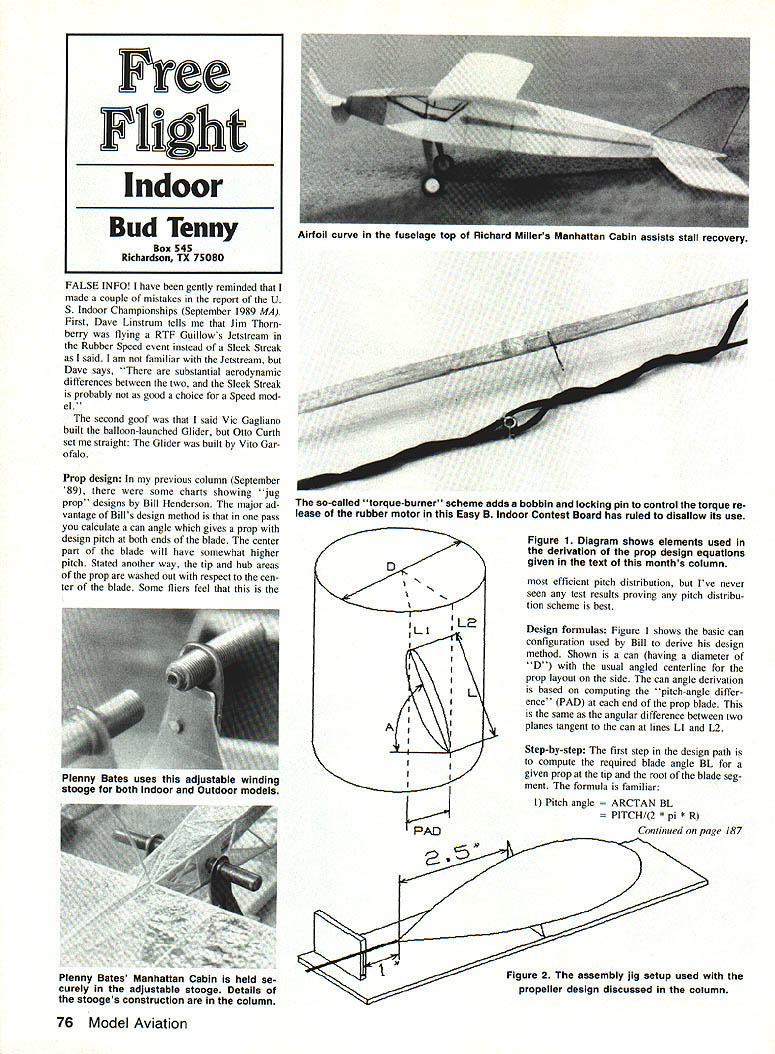
One of the challenges of this event is to use the required minimum-cross-section "box" in a benign manner (or in a beneficial manner if possible). Richard Miller apparently has managed to cross over to beneficial with his Blue Fin design (see the photo). In this view you can see an airfoil shape built into the top of the fuselage.
I have seen this model fly several times, and it has a very repeatable and beneficial response during the climb. At a time when other models would stall and drop, this model hesitated—almost hovered—before resuming the climb. Richard has another model built to the same plan, except this fuselage box is oriented vertically instead of horizontally, and this model flies much better. Not visible in the photo are tip vignettes which may also contribute to the very benign stall characteristics.
Versatile stooge
My September '89 column gave data compiled by Plenny Bates on woven vs. aluminum rear rubber pegs for Scale, Manhattan, and Bostonian models. The rest of the story is the special winding stooge that Plenny uses for both indoor and outdoor models. The photo shows a close-up of the adjustments that adapt the stooge to all models. The 1/4-in. threaded nipples have been filled with telescoping tubing soldered into place. Inside the filler tubing is a small plug which tends to center the wood pegs.
Another photo shows Plenny's Manhattan Cabin in the stooge. In use, one side of the stooge is set so the fuselage is approximately centered, and the other side is screwed inward to hold the model in place. Note that under the clamp the same motor pads used to support the fuselage are in a convenient winding position.
Flying opportunities
This list has been updated, with schedules announced whenever possible. CDs: now is the time to send me solid schedules if you have them; otherwise, let me know the approximate time frame you plan activity!
California
- Santa Ana: The Santa Ana hangar is being refurbished, and availability will be limited and uncertain. The first weekend each month will be sanctioned as usual in case; contact Curt Stevens, 25108 Marguerite Parkway, Mission Viejo, CA 92692; phone 1-714/240-9433 about any particular session.
- San Diego: Monthly sessions in Cat. I. Contact Howard Haupt, 3860 El Canto Ave., San Diego, CA 92117.
Connecticut
- Glastonbury: Contact George Armstead, 89 Harvest Lane, Glastonbury, CT 06037.
- Wilton: Contact Roger Kleinert, 17 Gardner St., Darien, CT 06820; phone 1-203/655-1585.
Florida
- Miami: The MIAMA indoor season started with a Cat. I contest at St. Pete/Clearwater Airport followed by the MIAMA Annual Awards Dinner. Contact Dr. John Martin, 2180 Tigertail Ave., Miami, FL 33133; phone 1-305/858-6363 for info and confirmation of the following: MIAMA #2, Oct. 21–22, 1989 at MacDill AFB. Cat. I Record Trials at Dade County Youth Fair, Nov. 11, 1989. MIAMA #3, Dec. 30, 1989–Jan. 1, 1990 (King Orange Indoor Meet) at the Delta Airlines Hangar, Tampa, FL.
Georgia
- Atlanta area: Contact John Barker; phone 1-404/436-9912.
Iowa
- Cedar Rapids: Contact Paul McIlrath, 1524 48th St. NE, Cedar Rapids, IA 52402; phone 1-319/393-4677.
Kansas
- Topeka: The following sessions have been scheduled by the TOPMAC Club:
- Nov. 12, 1989: Fun Fly, Club Record Trials, and Mini Contest.
- Nov. 19, 1989: Indoor Contest at Beatrice site (27-ft.), events TBA.
- Nov. 26, 1989: Fun Fly, Club Record Trials, and Mini Contest.
- Dec. 10, 1989: Fun Fly, Club Record Trials, and Mini Contest.
Kentucky
- Louisville: Sessions have been held in the Kentucky Air National Guard Hangar in Louisville. Contact Burr Stanton, 9210 Darley Dr., Louisville, KY 40241 for further details.
Massachusetts
- Cambridge: Contact Ray Harian, 15 Happy Hollow Rd., Wayland, MA 01778; phone 1-617/358-4013.
New Jersey
- Glassboro: Contact Doug Barber, 146 Stratton House, Maple Shade, NJ 08052; phone 1-609/235-5318.
New York
- Chappaqua: Contact Art Maiden; phones 1-914/760-3280 and 1-914/769-2644.
- NYC: Contact Ed Whitten, P.O. Box 176, W. 54 St. Station, New York, NY 10019; phone 1-212/765-5327 for info about possible flying at Columbia University.
- Queens: Contact Bob Bender; phone 1-516/248-5118.
Oklahoma
- Oklahoma City: Contact Jim Belson, 4933 NW 29th, Oklahoma City, OK 73122; phone 1-405/946-1093.
Washington
- Seattle: Indoor season planned. Contact Ed Lamb, 15911 SE 42nd Pl., Bellevue, WA 98006.
Transcribed from original scans by AI. Minor OCR errors may remain.

