
Free Flight: Indoor
Bud Tenny Box 545 Richardson, TX 75080
GOOD NEWS / BAD NEWS
- Good news: It has been confirmed that the 1990 Indoor Nats will be held at a good site — Johnson City, TN — in conjunction with the 1990 NFFS Indoor Championships.
- Bad news: Indoor fliers have only one major (Class AAAA) contest in 1990 instead of two.
New addresses
- Bill Hannan's Runway has relocated to Box 860, Magalia, CA 95954. Send an order or a postcard to remain on his revised mailing list.
- Lew Gitlow's Indoor Model Supply has been at Box 5311, Salem, OR 97304 (tel. 1-503/370-6350) for some time.
Prop pamphlet
- Jim Jones has written a brief piece on jug props. It is available for a SASE and $1 sent to: 36631 Ledgestone, Mt. Clemens, MI 48043. It includes a step-by-step assembly discussion and some design information.
Winding review
It has been some time since the basic process of winding indoor motors was reviewed. Even if you have an almost perfect match between motor and prop, you won't do well in competition without proper winding techniques. The same applies to rubber: regardless of the best available rubber, you can't make the best use of it unless it is properly wound.
The basic tools
- A torque meter and a geared winder are required to properly wind rubber motors.
- For indoor flying, a winder with low friction helps so you can feel the pressure even on motors with a small cross section.
- Typical gear ratios for indoor winders: 10:1, 16:1, and 20:1. The 10:1 is a favorite of fliers using heavier motors such as Pennyplane.
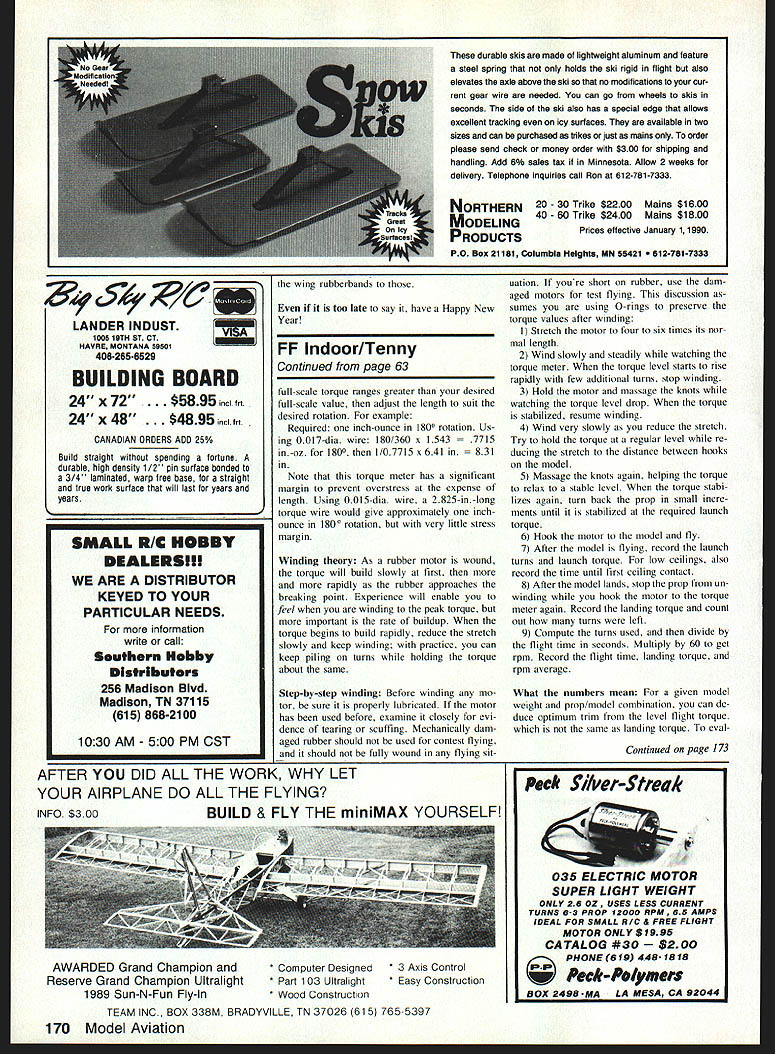
- Torque meters are available commercially, and some fliers build their own. A popular design by Cezar Banks has appeared in numerous club newsletters.
Note: Neither commercial nor home-built torque meters can be relied upon to read correctly unless calibrated to a known standard. If uncalibrated, you cannot directly compare absolute readings with other fliers. However, using the same torque meter consistently yields perfectly useful relative readings for competition and experimentation.
Calibrating torque meters
- Acquire a weight that is precisely 0.1 oz.
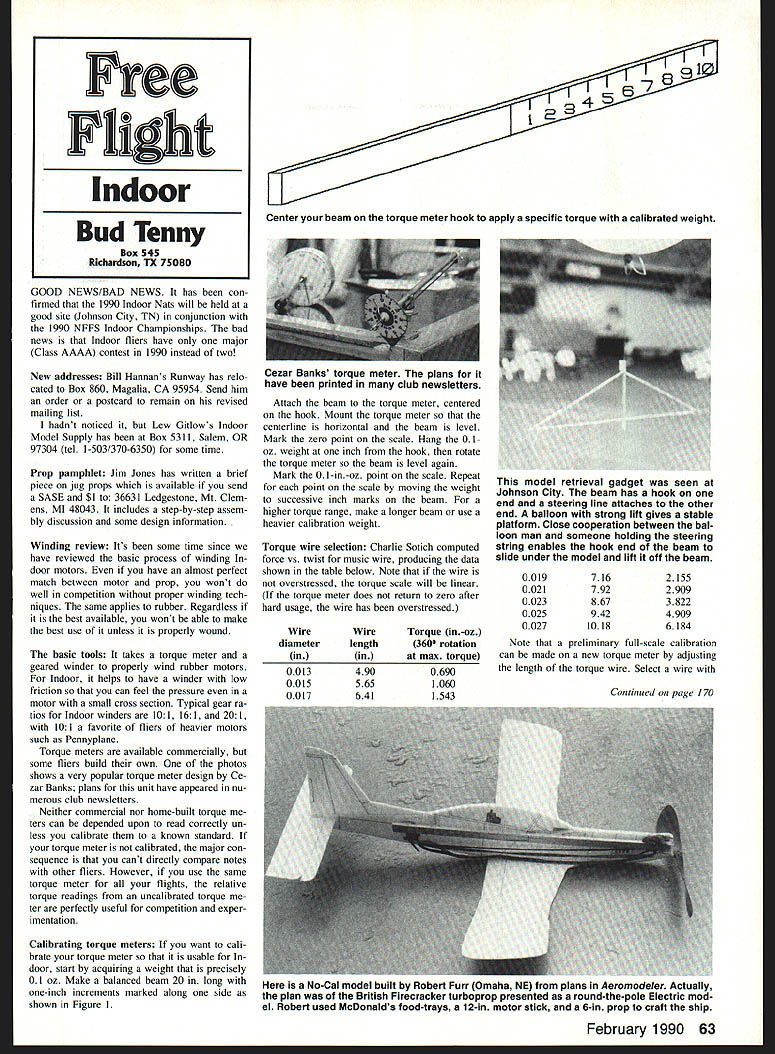
- Make a balanced beam 20 in. long with one-inch increments marked along one side.
- Attach the beam to the torque meter, centered on the hook. Mount the torque meter so the centerline is horizontal and the beam is level.
- Mark the zero point on the scale.
- Hang the 0.1-oz weight at one inch from the hook, then rotate the torque meter so the beam is level again. Mark the 0.1 in.-oz point on the scale.
- Repeat for each point on the scale by moving the weight to successive inch marks on the beam.
- For a higher torque range, make a longer beam or use a heavier calibration weight.
This procedure gives an accurate in.-oz. calibration across the scale.
Torque wire selection
Charlie Sotich computed force vs. twist for music wire and produced the following data (torque in in.-oz. for a 360° rotation at max. torque):
- Wire diameter: 0.013 in. — Wire length: 4.90 in. — Torque: 0.695 in.-oz.
- Wire diameter: 0.015 in. — Wire length: 5.65 in. — Torque: 1.060 in.-oz.
- Wire diameter: 0.017 in. — Wire length: 6.41 in. — Torque: 1.543 in.-oz.
Notes:
- If the wire is not overstressed, the torque scale will be linear. If the torque meter does not return to zero after hard usage, the wire has been overstressed.
- A preliminary full-scale calibration on a new torque meter can be made by adjusting the length of the torque wire. Select a wire with a full-scale torque range greater than your desired full-scale value, then adjust the length to suit the desired rotation.
Example:
- Required: 1.0 in.-oz. in a 180° rotation.
- Using 0.017-in. dia. wire (1.543 in.-oz. at 360° for 6.41 in. length):
- Torque at 180° for 6.41 in. = (180/360) × 1.543 = 0.7715 in.-oz.
- Required length = (1.0 / 0.7715) × 6.41 in. ≈ 8.31 in.
This example shows the trade-off between torque range and wire length; choosing a slightly larger wire diameter gives a greater margin against overstress but may require a longer wire.
Winding theory
- As a rubber motor is wound, torque builds slowly at first, then more rapidly as the rubber approaches its breaking point.
- Experience helps you feel when you're near peak torque, but the rate of torque build-up is more important.
- When torque begins to rise rapidly, reduce the stretch slowly and continue winding; with practice, you can add turns while holding the torque about the same.
Step-by-step winding
Before winding any motor:
- Be sure it is properly lubricated.
- If the motor has been used before, examine it for tearing or scuffing. Mechanically damaged rubber should not be used for contest flying and should not be fully wound in any flying situation. Use damaged motors for test flying.
- This discussion assumes you are using O-rings to preserve torque values after winding.
- Stretch the motor to four to six times its normal length.
- Wind slowly and steadily while watching the torque meter. When the torque level starts to rise rapidly with few additional turns, stop winding.
- Hold the motor and massage the knots while watching the torque meter. When the torque stabilizes, resume winding.
- Wind very slowly as you reduce the stretch. Try to hold the torque at a regular level while reducing the stretch to the distance between hooks on the model.
- Massage the knots again, helping the torque to relax to a stable level. When it stabilizes again, turn back the prop in small increments until it is stabilized at the required launch torque.
- Hook the motor to the model and fly.
- After the model is flying, record the launch turns and launch torque. For low ceilings, also record the time until first ceiling contact.
- After the model lands, stop the prop from unwinding while you hook the motor to the torque meter again. Record the landing torque and count how many turns were left.
- Compute the turns used, divide by the flight time in seconds, and multiply by 60 to get average rpm. Record the flight time, landing torque, and rpm average.
What the numbers mean
- For a given model weight and prop/model combination, you can deduce optimum trim from the level flight torque, which is not the same as landing torque.
- To evaluate level flight torque: launch the model with just enough torque to climb slightly (it should not climb out of reach). When it stops climbing, catch it and measure the level flight torque.
- Number of remaining turns — should be less than 10% of launch turns. If too many turns remain, try a shorter, heavier loop of the same weight to reduce remaining turns.
- Average rpm — interacts with landing torque. Generally, the lowest average rpm implies the best trim or most efficient operation.
- For a no-touch flight using more than 85% of the launch turns, optimum trim is indicated by the lowest average rpm and the lowest landing torque.
- Overleveled models may mush down and land at a higher torque.
Next time
A follow-up will show the relationship of torque, turns, rpm, and flight time — plus whatever else will fit.
Flying opportunities
The following listings have been updated whenever possible. Events from late March 1990 can be listed next time.
#### California
- Santa Ana: The Santa Ana hangar is being refurbished; availability will be limited and uncertain. The first weekend of each month will be sanctioned just in case. Contact Curt Stevens, 25108 Marquette Parkway, Mission Viejo, CA 92692; phone 1-714/240-8433 about any particular session.
- San Diego: Monthly sessions (details not provided).
#### Connecticut
- Glastonbury: Indoor flying at Glastonbury High School first Sunday each month through April 1990 except the 2nd Sunday in March. Contact Jerry Bockius, 48 Division St., Norwich, CT 06360.
#### Florida
- Miami: Contact Dr. John Martin, 2180 Tigertail Ave., Miami, FL 33133; phone 1-305/858-6363.
- MIAMA schedule (selected): Indoor Meet #4, Feb. 17–18, 1990 (Cat. II) at the Coast Guard Hangar. Meet #5, March 17–18, 1990 at MacDill AFB, Tampa, FL. Meet #6, May 12–13, 1990 at MacDill AFB, Tampa. (April meet details not available.)
#### Iowa
- Cedar Rapids: Approximately weekly flying sessions all winter; 34-ft. ceiling. Contact Paul McElrath, 1524 48th St. NE., Cedar Rapids, IA 52402; phone 1-319/393-4677.
#### Kansas
- Topeka: The Topeka Model Aircrafters Club (TOPMAC) has regular scheduled events; the 1990 schedule is not available. Contact Jack Koehler, 3425 SW Arrowhead Rd., Topeka, KS 66614-3845; phone 913/272-8439.
#### Kentucky
- Louisville: Sessions have been held in the Kentucky Air National Guard Hangar. Contact Burr Stanton, 9210 Darley Dr., Louisville, KY 40241 for further details.
#### Massachusetts
- Cambridge: Contact Ray Harlan, 15 Happy Hollow Rd., Wayland, MA 01778; phone 1-617/358-4013.
#### Minnesota
- Burnsville: Contests in the Burnsville High School gym, 35-ft. ceiling, relatively uncluttered; three adjacent basketball courts. Events: Feb. 18 and Apr. 8, 1990, 10:30 a.m.–5 p.m. Contact John O'Leary, 1425 Kell Circle, Bloomington, MN 55437; phone 1-612/888-0638, or Don Marchant, 17110 24th Ave. N., Plymouth, MN.
Transcribed from original scans by AI. Minor OCR errors may remain.

