
Free Flight: Indoor
Bud Tenny
World Indoor Record: In September, 1962, Karl-Heinz Rieke set the absolute Indoor World Record at 45:40, with his third official flight of the 1962 Indoor World Championships. The 1962 WCh was held at Cardington, England, former home of Great Britain's two dirigibles. Fourteen years later, on Aug. 14, 1976, Dick Kowalski's "300" (maximum size for AMA Indoor Stick — 300 sq. in. wing area) logged a 50:41 flight. The site was the Goodyear Aerospace Hangar, where the American dirigibles Akron and Macon were built. Kowalski had witnessed the Rieke flight, and his own flight culminates years of planning and preparation. With both AMA and FAI sanctions in effect, this flight also qualifies for the AMA Cat. III Indoor Stick record.
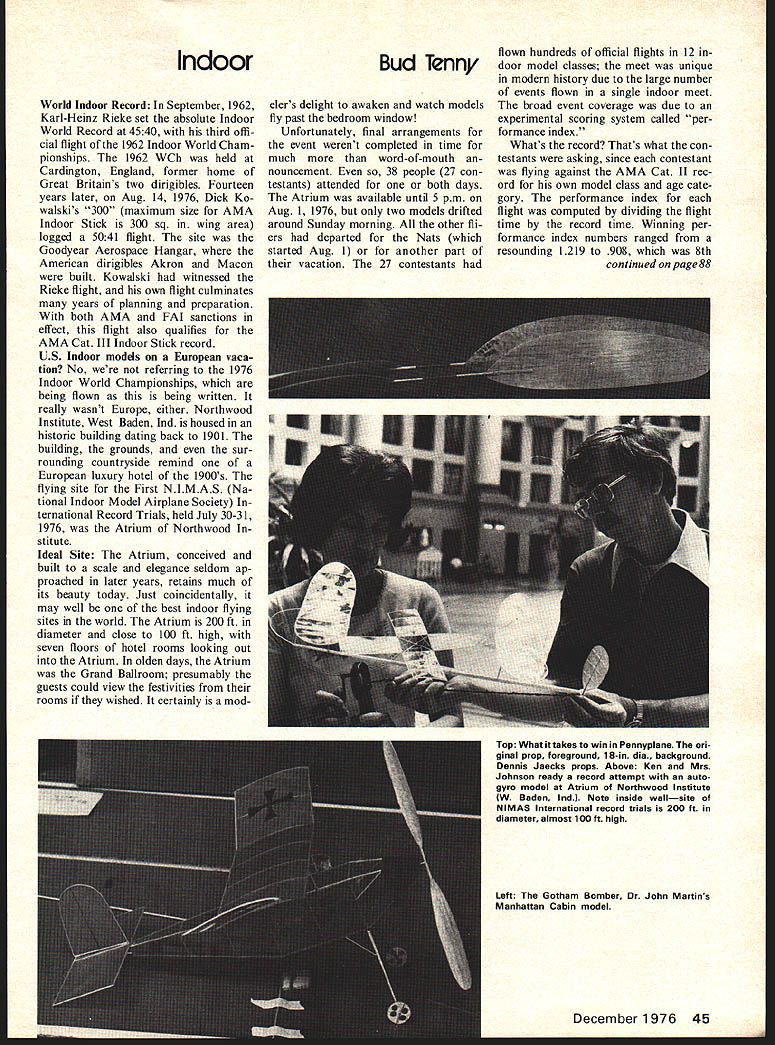
U.S. Indoor models on a European vacation? No, we're not referring to the 1976 Indoor World Championships, which are being flown as this is being written. It really wasn't Europe, either. Northwood Institute, West Baden, Ind. is housed in an historic building dating back to 1901. The building, the grounds, and even the surrounding countryside remind one of a European luxury hotel of the 1900's. The flying site for the First N.I.M.A.S. (National Indoor Model Airplane Society) International Record Trials, held July 30-31, 1976, was the Atrium of Northwood Institute.
Ideal Site: The Atrium, conceived and built to a scale and elegance seldom approached in later years, retains much of its beauty today. Just coincidentally, it may well be one of the best indoor flying sites in the world. The Atrium is 200 ft. in diameter and close to 100 ft. high, with seven floors of hotel rooms looking out into the Atrium. In olden days, the Atrium was the Grand Ballroom; presumably the guests could view the festivities from their rooms if they wished. It certainly is a modeler's delight to awaken and watch models fly past the bedroom window.
Unfortunately, final arrangements for the event weren't completed in time for much more than the word-of-mouth announcement. Even so, 38 people (27 contestants) attended for one or both days. The Atrium was available until 5 p.m. on Aug. 1, 1976, but only two models drifted around Sunday morning. All the other fliers had departed for the Nats which started Aug. 1, or for another part of their vacation. The 27 contestants had flown hundreds of official flights in 12 indoor model classes; the meet was unique in modern history due to the large number of events flown in a single indoor meet. The broad event coverage was due to an experimental scoring system called "performance index."
What's the record? That's what the contestants were asking, since each contestant was flying against the AMA Cat. II record for his own model class and age category. The performance index for each flight was computed by dividing the flight time by the record time. Winning performance index numbers ranged from a resounding 1.219 to .908. place for the contest. As it worked out the trophies were awarded this way: two in FAI Stick, three in Indoor Stick, one in Paper Stick and two in Indoor Cabin. That is, all classes and age groups were lumped together and each contestant had to find the best competition strategy for the models he had. Richard Whitten had the range pretty well; he upped the Senior FAI Stick record by 21.9% and the Senior Indoor Stick record by 21.4% to carry off both first and second places.
What Should I Fly? Most of the contestants wondered this, and this uncertainty led to the wide range of model events flown. Entries were made in FAI and Indoor Stick, Paper Stick, Indoor Cabin, R.O.G. Stick (formerly A R.O.G.), Autogyro and Ornithopter. At first glance it seemed likely that a Junior would win the event with flights in either Autogyro or Ornithopter, since these records were low. Instead, a Senior won two awards in the two most strongly contested indoor events.
So, Who Won? All the discussion so far has centered on the performance index events which were flown on July 30, and eight handsome pewter mugs were awarded:
Contestant Class Time Record Index Richard Whitten FAI Stick 29:31 24:13 1.219 Richard Whitten Indoor Stick 29:31 24:19 1.214 Jim Richmond Paper Stick 24:16 23:19 1.042 Richard Doig Indoor Cabin 22:42 23:19 .9734 Clarence Mather FAI Stick 30:14 32:31 .9349 Al Rohrbaugh Indoor Stick 32:02 34:57 .9167 Ron Ganser Indoor Cabin 21:23 23:19 .9169 Clarence Mather Indoor Stick 31:46 34:57 .9092
A number of wives and family members accompanied contestants to the contest, which is fairly commonplace. However, this time other entertainments were available for wives who tired of the meet. Some played tennis, shopped at antique stores and toured a piano factory. Also available were swimming, golf and a mineral spa — all at a nearby historical hotel. Besides all these extra family activities available by arrangement through Northwood Institute, don't overlook the Northwood facilities.
Besides food (excellent) and lodging for $10 per person per day, it was possible for historically minded persons to study the background of the building, admire its unique architectural details, and enjoy the beauty of the surrounding grounds, nearby river and other buildings of yesteryear.
At 10 p.m. on July 30, the first-ever social activity of NIMAS took place as the Northwood staff catered a tasty banquet of generous proportions. Special guests of honor were Mr. Ray Semmons, Director of Outside Activities at Northwood, and his wife and infant son. Ray had made available almost the full resources of the Institute, solving whatever problems came up regarding the contest or the facilities. After the meal, brief remarks were made by Stan Chilton, who conceived the idea of the contest, and Dr. John Martin, who organized the contest and served as contest director. Bud Tenny, one of the founders of NIMAS and editor of Indoor News and Views, gave a brief summary of the origins and history of the organization from its December, 1961 beginning until the present. Award presentations followed, with good-natured banter regarding Richard Whitten's dual trouncing of the other fliers, and chiding of those who, like Al Rohrbaugh, either failed to turn in their time sheets at all or were late. Finally, Stan Chilton presented Mr. and Mrs. Semmons with a beautiful silver serving tray in appreciation for their efforts.
So what if the banquet lasted until after 11 p.m.? Let's fly! All that beautiful space is going to waste! And fly they did — some of them all night, so they could sleep while gliders flew the next day. A few Pennylanes and Easy B's and Manhattan Cabin models went on and on, while someone poured microfilm at 2 a.m.
The second day of competition followed more traditional contest practice, with pewter mugs awarded for first place in HLG, Indoor Scale, Peanut Scale, Easy B, Pennylane and Manhattan Cabin. Competition was low in HLG (Buckey Servaites won with 106.8 sec.), Indoor Scale (Ken Johnson's Hyperbipe flew 1:43) and Peanut Scale (Clarence Mather's D-A-2A flew 1:45.8). Walt Lounsbery set a Novice Pennylane record and got a mug for his 8:31.3 flight. Buckey Servaites and Richard Whitten set the pace in Manhattan Cabin, with 4:52.8 and 4:32.2 respectively. This contest marked the first national participation in Manhattan, which had been "invented" by Ed Whitten years ago.
Dennis Jaecks came out of semi-retirement to recapture his Cat. II Pennylane record, which he did most convincingly at 13:42. The battle came between Dick Hardcastle, Clarence Mather, Buckey Servaites and Ron Ganser. Except for Dennis' clear mastery, the placings see-sawed back and forth all afternoon. Meanwhile, the Easy B's almost swarmed like bees, with the 2nd through 6th places bunched closely together.
Can We Top This? Certainly, everyone who attended this meet wants to try! Comments at the Nats indicated that the next NIMAS International Record Trials would be eagerly awaited. Planning is already beginning, and it seems likely that the pattern of light competition, 24-hours-a-day happenings and relaxed renewal of acquaintances will be repeated. Wait 'til next year!
Bud Tenny, Box 545, Richardson, Tex. 75080.
Transcribed from original scans by AI. Minor OCR errors may remain.

