
Free Flight: Indoor
Bud Tenny Box 545 Richardson, TX 75080
MODERATION is needed! In recent months there has been a lot of acrimonious debate between FF newsletter editors and one or more members of the AMA Executive Council. The issues:
- The Executive Council doesn't understand why FF and Indoor fliers are upset with AMA policies.
- The major beef on FF plates is the Nats accommodations for FF and Indoor: occasionally shabby—and sometimes worse.
So cool it! Note the following facts:
- In the AMA Bylaws, four of the 16 stated purposes for AMA deal with competition—more than any other single issue.
- Less than 10% of the total AMA membership flies rule-book events.
- A significantly higher percentage of all Indoor and FF fliers supports its own events at the Nats, as well as at other major events, than is the case with RC fliers.
Failures in understanding:
- Few FF/Indoor spokesmen understand Nats planning problems.
- Few FF/Indoor spokesmen understand the conflicts in Executive Council policy requirements implied by facts 1 and 2 above.
- Nats planners don't understand the realities of FF/Indoor contest flying—and sometimes not even of their own events.
- The FF spokesmen don't understand that Nats policies are set by a committee appointed by—but only nominally supervised by—the AMA Executive Council, not by Executive Council action.
How about all parties showing some restraint?
The rubber story
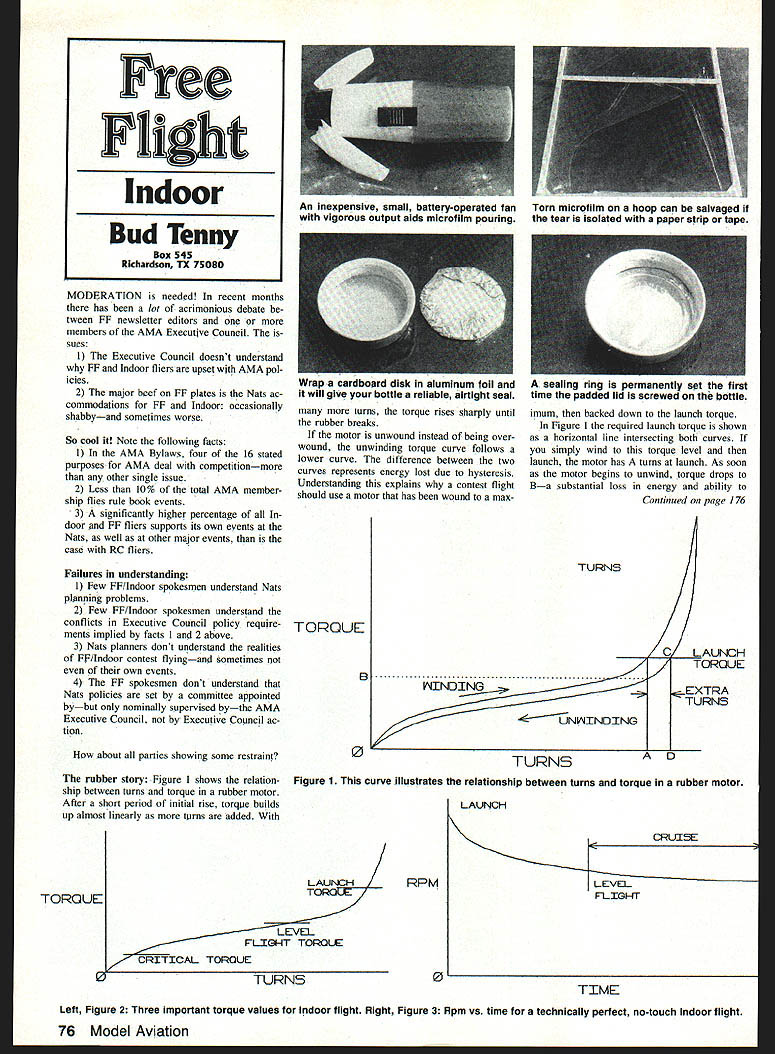
Figure 1 shows the relationship between turns and torque in a rubber motor. After a short period of initial rise, torque builds up almost linearly as more turns are added. With many more turns, the torque rises sharply until the rubber breaks. If the motor is unwound instead of being overwound, the unwinding torque curve follows a lower curve. The difference between the two curves represents energy lost due to hysteresis.
Understanding this explains why a contest flight should use a motor that has been wound to a maximum, then backed down to the launch torque. In Figure 1 the required launch torque is shown as a horizontal line intersecting both curves. If you simply wind to this torque level and then launch, the motor has A turns at launch. As soon as the motor begins to unwind, torque drops to B—a substantial loss in energy and ability to climb.
Instead, wind the motor nearly to maximum stress and back the turns to C using the techniques discussed in my previous column on winding (February 1990). The motor will then have D turns, and the torque will be stabilized. Each flight on this motor will be quite repeatable, because the energy storage will be standardized.
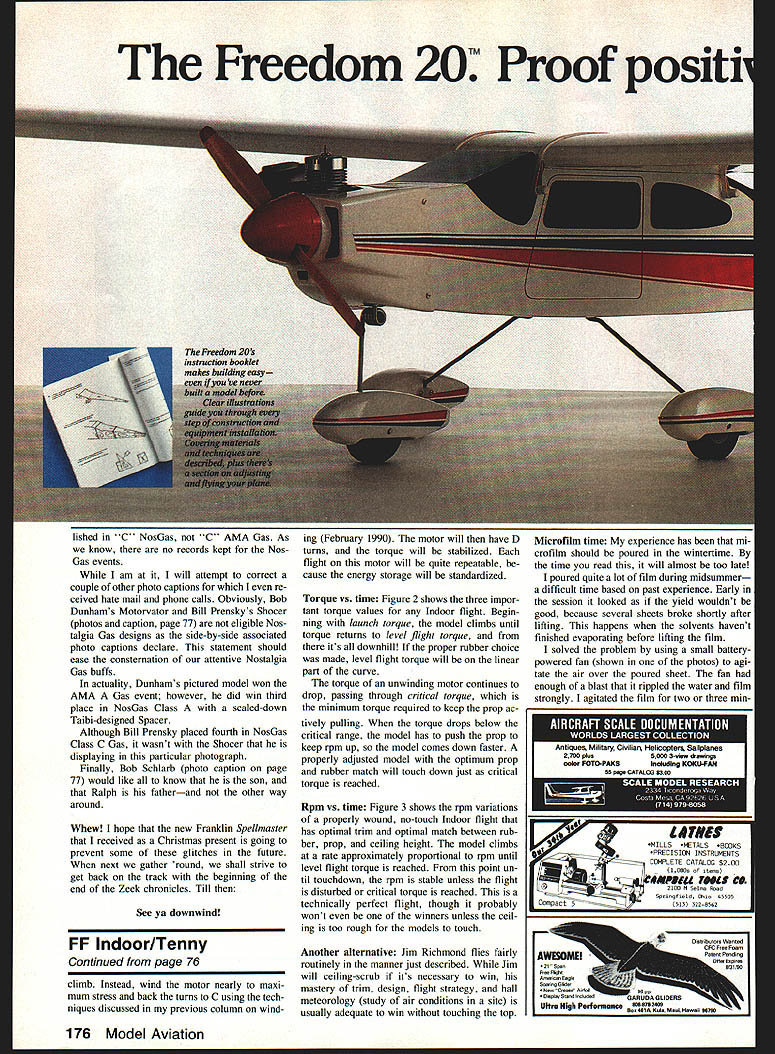
Torque vs. time
Figure 2 shows the three important torque values for any Indoor flight. Beginning with launch torque, the model climbs until torque returns to level flight torque, and from there it's all downhill. If the proper rubber choice was made, level flight torque will be on the linear part of the curve. The torque of an unwinding motor continues to drop, passing through critical torque, which is the minimum torque required to keep the prop actively pulling. When the torque drops below the critical range, the model has to push the prop to keep rpm up, so the model comes down faster. A properly adjusted model with the optimum prop and rubber match will touch down just as critical torque is reached.
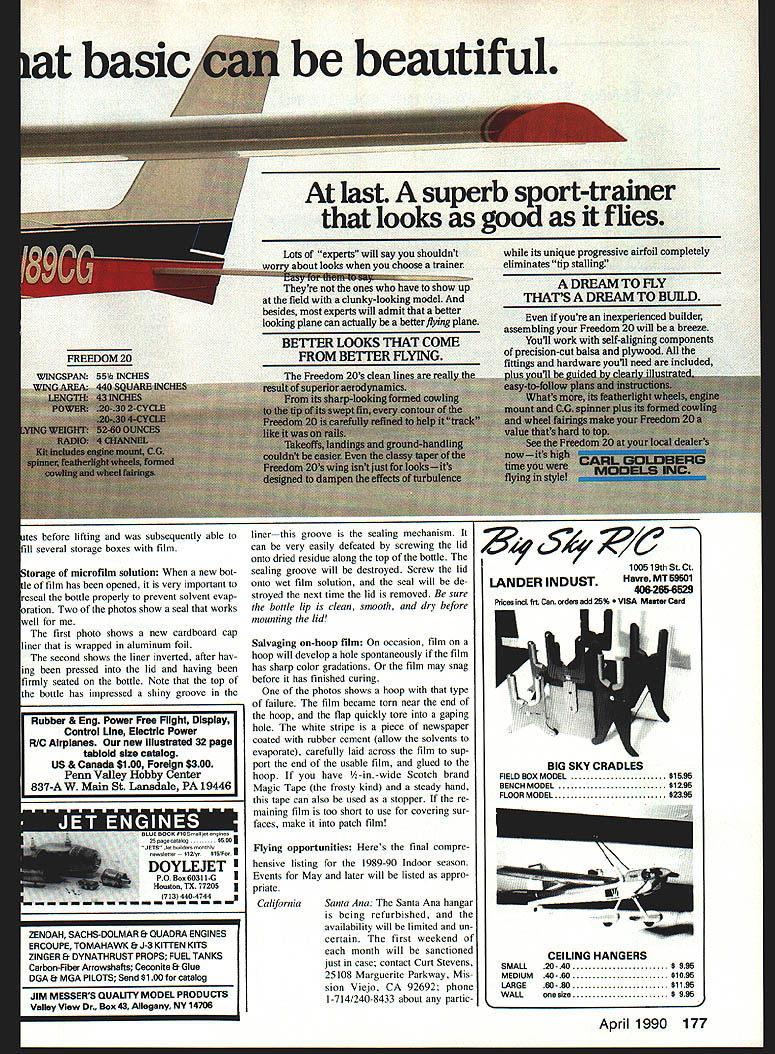
RPM vs. time
Figure 3 shows the rpm variations of a properly wound, no-touch Indoor flight that has optimal trim and an optimal match between rubber, prop, and ceiling height. The model climbs at a rate approximately proportional to rpm until level flight torque is reached. From this point until touchdown, the rpm is stable unless the flight is disturbed or critical torque is reached. This is a technically perfect flight, though it probably won't even be one of the winners unless the ceiling is low enough for the models to touch.
Another alternative: Jim Richmond flies fairly routinely in the manner just described. While Jim will ceiling-scrub if it is necessary to win, his mastery of trim, design, light structure and meteorology (study of air conditions in a site) is usually adequate to win without touching the top.
See ya downwind!
Sealing bottle lids
The liner groove in a bottle cap is the sealing mechanism. It can be easily defeated by screwing the lid onto dried residue along the top of the bottle—the sealing groove will be destroyed. Screw the lid onto wet film solution, and the seal will be destroyed the next time the lid is removed. Be sure the bottle lip is clean, smooth, and dry before mounting the lid.
Salvaging on-hoop film
On occasion, film on a hoop will develop a hole spontaneously if the film has sharp color gradations, or the film may sag before it has finished curing. One example shows a hoop with that type of failure: the film became torn near the end of the hoop, and the flap quickly tore into a gaping hole. A white stripe (a piece of newspaper coated with rubber cement and allowed to dry) can be carefully laid across the film to support the end of the usable film and glued to the hoop.
If you have 1/4‑in.-wide Scotch brand Magic Tape (the frosty kind) and a steady hand, this tape can also be used as a stopper. If the remaining film is too short to use for covering surfaces, make it into patch film.
Flying opportunities
Here’s the final comprehensive listing for the 1989–90 indoor season. Events for May and later will be listed as appropriate.
California Santa Ana: The Santa Ana hangar is being refurbished, and availability will be limited and uncertain. The first weekend of each month will be sanctioned just in case; contact Curt Stevens, 25105 Marguerite Parkway, Mission Viejo, CA 92692; phone 714‑240‑8433 about any particulars.
Transcribed from original scans by AI. Minor OCR errors may remain.

