
Free Flight: Indoor
Bud Tenny Box 545 Richardson, TX 75080
SUMMER INDOOR? For almost 30 years I have hoped more people would learn how great it is to fly indoor during the summer instead of limiting it to cold weather and other winter hassles. As you can see in the "Flying Opportunities" section below, summer indoor is bustin' out all over. I have preliminary information about programs that may result in increased site availability and more opportunities to fly year-round — more on that if it works out.
Note an important factor common to many summer sessions: advance notice and entry lists. In some cases a list is required for security; in other cases a meet may be cancelled with little notice and expected participants must be notified. Be sure you are expected and verify the meet is still being held before you leave home.
Columbia University activity
For some time the situation at Columbia University was viewed pessimistically. Recent weeks may have turned that around: a trial session in mid-May worked out and several more sessions will be scheduled. Write to Dan Marek, 210 West 101st St., #10F, New York, NY 10025; or phone 1-212/222-1546 for details about the flying schedule.
Once a schedule has been approved, anyone who wants to fly in a contest (or be a spectator) must furnish Social Security and AMA numbers to Gary Underwood at least two weeks in advance of any scheduled event. Gary Underwood, 9 Treelawn Terrace, Mercerville, NJ 08619 (tel. 1-609/586-4441). Absolutely no one will be allowed into the building unless on the approved list.
Lakehurst NAS (Hangar #1) activity
Extensive work by Gary Underwood and Dan Domina has produced excellent relations between the East Coast Indoor Modelers (ECIM) and officials at Lakehurst Naval Air Station Hangar #1 (the former U.S. home of the Hindenburg). The hangar has been repaired and is in better condition than in many years; it is one of the largest hangars in the world and will be busy in the months to come. Interested persons should contact ECIM to get on its access list. All participants flying models must be AMA members. Non-licensed spectators and family members may attend if registered. Foreign nationals with a current license from their national aero club may participate but must register and allow extra time for clearance.
Names must be compiled by Tom Vallee; you must notify Tom of your intention to attend in advance of each meet. Changes in NASA launch schedules and other events can preempt hangar or auditorium use with little warning. Be sure to verify the date with Tom before leaving home. Tom Vallee, 444 Henryton St., So. Laurel, MD 20707 (tel. 1-301/498-0790).
Flying opportunities
If warranted by available information, this section will become a year-round feature instead of being supplemental.
Idaho
Moscow (Kibbie Dome): Andy Tagliafico has set up a three-day contest, August 3–5, 1990. Call Andy at 1-503/371-0492 for more details.
Kansas
Topeka: Nonsanctioned indoor meets in the Stone Hangar site on June 10, July 8, August 12, September 9, October 14, 1990. Jack Koehlar, 3425 SW Arrowhead Rd., Topeka, KS 66614-3485 (tel. 1-913/272-8439). Check with Jack to verify each session, especially if the weather is questionable. Aircraft must be moved out of the hangar, which isn't allowed in bad weather.
Maryland
Greenbelt (Goddard, NASA): Record Trials and flying sessions have been scheduled in the auditorium of Building 8 at Goddard on Saturdays, noon to 10:00 p.m., on June 23, July 14, July 28, August 1, August 25, September 15, September 29, October 13, October 20, and November 3, 1990. NASA security requires that attendees be both U.S. citizens and AMA members. Your AMA license must be available for inspection at the gate, and the contestant's name must be on a list compiled by Tom Vallee. You must notify Tom of your intention to attend in advance of each meet. Changes in NASA launch schedules and other events can preempt use of the auditorium with little warning. Verify the date with Tom before leaving home. Tom Vallee, 444 Henryton St., So. Laurel, MD 20707 (tel. 1-301/498-0790).
New Jersey
Lakehurst NAS: A number of Record Trials and FAI Regional Trials have been set up at Hangar #1. Record Trials: June 16, August 29, September 16, October 7, 1990. FAI Regional meets: July 7–8 and September 1–3, 1990. Note: you must be registered with the East Coast Indoor Modelers club in advance of the meet. Contact Dan Domina, 6 Meadow Lane, East Windsor, NJ 08520 (tel. 1-609/448-2840), or Gary Underwood, 9 Treelawn Terrace, Mercerville, NJ 08619 (tel. 1-609/586-4441) for registration info.
New York
Levittown (Cantiague Park): Flying session at Cantiague Park June 10, 1990, 8:00 a.m. to 5:00 p.m. Contact Richard Fiore, 531 Secatogue Ave., Farmingdale, NY 11735 (tel. 1-516/249-4358) for details.
Participation numbers and meaning
How many? A May ’89 column asked “How many Indoor fliers?” AMA headquarters later released figures showing that approximately 450 AMA members flew in one or more rule-book events during the period January 1–October 6, 1989. The total of all contestants in the same report was less than 9,000 — out of an AMA membership of over 100,000.
What does this mean? Two things: AMA obviously offers members something more than competition; and Indoor fliers aren’t a 0.5% minority. Instead, Indoor fliers are really a 5% minority — that is, 5% of the approximately 9,000 members who flew in competitions. Further, a survey of AMA Nats entries shows that a much higher percentage of all Indoor fliers than of RCers attend the Nats and other major events. No matter how much bad stuff you hear about Indoor fliers, we’re doing great!
Where's the CG (center-of-gravity)?
You balanced the model with a motor you thought would be about the right size so you could decide where to locate the wing. When you began flying, you often needed a bigger or smaller motor than your first guess. The CG location almost certainly changed unless the model balances exactly halfway between the front and rear motor hooks.
A typical example is my Novice Pennyplane (now called Limited Pennyplane). Without the motor, the CG is four inches from the front of the thrust bearing; with the motor installed the center of the motor is 1.6 in. farther back. A 23-in. loop of 0.093-in.-thick tan rubber shifts the CG rearward by 0.4 in. That’s only 0.4 in., but it is 8% of the wing chord. If a model has been critically trimmed, that much shift in balance can make it unstable. Even if stability isn’t compromised, the finely tuned cruise may deteriorate, costing minutes on a long flight.
As the CG is moved rearward, there is a point where the model has neutral stability. With the CG behind this point the model is unstable; it becomes progressively more stable as the CG is moved forward. The amount the balance point moves is expressed as a percentage of the average wing chord, and the distance between the CG and the neutral point (also called the aerodynamic center) is called the margin of stability.
In future columns we will compute the aerodynamic center of a model design. By using that information properly, it is possible to locate the wing on Indoor Duration models correctly on the first try.
So you changed the weight of rubber (loop length, rubber cross section, or both). If the model balances ahead of the center of the motor, a heavier motor moves its CG rearward while a lighter motor moves it forward. You can either repeat previous flight tests to reset the trim, or shift the CG to keep the already-proven trim.
Moving the CG can be done three ways:
- Add weight equal to the difference in motor weights halfway between the front and rear motor hooks (useful when switching to lighter motors).
- Add just enough weight at the front or rear hook to restore the original CG.
- Use a known movable ballast: if, for example, a new wing is lighter than the old wing and required ballast is about 0.08 oz., you can place that ballast at a variable position and make a simple chart showing where the ballast must be placed for each motor weight.
Prop assembly fixture
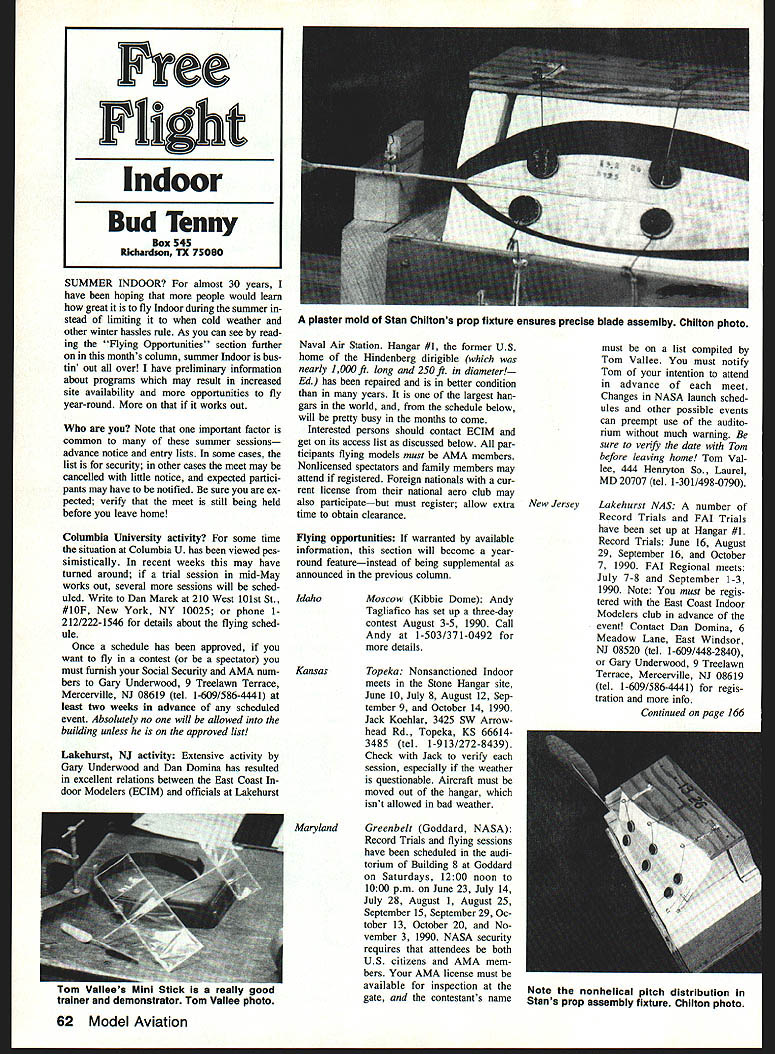
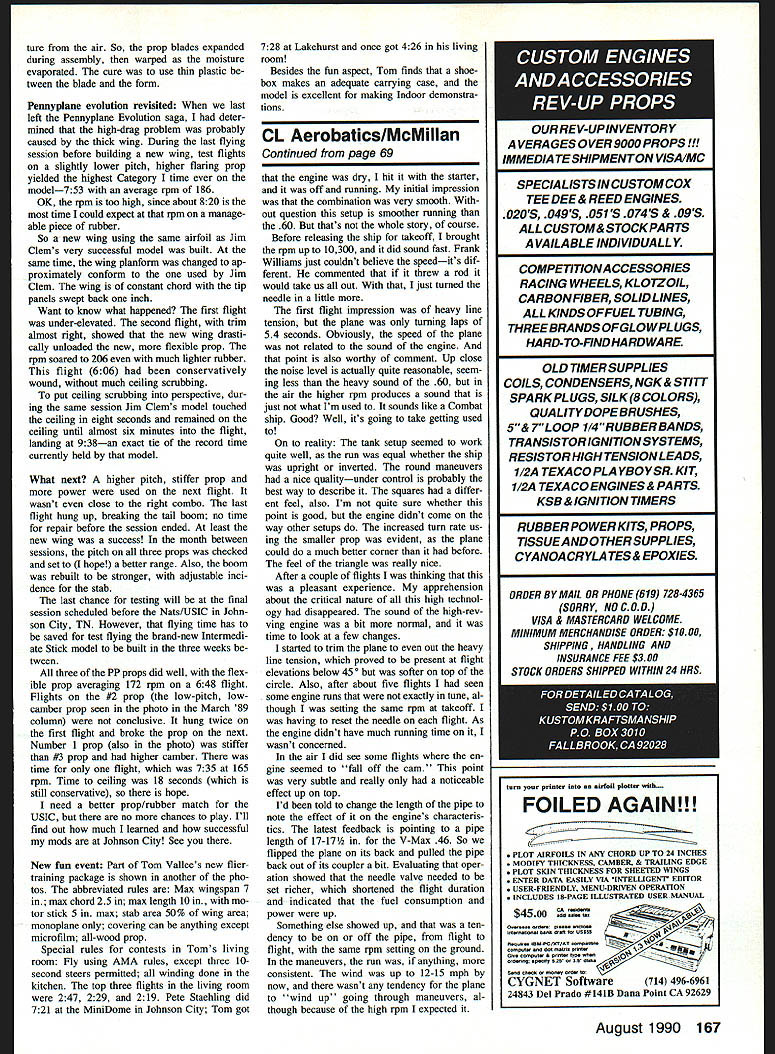
The typical problem of assembling all-wood props (such as those used on Easy Bs and Pennyplanes) is blade/spar alignment. It’s difficult to get the blade to lay flat against the spar while both are at the correct angle in a typical assembly fixture. Stan Chilton made a fixture for the job: he glues the prop halves to prop blocks, clamps the halves in place with felt-covered clamps, places the spar on top, and slides the spar back and forth until the correct phase is obtained. The whole assembly is then glued together.
Gotcha! The first props Stan assembled in this type of fixture warped severely after being removed. The problem was that plaster of Paris is hygroscopic — it absorbs moisture from the air. The prop blades expanded during assembly, then warped as the moisture evaporated. The cure was to use thin plastic between the blade and the form.
Pennyplane evolution revisited
When we last left the Pennyplane Evolution saga, I had determined that the high-drag problem was probably caused by the thick wing. During the last flying session before building a new wing, test flights on a slightly lower-pitch, higher-flaring prop yielded the highest Category I time ever on the model — 7:53 with an average rpm of 186.
That rpm is too high, since about 8:20 is the most time I could expect at that rpm on a manageable piece of rubber. So a new wing using the same airfoil as Jeff Clem's very successful model was built. The wing planform was changed to approximately conform to one used by Jim Clem: constant chord with the tip panels swept back one inch.
What happened? The first flight was under-elevated. The second flight, with trim almost right, showed the new wing drastically unloaded the new, more flexible prop. The rpm soared to 206 even with much lighter rubber; that flight (6:06) had been conservatively wound, without much ceiling scrubbing.
To put ceiling scrubbing into perspective, during the same session Jim Clem's tool reached the ceiling in eight seconds and remained on the ceiling until almost six minutes into the flight, landing at 9:38 — an exact tie of the record time currently held by that model.
Next, a higher-pitch, stiffer prop and more power were tried; it wasn't the right combo. The last flight hung up and broke the tail boom; no time for repair before the session ended. At least the new wing was a success. In the month between sessions I checked and reset the pitch on all three props and rebuilt the boom to be stronger, with adjustable incidence for the stab.
The last chance for testing will be at the final session scheduled before the Nats/USIC in Johnson City, TN. That flying time must be saved for test flying a brand-new Intermediate Stick model to be built in the three weeks prior.
All three PP props did well: the flexible prop averaged 172 rpm on a 6:48 flight. Flights on the #2 prop (low-pitch, low-camber) were not conclusive — it hurt twice on the first flight and broke on the next. Prop #1 was stiffer and had higher camber; one flight was 7:35 at 165 rpm. Time to ceiling was 18 seconds (conservative), so there is hope. I need a better prop/rubber match for the USIC, but there are no more chances to play. I'll find out how much I learned and how successful my mods are at Johnson City.
New fun event
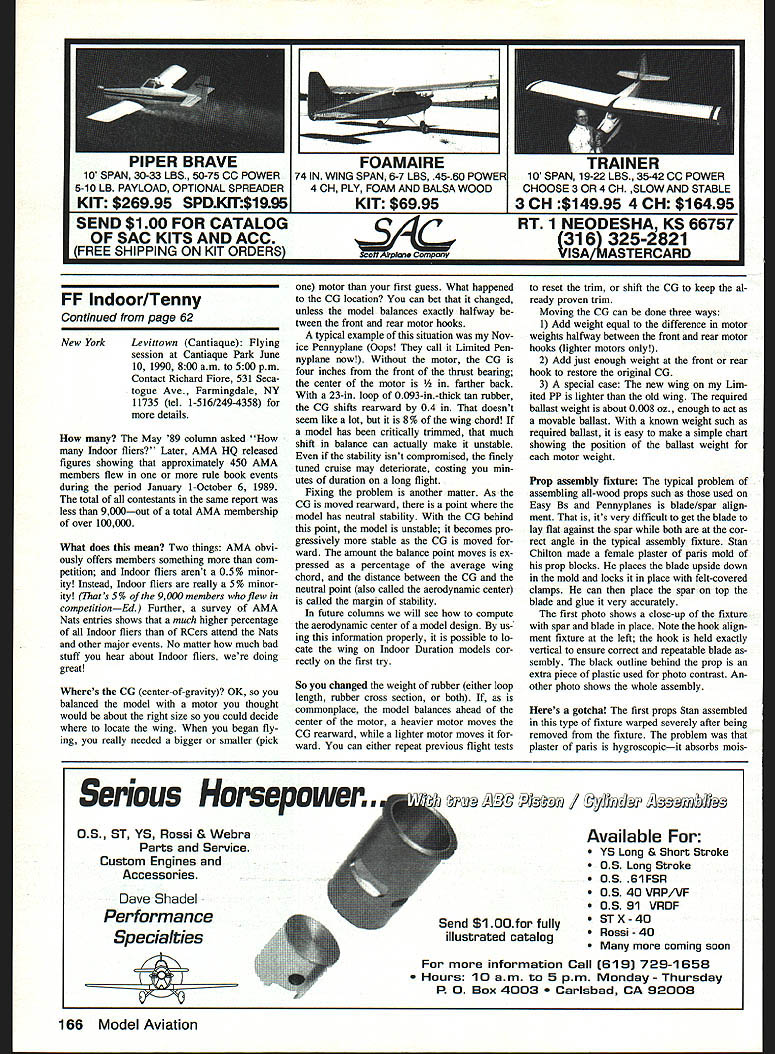
Part of Tom Vallee's new flier training package is an abbreviated set of rules shown in a photo: max wingspan 7 in.; maximum chord 2.5 in.; max length 10 in., with motor stick 5 in. max; stab area 50% of wing area; monoplanes only; covering can be anything except microfilm; all-wood prop.
Special rules for contests in Tom's living room: fly using AMA rules, except three 10-second steers permitted; all winding done in the kitchen. The top three flights in the living room were 2:47, 2:29, and 2:19. Pete Stahling did 7:21 at the MiniDome in Johnson City; Tom got 7:28 at Lakehurst and once got 4:26 in his living room!
Besides the fun aspect, Tom finds that a shoebox makes an adequate carrying case, and the model is excellent for making indoor demonstrations.
SUMMER INDOOR (reiterated): For almost 30 years I have hoped people would learn to fly indoor during summer. As shown in the Flying Opportunities section, summer indoor is expanding. Programs may increase site availability and year-round flying opportunities if they work out. Remember that many summer sessions require advance notice or entry lists — verify meets before you leave home.
Tech tip
In these days of so-called bulletproof controls, arrow-shaft pushrods are common. But solving control-rod flexing raises other issues, such as space when tucking up the interior of your fuselage. A couple of suggestions:
- Plan before you cut wood. Lay out the travel on the flap-to-elevator pushrod and develop patterns for the formers.
- You probably don't need more than the barest outline to clear the arrow shaft if your pushrod is as stiff as that shaft.
Standard formers were made from 1/8-in., cross-grained balsa with pushrod braces added as necessary, but cutting out the middle left little strength. Instead, laminate the wood with the grain in the layers crossed at a 30° angle. Use either two laminations of 1/8" balsa, or one layer of 3/32" balsa and one of 1/8" plywood.
Using your pattern, rough out the shapes on one sheet. Use a flat surface (plate glass) to complete laminating. Outline your rough former with slow-setting CYA glue, place the glued piece face down on the glass, put the other piece on top with the grain at the desired cross angle, and apply heavy pressure until the glue "clicks." You now have a very stiff former ready for final trimming. Use a jigsaw for rough trim and finish with sandpaper.
I've weighed laminated parts on a gram scale and can barely detect the weight difference between a laminated former and a single 1/8-in. sheet former of the same shape.
Transcribed from original scans by AI. Minor OCR errors may remain.

