
Free Flight: Indoor
Bud Tenny Box 545 Richardson, TX 75080
Summer Indoor
Besides the activities listed in the previous column, there was significant activity in the Northwest. Unfortunately, the announcement was mailed in mid-May—two weeks too late to be included with the other announcements.
It was the Summer Indoor Meet and Symposium sponsored by the Willamette Modelers Club at South Albany High School, July 7–8, 1990. The Symposium program included presentations by Andy Tagliafico, Lew Gitlow, and Bruce Kimball. Let's hope that future events will be planned far enough ahead to allow them to be announced here.
To be fair about it, the contest part of this event was announced in the "Sanctioned Events Calendar" in Model Aviation, but there are so many listings and so few indoor events that only a dedicated search would have found it.
Great attendance! You have already read the story of the World Championships/USIC/Nats at Johnson City, TN. However, final statistics may not have been available.
The USIC (U.S. Indoor Championships—Ed.) had 135 contestants from this continent (a major increase over past years), and seven World Champs contestants stayed to compete in the USIC/Nats. Ten entrants from Canada. U.S. entrants came from 27 states, including eight from Arizona, California, Oregon, and Washington. This provides an interesting contrast with a comment by a Nats official several years ago, who said that indoor contestants won't travel to support major contests!
Flying opportunities: Here's a note to CDs and PR persons: you will see this listing in late August or early September, but there will be a three-month gap due to the magazine's Nats coverage. Events not listed below but scheduled for September through mid-December will be over before they can be announced.
Special listings coming up: Due to the just-mentioned gap in column publication, sessions scheduled between late October and the end of the year will be listed in highly abbreviated form in the "Competition News" portion of my report in the Nats-coverage issue, provided I have the information no later than September 5, 1990. What I need is the name and phone number of a contact person, and whether the event is to be a contest or a flying session, sanctioned or not.
If you plan a session but don't know the date, let me know anyway! This is an experiment. If there is a good response, it can be done because the column is displaced by Nats coverage. If the response is not good, it's going to be too much trouble.
Send the information to P.O. Box 830545, Richardson, TX 75083.
California
San Diego: Monthly sessions in Cat. I. Howard Haupt, 3860 Ecochee Ave., San Diego, CA 92117.
Kansas
Topeka: Look for unsanctioned indoor meets in the Stone Hangar site. Sept. 9 and Oct. 14, 1990. Jack Koehler, 3425 SW Arrowhead Rd., Topeka, KS 66614-3485 (tel. 1-913/272-8439).
Newsletters can be inconsistent because of the change of editors and whims of interest within the club. This situation isn't detrimental except to the extent that it increases the difficulty of keeping a current grip on the information.
I have always had an interest in what other modelers across the country are doing in pursuit of free flight activities, and the newsletters are an excellent vehicle in accomplishing this. The single most significant advantage of being a columnist is that it puts you in the center of all the excitement—even though you cannot always be present. I wish to thank all of those who continue to write to this "grass roots media" for the purpose of furthering free flight, and I feel it is the responsibility of this column to relay that which may be significant or of interest to larger audiences of our following.
I have not mentioned this before, but for some time I have been a fan of a particular segment of the Fresno Model News, which is currently edited by Bill Booth of the Fresno Gas Model Club. Seldom does this segment contain anything much that would be considered news from a technical or pertinent informational viewpoint, though it caps the human interest category. I am referring to "Corky's Corner," which usually is a single page of each issue. It gives the wife's point of view in respect to hubby's hobby. Most of the items she supplies are those which the club editor might overlook in the hectic tempo of attempting to adequately cover a contest and get in a little flying for himself.
She might choose to offer a little heartfelt sympathy to those who crashed models rather than be awestruck by the feats of the winners. Or comment about some toddler who carries his toy airplane everywhere, making engine noises with his mouth in attempting to mimic the more authentic noises generated by the real "toy airplanes" of dad's or granddad's world. Who's been ill; who's gotten well; whose wife furnished the great baked beans at the last club cookout. Who has moved into the area and who has moved out; the old friendships renewed and the new ones made. In some ways this socializing and expressing mutual concern may be the most important aspect of the hobby. Anyway, Corky Mullen, I am a fan of yours. Please continue to keep us from straying too far from reality as we "do our thing."
Should any of our readers—and especially the wives of our readers—care to get the woman's viewpoint on the things men do in pursuit of free flight fun, you might wish to subscribe to Fresno Model News, 4215 E. Clay, Fresno, CA 93702. Twelve dollars for 12 issues will cover the cost.
Meanwhile, 'til next session—see you. After all, Jim has enough trophies, I can assure you.
Recently I saw a short filler piece in the newspaper saying that six people had been killed in fighting between remote tribes in New Guinea when a dispute over how to prepare a pig for a feast to celebrate a peace treaty got out of hand. Sometimes I think our disputes over rules and categories of model planes get a bit out of hand, too. I once had a small aquarium with a few tiger barb fish in it. They destroyed each other while trying to establish dominance within such limited territory. Their five gallons were that important!
Go fix your model and have some fun. I think it was Jim Clem who once signed off a letter to me, "Have a nice transition today." Yeah.
Maryland
Goddard NAS: Record Trials and flying sessions scheduled in the auditorium of Building 8 at Goddard NAS on Saturdays, 12:00 noon to 10:00 p.m., Oct. 20 and Nov. 3, 1990. NASA security requires that attendees be U.S. citizens and AMA members with current AMA cards and be on a list compiled by Tom Vallee. You must notify Tom in advance of each meet. Changes in NASA launch scheduling and other possible events can preempt the auditorium without much warning—be sure to verify with Tom before leaving home! Tom Vallee, 444 Henryton St., Laurel, MD 20707 (tel. 1-301/498-0790).
New Jersey
Lakehurst NAS: Record Trials and FAI Trials in Hangar #1, Lakehurst NAS. Record Trials—Aug. 29, Sept. 16, Oct. 7, 1990. FAI Regional meets—Sept. 1–3, 1990. Note: you must be registered with the East Coast Indoor Modelers club in advance of the event! Contact Dan Domina, 6 Meadow Lane, East Windsor, NJ 08520 (tel. 1-609/448-2840), or Gary Underwood, 9 Treelawn Terrace, Mercerville, NJ 08619 (tel. 1-609/586-4441) for registration and more info. By mail, send a photostat of your AMA license and your phone number(s) well in advance of an event you want to attend.
Pennyplane evolution wrap-up
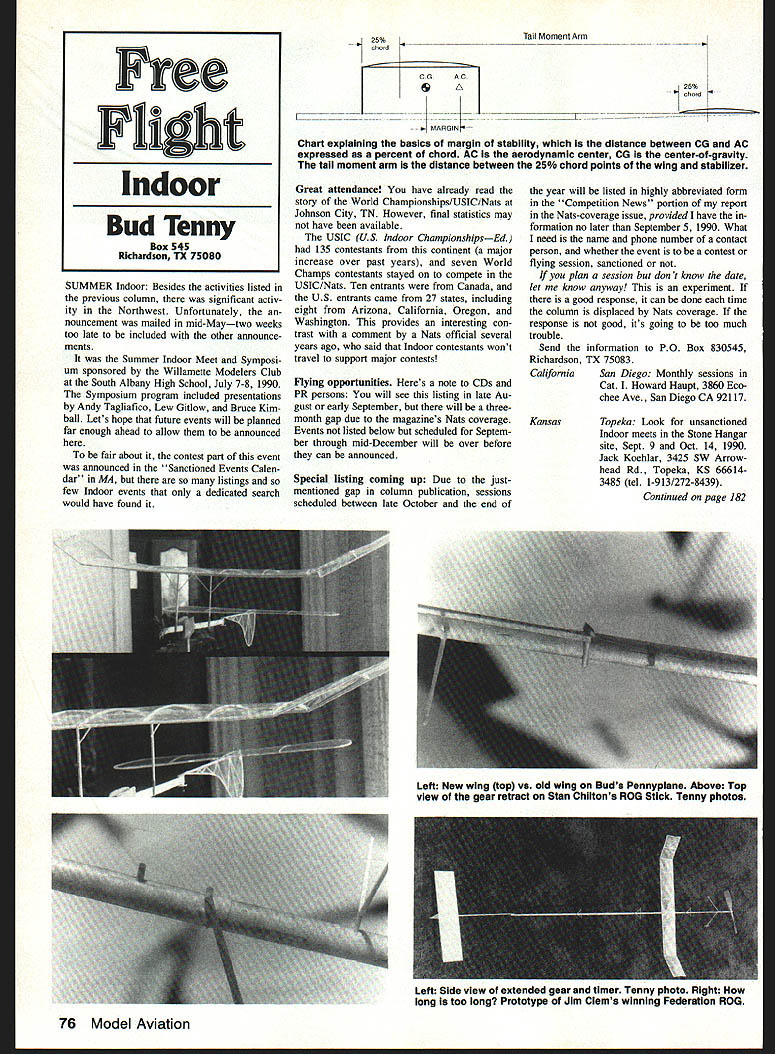
The bottom line in this saga is that the major problem with my original model was too much wing camber. One of the photos is a composite comparing the two wings. The best flight on the new wing at the USIC was 1:14—good enough to keep me in the top five for about two hours. The trim, made on the fourth official flight, was a 50% improvement over the original model flown at the '88 USIC. My final official flight was made with more negative stab incidence on the assumption that the model was under-elevated. Wrong! In the final analysis, the model's current configuration is nearly optimum; the owner just needs to know how to huck rubber and adjust the model.
Lest we forget: although the wing was too thick, several other lessons were learned:
- There absolutely must be enough clearance between the motor and stick to prevent rubber bunching.
- The wing incidence was set to zero relative to the stick centerline. With negative incidence in the stab, the nose rides high in the cruise to help load the prop.
- All twist was removed from the wing, leaving only offset to control torque. This has proved adequate to handle full torque when a small amount of left thrust is used. Left thrust is set to the smallest amount needed to control turning during the burst. As left thrust is reduced, the climb turns open slightly, and the climb is significantly steeper without loss of climb speed.
- Very slight and equal wing tip washout was used to help prevent tip stall and improve the model's response to turbulent air and upsets due to ceiling touches.
One more thing: a typical problem for models requiring high launch torque is reverse stab tilt caused by a twisting motor stick. The tail boom on my Limited P is still fit for up/down loads, but very weak in torsion. The stab is twisted slightly so that it flies into the required tilt by twisting the boom. Between the automatic stab tilt and the left thrust, the model grooves perfectly at any level of launch torque it has been possible to use.
Where's the CG—Part II
My August 1990 column introduced the concept of margin of stability. Let's review by looking at Figure 1. This figure shows the critical components of aerodynamic stability.
- AC (aerodynamic center)—a theoretical point about which all external aerodynamic forces act.
- CG (center-of-gravity)—fore/aft balance point of model complete with rubber motor.
- Stability margin—the distance between CG and AC, expressed in percent of the wing chord.
- Tail moment arm—the distance measured between the 25% chord points of wing and stab.
CG location: The CG must always be ahead of the AC, as shown, if the model is to be stable. It works like this: the model's weight acts downward through the CG, and aerodynamic forces act upward through the AC. On a model in equilibrium flight, these forces exactly balance. If the model noses up, the aero force increases enough to bring it back to level flight. For a nose-down condition, the aero force reduces, allowing the tail to drop.
The distance between CG and AC (margin) is the leverage the aero forces have to restore level flight. When the margin drops to zero, the model will have neutral stability. That is, it will go in whatever direction it is pointed until some outside force diverts it. If the CG is behind the AC, the model is uncontrollably unstable; if the nose comes up, it will continue to rise.
What about too much margin? If a model has a very high positive stability margin, two undesirable things happen:
- The stability is so high that little can stop it. After contact between the outboard wing tip and a curved ceiling or beam, the model chugs along, turning into the obstruction. It invariably hangs up or slides down the curve. With optimum margin, even an overgrown model tends to stall, turn into torque (away from the obstacle), and continue flying.
- The angular difference between wing and stab is greater, giving higher drag. More power is required for both climb and cruise, and the flight speed is higher. The only time a high margin can help is in highly turbulent air; the higher speed helps the model penetrate better.
On outdoor models, the correct stability margin is fixed by adding weight to the nose or tail and adjusting the trim to fix the glide.
If the wing of an indoor model can be properly located with respect to the CG, it is possible to set the cruise trim of a new model almost perfectly in as few as two test flights. Once the margin and trim are set, always fly the model with the same amount of rubber as was used to find its CG, or ballast the plane to keep the same CG location.
World's lightest timer!
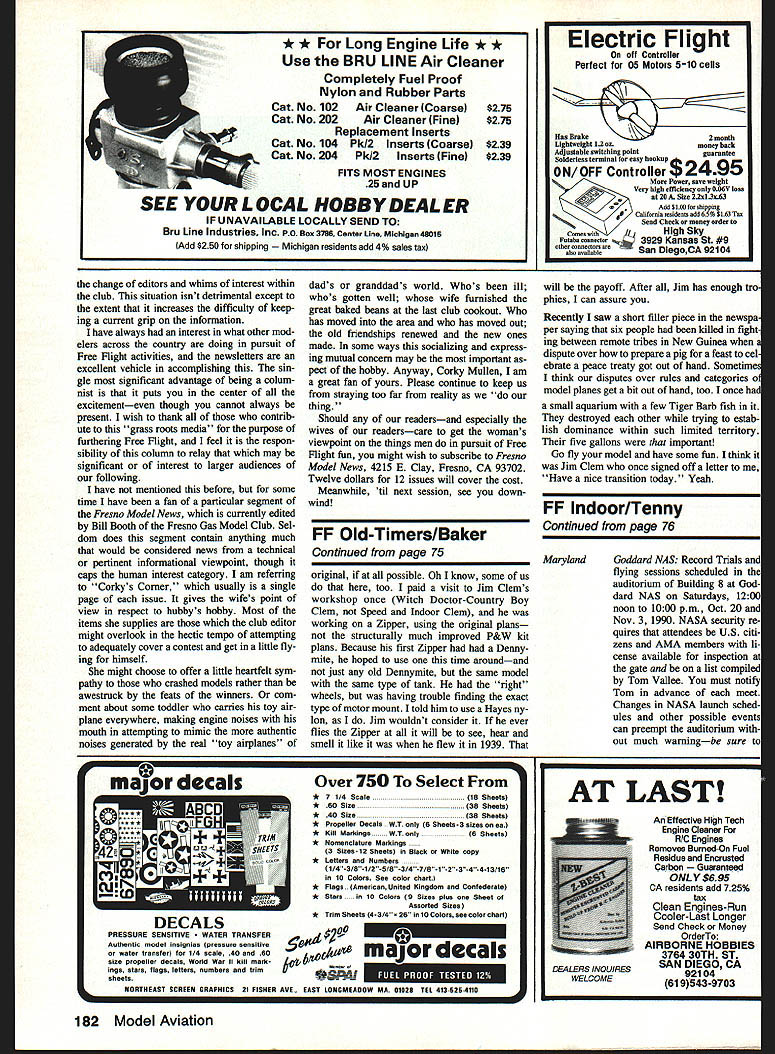
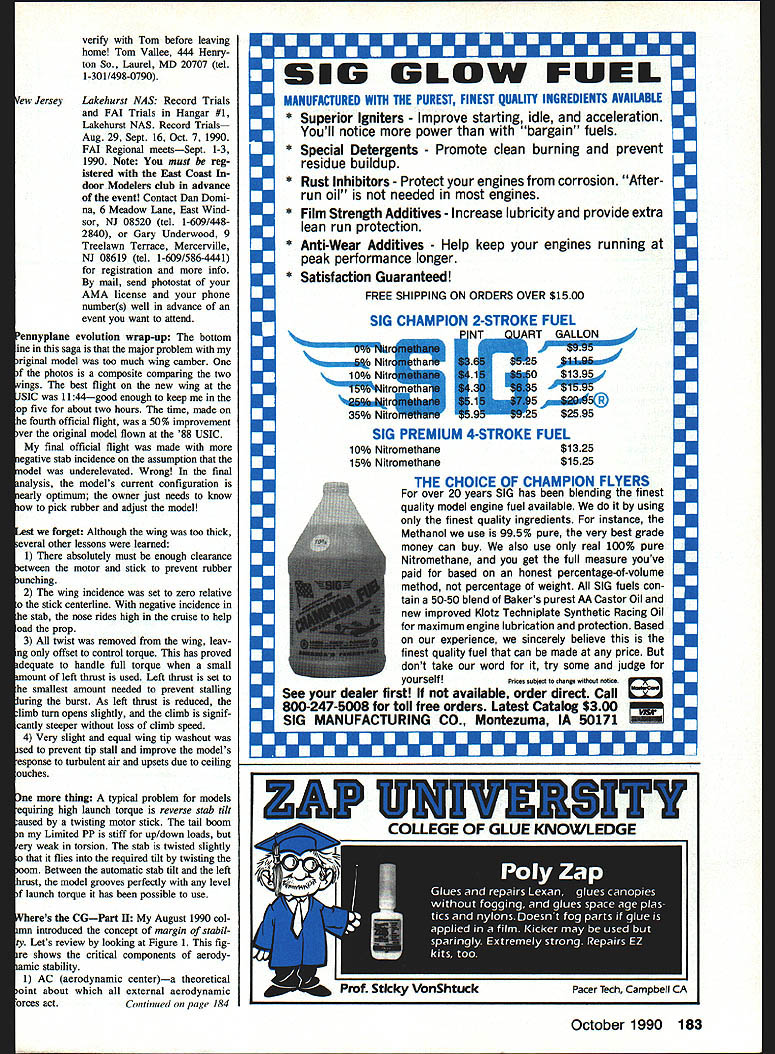
Two of the photos show the works of Stan Chilton's gear-retraction mechanism as used on his record-holding ROG Stick. One shows a top view of the retracted gear with the hinge mechanism. The other is a side view of the stop and timer. You can see the stop, but the timer is too tiny to see. It is a tiny double-stick transparent tape; the hinge mechanism is both a pivot and a torsion bar which retracts the gear.
Stan cocks the timer using a pair of tweezers, and the tape holds for a couple of minutes. Although there is a CG shift when the gear retracts, the model is very stable and shows no apparent effect from the retraction.
How long?
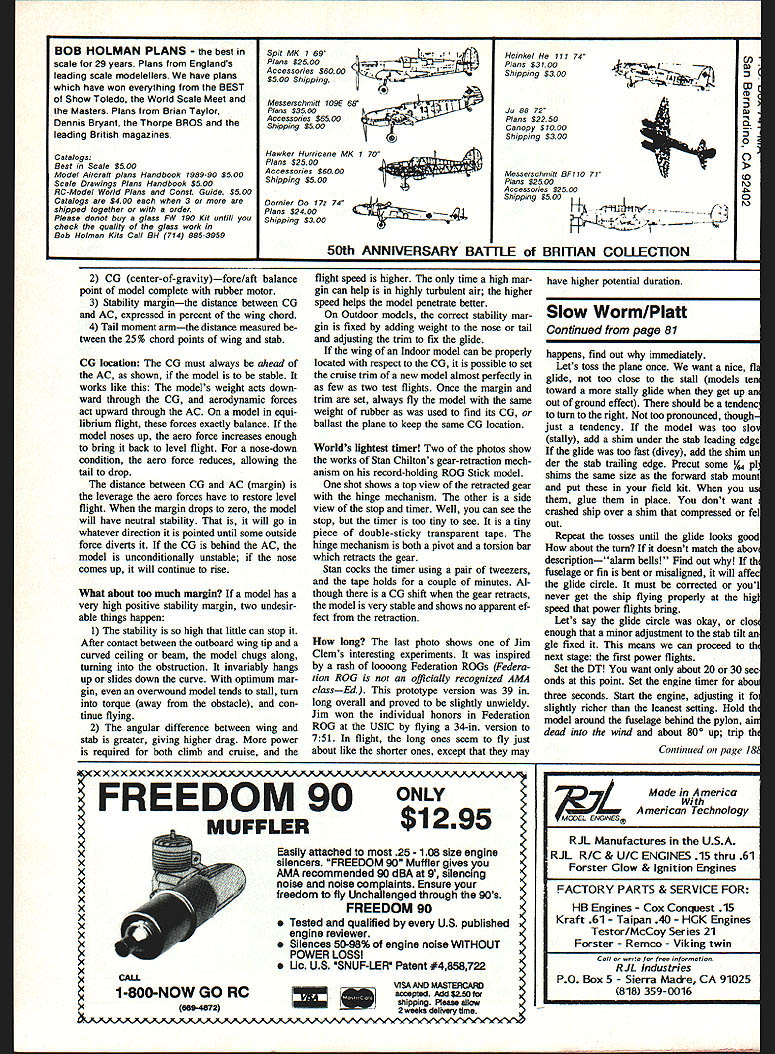
The last photo shows one of Jim Clem's interesting experiments. It was inspired by a rash of loooong Federation ROGs (Federation ROG is not an officially recognized AMA class—Ed.). This prototype version was 39 inches long overall and proved to be slightly unwieldy. Jim won the individual honors in Federation ROG at the USIC by flying a 34-inch version to 7:51. In flight, the long ones seem to fly just about like the shorter ones, except that they may have higher potential duration.
Transcribed from original scans by AI. Minor OCR errors may remain.

